Valmiki's Hermitage

Birth of the Divine Twins

Abandoned in the forest, Sita finds sanctuary at Valmiki's ashram. There, far from Ayodhya's golden towers, she gives birth to twin sons, Lava and Kusha. As the sage begins composing the Ramayana, he trains the boys to become warriors and bards who will one day carry their father's story back to him.

The Forest Returns

Lakshmana's chariot stopped at the edge of the forest. Sita had been told they were visiting holy hermitages, that Rama wished her to receive the blessings of sages. But something in Lakshmana's silence had made her uneasy throughout the journey.

Now, as he helped her descend but did not follow, the truth became clear.

"He has sent me away," Sita said. It was not a question.

Lakshmana could not meet her eyes. "The people... they speak against you. Rama believes... he feels that as king..."

"I understand." Sita's voice was calm, almost gentle. "Do not blame yourself, Lakshmana. You are only carrying out his command."

"I should refuse. I should, "

"You should return to Ayodhya and serve your brother. That is your dharma, as this exile is now mine." Sita touched his arm. "Tell Rama I do not blame him. Tell him I understand the weight he carries. And tell him..." her voice caught for just a moment, "tell him I will always love him, regardless of where I am or what he must do."
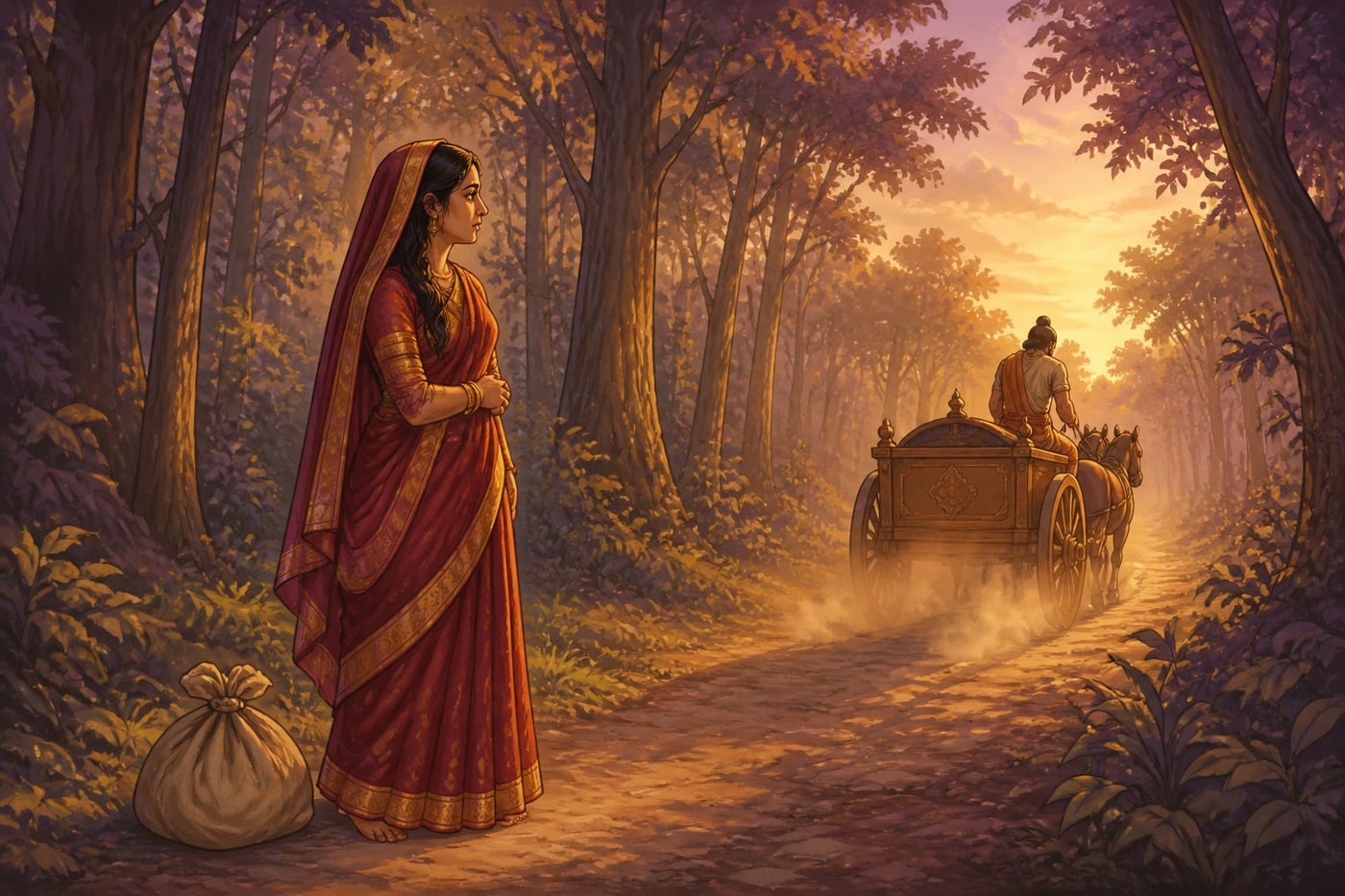
Lakshmana driving away as Sita stands alone at the forest edge

Lakshmana wept as he drove away. Behind him, the queen of Ayodhya stood alone at the forest's edge, just as she had stood years ago when exile first began. History, it seemed, was determined to repeat itself.

The Sage of Compassion

But Sita was not entirely alone. Word of a noble woman wandering near the ashram reached Valmiki within hours. The sage himself came to find her.

Valmiki was no ordinary rishi. He was the adi-kavi, the first poet, whose grief at seeing a hunter kill a mating bird had transformed into the first shloka ever composed. From that spontaneous verse had come the revelation that poetry could capture truth in ways prose never could. Now he was composing a great work, the story of Rama himself, revealed to him in meditation.

"I know who you are," Valmiki said gently. "And I know why you are here. My ashram will be your home for as long as you need."

"You would shelter the queen that Ayodhya rejected?" Sita asked.

"I would shelter a woman of perfect virtue who has been wronged by circumstances, not by character. The world may doubt you, daughter. The gods do not. And neither do I."

The ashram women welcomed Sita as one of their own. They gave her a hut, simple but clean, surrounded by flowering trees. She was pregnant, alone, exiled for the second time in her life, yet something in her had grown stronger through her trials. She would not merely survive. She would endure.

The Birth of Lava and Kusha

Months passed. Sita lived quietly, helping with the ashram's work, joining in the evening prayers, watching the seasons change over the forest she had once known during her first exile. The child within her grew.

When her time came, Valmiki's wife Priyamvada attended her. The birth was difficult, not one child but two, twins who entered the world one after the other like two verses of a single poem.

Sita named them Lava and Kusha. Lava was born first, fierce-eyed even as an infant. Kusha followed, calmer but with a gaze that seemed to see through surfaces to the truth beneath.

"They are Rama's sons," Valmiki declared when he saw them. "The blood of the Ikshvakus runs true. These boys will shake the world."

Sita held her children and wept, tears of joy and grief intermingled. These were the heirs of Ayodhya, princes of the greatest kingdom in the world, born in a forest hut because their mother's virtue had been questioned. They would never know their father's face, never walk the palace halls that were their birthright.

Sita sits on a low mat in Valmiki's forest ashram cradling her newborn twin sons as the elderly sage raises his hand in blessing.

Or so she believed.

The First Poets After the First Poet

As the twins grew, Valmiki took personal charge of their education. They learned not in palace schools with noble companions but in the forest with sage children, their playground the same wilderness that had tested their parents.

By five, they could recite the Vedas. By seven, they had mastered the sciences of grammar and logic. By ten, they were training in martial arts, not the refined techniques of palace warriors but the practical combat of forest dwellers who needed to defend against wild beasts and bandits.

But their greatest training was in something no prince had ever learned: the art of bardic recitation.

Valmiki composing the Ramayana by lamplight

Valmiki had completed his great work, twenty-four thousand shlokas telling the story of Rama from birth to the defeat of Ravana. He had not yet composed the final chapters, the dark events of Uttara Kanda, because those events were still unfolding. But the poem was complete enough to be taught.

Lava and Kusha learned it all. Their voices, trained from childhood, could carry the epic's rhythms with perfect pitch and timing. They learned to accompany themselves on the veena, to modulate their tones for dialogue, to bring the ancient story to life as no written text ever could.

A Mother's Silence

Sita watched her sons grow with pride that ached like a wound. They were so like their father, Lava had Rama's directness, his warrior's instinct; Kusha had Rama's patience, his ability to think before acting. Sometimes, watching them practice archery, she could almost believe that Rama himself stood before her.

But she never told them who their father was.

"Your father was a great warrior," she would say when they asked. "A king of righteousness. You will meet him someday. For now, learn what Valmiki teaches. Become the men he would want you to be."

The boys were curious but trusted their mother. And Valmiki, respecting Sita's wishes, taught them the Ramayana as a story of ancient kings, not as the tale of their own parents. They learned of Rama's heroism without knowing it was their own heritage.

The Story Takes Shape

In the evenings, after training, the ashram would gather to hear the boys perform portions of the epic. Their voices rang through the forest clearings, carrying tales of divine birth and exile, of golden deer and demon kings, of bridges across the ocean and battles that shook the heavens.

Visitors from other ashrams came to hear them. Merchants traveling the forest roads stopped to listen. The fame of the twin bards spread, two boys who could sing the Ramayana with voices that seemed to carry the very soul of the story.

"They must perform for King Rama himself," visitors often said. "Surely the king would reward such talent."

Sita listened to such talk in silence. She wondered if she would ever see Rama again, if her sons would ever know the truth, if the story they sang so beautifully would ever bring their family back together.

Years passed. The twins grew from boys to young men. And in Ayodhya, a king prepared a great sacrifice that would draw pilgrims from across the realm, a sacrifice that would, unknowingly, summon his own sons to sing his own story before his own throne.

Living traditions

Valmiki's work has been translated into virtually every major world language. The Ramayana's influence extends beyond Hinduism, versions exist in Buddhist and Jain traditions, and Southeast Asian cultures (Thailand, Indonesia, Cambodia) have their own Ramayana traditions. UNESCO recognizes the Ramayana tradition as an intangible cultural heritage of multiple nations.

Reflection

More in Uttara Kanda

All lessons in Uttara Kanda · The Ramayana course