Tales of Vaali and Hanuman
The Vanara Warriors
The sages reveal two pivotal tales from the vanara world. How Ravana, conqueror of gods, was humbled by Vaali and became his friend instead of his enemy. And the childhood of Hanuman, his leap toward the sun and the curse that made him forget his powers until Rama's cause awakened them.
Ravana's Pride Meets Its Match
As the evening deepened in Rama's court, Agastya continued his tales of the past. But now his subject shifted from rakshasas to vanaras, the monkey beings who had proved so crucial to Rama's victory.
"You knew Vaali only as Sugriva's brother, the king you had to defeat," Agastya said. "But there was a time when Vaali taught Ravana himself a lesson in humility."
Rama leaned forward. He had killed Vaali, the memory still weighed on him. To learn more of the vanara king's true nature was both uncomfortable and necessary.
The tale took place when Ravana was at the height of his power. Drunk on conquests, he had decided to challenge Vaali, whose reputation had spread even to Lanka. The vanara king possessed a unique boon, in any fair combat, half his opponent's strength would flow into him, making him nearly impossible to defeat in direct confrontation.
Ravana arrived at Kishkindha with his armies, demanding that Vaali acknowledge his supremacy. But Vaali was not in his capital. He was performing his evening sandhyavandana, the ritual worship performed at the junction of day and night, at the shore of the southern ocean.
The Humiliation of the Ten-Headed King
Ravana tracked Vaali to the ocean's edge, intending to attack him during his prayers. But as he approached, Vaali sensed him. Without breaking his meditation, without even turning around, the vanara king reached back with his tail.
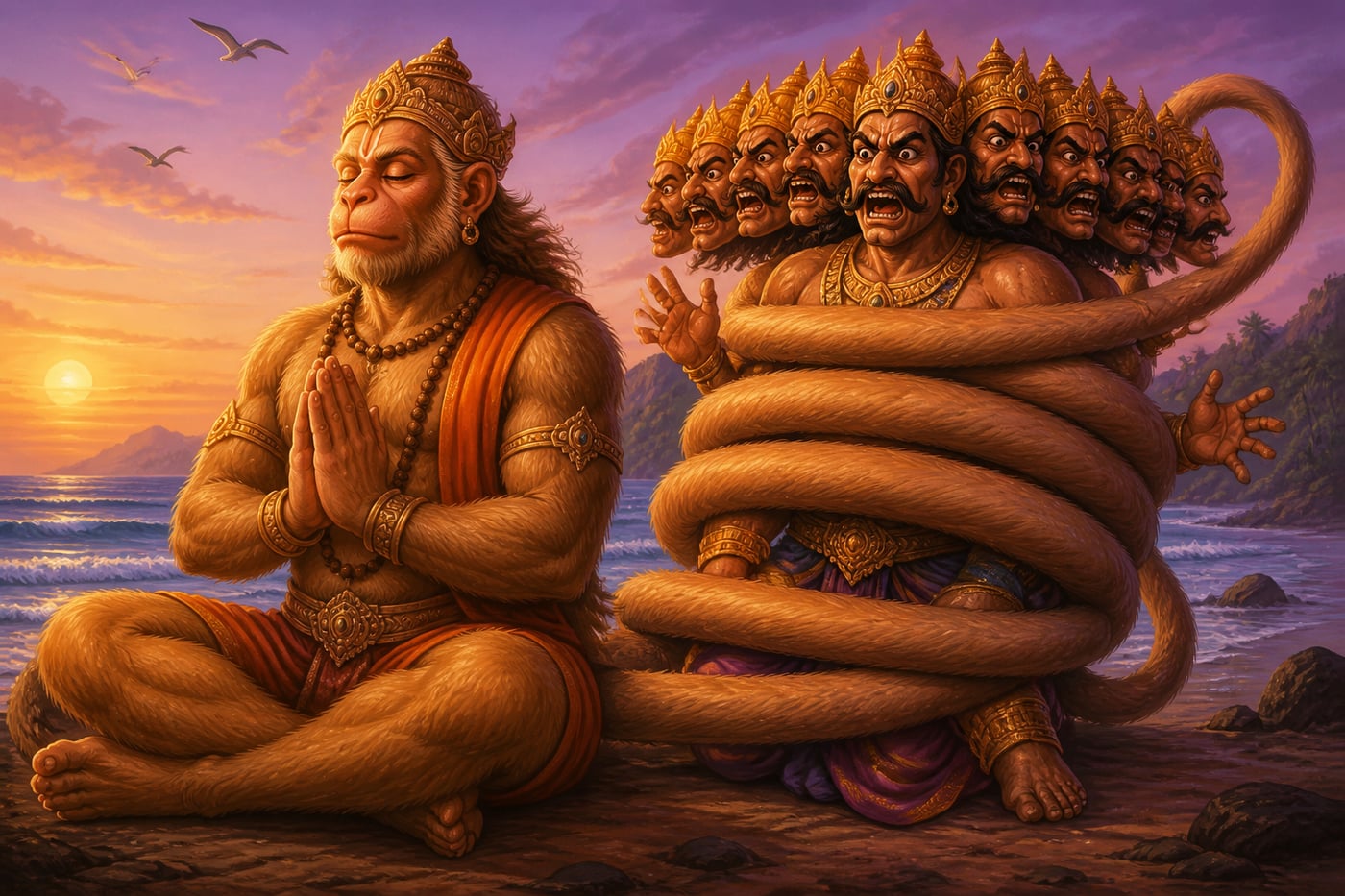
That tail wrapped around Ravana with force that shocked the demon king. Before Ravana could react, Vaali had tucked him under his arm like a bundle of cloth and continued his prayers, walking from ocean to ocean, performing his rituals at the eastern, western, northern, and southern seas.
For hours, Ravana struggled helplessly. His twenty arms could not break free. His ten heads could not formulate a spell that would work. Vaali's boon was drawing power from Ravana himself, the more the demon struggled, the weaker he became relative to his captor.
When Vaali finally completed his prayers, he set Ravana down and looked at him with amusement.
"You came to conquer me, Dashagriva," Vaali said, using Ravana's birth name. "How did that work out for you?"
Enemies Become Allies
Ravana, for once, recognized when he was outmatched. Rather than nursing humiliation into hatred, he made a calculation that revealed his intelligence beneath his arrogance.
"I came seeking a subordinate," Ravana admitted. "I found an equal. Perhaps we should be friends instead."
Valai agreed. They made a pact of mutual assistance, sealed with fire and sacred mantras. Neither would attack the other; each would come to the other's aid if called.
"This is why," Agastya explained, "Ravana never asked Vaali for help when you attacked Lanka. The pact bound Vaali, but Ravana's pride would not let him admit he needed the vanara's strength. He would rather face destruction than ask for help."
Rama understood something new about the enemy he had defeated. Ravana's greatest weakness was not the gap in his boon that allowed humans to harm him. It was his inability to accept help, to acknowledge that he was not supreme in all things.
The Child Who Reached for the Sun
But Agastya had another tale to tell, one closer to Rama's heart. The story of Hanuman.
"You know Hanuman as your greatest devotee," the sage said. "But do you know why, for most of his life, he did not know his own powers?"
Hanuman himself was present in the court, having refused to return to Kishkindha while Rama lived. He bowed his head as Agastya spoke, for the tale was both glorious and painful.
Hanuman was born to Anjana, a celestial nymph cursed to take vanara form, and Kesari, a vanara chief. But his true father was Vayu, the wind god, who had carried the divine essence that created him. From birth, Hanuman possessed powers beyond any mortal vanara.
As an infant, Hanuman looked up at the rising sun and thought it was a ripe mango. Hungry, he leaped toward it, not a small leap, but a leap that carried him across the sky toward the sun itself.

The Curse That Bound Him
Indra, king of the gods, saw a strange creature racing toward the sun and panicked. He hurled his vajra, his thunderbolt, at the infant. The weapon struck Hanuman's jaw, breaking it and sending him plummeting back to earth.
Vayu was enraged. His son had been attacked unprovoked, wounded grievously. In his fury, the wind god withdrew himself from the world. Without wind, no creature could breathe. The universe began to suffocate.
The gods rushed to appease Vayu. They healed Hanuman, blessed him with invincibility, and granted him powers beyond counting. Brahma made him immune to his own weapons. Indra, ashamed, granted that the vajra would never harm him again. Other gods added their blessings until Hanuman was arguably the most gifted being in creation.
But there was a problem. A child with such powers was dangerous, not from malice but from ignorance. Young Hanuman began causing chaos, disrupting sages' meditations for fun, playing pranks that endangered ashrams.
The rishis, unable to harm him, did the only thing they could. They pronounced a curse:
"You will forget your powers until someone reminds you of them in a moment of great need. Only when a worthy cause awakens your memory will you know what you truly are."
The Power Awakened
For years, Hanuman lived as an ordinary vanara, strong, yes, but unaware of his cosmic gifts. He served Sugriva, fought in small battles, never knowing that he could leap across oceans or grow to the size of mountains.
Then came the search for Sita. The vanara armies reached the southern ocean, and all seemed lost. The sea was too vast; no one could cross it.
It was Jambavan, the ancient bear king, who remembered. He spoke to Hanuman of his true nature, reminded him of powers long forgotten.

"You are the son of the wind," Jambavan said. "No distance is beyond you. No obstacle can stop you. Remember who you are."
And Hanuman remembered. The curse lifted in that moment of need, for a cause more worthy than any, the service of Rama, the search for Sita. He grew to enormous size and leaped across the ocean, beginning the mission that would define his eternal legacy.
The Meaning Behind the Tales
Rama sat quietly, absorbing what he had learned. The tales of Vaali and Hanuman revealed something important about power itself.
Vaali's power had been his destruction, he had trusted in it so completely that he ignored the subtler forces that could undo him. Hanuman's power had been hidden precisely so it would not destroy him, released only when his character had developed enough to use it wisely.
"Power is not a gift," Agastya concluded. "It is a test. Those who pass the test, who use power for dharma rather than for self, become immortal in memory. Those who fail become warnings, their names spoken only as examples of what not to do."
Hanuman looked up at Rama, and in that look was everything, the devotion that had carried him across the ocean, the humility that made his power bearable, the love that would keep him serving long after this age had passed.
Rama smiled at his friend. But in the depths of his heart, he wondered: would the power he himself held pass the test? The answer, he sensed, was still being written.
Living traditions
Hanuman's story of hidden potential awakening for a worthy cause has become a powerful metaphor in self-help and motivational literature. The concept of 'dormant abilities' waiting for the right trigger appears in everything from sports psychology to leadership training. The annual Hanuman Jayanti celebrates his birth with special prayers and community gatherings.
- Sandhyavandana: The three-time daily prayer practice that Vaali maintained even while holding Ravana captive. This ancient Vedic ritual continues to be practiced by millions, particularly among those who have undergone the sacred thread ceremony.
- Kishkindha (Hampi): The rocky landscape around Hampi is traditionally identified as Kishkindha, the vanara kingdom where Vaali ruled. Sites include Anjanadri Hill (Hanuman's birthplace), Rishyamukha Hill (where Rama met Sugriva), and numerous boulder formations associated with Ramayana events.
- Anjanadri Hill: Believed to be the birthplace of Hanuman. The hill features a small temple dedicated to Anjana (Hanuman's mother) at the summit, reached by climbing 570 steps carved into the rock.
- Hanuman Temples (nationwide): Hanuman is one of the most widely worshipped deities, with temples in virtually every Indian town and increasingly worldwide. His story of forgotten powers awakening for divine service resonates with devotees facing their own challenges.
Reflection
- Is there a conflict in your life where seeking alliance rather than victory might actually serve you better? What would it take to make that shift?
- Hanuman had to be reminded of his own powers by Jambavan. What does this suggest about self-knowledge and the role others play in helping us see ourselves clearly?
- The rishis limited Hanuman's powers until he was ready to use them wisely. What does this suggest about the relationship between capability and character development?