Journey to Vaikuntha

The Avatar's Return

The final chapter of the Ramayana unfolds. Lakshmana, trapped by an impossible oath, accepts death to preserve his brother's honor. Time itself arrives to remind Rama of his divine mission. And when all is settled, his sons enthroned, his duties complete, Rama walks into the waters of the Sarayu to return to Vaikuntha, where Sita waits as Lakshmi, and the avatar's work is finally done.

The Curse of Durvasa

Years passed after Sita's departure. Rama ruled alone, his golden statue beside him, his heart a hollow place that no achievement could fill. He was an excellent king, perhaps even a better one, for he had learned the cost of prioritizing public opinion over private truth. But he was not a happy man.

His sons grew to adulthood. Lava and Kusha proved worthy heirs, ruling portions of the kingdom with wisdom that honored both their parents. The Ikshvaku line would continue, would flourish, would produce kings for ages to come.

But Rama's own time was drawing to a close. The signal came in a strange way, through a visitor no mortal could refuse.

A figure appeared at the palace gates, asking to speak with the king privately. He introduced himself simply as a yogi, but his presence radiated power that made guards step back and priests bow without knowing why. Rama received him alone.
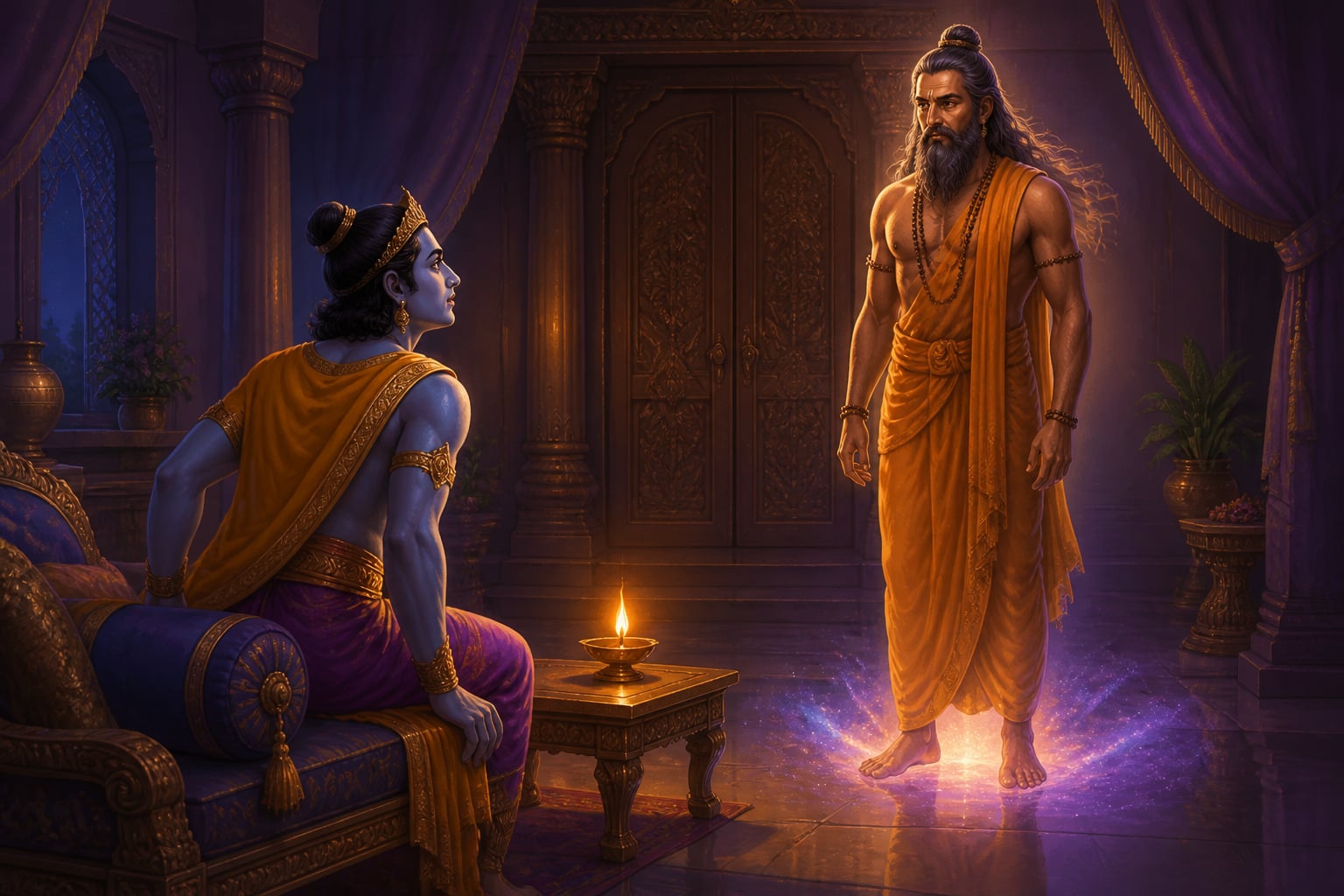
Kala the mysterious yogi visits Rama in private audience

"I come from beyond this world," the yogi said. "My message is for you alone. If anyone interrupts our conversation, they must die. This is the condition of my speaking."

Rama agreed. He posted Lakshmana at the door with strict instructions: no one was to enter, under any circumstances.

The yogi then revealed his true nature. He was Kala, Time itself, sent by Brahma to remind Rama of who he truly was.

"You are Vishnu," Time said. "You descended to this realm to destroy Ravana and restore dharma. That mission is complete. Your time as Rama is ending. You must prepare to return to Vaikuntha, where you belong."

The Impossible Choice

As Time spoke with Rama, the sage Durvasa arrived at the palace. Durvasa was infamous for his temper, his curses had destroyed kings and ruined kingdoms over minor slights. He demanded immediate audience with Rama.

Lakshmana explained that the king was in private conference and could not be disturbed. Durvasa's face darkened with rage.

"If you do not bring me to Rama immediately," the sage thundered, "I will curse Ayodhya to ashes! Every man, woman, and child will perish!"

Lakshmana faced an impossible choice. If he interrupted Rama, he would die, the condition of Time's visit was clear. If he did not, Durvasa would destroy the entire kingdom.

He chose.

Lakshmana opened the door and stepped inside, knowing he was walking to his death. He loved his brother. He loved Ayodhya. He had spent his entire life in service to both. If his death could save the kingdom, it was a price worth paying.

"Brother," he said simply, "Durvasa is here. He threatens destruction."

Time vanished, his message delivered. Rama stared at Lakshmana with dawning horror.

"The condition, "

"I know." Lakshmana smiled. "It was always going to end this way, brother. You and I... we were never meant to grow old together. Let me go. Let me return to where I belong, as you will soon return to yours."

Lakshmana's Departure

Rama could not bring himself to execute his brother. Instead, he banished him, a legal death that fulfilled the letter of the curse without requiring actual killing. But Lakshmana knew the spirit of such oaths could not be evaded.

He walked to the banks of the Sarayu river, the same waters that flowed past Ayodhya, the same river that would soon claim Rama himself. There, he performed his final prayers.

The stories say different things about what happened next. Some say Lakshmana simply sat in meditation until his life force departed. Others say the river rose to claim him, carrying him to the cosmic ocean. What is certain is that Lakshmana left the mortal world that day, returning to Vaikuntha ahead of his brother.

Rama grieved, but Time's message had changed him. He understood now that these departures, Sita's, Lakshmana's, and soon his own, were not tragedies but completions. The avatar's work required a beginning and an end. Clinging to mortal existence when divine purpose was fulfilled would be its own form of adharma.

The Kingdom Secured

Rama set his affairs in order. He divided the kingdom between his sons and nephews, Lava received the northern territories with Shravasti as capital, Kusha the southern with Kushavati. Bharata's sons received Takshashila and Pushkalavati. Shatrughna's sons confirmed in Mathura.

The Ikshvaku line, which had ruled from a single throne, now spread across the subcontinent. Each branch would develop its own character, its own traditions, but all would remember their common ancestor. The story of Rama would be told in each of these kingdoms, passing from generation to generation, becoming the foundation of dharmic civilization itself.

The citizens of Ayodhya sensed what was coming. They watched their king with worried eyes, noting how he gave away treasures, blessed children more frequently, spoke of his father and brothers in ways that suggested imminent reunion.

When Rama announced that he would walk to the Sarayu the next morning, no one was surprised. But no one was prepared either.

The Final Walk

The entire city followed Rama to the river. Not just humans, the vanaras came, led by Sugriva and Hanuman. Vibhishana came from Lanka. Bears from the southern mountains, birds from the forests, creatures of every kind gathered to witness the departure of one who had touched all their lives.

Rama wore simple white garments, the clothes of renunciation. He carried no weapons, wore no crown, bore none of the symbols of kingship he had held for so long. He was going home, and he needed nothing from this world to make that journey.

At the river's edge, he turned to face the multitude.

"I was sent to this world for a purpose," he said. "That purpose is complete. Ravana is destroyed. Dharma is restored. My sons will carry forward what I began. There is nothing more for me to do here."

Hanuman stepped forward, tears streaming down his face. "Let me come with you, Lord. Wherever you go, let me serve you still."

Rama embraced him. "You will serve me forever, old friend. Wherever my story is told, you will be remembered. Wherever dharma is honored, your devotion will inspire. Stay in this world. Be its guardian. And when the end of this age comes, you will join me in what follows."

The Waters Rise

Rama walked into the Sarayu. The water was cold, then warm, then beyond temperature altogether. With each step, the mortal world grew more distant, more dreamlike. The crowds on the bank seemed to flicker like flames in wind.

He thought of Sita. He thought of the life they had shared, the love that had survived exile and war and separation. He thought of the moment he had failed her, the question he should never have asked. In the next world, he would have eternity to make amends.

The water rose to his chest, then his shoulders, then his chin. The last thing the watchers saw was his face, serene, at peace, finally free of the burdens that had weighed on him since the day he was crowned.

Then the Sarayu closed over his head, and Rama was gone.

Rama in plain white walks slowly into the still dawn waters of the Sarayu river while a vast crowd of citizens and Hanuman watch in tearful reverence.

The Story That Never Ends

Vishnu reclining on Shesha in Vaikuntha

In Vaikuntha, beyond time and space, Vishnu rests on the cosmic serpent with Lakshmi beside him. Those who achieved liberation through devotion to Rama see him still, sometimes as the blue god on his serpent throne, sometimes as the prince of Ayodhya walking through eternal forests with his beloved at his side.

The story of Rama did not end when he entered the Sarayu. It continued in the kingdoms his sons built, in the songs his tale inspired, in the temples that rose across the land to honor him. It continued in the hearts of all who heard his story and found in it a model for their own struggles.

The Ramayana teaches that dharma requires sacrifice, sometimes terrible sacrifice. It teaches that even gods, when they take mortal form, must suffer mortal consequences. It teaches that love endures beyond death, beyond doubt, beyond all the failures that mark human relationships.

But most of all, it teaches that the story never truly ends. In every age, in every land, whenever beings face impossible choices and find the courage to choose dharma over desire, Rama lives again. Whenever love survives what should destroy it, Sita lives again. Whenever devotion transcends self-interest, Hanuman lives again.

The characters pass from this world. The story remains. And in that remaining, the purpose of the avatar is eternally fulfilled.

Iti Shri Ramayana, Thus ends the Ramayana.

Living traditions

The Ramayana remains one of the most influential texts in human history, with versions in hundreds of languages across Asia. Its themes, duty versus love, the cost of leadership, conscious endings, continue to resonate in literature, film, and ethical discussion. The story's refusal to offer easy answers ensures it remains a living text, debated and reinterpreted across generations.

Reflection

More in Uttara Kanda

All lessons in Uttara Kanda · The Ramayana course