The King's Justice
Tales of Dharmic Wisdom
Rama contemplates the nature of kingship through ancient tales. He learns of King Nriga, transformed into a lizard for a careless gift; of Nimi, whose impatience cost him his body; of Yayati, whose lust earned him premature old age; and of Ila, who lived as both man and woman. Each story illuminates the burdens of rule.
The Weight of Decisions
As the years passed, Rama found himself increasingly troubled by questions of justice. The washerman's words, Sita's exile, the terrible weight of choosing kingdom over heart, these haunted him in ways that public success could not ease.
He sought counsel from the sages who visited his court, asking them not for praise but for wisdom. "Tell me of kings who failed," he requested. "Tell me of rulers who made mistakes. I would learn from their errors, not merely repeat the successes of my ancestors."
The sages, impressed by this unusual humility, shared tales they rarely told, stories of good kings undone by small oversights, of dharma's unforgiving precision.
The Tale of King Nriga
The first tale came from the sage Chyavana, who spoke of King Nriga, a ruler of Rama's own Ikshvaku lineage who had lived in ancient times.
Nriga was famous for his generosity. He had given away countless cows to brahmins, earning spiritual merit that should have guaranteed him a place in the highest heavens. But one cow he gifted had wandered from one brahmin's herd and been included accidentally in a gift to another.
Both brahmins claimed the cow. Both were right. And Nriga, though unaware of the error, was responsible.
When Nriga died, Yama's servants found this flaw in his record. "You gave what was not yours to give," they judged. "The merit of your generosity is canceled by this carelessness."
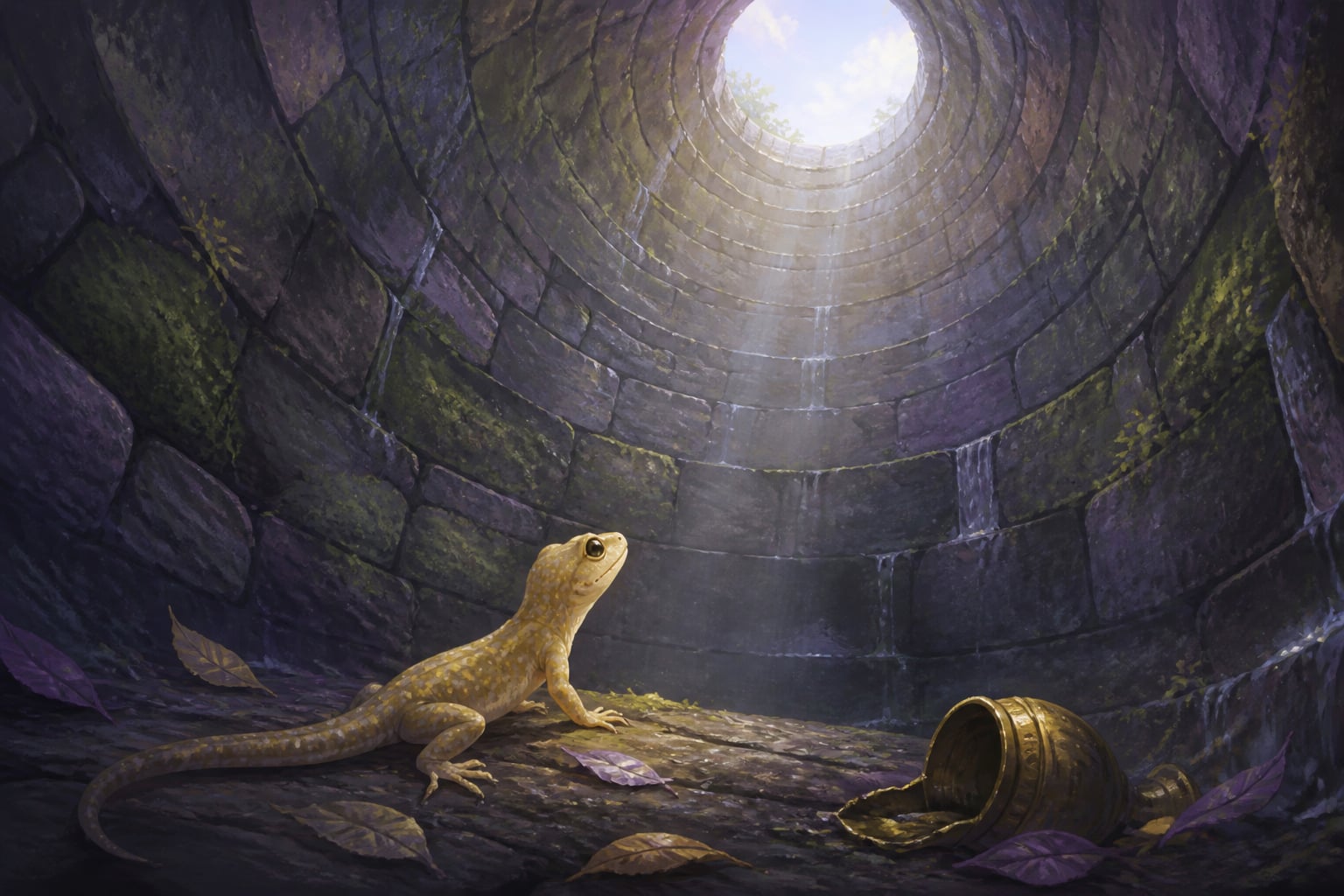
Nriga was condemned to spend ages as a lizard, trapped in a deep well, awaiting liberation that would only come when a descendant of Vishnu touched him. The story's lesson was clear: good intentions were not enough. A king's gifts, like a king's judgments, must be absolutely certain.
"Is this justice?" Rama asked. "A lifetime of generosity undone by a single mistake he did not even know he made?"
"Dharma does not measure intent alone," Chyavana replied. "It measures consequences. A king's carelessness can harm those he means to help. Nriga's confusion over that cow caused strife between two brahmins who should have been at peace."
The Tale of King Nimi
The sage Narada, who often visited Ayodhya, told the next tale, that of Nimi, another Ikshvaku king, who had quarreled with none other than Vasishtha himself.
Nimi had begun a great yajna and summoned Vasishtha to officiate. But Vasishtha was already committed to a ceremony for Indra and asked Nimi to wait. Nimi, impatient, began without him, appointing another priest.
When Vasishtha returned and found himself replaced, his anger was terrible. "May your body fall lifeless," the sage cursed. But Nimi, righteously angry at being abandoned, returned the curse: "May the same fate befall you."
Both curses took effect. Both lost their bodies. Vasishtha was reborn through divine intervention, but Nimi's case was more complex. His soul was offered a new body, but he refused it, preferring to remain bodiless.
"Where then is Nimi now?" Rama asked.
Narada smiled. "He dwells in the eyelids of all beings. Every time you blink, it is Nimi closing and opening his eyes. He found peace in that strange immortality."
The lesson was subtler than Nriga's. Both Nimi and Vasishtha had been partially right and partially wrong. Both had let pride override patience. Both had suffered consequences that far outweighed the original offense.
The Tale of King Yayati
Lakshmana, sitting beside his brother, asked about another ancient king, Yayati, whose name was synonymous with caution about desire.
The sages explained: Yayati had two wives, Devayani and Sharmishtha. His favoritism toward Sharmishtha enraged Devayani's father, the powerful sage Shukracharya, who cursed Yayati with immediate old age.
Decrepit and desperate, Yayati begged his sons to trade their youth for his age. His eldest, Yadu, refused and was cursed to found a lineage that would never rule. But his youngest, Puru, agreed to sacrifice his youth so his father could enjoy pleasures a while longer.
Yayati took Puru's youth and spent it pursuing the same desires that had caused his curse. But at the end, he realized a profound truth: desire is never satisfied by indulgence. The more one feeds it, the more it demands.
He returned Puru's youth, accepted his old age, and spoke words that echoed through ages: "Desire is a fire that grows stronger the more fuel you add. Only when you stop feeding it does it finally subside."

Rama recognized himself in this tale. He had desired Sita back. He had desired public approval. He had desired to be both perfect husband and perfect king. And in trying to satisfy all these desires, he had lost what mattered most.
The Tale of Ila
The strangest tale came last, the story of King Ila, also called Sudyumna, who had been both man and woman.

Ila was a powerful king who wandered into a sacred grove where Shiva and Parvati were making love. By Parvati's power, no male could see her in that state without becoming female. Ila and his entire retinue were transformed.
As a woman, Ila wandered confused until encountering Budha, son of the Moon. They fell in love and had a son, Pururavas, who would become the ancestor of the Chandravamsha, the Lunar Dynasty of kings.
Eventually, Shiva took pity on Ila. But he could not fully reverse Parvati's power. Instead, he decreed that Ila would alternate, one month male, one month female, remembering nothing of the other state during each transformation.
This strange existence continued until Ila performed such intense penances that the curse was fully lifted. He returned to his kingdom, but he was forever changed by having lived both as man and woman.
"What does this tale teach?" Rama asked.
"That identity is more fluid than we believe," the sage replied. "That circumstance can force us into roles we never imagined. That wisdom comes from understanding experiences beyond our own nature. Ila became a better king for having been a queen."
Dharma's Endless Questions
These tales occupied Rama's thoughts as he prepared for the Ashvamedha Yajna. Each story showed kings confronting impossible situations, curses that seemed unjust, choices between equally valid claims, transformations that challenged everything they knew about themselves.
Rama saw his own story reflected in each tale. Like Nriga, he had made a decision with unintended consequences. Like Nimi, he had let pride and duty clash in ways that harmed everyone. Like Yayati, he had fed desires that could never be satisfied. Like Ila, he had been forced into a role, king without queen, that felt alien to his nature.
"Is there any tale," he asked the sages, "where the king makes the right choice and suffers no consequences?"
The sages were silent.
"I thought not," Rama said. "Kingship is the art of choosing which pain to endure. The question is never whether to suffer but how to suffer in service of dharma."
With these heavy thoughts, he turned to prepare for the great sacrifice, the Ashvamedha that would proclaim his sovereignty and, unknowingly, summon his own sons to his court.
Living traditions
The ethical dilemmas presented in this lesson, consequences exceeding intentions, desire's insatiability, the value of diverse perspectives, remain central to Hindu philosophical discussion. Business ethics courses in Indian management schools sometimes use Nriga's story to discuss corporate responsibility. Yayati's realization about desire appears in modern mindfulness and addiction recovery literature.
- Dana (Charitable Giving): The story of Nriga illustrates the importance of careful, intentional giving. Hindu tradition emphasizes that dana should be given with attention, not casually, ensuring the gift truly reaches those intended. Proper dana includes verifying that what you give is legitimately yours to give.
- Varanasi Ghats: The oldest continuously inhabited city in the world, where many of the Uttara Kanda's ethical teachings about karma, death, and liberation are regularly taught. The ghats host countless discussions of dharma, including the stories of Nriga, Yayati, and Nimi.
- Kashi Vishwanath Temple: One of Hinduism's holiest Shiva temples, standing in the city most associated with teachings about karma, death, and liberation. The philosophical questions Rama asks about justice and consequences are regularly discussed in the scholarly traditions centered here.
Reflection
- Has something you intensely desired, once obtained, failed to provide the satisfaction you expected? What did this teach you about the nature of wanting?
- Why do you think Rama specifically asked to hear stories of kings who failed? What does this say about how wisdom is best acquired?
- Nimi's curse transformed him into something present in every living being's blink. What might this mean symbolically about how the consequences of our choices persist in the world?