Sons Meet Father
The Truth Revealed
Rama arrives to face the mysterious twins who defeated his brothers and armies. The battle is fierce, the first time since Ravana that Rama finds himself evenly matched. When Valmiki intervenes and reveals the truth, the king of Ayodhya discovers that the warriors he has been fighting are his own sons, and the Ramayana they sing is his own story.
The King Arrives
Rama's chariot emerged from the forest path into the clearing where the twins waited. The sight of them stopped his breath.
They were beautiful. There was no other word for it. Two young men, identical in face but distinct in bearing, one standing with the coiled readiness of a warrior expecting attack, the other with the calm watchfulness of a strategist assessing options. Their bows were drawn but not aimed, respecting the approaching king while remaining prepared.
And their faces... Rama felt his heart crack. He knew those faces. He had seen them in dreams for fifteen years. The arch of the eyebrows was Sita's. The set of the jaw was his own. These were not strangers. These could not be strangers.
"You are the king," Lava said. It was not a question. "We have heard much about you."
"Who are you?" Rama asked, though his soul already knew.
"We are Lava and Kusha, students of the sage Valmiki. We have captured your horse. Will you fight to reclaim it, or negotiate?"
Rama dismounted slowly. "First, tell me of your parents."
Something flickered across Kusha's face. "Our mother lives. Our father... we have never known him. She says he was a great warrior. A king. She says we will meet him someday."
"I see." Rama's voice was barely a whisper. "Then let us fight. And afterward, perhaps, we will talk more."
A Battle Like No Other
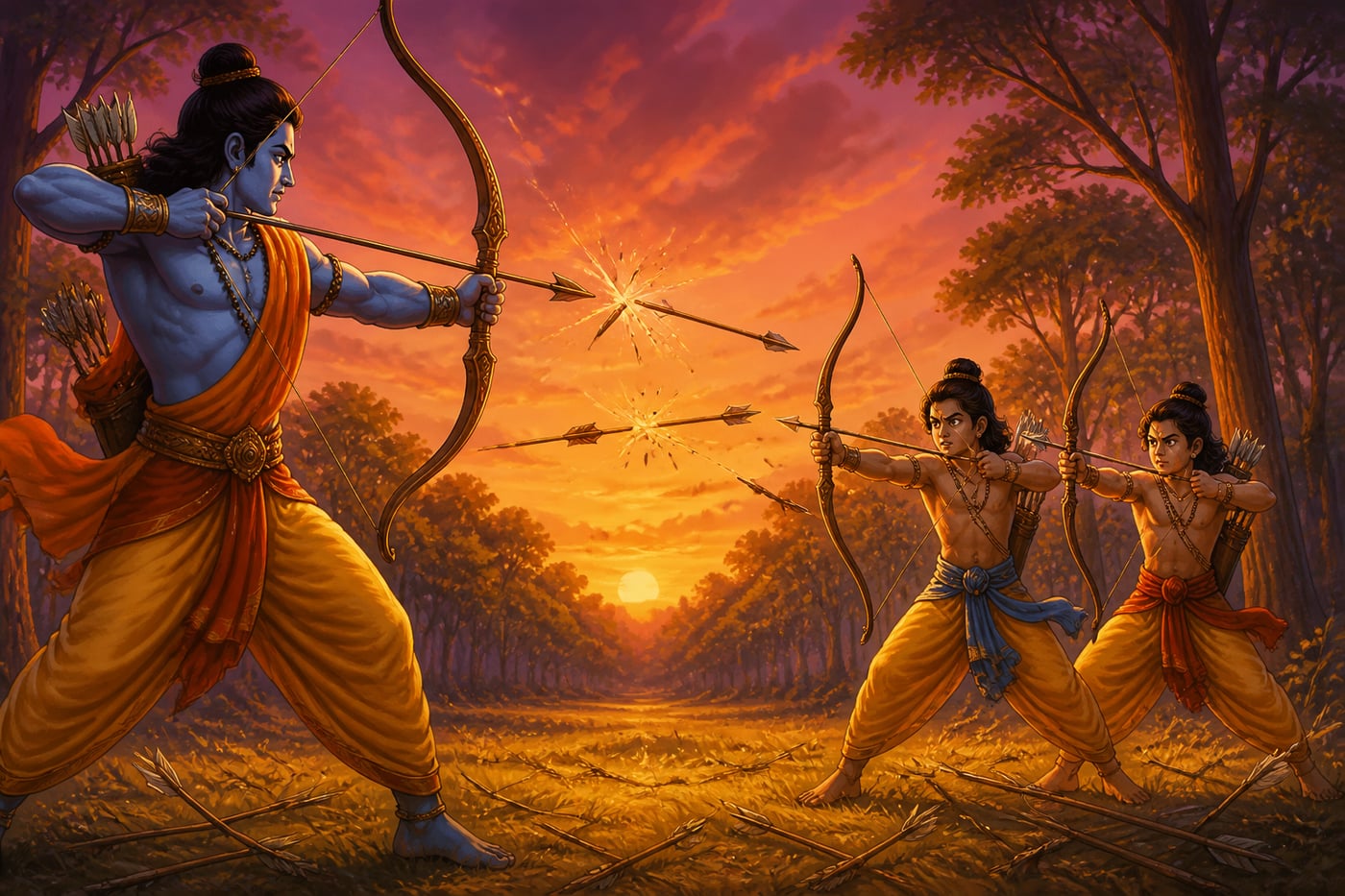
The combat that followed was unlike any Rama had experienced since Lanka. These young warriors did not simply fight well, they fought with techniques that mirrored his own, with timing that anticipated his movements, with precision that matched his lifetime of training.
Every arrow Rama shot was countered. Every advance was blocked. The twins worked as a single entity, Lava pressing forward while Kusha provided covering fire, then reversing roles with seamless coordination. It was like fighting two halves of the same warrior.
Rama found himself using techniques he had learned from Vishwamitra, from Parashurama, from his own years of practice. The twins matched them all. Someone had trained them in the Ikshvaku traditions. Someone had taught them the very arts that were supposed to be secret to the royal line.
"Who taught you?" Rama demanded between exchanges. "This is not forest archery. This is palace training."
"Our mother taught us the basics," Kusha replied, loosing an arrow that nearly pierced Rama's defense. "Then Valmiki completed our education. He said we had natural talent."
Natural talent. The Ikshvaku blood, passed through generations, expressing itself in forest-raised children who had never seen a palace.
The battle raged until the sun began to set. Neither side could claim advantage. Rama was the more experienced warrior, but the twins' youth gave them endurance, and their coordination gave them tactical options a single fighter could never match.
Valmiki's Intervention
It was Valmiki himself who ended the combat.
The old sage emerged from the forest with a presence that commanded attention. His hand was raised in the gesture of peace, and his voice carried across the clearing with authority that made weapons lower.
"Enough," he said. "This battle should never have been fought."
Rama turned to face the sage who had sheltered him during his exile, whose blessings had sustained him through trials. "Valmiki-muni, these boys captured my horse. They have defeated my brothers, my armies. I came to reclaim, "
"You came to reclaim your sons," Valmiki interrupted. "Though you did not know it."
The words hung in the air. Lava and Kusha looked at each other in confusion. Rama's bow fell from suddenly nerveless fingers.
"What did you say?"
"These are Lava and Kusha, born to Sita in my ashram after you abandoned her. They are your sons, Rama. The heirs of Ayodhya you never knew you had."
The World Remade
Rama sank to his knees. The twins stared at him, the man they had been fighting, with dawning recognition.

"Our father," Kusha whispered. "You are our father."
"The king who sent our mother away," Lava added, his voice harder. "The one who believed gossip over truth."
"I never believed it," Rama said, his voice breaking. "I knew she was pure. I knew it in my soul. But the people... a king must..." He could not finish.
Valmiki's voice was gentle but firm. "The time for explanations will come. For now, understand what has happened. You have found your sons. They have found their father. What you do with this knowledge will define the rest of your story."
Rama looked at the twins, his sons, his blood, raised in exile as he had once been raised in palaces. They were magnificent. They were everything he could have hoped for. And he had missed every moment of their lives.
"Can you forgive me?" he asked. "Can you understand why I did what I did?"
Kusha stepped forward first. "Mother never spoke against you. She said you did what you thought you had to do. She said we should not judge until we understood the weight of kingship."
"She is wiser than I deserve," Rama said.
"Yes," Lava agreed. "She is. But she loves you anyway. She always has."
The Song That Changed Everything
Valmiki invited Rama to the ashram. There, amid simple huts and peaceful gardens, the king of Ayodhya saw the life his family had lived without him. He saw where his sons had practiced archery, where they had studied scripture, where they had grown from infants to young men.
And he heard them sing.
Lava and Kusha took up their veenas and began to recite the Ramayana, the poem Valmiki had composed, the story of Rama's own life set to perfect verse. Their voices wove together, alternating and harmonizing, carrying the tale from Dasharatha's longing through exile and war to the moment of triumph at Lanka.
Rama listened to his own history sung by his own sons. He heard his father's death described in verses that broke his heart anew. He heard Sita's abduction related with poetry that captured the horror he had felt. He heard his victory over Ravana celebrated with words that made it seem almost noble.
But when they reached the events of Uttara Kanda, when they sang of the washerman's words, of Sita's second exile, of their own birth in the forest, Rama wept openly.
This was how the world would remember him. Not just as the hero who defeated Ravana, but as the king who abandoned his pregnant wife. The story was complete, and it was not entirely flattering.
"This is truth," Valmiki said. "This is what happened. I have not softened it. I have not hidden your mistakes. The Ramayana is not a tribute to a perfect king. It is the story of a good king who made terrible choices for what he believed were good reasons. It is the most human of stories."
The Invitation
Rama stayed at the ashram for three days, learning everything he had missed. He watched his sons practice, heard them debate scripture, saw them help with the ashram's daily work. They were princes in every way that mattered, noble in character, skilled in all arts, devoted to dharma.
But he did not see Sita. She had withdrawn to her hut when he arrived and had not emerged.
"She is waiting," Valmiki explained. "She will not seek you out. If you wish to see her, you must take the first step."
Rama was not ready. The shame of what he had done, the weight of fifteen years of separation, the uncertainty of what he could possibly say, all of it held him back.
Instead, he made a different offer. "Come to Ayodhya," he told his sons. "The Ashvamedha must be completed. Come and sing the Ramayana before my court. Let all the kingdom hear what you can do."
He paused. "And bring your mother, if she will come. Let her see the throne she was denied. Let the people see the queen who proved herself in fire. Perhaps... perhaps this time, things can be different."
Valmiki nodded slowly. "We will come. But understand, Rama, what happens at Ayodhya will complete your story. The choice Sita makes there will echo through ages. Are you prepared for that?"
Rama did not know. He only knew he had to try.
Living traditions
The image of children demonstrating excellence despite being raised away from privilege resonates in modern Indian society, where education and character development are seen as accessible regardless of wealth. Films depicting Lava-Kusha's story emphasize this theme. The twins represent hope that righteousness, not circumstance, determines capability.
- Harikatha / Pravachan: The tradition of singing/narrating the Ramayana continues in performances called Harikatha (in South India) or Pravachan (in North India). Like Lava and Kusha's original performance, these blend music, storytelling, and spiritual teaching.
- Lahore (Lavapuri): The city of Lahore claims foundation by Lava, son of Rama. The Lahore Fort contains the Loh Temple, traditionally associated with this origin story. Though access may be limited, the connection between city and epic remains part of local heritage.
- Kushinagar: Founded by Kusha according to Ramayana tradition, this city later became famous as the site of Buddha's Mahaparinirvana. The layered history shows how sacred sites accumulate significance across traditions.
- Ram Ghat, Ayodhya: Traditional site where Rama returned after exile. The same ghat would have witnessed Lava and Kusha's arrival for the Ashvamedha. Daily aarti on the Sarayu continues the tradition of welcoming at this sacred spot.
Reflection
- If someone told your life story, honestly, including your failures, what would be hardest to hear? What might that reveal about unfinished business?
- Lava was described as more aggressive while Kusha was more thoughtful, yet they were twins. What does this suggest about how the same inheritance can express differently?
- The Ramayana was composed about events before they all occurred, then sung by characters within the story. What does this suggest about the relationship between narrator and narrative?