The Washerman's Words
The Price of Kingship
The golden age of Rama Rajya is shattered by whispers. A washerman's cruel words about Sita spread through Ayodhya. Rama, who has never doubted his wife's purity, faces an impossible choice: his love for Sita or his duty to a kingdom that demands a queen beyond all reproach.
The Poison Spreads
It began, as such things often do, with casual cruelty.
A washerman in the lower quarters of Ayodhya was arguing with his wife. She had been away for a night, visiting her sister, and he suspected infidelity. When she returned, he erupted in fury.
"Do you think I am Rama?" he shouted, loud enough for neighbors to hear. "Do you think I will take back a wife who has spent the night in another man's house? I am not so weak as our king, who welcomed back a woman who lived for months in a demon's palace!"
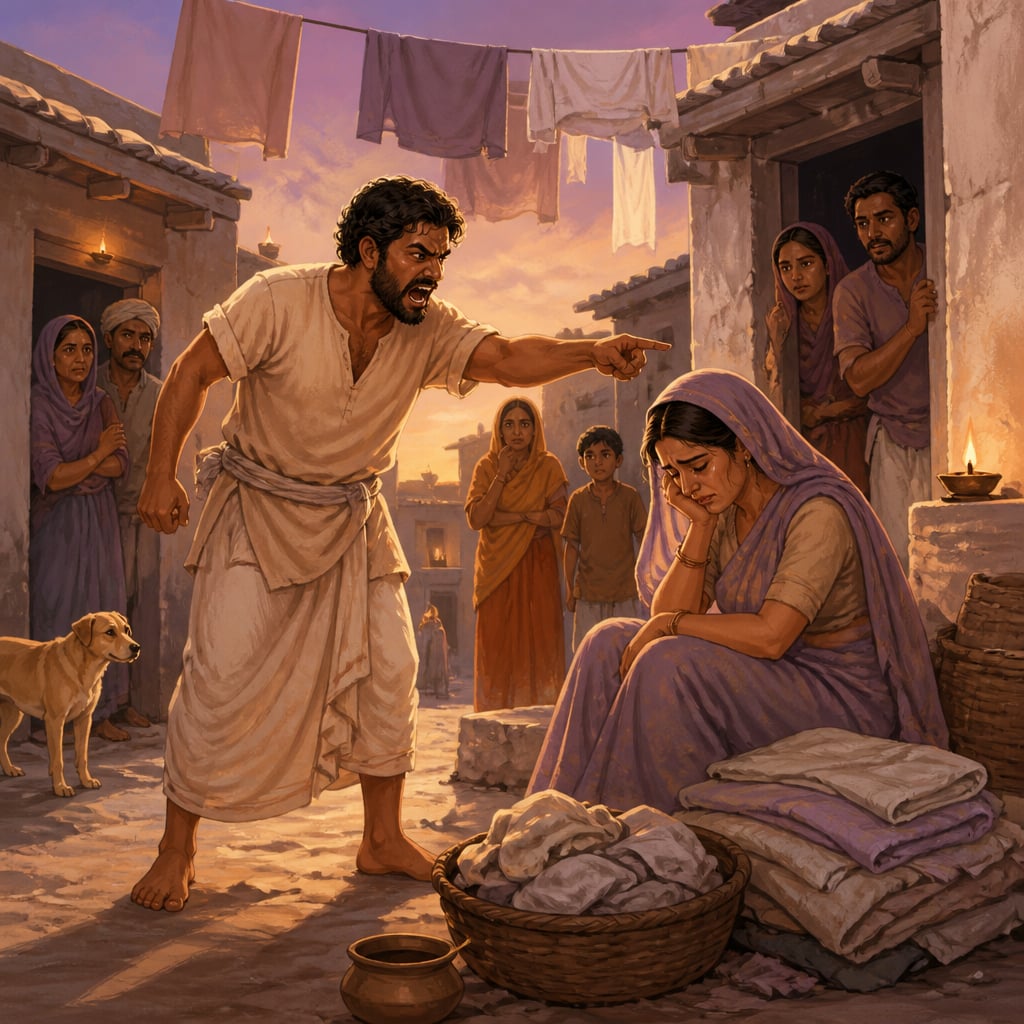
The neighbors heard. They whispered to others. Within days, the washerman's words had traveled through the marketplaces, the temple grounds, the gathering places where citizens discussed the affairs of their kingdom.
Most dismissed it as ignorance. Sita had proved her purity in fire, Agni himself had testified to her virtue. What more proof could anyone need?
But some listened. Some wondered. And that wondering was enough.
The Reports Reach the Palace
Rama had spies throughout his kingdom, not for tyranny but for awareness. He needed to know what his people thought, what troubled them, what they needed. Usually, their reports brought news of floods or bandits or disputes between villages.
This time, Bhadra, his most trusted agent, came with something different.
"My lord," Bhadra said, clearly uncomfortable, "there are... whispers. About the queen. About her time in Lanka."
Rama's face went still. "What kind of whispers?"
"Some citizens question... they wonder if a woman who lived in Ravana's palace, however unwillingly, can truly be..." Bhadra could not finish.
"Can truly be pure," Rama completed. "That is what they say."
"Yes, my lord. I report only what I hear. I do not believe, "
"I know you do not. Leave me."
Alone, Rama sat in silence. The room that had seemed bright moments ago now felt dark. The golden age he had built seemed suddenly fragile, a beautiful structure resting on foundations that others were beginning to question.
The Council of Brothers

That night, Rama called his brothers to private council. Lakshmana, Bharata, Shatrughna, the three who had been with him through everything. They needed to know what he faced.
"The people doubt Sita," Rama said simply. "Despite the Agnipariksha. Despite her proven virtue. They whisper."
Lakshmana's reaction was immediate fury. "Then punish them! They slander their queen with lies!"
"I cannot punish people for their thoughts," Rama replied. "Nor for speaking among themselves. A king who silences doubt through force creates only more doubt."
Bharata saw the trap. "If you ignore the whispers, they grow. If you address them directly, you acknowledge they have merit. What can you do?"
Rama's voice was heavy. "A king cannot have a queen whose virtue is questioned by his people. Not because the queen is impure, I know Sita's soul as I know my own, but because a questioned queen cannot fulfill her role. She cannot bless marriages, cannot preside over rituals, cannot represent the kingdom. The doubt itself becomes the problem."
Shatrughna, the quietest of the brothers, finally spoke. "Brother, you are not considering what I think you are considering."
Rama did not answer. His silence was answer enough.
The Private Agony
That night, Rama found Sita in their chambers. She was weaving flowers into garlands for the morning puja, humming softly. When she saw his face, her hands stilled.
"What has happened?" she asked.
"Nothing. Nothing has happened." But his voice betrayed him.
Sita set down the flowers. "You have never lied to me, my husband. Do not begin now."
So Rama told her. The washerman's words. The spreading whispers. The impossible position in which they now found themselves.
Sita listened in silence. When he finished, she did not weep, did not rage. Instead, she smiled sadly.
"I wondered when this would come," she said. "In Lanka, during those dark months, I knew that even rescue would not end my trials. A woman who has been taken, however innocently, carries that shadow forever. It is not just, but it is how the world works."
"I will not abandon you," Rama said fiercely. "The people are wrong. You are pure."
"I know you believe that. I know it is true." Sita took his hands. "But you are not merely my husband. You are their king. And a king who ignores his people's concerns, even unfair ones, ceases to be a king worth following."
The Decision No One Could Make
For days, Rama wrestled with the choice. He held court mechanically, ate without tasting, slept without resting. The brother who had always known the right path now found himself at a crossroads where every direction led to pain.
If he kept Sita, he would lose his people's trust. The whispers would grow. Eventually, they would question not just Sita but Rama himself, his judgment, his fitness to rule. The golden age would crumble not from external enemies but from internal doubt.
If he sent Sita away, he would lose himself. She was not merely his wife; she was his soul's companion, the one for whom he had waged war against the most powerful demon in creation. How could he betray her after everything they had survived together?
"There is no right answer," Lakshmana said bitterly. "This is the cruelty of kingship. Personal happiness and public duty cannot always coexist."
Bharata disagreed. "There must be another way. Perhaps if Sita addresses the people directly, "
"She already proved herself in fire," Rama interrupted. "If that was not enough, what would be? Should she prove herself again and again, every time someone speaks cruelly? That is no life for anyone."
The Command That Broke Him
In the end, Rama chose his kingdom over his heart. But he could not speak the words himself.
He called Lakshmana to him privately. "Tomorrow, take Sita to the forest. Tell her I am sending her on a pilgrimage to visit the hermitages of the sages. Leave her at Valmiki's ashram, she will be safe there. Then return alone."

Lakshmana stared at his brother in horror. "You cannot ask this of me. I was the one who drew the line around her in Panchavati. I was supposed to protect her. And now you want me to, "
"I am asking because I cannot do it myself," Rama said, his voice cracking. "If I see her face when she understands, I will break. I will abandon the throne, abandon the kingdom, and follow her into exile. I cannot trust myself. I am trusting you."
"This is wrong," Lakshmana whispered.
"Yes. It is. But it is also my duty. A king's personal morality must sometimes bend to his people's needs. That is the terrible truth of rulership." Rama paused. "And there is something else. Sita is pregnant. My child, my children perhaps, will grow up in the forest, not knowing their father."
Lakshmana wept. He wept for Sita, for Rama, for the unborn children who would never know palace walls. But in the end, he agreed.
Some duties are too heavy for one person to carry. Sometimes, brothers must share the weight of tragedy.
Living traditions
The episode of Sita's exile has become a focal point for discussions about women's treatment in traditional societies. Women's groups and scholars have used it to examine how female virtue is scrutinized differently than male virtue. Contemporary artists often reimagine the story to give Sita greater voice and agency. The continuing debate demonstrates the text's power to spark ethical reflection.
- Sitamarhi: The district claims to be Sita's birthplace (where Janaka found her). The name itself means 'Sita's boundary.' Multiple temples honor different aspects of her story, making it a pilgrimage site for those following Sita's journey.
- Valmiki Ashram, Bithoor: One of the sites claiming to be where Sita was sheltered and where Lava and Kusha were born. Features temples to Valmiki and the twins, with claims of ancient meditation spots used by the sage.
- Janaki Mandir: Grand temple dedicated to Sita (Janaki), built at the site claimed as her birthplace. The white marble structure is one of the largest temples in Nepal and serves as a major pilgrimage destination for those honoring Sita's story.
Reflection
- Have you ever said something casually, about a coworker, friend, or public figure, that you later learned hurt them deeply? What did this teach you about the power of words?
- Lakshmana was forced to abandon Sita against his own judgment. What does it mean to obey an order you believe is wrong? When is obedience itself a moral failure?
- Was Rama right to prioritize his kingdom over his wife? What does this story suggest about the relationship between private love and public duty?