The Golden Reign Begins

Rama Rajya Dawns

With Ravana slain and Sita restored, Rama returns to Ayodhya in triumph. The long exile ends not with quiet homecoming but with the most magnificent coronation the world has ever witnessed. As Rama takes his father's throne, an age of unparalleled righteousness begins.

The Return of the Exiles

The Pushpaka Vimana descended through clouds that seemed to part in reverence. Below, Ayodhya had transformed. What had been a city draped in mourning for fourteen years now blazed with joy. Every street was lined with flowers, every rooftop crowded with citizens who had waited through the longest night of their kingdom's history.

Rama stood at the vimana's edge, Sita beside him, Lakshmana just behind. The brothers who had left as princes in bark cloth now returned as warriors who had defeated the unconquerable. Yet Rama's expression held not triumph but something deeper, the quiet relief of duty fulfilled, of promises kept.

Pushpaka Vimana descends through morning clouds toward Ayodhya, with Rama, Sita, and Lakshmana visible at its open edge.

Bharata was first to reach them. He had spent fourteen years ruling Ayodhya as a regent, placing Rama's sandals on the throne, refusing to sit upon it himself. Now he fell at his brother's feet, tears flowing freely.

"The kingdom is yours," Bharata said. "It was always yours. I was merely its caretaker."

Rama lifted him, embracing him tightly. "You did what I could not, you held our father's kingdom together through grief and uncertainty. That is the greater service."

The Coronation of an Era

The preparations that followed were unlike anything seen before. Vasishtha, the royal priest whose wisdom had guided generations of Ikshvaku kings, oversaw every detail. Sacred waters were brought from all the holy rivers, the Ganga, Yamuna, Saraswati, Godavari, Narmada, and dozens more. Precious gems were gathered, mantras rehearsed, the ancient rituals reviewed.

Rama's coronation in the great hall of Ayodhya

On the chosen day, Rama sat upon the throne where Dasharatha had once sat, where Aja and Raghu and Dilipa had ruled before him. The crown of the Ikshvakus, heavy with history and expectation, was placed upon his head.

The gods themselves attended, though invisible to mortal eyes. Indra sent celestial flowers that fell like rain. Vayu ensured the sacred fires burned perfectly. The gandharvas played music that seemed to heal old wounds in the hearts of all who heard it.

Sita was crowned beside him, her ordeal in Lanka never mentioned in the ceremony. She was queen now, as she had always been destined to be, not despite her trials but perhaps because of them. She had proven her virtue in fire itself. What crown could add to that?

Rewards for the Faithful

Before the celebrations ended, Rama called forth those who had made his victory possible.

Sugriva came first, the Vanara king who had risked everything on an alliance with a wandering exile. Rama embraced him as a brother. "Your kingdom is secure forever. No enemy shall threaten Kishkindha while I draw breath."

Vibhishana, who had abandoned his own brother for dharma's sake, received confirmation of his kingship over Lanka. "Rule with righteousness," Rama told him. "Show the rakshasas that dharma leads to prosperity, not weakness."

But it was Hanuman who touched Rama most deeply. The great vanara had been offered any boon, kingdoms, celestial weapons, immortal glory. He refused them all.

"I want nothing but to serve you," Hanuman said simply. "Let me remain wherever your story is told, wherever your name is spoken. That is my only desire."
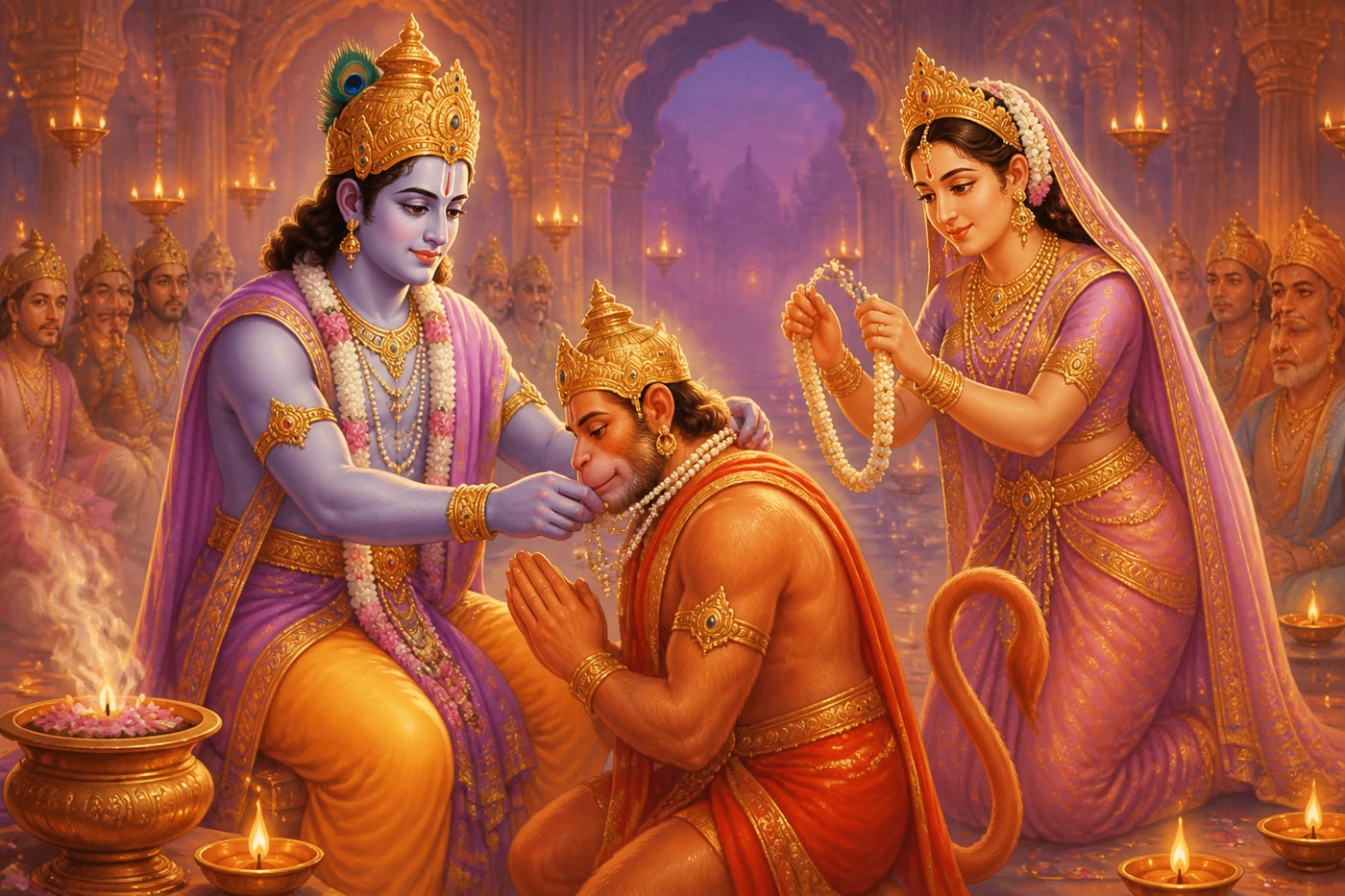
Rama and Sita gifting the pearl necklace to Hanuman

Rama's eyes glistened. He removed a pearl necklace from his own neck and placed it around Hanuman's. "You ask for the highest thing, eternal devotion. It is granted. As long as the sun and moon endure, you shall live. Wherever my story reaches, you shall be remembered."

Sita, moved beyond words, removed her own necklace and added it to Hanuman's gift. The vanara who had found her in Lanka, who had brought her hope in her darkest hour, bowed low.

The Age of Rama

What followed was Rama Rajya, the rule of Rama, an era that would become the golden standard against which all governance would be measured.

In this age, rains came when needed and never flooded the land. Crops grew abundantly without excessive labor. Disease was rare, and when it came, it was easily cured. No one died before their natural time. Children respected elders, and elders guided children with wisdom rather than harshness.

But it was not merely nature that cooperated. The kingdom's prosperity flowed from Rama's constant attention to his duties. He held court every day, hearing complaints from the humblest citizen. No petition was too small, no grievance too minor.

"A king who does not know his people's suffering," Rama said, "is not a king at all. He is merely a man sitting on a decorated chair."

He established officers throughout the realm whose sole duty was to report on the welfare of citizens. Spies brought word of any injustice, any corruption, any abuse of power. These were addressed swiftly and firmly.

Sita's Gentle Influence

Beside the throne, Sita's influence shaped the kingdom in subtler ways. She established institutions for widows and orphans, ensuring that those whom society often forgot were cared for. She promoted arts and learning, inviting scholars and artists to the court.

Women in Rama's kingdom enjoyed a respect uncommon in that age. Sita's own example, her courage, her wisdom, her unwavering dignity through unimaginable trials, had changed how the people thought about feminine strength.

The royal couple seemed blessed in every way. Their love, tested by separation and fire, had emerged stronger. They walked together in the palace gardens each evening, discussing the day's affairs, planning for the kingdom's future.

Yet sometimes, in quiet moments, a shadow crossed Sita's face. She never spoke of it, but she sensed something, a distant rumbling, like thunder that had not yet broken into storm. She had learned in Lanka that happiness, however earned, was never guaranteed.

The Sages Arrive

One evening, as the court prepared to close, a group of rishis arrived at the palace gates. They had traveled from distant ashrams, drawn by reports of this remarkable kingdom. Their leader was Agastya, the same sage who had blessed Rama during his exile, who had given him the Aditya Hridayam that had proved crucial in defeating Ravana.

"We come to witness what we have heard," Agastya said. "They say Rama Rajya has no parallel in history. We wished to see if this is truth or exaggeration."

Rama welcomed them with the honors due to the greatest of sages. He washed their feet himself, served them food, prepared comfortable quarters. Only when they were refreshed did he ask what he might learn from their wisdom.

Agastya smiled. "We came to learn from you, King of Ayodhya. But since you ask, there is something you should know, the history of the demons you defeated. You slew Ravana and his forces, but do you know how they came to be? Do you understand what made them what they were?"

Rama's interest was genuine. "I know little of their origins. I fought them because they had done evil, not because I understood them."

"Then listen," Agastya said, settling into the storytelling posture. "For to truly close a chapter, one must first understand its beginning. Let me tell you of the rakshasa lineage, of Brahma's creations, and of how Ravana's very existence was shaped by cosmic forces older than this world..."

The court fell silent. A new chapter was about to unfold, one that would explain the past even as it prepared Rama for challenges yet to come.

Living traditions

The concept of 'Rama Rajya' continues to influence Indian political and social discourse. The Ram Mandir inauguration in January 2024 was a nationally televised event. Governance ideals from Rama's rule, accessibility to citizens, swift justice, welfare focus, are regularly invoked in discussions of good governance.

Reflection

More in Uttara Kanda

All lessons in Uttara Kanda ยท The Ramayana course