Vishwamitra's Request
A Father's Dilemma & A Sage's Demand
The great sage Vishwamitra arrives seeking Rama's help. Dasharatha's anguish and Vasishtha's wise counsel lead to a fateful decision.
The Sage Arrives
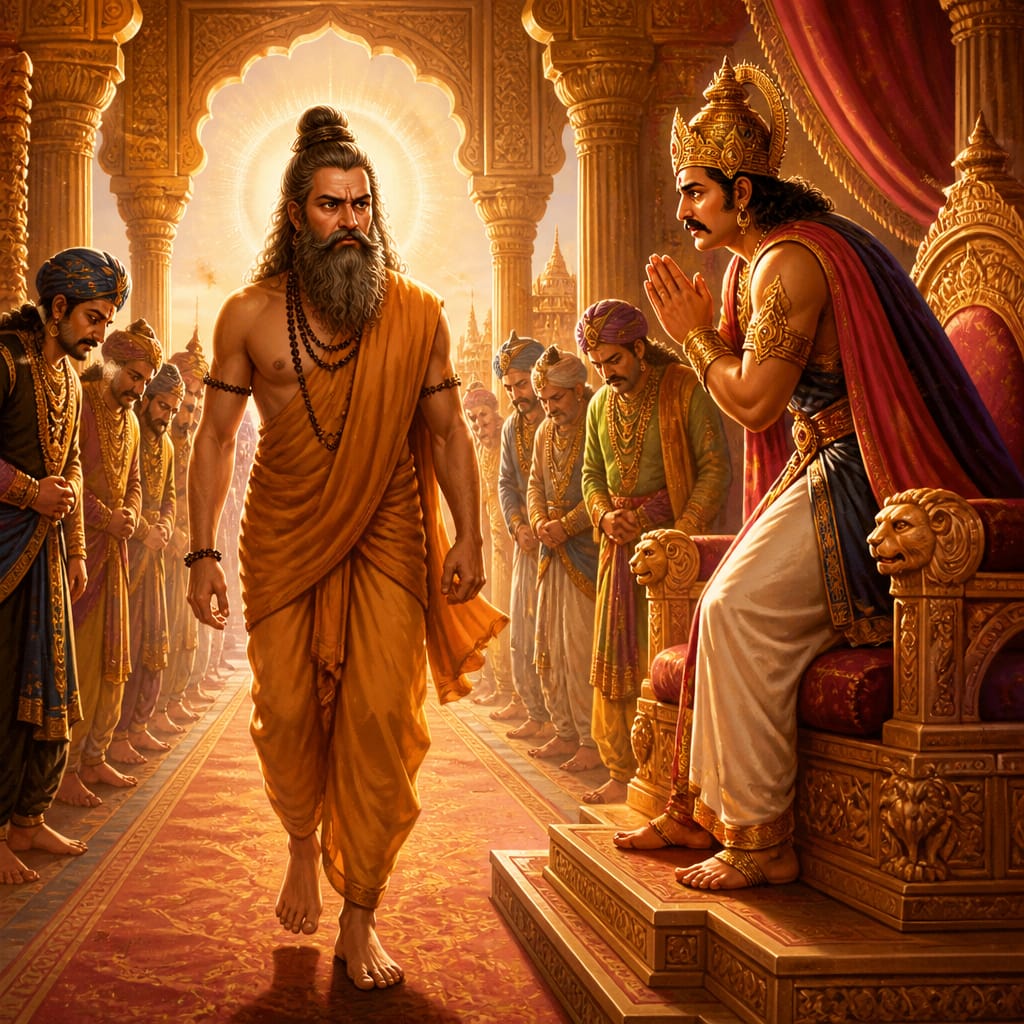
The great sage Vishwamitra strode toward Ayodhya like a storm approaching - his presence announced before his arrival. Birds fell silent. The wind itself seemed to hold its breath. For this was no ordinary visitor, but one of the most powerful beings in creation, a king who had transformed himself into a Brahmarishi through millennia of fierce penance.
King Dasharatha, learning of the sage's approach, rushed to receive him with all the honors befitting such an exalted guest. Water was brought for his feet. The finest seat in the court was offered. The entire assembly rose in reverence, for Vishwamitra's name commanded respect across all three worlds.
The Story of Vishwamitra
To understand why Vishwamitra had come - and why he needed Rama - one must know his extraordinary story.
Vishwamitra was not born a sage. He was born Kaushika, a mighty Kshatriya king of the Chandravanshi (Lunar) dynasty. His kingdom was powerful, his armies invincible, and his pride immeasurable. He believed there was nothing he could not conquer.
One day, while returning from a hunting expedition, Kaushika and his vast army came upon the ashram of Sage Vasishtha - the same Vasishtha who now served as Ayodhya's royal priest. The sage hospitably offered to feed the entire army. Kaushika laughed at the impossible offer - how could one hermit feed thousands of soldiers?
But Vasishtha possessed Kamadhenu, the divine wish-fulfilling cow, also called Sabala. At the sage's command, the miraculous cow produced a feast for every soldier - mountains of food, rivers of sweet drinks, delicacies beyond imagination.
Kaushika was thunderstruck. Such power! He demanded the cow as tribute. When Vasishtha refused, the arrogant king attacked with his entire army. But from Kamadhenu emerged warriors who annihilated the king's forces. Kaushika's hundred sons charged the sage - and all hundred were reduced to ashes by a single syllable from Vasishtha's lips.

Defeated and humiliated, Kaushika realized the terrible truth: The power of a Brahmin's tapas exceeds all worldly might. My armies, my kingdom, my pride - all are nothing before spiritual power.
In that moment, the king made an impossible vow: he would become a Brahmarishi himself. He abandoned his throne and began millennia of penance. The gods, threatened by his growing power, sent celestial nymphs to distract him. He failed, and had to start again. He was tested by hunger, by desire, by rage. Each time he fell, he rose again.
Finally, after countless ages, even Brahma himself acknowledged Kaushika as Vishwamitra - "Friend of the Universe" - a Brahmarishi equal to Vasishtha. But the journey had taught him that a true sage does not fight. He had transcended violence.
The Request That Shook a Father's Heart
Now, in Dasharatha's court, Vishwamitra spoke: "O King, I have come to ask something of you. Promise first that you will grant it."
Dasharatha, eager to please the legendary sage, replied: "Whatever you desire shall be yours - my treasury, my armies, even my life if you ask."
The sage smiled grimly. "I do not want your gold or your soldiers. I want your son Rama."
The words hit Dasharatha like a thunderbolt. His face paled. His hands trembled. He who had faced demon armies without flinching now felt his world crumbling.
Vishwamitra explained: He had established an ashram called Siddhashrama where he wished to perform sacred rituals for the benefit of the world. But two demons, Maricha and Subahu, children of the demoness Tataka, repeatedly defiled these sacrifices. They would wait until the final moment, when the ritual was about to succeed, then rain down blood and flesh upon the sacred fire, destroying months of effort.
"Only Rama can kill these demons," Vishwamitra declared. "The gods themselves have told me so. Send him with me for ten days, and he shall return covered in glory."
Dasharatha's Anguish
Dasharatha was torn in two. His love for Rama was beyond measure - this son for whom he had performed the great yajna, this child who was dearer to him than his own life. To send a sixteen-year-old boy against powerful demons seemed like sending a lamb to slaughter.
"O sage," Dasharatha pleaded, tears streaming down his face, "I am old. I have only recently been blessed with sons after a lifetime of longing. Rama is young, inexperienced. Let me come instead! I will bring my entire army. Together we shall destroy these demons!"
Vishwamitra's eyes flashed with anger. "You promised! Will the great Dasharatha, descended from the sun god himself, break his word? Has the Raghu dynasty fallen so low that its oaths mean nothing?"
The sage began to tremble with rage, and the courtiers felt the earth itself shake. A Brahmarishi's curse could destroy dynasties. The situation was desperate.
Vasishtha's Counsel

It was then that Vasishtha intervened - the same guru who had guided the princes, who understood more than any mortal the destiny that awaited Rama.
"O King," Vasishtha spoke gently but firmly, "do not fear. Vishwamitra is not asking this without purpose. He is one of the greatest warriors who has ever lived. He possesses divine weapons that can destroy armies of demons. He could easily kill these rakshasas himself."
Dasharatha looked up, confused. If Vishwamitra could kill the demons himself, why did he need Rama?
Vasishtha continued: "The sage has transcended violence. Having become a Brahmarishi, he cannot take up weapons again without losing the spiritual status he spent ages achieving. But more importantly - the gods have willed that Rama must begin his destined work. The demons must fall by Rama's hand, for reasons that will become clear in time."
"Trust in the cosmic order. Your son is not an ordinary boy. He is divine energy clothed in human form. This is not danger you send him toward - it is glory. And Vishwamitra will protect him as his own life."
The Decision
Dasharatha, reassured by his trusted guru, finally yielded. With a heavy heart but bowing to divine will, he summoned Rama and Lakshmana.
Rama came forward without a trace of fear, only peaceful readiness. When told of the task, he simply touched his father's feet and said: "Command me."
Lakshmana, naturally, refused to be separated from his brother. Where Rama went, he would go. The bond forged in childhood would not break now.
As the two young princes departed with the fierce sage, Dasharatha watched until they disappeared from sight. The palace had never felt so empty. But what the father feared as danger was, in truth, the beginning of Rama's true life purpose. The boy who left Ayodhya that day would soon become a legend.
Living traditions
The Gayatri Mantra has become one of the most globally recognized Sanskrit verses, chanted in yoga studios, meditation centers, and temples worldwide. The All World Gayatri Pariwar, founded by Pandit Shriram Sharma Acharya, has over 100 million practitioners globally. Vishwamitra's story of transformation from warrior-king to spiritual sage is cited in self-development literature as proof that anyone can achieve spiritual heights through persistent effort.
- Gayatri Mantra Chanting: The mantra composed by Vishwamitra is chanted daily by millions during Sandhyavandana (twilight prayers). It is considered the essence of the Vedas
- Gayatri Tapobhumi (Shantikunj): Headquarters of the All World Gayatri Pariwar, dedicated to spreading Gayatri mantra practice. Features meditation halls, yajnashalas, and ashrams for thousands of visitors
- Vishwamitra Ashram (Traditional Site): Area believed to be where Vishwamitra's ashram stood, where he trained Rama and Lakshmana. The region is identified with Siddhashrama mentioned in the Ramayana
- Gayatri Mata Temple, Pushkar: One of the few temples dedicated to Goddess Gayatri, the deity personifying the mantra. Said to be where Brahma performed a yajna with Vishwamitra's Gayatri
- Brahma Rishi Vishwamitra Temple: Temple honoring Vishwamitra's transformation from king to Brahmarishi. Depicts his penance and eventual recognition
Reflection
- Lakshmana insisted on accompanying Rama even though he wasn't asked. Was this devotion admirable, or was he overstepping? When is it right to insert ourselves into someone else's challenges?
- Dasharatha made a promise before knowing what was being asked. Was this wise or foolish? In what situations might it be appropriate to make unconditional promises, and when should we always know the conditions first?
- Vasishtha told Dasharatha that Rama was 'divine energy clothed in human form' and that the demons must fall by Rama's hand for 'reasons that will become clear in time.' How do we balance rational decision-making with trust in unseen purposes?