The Sage with Deer Horns
Innocence, Purity, and the Power of a Blameless Heart
The extraordinary tale of Rishyashringa, raised in isolation by his father, and how he is brought to Ayodhya to perform the sacred yajna. Learn how this innocent sage, who had never seen a woman, became the key to ending a kingdom's drought and fulfilling Dasharatha's deepest wish.
The Search for the Holy Sage
When Vasishtha told Dasharatha about the need to bring Rishyashringa to perform the Putrakameshti Yajna, the king immediately asked, "Who is this sage? Where can he be found?"
Vasishtha replied with a story that would reveal why this particular sage was necessary - a story of extraordinary purity born from extraordinary circumstances.
The Hermitage in the Wilderness
Deep in the forest lived a sage named Vibhandaka, son of the great sage Kashyapa. Vibhandaka was known for his intense tapas (austerity) and his fearsome temper. He had renounced the world completely and lived alone in a remote hermitage.
One day, while performing rituals by a lake, Vibhandaka saw the celestial apsara Urvashi bathing in the waters. Despite his years of austerity, desire arose in his heart. From this momentary lapse, a son was born - but this was no ordinary child.
The Boy with Antlers
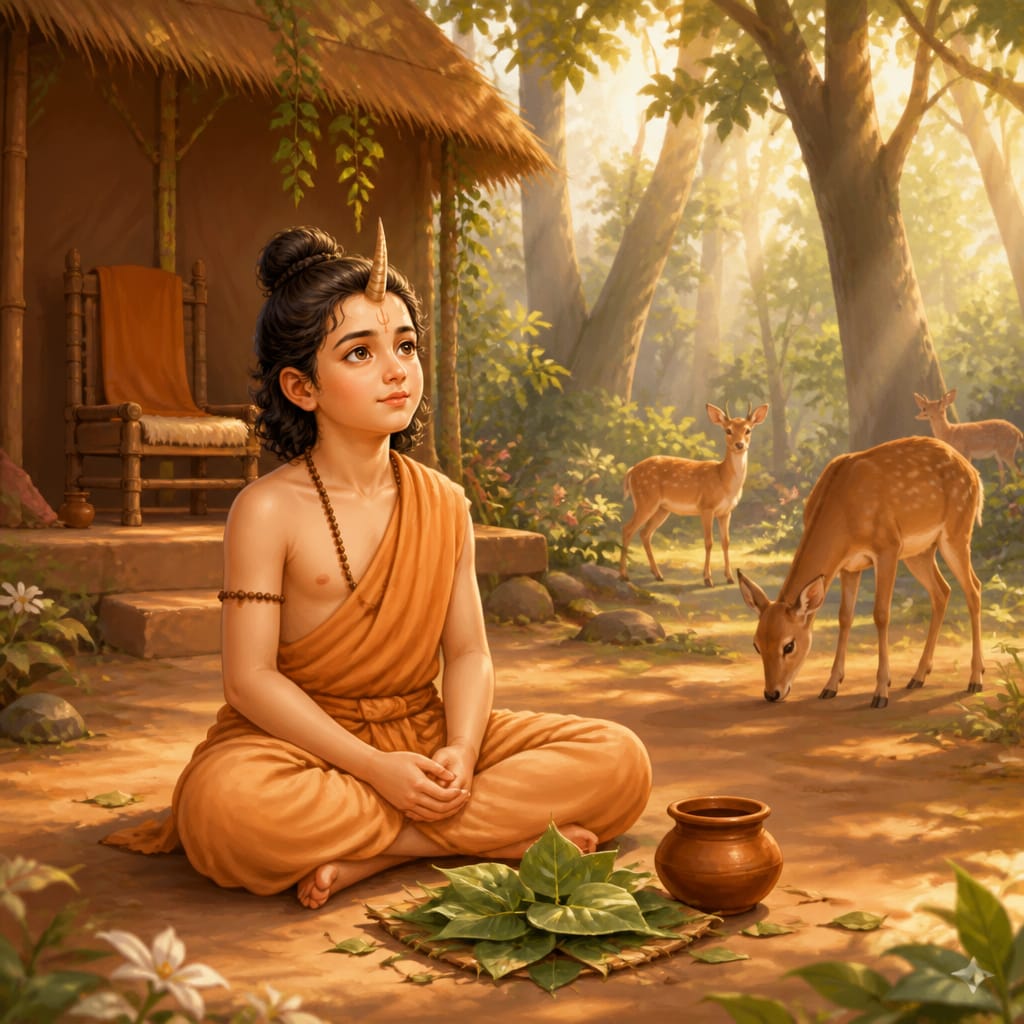
The baby was born with a single horn growing from his forehead, like that of a deer. Vibhandaka named him Rishyashringa - "deer-horned one" (rishya = deer, shringa = horn).
Ashamed of his moment of weakness and determined that his son would never fall prey to desire, Vibhandaka raised Rishyashringa in complete isolation. The boy:
- Never saw any human being except his father
- Never knew that women existed
- Spent his entire childhood in meditation and Vedic study
- Achieved extraordinary spiritual power through his pure tapas
The forest around their hermitage flourished. Animals lived without fear. Rain fell in perfect measure. Such was the power of Rishyashringa's innocence.
The Drought in Anga
Meanwhile, in the kingdom of Anga, ruled by King Romapada (also called Lomapada), a terrible drought had struck. For years, no rain fell. Crops withered, rivers dried up, and the people suffered immensely.
The king consulted his priests, who told him: "This drought is punishment for a sin. Only the presence of the pure sage Rishyashringa can bring rain to your land. But beware - his father Vibhandaka is fierce and will curse anyone who disturbs his son's purity."
The Courtesans' Mission
King Romapada devised a clever plan. He sent a group of beautiful courtesans into the forest, disguised with items that might intrigue a young man who knew nothing of the world.
These women approached Rishyashringa's hermitage when Vibhandaka was away. The young sage, seeing humans other than his father for the first time, was utterly bewildered.
"What manner of sages are you?" he asked innocently. "Your forms are so different from my father's. Your voices are so melodious. What is this sweet fragrance you carry?"
The women spoke kindly to him, offered him fruits and sweets he had never tasted, and showed him gentle affection. Rishyashringa, knowing nothing of worldly ways, thought these were simply new kinds of sages practicing a different form of tapas.
Enchanted by this new experience, Rishyashringa followed the women when they invited him to "their hermitage." The moment his foot touched the soil of Anga, rain began to fall.

The drought that had lasted years ended instantly. The people rejoiced. King Romapada, overwhelmed with gratitude, offered his adopted daughter Shanta in marriage to Rishyashringa.
Shanta, it turns out, was actually Dasharatha's daughter, given in adoption to the childless Romapada. Thus, through this marriage, Rishyashringa became connected to Ayodhya's royal family.
Vibhandaka's Wrath

When Vibhandaka discovered his son was gone, his rage was terrible. He set out to curse whoever had taken his boy. But as he approached Anga, he saw the flourishing fields, the happy people, and finally his son - content, married, and honored as a great sage.
Romapada, warned of the angry father's approach, had placed offerings and comforts along every road. By the time Vibhandaka reached the palace, his anger had cooled. Seeing his son happy and respected, he gave his blessing and returned to his hermitage.
The Invitation to Ayodhya
When Dasharatha learned all this, he personally traveled to Anga with rich gifts. He invited his daughter Shanta and son-in-law Rishyashringa to come to Ayodhya and perform the sacred Putrakameshti Yajna.
The deer-horned sage, whose purity could bring rain from cloudless skies, would now invoke the gods to grant sons to the childless king. The stage was set for the divine births that would change the world.
Key Takeaway
Rishyashringa's story teaches us that true spiritual power comes from purity of heart, not from mere knowledge or ritual. His innocence was not weakness but strength. Sometimes, the most powerful solutions come from the most unexpected sources - and what the world sees as naivety may actually be a window to the divine.
Living traditions
The Sringeri Peetham, tracing its sanctity to Rishyashringa, remains one of Hinduism's most influential institutions with educational programs, Sanskrit pathshalas, and charitable activities serving millions. The story of Rishyashringa's innocence being tested by courtesans is discussed in ethics courses exploring temptation and virtue. His legend of bringing rain through purity inspired the concept of individual merit affecting collective wellbeing.
- Parjanya Yajna (Rain Rituals): Vedic rituals invoking rain continue in India, echoing the tradition where Rishyashringa's presence brought rains to the drought-stricken kingdom of Anga
- Sringeri Sharada Peetham: One of the four mathas established by Adi Shankaracharya, built where Rishyashringa performed tapas. The name 'Sringeri' derives from 'Rishyashringa-giri'. Features the famous Sharadamba and Vidyashankara temples
- Rishyashringa Temple, Kigga: Temple dedicated to Rishyashringa at the exact spot where he is believed to have performed his penance. Houses an ancient idol and sacred grove
- Bhagandeshwara Temple: Ancient temple at the confluence of three rivers (Triveni Sangam), associated with Rishyashringa's father Vibhandaka. Pilgrims believe bathing here brings spiritual purity
- Shanta Devi Temple: Temple dedicated to Shanta, Rishyashringa's wife and Dasharatha's daughter. Local traditions hold that Rishyashringa lived here after leaving Ayodhya
Reflection
- Rishyashringa's presence alone was enough to bring rain. Have you experienced how the presence of a truly good person can positively affect their environment?
- Rishyashringa's isolation protected his purity but left him ignorant of the world. What are the benefits and risks of protecting children from worldly knowledge?
- The courtesans used deception to bring Rishyashringa to Anga, yet it resulted in great good - ending the drought and eventually leading to Rama's birth. Can deception ever be justified for a greater good?