Journey to the Forest
Divine Mantras & The Path into Darkness
Rama and Lakshmana begin their journey with Vishwamitra. The sage teaches them powerful mantras and tells the tale of the demoness Tataka.
Departure from Ayodhya
The two princes walked behind the sage Vishwamitra, leaving the comfortable world of palace and city far behind. With each step, the carefully tended gardens gave way to wild meadows, then to dense forest where sunlight barely pierced the canopy of ancient trees.
Vishwamitra walked with the easy stride of one who had traversed these forests for thousands of years. But his eyes remained alert, for he knew what dangers awaited. Before they entered the true wilderness, he had important gifts to bestow.
The Gift of Bala and Atibala
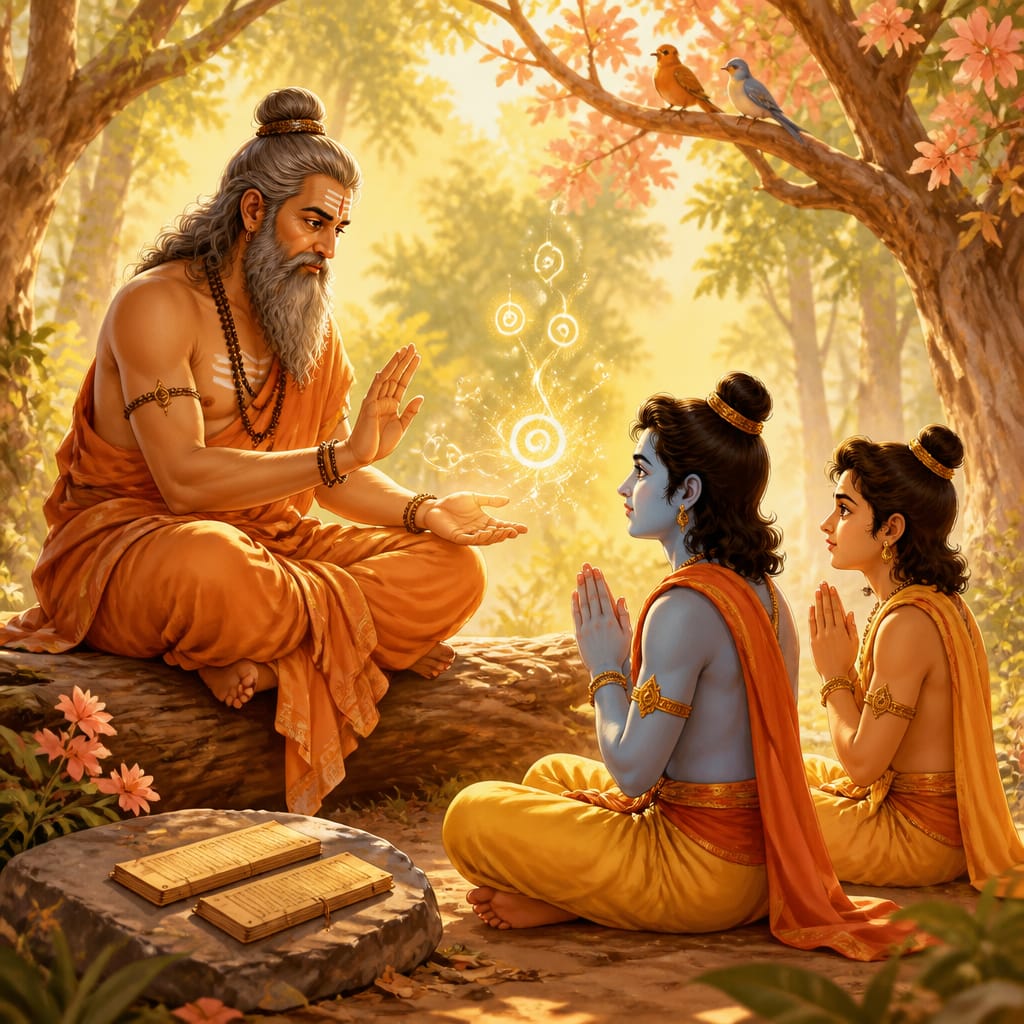
"Rama, Lakshmana," the sage commanded, "sit before me."
As the princes settled on the forest floor, Vishwamitra began to teach them two powerful vidyas - Bala and Atibala. These were not ordinary mantras but divine formulae that, once mastered, would make hunger and fatigue powerless against them. No exhaustion would touch them; no weariness would cloud their minds. They could march for days without food or rest, remaining as fresh as when they began.
"These vidyas are daughters of Brahma himself," Vishwamitra explained. "They will be your armor and your sustenance in the trials ahead."
The princes received these mantras with reverent attention, committing each sacred syllable to memory. Power flowed through them - a subtle energy that settled into their bodies like morning dew absorbed by the earth.
The Sacred Confluence
As they continued their journey, Vishwamitra began teaching them the lore of the land. They walked along the banks of the Sarayu River, then crossed the sacred sangam - the confluence where the Sarayu met the mighty Ganga. Each location had its story, and the sage was an endless repository of knowledge.
The sacred waters glimmered in the morning light. Rama and Lakshmana paused to offer prayers at this holy junction, where the spiritual power of two great rivers combined. Pilgrims from distant lands came here seeking purification - but the princes had no time for lengthy worship. Their mission lay ahead.
The Cursed Land of Tataka

"This place," Vishwamitra said, pointing to a desolate area where no birds sang, "was once a paradise called Malada and Karusha - two lands blessed by the gods. But look at it now."
The princes stared at the wasteland before them. Trees stood dead and blackened. No flowers bloomed. The very air felt heavy with dread. This had once been a flourishing kingdom, but now it was a place of death.
"What happened here, Gurudev?" Rama asked.
"Tataka happened," Vishwamitra replied grimly. "And her story is one you must know before you face her."
The Tragic Origin of Tataka
He told them of Tataka's origin: She was born a Yaksha woman of extraordinary beauty, given the strength of a thousand elephants by her father, the Yaksha chieftain Suketu. She married a nobleman named Sunda and bore him two sons, Maricha and Subahu.
When the sage Agastya killed her husband for his evil deeds, Tataka attacked the sage in her grief and rage. No one could assault a Brahmarishi and escape punishment.
Agastya, furious at this assault, cursed her:
"You shall become as hideous outside as you are within. Let your beauty become ugliness, your noble form become demonic."
The curse transformed her utterly. Where once stood a beautiful woman now crouched a monstrous demoness, thirty-six miles in height, with bloodshot eyes and a face that could freeze warriors in their tracks. Her sons, too, were cursed to become rakshasas. Driven mad by her transformation, Tataka made these lands her domain, devouring any who dared enter.
The Challenge
"This is her territory," Vishwamitra said quietly. "She knows we are here. She is watching."
As if in response to his words, a terrible roar shook the forest. Trees splintered and crashed. The ground trembled. Something massive was approaching.
Rama, without a trace of fear, raised his bow and called out:
"Reveal yourself, demon! I am Rama, son of Dasharatha. If you seek battle, come forth and face me!"
The challenge was answered by another earth-shaking roar, closer now. Through the destroyed trees, a monstrous form became visible - Tataka herself, her eyes blazing with the hunger of years.
Vishwamitra smiled. His instinct had been correct. This boy who looked so gentle, who spoke so softly, who had obeyed his father with such meekness - within him burned the fire of a warrior destined to change the world.
"Remember, Rama," the sage said calmly as the demoness charged, "dharma must be your guide. She was once a woman, but she is now a creature of evil who has devoured thousands. Do not let false compassion stay your hand. The protection of the innocent is the highest dharma."
Rama's arrow found his bowstring. The battle was about to begin.
Living traditions
The concept of forest-based spiritual education has inspired eco-ashrams and forest schools across India. The Tataka Vana region (near Buxar) is being studied for its archaeological significance. Modern adventure tourism often references the forest journeys of the Ramayana, with trekking routes designed along traditional pilgrimage paths. The protective mantras tradition influences stress-management practices, with institutions teaching mantra meditation for resilience.
- Protective Mantra Traditions: The practice of reciting protective mantras before journeys or challenging endeavors continues, inspired by Vishwamitra teaching Bala and Atibala to Rama
- Van Mahotsav (Forest Festival): Annual tree-planting initiative celebrating forests, which were considered sacred spaces for spiritual transformation in the Ramayana
- Kamadgiri Parikrama, Chitrakoot: Sacred hill circuit where Rama is believed to have stayed. The forest path (approximately 5 km) takes pilgrims through terrain similar to that traversed by Rama and Lakshmana with Vishwamitra
- Dandaka Forest Region (Dandakaranya): The vast forest region through which Rama traveled. Now includes wildlife sanctuaries that preserve some of the original forest character
- Rama's Journey Temples (Marg Sthals): Series of small temples marking points where Rama rested during his journeys. These include Nandgram, Bharatkund, and several forest shrines
Reflection
- Vishwamitra gave Rama powers (Bala and Atibala) before sending him into danger. In your life, who has equipped you with 'powers' - skills, knowledge, or wisdom - before you faced challenges? How did that preparation help you?
- Tataka was once a beautiful and powerful Yaksha woman who was cursed and became evil. Does knowing her tragic backstory change how you feel about what Rama must do? Can we feel compassion for someone while still recognizing they must be stopped?
- The conventional rule said 'don't kill women,' but the higher dharma said 'protect the innocent.' How do we know when to follow rules strictly versus when deeper principles should override them? What guidelines would you suggest?