The Breaking of the Bow
Shiva Dhanusha Bhanga
The climactic moment arrives as Rama steps forward to attempt the impossible test. What the mightiest warriors could not budge, Rama lifts effortlessly - and breaks. The sound echoes through the three worlds as destiny unfolds.
The day of the svayamvara had arrived. Kings and princes from every corner of Bharatavarsha filled King Janaka's magnificent assembly hall. They came from Kashi and Koshala, from Magadha and Matsya, from kingdoms near and far. Each believed himself worthy of Sita's hand. Each had heard of her beauty, her wisdom, her grace. None knew the true weight of what awaited them.
At the center of the hall, resting on an enormous wheeled platform, lay the Shiva Dhanusha - the bow of Lord Shiva himself. It had been gifted to Janaka's ancestors generations ago, a divine weapon so powerful that merely touching it without proper reverence could be fatal. The bow was black as a thundercloud, curved like a crescent moon, and emanated an aura that made even the bravest warriors feel small.
Vishwamitra sat among the honored sages, with Rama and Lakshmana beside him. The young princes had been given seats appropriate to their status - neither too prominent nor too humble. Rama watched the proceedings with calm interest, while Lakshmana's eyes constantly scanned the hall, ever vigilant for any threat to his brother.
The Failed Attempts
"Let the svayamvara begin," King Janaka announced, his voice carrying across the vast hall. "Whoever among you can lift, string, and draw this bow shall win my daughter Sita's hand in marriage."
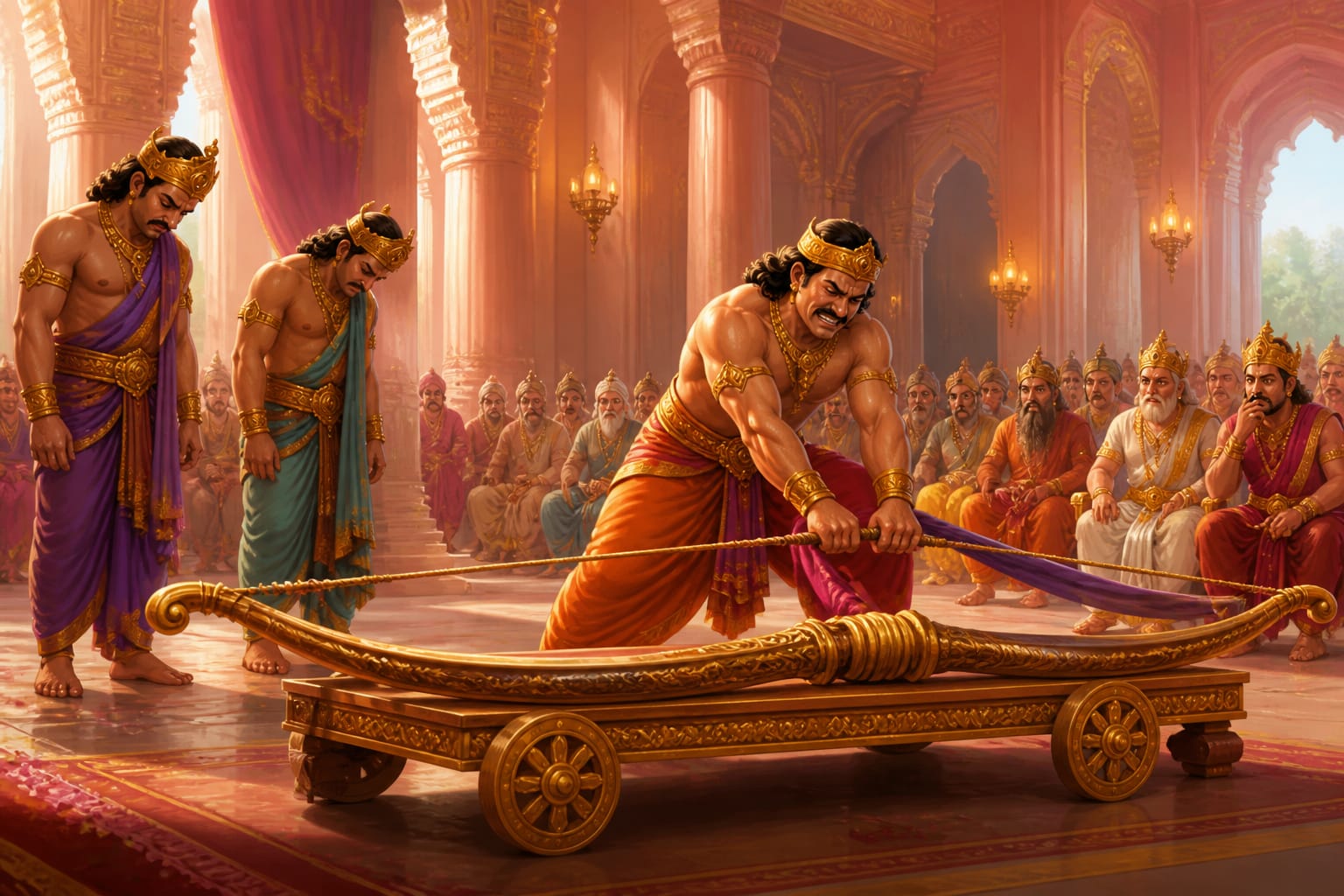
One by one, the mighty kings approached the bow. First came a warrior from the north, muscles bulging, confident in his strength. He gripped the bow with both hands, strained until veins stood out on his forehead - and could not move it even a hairbreadth. He retreated in shame.
Next came a prince renowned for conquering entire kingdoms. He tried a different approach, attempting to lever the bow up using technique rather than pure strength. The bow remained as if welded to its platform. More princes followed - tall ones, strong ones, clever ones. Some could barely touch it before being overwhelmed by its divine energy. Others managed to shift it slightly before failing.
Hours passed. Sweat and embarrassment filled the hall in equal measure. A murmur began among the spectators.
"Perhaps the test is impossible," one king muttered.
"Perhaps Janaka means to keep his daughter unwed forever," another agreed.
Janaka's Despair
King Janaka rose, his face troubled. "Is there no one? Is there no hero in all the world who can meet this challenge?" His voice carried not anger but genuine sorrow. "I set this test not to humiliate great warriors, but to find one worthy of my daughter - a daughter not born of any womb, but gifted to me by Mother Earth herself. Does she not deserve an extraordinary husband?"
The hall fell silent. The atmosphere grew heavy with disappointment and wounded pride.
Then Vishwamitra spoke: "King Janaka, there is one here who has not yet made the attempt. Young though he appears, he has already accomplished feats that would stagger the imagination. I request that Prince Rama of Ayodhya be permitted to try."
Murmurs rippled through the assembly. Some laughed - what could this slender youth accomplish where the mightiest warriors had failed? Others looked curious. Janaka remembered his earlier meeting with Rama, remembered the strange sense of recognition, remembered the prophecy.
"Let the prince come forward," Janaka said.
Rama's Approach
Rama rose and touched Vishwamitra's feet, receiving his blessing. Then, with measured steps, he walked toward the Shiva Dhanusha. He did not stride with arrogance nor shuffle with false humility. His gait was that of one walking toward his destiny with full awareness.
He circled the bow once, paying respect to it as one would honor a sacred object. Then he stood still, closed his eyes, and brought his palms together in prayer.
"O Mahadeva, Lord of the Cosmic Dance," Rama murmured, "this bow carries your essence. I seek not to conquer it but to serve through it. If it be dharma's will, grant me the strength to fulfill this task."
Sita watched from behind a screen, her heart beating rapidly. Since the garden encounter, she had thought of nothing else but the young prince from Ayodhya. Now, watching him pray before the bow rather than grabbing at it like others had done, she felt something click into place in her soul.
The Moment of Destiny
Rama opened his eyes. With his right hand, he reached down and gripped the bow at its center. Then, in one fluid motion - as naturally as lifting a flower garland - he raised the Shiva Dhanusha from its platform.
A collective gasp shook the hall. What five hundred men had strained to move, what the mightiest warriors could not budge, this young prince had lifted as if it weighed nothing.
But Rama did not pause to acknowledge the amazement around him. With the bow now vertical, he placed one end against his foot to brace it. Then, with both hands, he began to string the bow - bending its ancient, rigid shaft as one might bend a green bamboo.
The assembly held its breath. The bow, which had remained unchanged for generations, began to curve under Rama's hands. More than curve - it began to bend beyond the point any bow should bend.
The Thunder from Heaven
Then came the sound.
KRRRAAAKK!
The Shiva Dhanusha - indestructible, divine, ancient beyond memory - snapped in two.
The sound was like thunder. It echoed off the walls, rolled across the city, seemed to shake the very foundations of the earth. Birds for miles around took flight. Horses reared in their stables. In the distant Himalayas, Lord Shiva himself opened his eyes and smiled.
The bow had not merely been strung - it had broken under Rama's strength.
For a long moment, absolute silence filled the hall. Then King Janaka leapt from his throne, tears streaming down his face.
"Dharma triumphs! Dharma triumphs!" he cried. "At last, my daughter has found her match! A hero worthy of one born from the earth herself!"
Celestial Celebration

As the assembly erupted in cheers, something miraculous occurred. Flowers began to rain from the sky - not ordinary flowers, but celestial blossoms that carried divine fragrance. The pushpa vrishti, the flower-rain of the gods, fell upon the hall.
Gandharvas played celestial music. Apsaras danced in the heavens. The gods themselves had gathered to witness this moment, for they knew what the mortal kings did not - that this was not merely a prince winning a bride, but the reunion of Vishnu and Lakshmi, the divine couple who had descended to earth to accomplish cosmic purpose.
Sita emerged from behind the screen, carrying the jayamala - the victory garland. Her eyes found Rama's across the crowded hall, and in that gaze was everything: recognition, devotion, the memory of love that transcended time itself.
She walked toward him, and with trembling hands placed the garland around his neck. Rama bowed to accept it, and in that bow was the promise of a lifetime of protection, honor, and love.
"I am yours," Sita whispered, words meant only for him.
"And I am yours," Rama replied, "in this life and in all lives to come."

The Deeper Meaning
Vishwamitra later explained to his disciples what had truly occurred.
"The breaking of the bow was not mere physical strength," he said. "The Shiva Dhanusha cannot be broken by any force in the three worlds - not by all the gods combined. It yielded to Rama because it recognized its true master."
"But the bow was Shiva's," a disciple asked. "How could Rama be its master?"
Vishwamitra smiled. "All divine weapons ultimately belong to the Supreme. They recognize not the strongest arm, but the most righteous heart. The bow did not break - it surrendered. It transformed itself, completing its purpose by finding the one worthy to claim Sita."
He paused, gazing at Rama who stood speaking quietly with Janaka.
"What we witnessed today was not a contest of strength but a recognition of avatara. The divine, in human form, claiming his divine consort. This is the beginning of the purpose for which Rama was born. The bow-breaking is merely the first note of a symphony that will echo through all of time."
Living traditions
The image of Rama breaking the bow is one of the most recognizable scenes in Indian art, appearing on everything from ancient temple reliefs at Khajuraho and Hampi to modern calendar art and postage stamps. The phrase 'Shiva Dhanusha Bhanga' (breaking of Shiva's bow) has entered common parlance to describe any seemingly impossible feat accomplished with apparent ease. In classical dance forms like Kathakali and Bharatanatyam, the bow-breaking scene is performed with elaborate choreography contrasting the other kings' failed attempts with Rama's effortless success.
- Dhanusha Puja: The worship of bows and weapons during Vijayadashami (Dussehra) commemorates Rama's breaking of Shiva's bow and his martial prowess. Artisans, warriors, and those in professions requiring tools worship their instruments, invoking Rama's grace for skill and success.
- Svayamvara Traditions in Weddings: Many Hindu wedding traditions incorporate elements inspired by the Sita-Rama svayamvara, including the bride garlanding the groom (jayamala), tests of worthiness, and the groom's arrival with a ceremonial procession. These rituals connect modern weddings to the divine archetype.
- Dhanusha Dham: The site where tradition holds the broken pieces of Shiva's bow fell after Rama broke it. The area is named 'Dhanusha' (bow) after this event. A small temple marks the spot, and pilgrims visit to see where this world-changing moment occurred.
- Janaki Mandir Vivah Mandap: The ceremonial pavilion within the Janaki Mandir complex where the svayamvara and wedding are commemorated. Life-size images depict the moment Rama broke the bow and received the jayamala from Sita. During Vivah Panchami, elaborate reenactments occur here.
- Pinakini Temple Sites: Temples associated with the Pinaka (Shiva's bow) mark sites where parts of the bow are believed to have landed. These temples connect Shaiva and Vaishnava traditions, honoring both the bow's divine origin and Rama's transcendence of it.
Reflection
- Why do you think Rama prayed before attempting to lift the bow, when he had already demonstrated his prowess against Tataka and the demons?
- If the bow 'recognized' Rama and 'surrendered' to him, what does this teach us about the relationship between human effort and divine grace?
- The assembled kings were not weak - they were mighty warriors. Yet they could not even move the bow. What might this tell us about the difference between worldly power and spiritual worthiness?