The Birth of Poetry

From Sorrow Springs the World's First Verse

Witness the miraculous moment when grief transformed into art. As Valmiki watches a hunter's arrow strike down a krauncha bird, his anguish spontaneously flows out as the world's first shloka - the maa nishada verse - giving birth to poetry itself and the anushtubh meter that would carry the Ramayana.

The Morning Walk

After Narada's departure, Valmiki's mind was filled with the story of Rama. But he did not yet know how to express it. That revelation would come through an unexpected tragedy.

One morning, Valmiki walked to the banks of the Tamasa River with his disciple Bharadvaja to perform his daily ablutions. The forest was serene - birds sang, deer grazed peacefully, and the sacred river flowed gently.

As they walked through the lush forest, Valmiki noticed a pair of krauncha birds (Sarus cranes) - beautiful, elegant birds known for their lifelong devotion to their mates. The two birds were engaged in their courtship, lost in the joy of their union.

The Hunter's Arrow

Suddenly, a cruel hunter (nishada) appeared. Without warning, he released an arrow that struck the male krauncha bird. The bird fell to the ground, writhing in agony, its feathers stained with blood.

The female krauncha let out a heart-wrenching cry. She circled her fallen mate, calling out in anguish, unable to comprehend the sudden loss. Her mournful cries pierced the peaceful morning air.

Valmiki's Anguish

Witnessing this scene, Valmiki was overwhelmed with grief and compassion. The happiness of the birds had been so suddenly destroyed. The female's sorrow mirrored a universal pain - the pain of separation, of loss, of love cut short.

In that moment of intense emotion, something extraordinary happened. Words formed spontaneously on Valmiki's lips - not ordinary words, but words arranged in a perfect metrical pattern. The sage spoke the famous Maa Nishada verse - a curse upon the hunter that would echo through eternity:

"O hunter, may you never find peace for eternity, for you have killed one of this pair of krauncha birds, lost in the bliss of love."
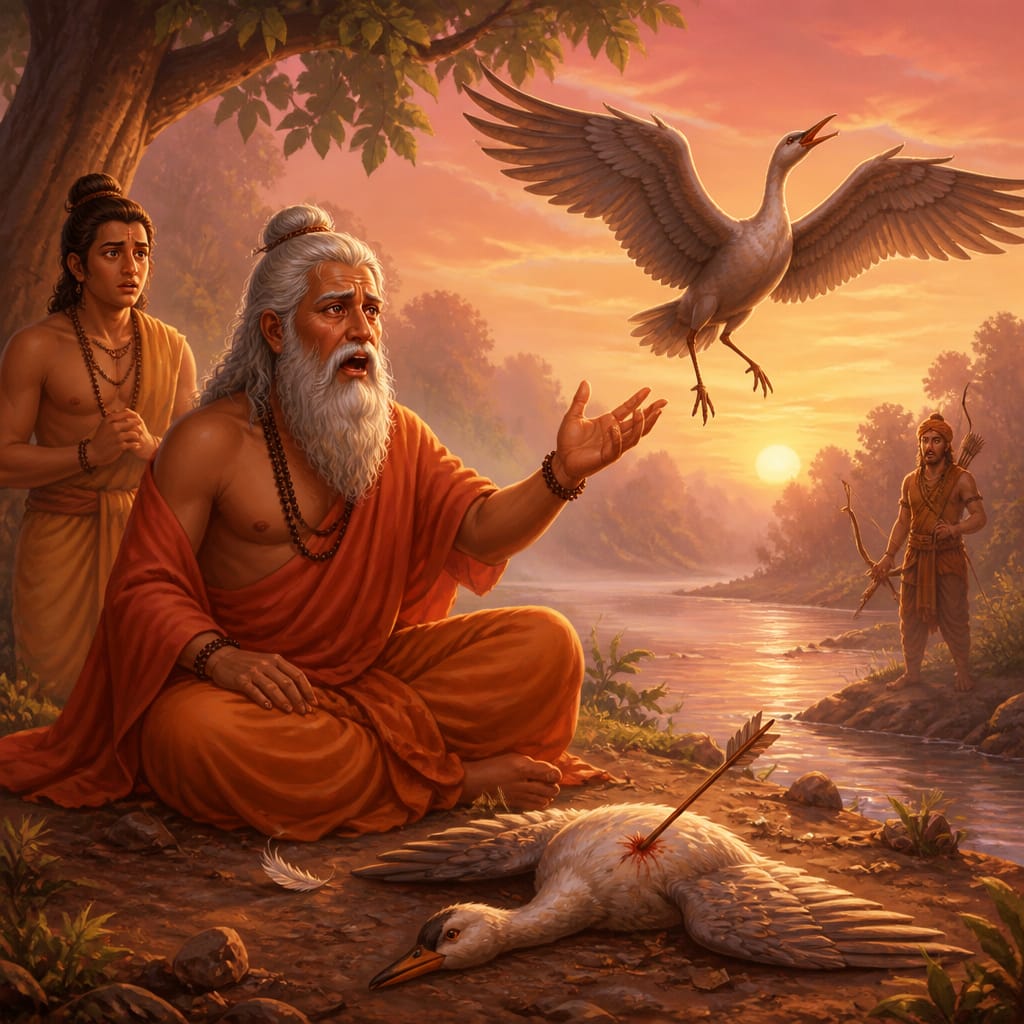
Valmiki at the Tamasa riverbank speaking the first shloka as a krauncha bird falls struck by the hunter's arrow, Bharadvaja beside him

The Birth of Shloka

Valmiki was himself astonished. What had he just spoken? He turned to Bharadvaja and said: "What emerged from me, arising from my grief (shoka), has become a shloka - a verse of measured syllables that can be sung."

This was the first shloka ever composed - the birth of Sanskrit poetry. The word "shloka" itself is derived from "shoka" (grief), indicating that poetry was born from the deepest human emotions.

The verse followed a specific meter of 32 syllables arranged in four quarters of 8 syllables each. This meter would later be known as Anushtubh, and it would become the dominant meter of the Ramayana and countless other Sanskrit texts.

Brahma's Blessing

Lord Brahma blessing Valmiki with divine sight at his ashram

Still wondering at what had occurred, Valmiki returned to his ashram. There, the creator god Brahma himself appeared before him.

Brahma smiled and said: "This shloka came from me through you. It is my will that you compose the entire story of Rama in this meter. Narada has told you the story in brief - now expand it with your poetic vision."

Brahma blessed Valmiki with divine sight, enabling him to see all the events of Rama's life as if he were present at each moment. "As long as mountains stand and rivers flow on earth, so long will the story of Ramayana spread throughout the world," Brahma declared.

The Poetic Vision Awakens

With Brahma's blessing, Valmiki sat in meditation. Before his inner eye, the entire life of Rama unfolded - every conversation, every emotion, every event - as clearly as if he were watching it happen.

Valmiki seeing Rama's life unfold in divine vision

He saw Rama's noble character, Sita's divine beauty, Lakshmana's unwavering loyalty, and all the other characters who would populate his epic. He saw their joys and sorrows, their triumphs and tribulations.

Thus began the composition of the Ramayana - not as a dry historical account, but as a work of art born from the deepest wells of human emotion. The sorrow of the krauncha bird had become the catalyst for humanity's first great poem.


Key Takeaway

The birth of poetry from grief teaches us that our deepest sorrows can become our greatest creative expressions. Art emerges not despite our pain, but because of it. The Ramayana, which would inspire billions, began with a single tear shed for a bird - reminding us that compassion for all beings is the foundation of true wisdom.

Living traditions

The krauncha story is cited in animal conservation discourse as evidence of ancient Indian reverence for wildlife. The Sarus Crane is now the official state bird of Uttar Pradesh, partly due to its association with this sacred narrative. Literary scholars worldwide study the 'Ma Nishada' shloka as an example of how profound emotion (shoka) transforms into aesthetic experience (shloka) - a concept central to Sanskrit literary theory called Rasa.

Reflection

More in Bala Kanda

All lessons in Bala Kanda ยท The Ramayana course