Slaying of Tataka

The First Battle & The Weight of Dharma

Rama faces his first demon - and his first moral crisis. Can he bring himself to kill a woman, even one who has become a monster? In this pivotal moment, dharma reveals its deeper truth.

The earth shook as Tataka charged through the forest, uprooting trees with each stride. Her roar was like thunder rolling across the mountains. Birds fled screaming into the sky; animals scattered in terror. The very air grew thick with her demonic presence.

Rama stood his ground.

At fifteen years old, he had never faced such a creature. The demoness towered above the tree line, her matted hair streaming behind her like storm clouds, her eyes burning with hatred accumulated over centuries. The stench of death preceded her - the smell of countless victims who had wandered into her domain.

"There she is," Vishwamitra said calmly, as if pointing out an unusual bird. "Tataka. Destroyer of these lands. Devourer of sages and travelers. Your task awaits, Rama."

But Rama hesitated.

The Moment of Doubt
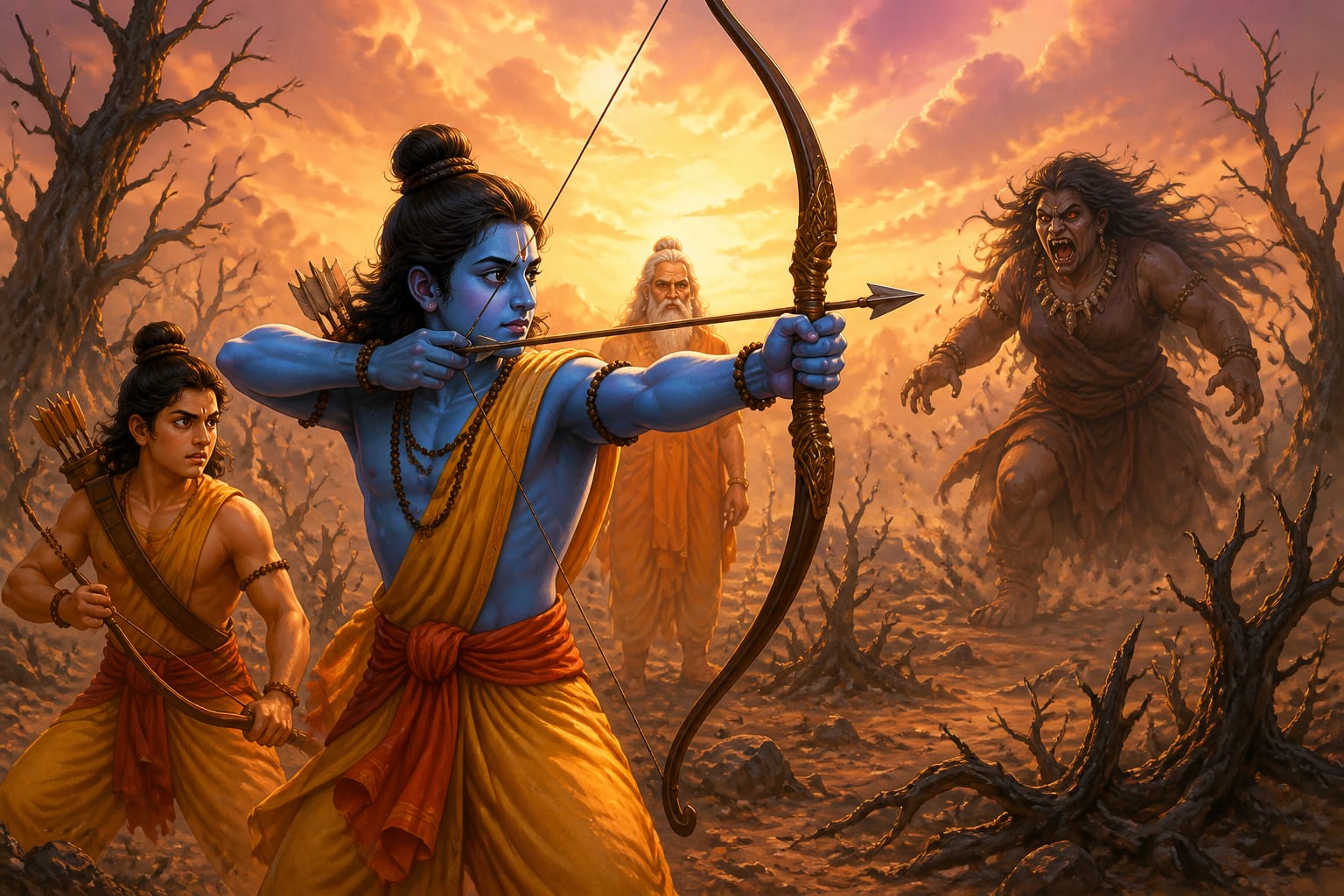
Rama hesitating with bow drawn before slaying Tataka

His bow was in his hand, an arrow nocked and ready. His aim was true - he could already see where the shaft would strike. But something held him back. A voice in his mind whispered the teachings he had learned since childhood:

A woman must never be harmed. Even in war, women are to be protected. This is eternal dharma.

"Gurudev," Rama spoke, his voice steady despite his inner turmoil, "she was once a woman. The scriptures teach that killing a woman is among the gravest sins. How can I, sworn to uphold dharma, commit such an act?"

Lakshmana, standing beside his brother, gripped his own bow tighter. He would follow Rama's lead, whatever that might be. But inwardly, he was ready to loose a hundred arrows at this monster who had caused so much suffering.

Vishwamitra smiled - not with mockery, but with the satisfaction of a teacher whose student has grasped the right question.

The Sage's Teaching

"Rama," Vishwamitra said, "you show wisdom in your hesitation. But let me show you deeper wisdom still."

He pointed to the desolate wasteland around them - the blackened trees, the poisoned soil, the silence where birds should sing.

"This was once Malada and Karusha - two prosperous regions blessed by the gods. See what they have become. And this destruction is but a fraction of Tataka's crimes. She has devoured thousands - men, women, children. She has prevented sages from performing sacred rituals. She has spread darkness wherever light tried to bloom."

Vishwamitra's voice grew more intense. "The dharma that protects women assumes they remain within the bounds of dharma. When a being - man or woman - becomes a weapon of mass destruction, a different dharma takes precedence: the protection of the innocent."

He continued: "There is a principle, Rama: Dharma rakshati rakshitah - Dharma protects those who protect dharma. But the corollary is equally true: those who fail to protect the innocent, citing lesser rules, become complicit in adharma."

"Think of a physician," the sage added. "Would a doctor refuse to amputate a gangrenous limb because cutting the body is normally harmful? Would that doctor let the patient die to preserve his own sense of purity? No - true compassion sometimes requires difficult action."

The Arrow Flies

Tataka was almost upon them now. Rama could see the individual hairs on her massive arms, the yellow teeth in her gaping mouth, the madness in her bloodshot eyes. She was screaming curses - promising to devour them slowly, to add their bones to the piles of her victims.

In that moment, something shifted within Rama.

He saw her not as a woman to be protected, but as she truly was: a force of destruction that had obliterated countless innocent lives. His hesitation transformed into clarity. The bow that had felt heavy now felt light in his hands.

Twang.

The first arrow struck Tataka in the shoulder - not to kill, but to warn. Perhaps some part of Rama still hoped she would flee, would choose life over violence.

She didn't. Roaring with greater fury, she charged again, now using her demonic powers to create clouds of darkness, to hurl boulders torn from the earth itself.

Twang. Twang.

Two more arrows flew, cutting off her hands as they reached for the princes. Still she came, using her massive body as a weapon, prepared to crush them beneath her bulk.

Rama took a breath. He thought of the thousands she had killed. He thought of the sages who could not perform their sacred duties. He thought of the travelers who had never reached their destinations, the families who had never known what happened to their loved ones.

With perfect focus, he released the final arrow.

It struck her heart.

Rama loosing the final arrow into Tataka's heart as the giant demoness falls before him, Lakshmana and Vishwamitra at his side

The Fall of a Demon

Tataka's death cry echoed across the forest, but it was not entirely a cry of pain. Those who listened carefully - as Vishwamitra did - heard something else in it. A note of release. Of liberation.

For Tataka had been trapped in her demonic form for centuries, cursed to exist as a monster, driven by appetites she could not control. In death, she was finally free.

As her massive body crashed to the earth, the sky itself seemed to brighten. The oppressive darkness that had shrouded these lands for so long began to lift. And from the heavens, a rain of flowers fell - the gods' acknowledgment that righteousness had prevailed.

"Sadhu! Sadhu!" the voices of celestial beings rang out. "Well done! Well done, Rama!"

Indra and the celestial host showering flowers in celebration

Indra, king of the gods, led the divine host in celebrating the young prince who had protected the world from a great evil. It was just the first of many such battles Rama would fight - but it was perhaps the most important, for it established who he truly was.

The Lesson Within

Vishwamitra placed his hand on Rama's shoulder. "You hesitated," he said. "That was good. A warrior who kills without thought is merely a butcher. You questioned, you struggled, you understood - and only then did you act."

"But Gurudev," Rama asked, "how will I know in the future when the higher dharma requires me to set aside a conventional rule?"

The sage nodded approvingly at the question. "Three tests, Rama. First: What outcome serves the greater good - not for yourself, but for all beings? Second: What would a wise and compassionate person, free from selfish motives, do in this situation? Third: Can you act with a clear conscience, without hatred or anger, but with surgical precision for the welfare of all?"

"You passed all three tests today. You did not kill Tataka from anger or fear. You killed her as a physician removes a disease - with regret for the necessity, but without hesitation in the execution."

Rama looked at the fallen demoness. "I will pray for her soul," he said quietly. "May she find peace in her next birth."

And this, Vishwamitra knew, was why Rama was different from other warriors. He could kill when necessary - but his heart remained pure, free from hatred even toward his enemies.

Living traditions

The Tataka episode is taught in business ethics courses as an example of situational leadership. The phrase 'killing one to save many' traces its Indian philosophical roots to this story. Modern feminist scholars discuss the episode in gender studies, analyzing how ancient texts handled the complexity of female antagonists. The concept of a being losing their 'nature' (swabhava) through cursed actions influences discussions of criminal rehabilitation.

Reflection

More in Bala Kanda

All lessons in Bala Kanda ยท The Ramayana course