Childhood in Ayodhya

Education, Brotherhood & Growing Up

The princes grow up under the guidance of Guru Vasishtha. Their education, brotherhood, and the special bond between Rama and Lakshmana.

Life in the Royal Palace

The palace of Ayodhya echoed with the laughter of four princes whose divine origins remained hidden even from themselves. Like lotus flowers that bloom in muddy ponds yet remain untouched by impurity, these royal children grew in worldly surroundings while retaining their celestial essence.

The royal nursery was a world of wonder. Golden toys crafted by the finest artisans lay scattered across marble floors. Murals depicting the glorious deeds of their ancestors - Raghu, Dilipa, Bhagiratha - adorned the walls, silently teaching the princes their heritage. The queens took turns caring for all four children equally, so that none would feel the difference of having different mothers.

Dasharatha, who had waited so long for sons, could hardly bear to be separated from them. He would often abandon court proceedings to watch them play, tears of joy streaming down his aged face. After all those years of emptiness, he would think, the gods have blessed me fourfold.

Under Guru Vasishtha's Guidance
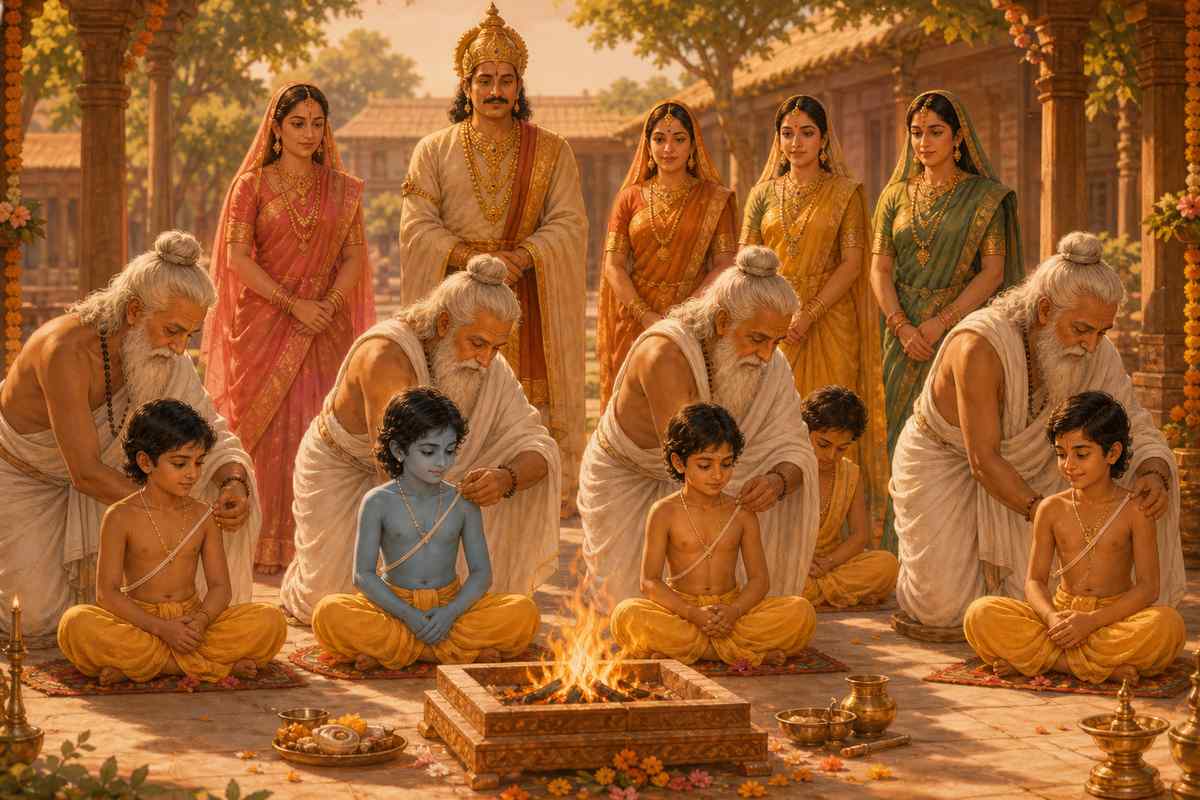
The four princes undergoing the Upanayana thread ceremony

When the princes reached the age of five, they underwent the sacred Upanayana ceremony - the thread ceremony that marked the beginning of formal education. With shaven heads and sacred threads across their chests, they entered the gurukula of the great Vasishtha.

The gurukula was not merely a school but a forge where raw potential was shaped into refined character. Here, princes sat on grass mats no different from those of the poorest student, for knowledge recognizes no distinctions of birth. They rose before dawn for prayers, gathered firewood for the sacred fires, and served their guru with complete devotion.

Vasishtha, whose wisdom spanned countless ages, recognized immediately that Rama was no ordinary student. What took others months to memorize, he grasped in days. Yet what distinguished him was not his brilliance but his humility - he served his guru with such devotion that Vasishtha often remarked he had never seen a student who combined supreme ability with such perfect obedience.

"This child," Vasishtha confided to his wife Arundhati, "is not learning dharma. He is dharma itself, remembering what it already knows."

The Sixty-Four Arts

Their education encompassed the Chatuhshashti Kala - the sixty-four arts and sciences that formed the complete education of a cultured person. These included:

Martial Arts: Archery, sword fighting, wrestling, chariot warfare, and the science of divine weapons. The princes trained under master warriors, their arrows singing through the air with deadly precision. Rama's skill with the bow became legendary - he could split a hair at a hundred paces.

Fine Arts: Music, dance, painting, sculpture, and poetry. Rama's voice, when he sang the Sama Veda, could bring tears to the eyes of the most hardened warriors.

Sciences: Mathematics, astronomy, medicine, and architecture. They learned to read the stars, predict eclipses, and understand the movements of planets.

Governance: Law, diplomacy, economics, and the art of just rule. Vasishtha taught them that a king's true wealth is not his treasury but the trust of his people, that power exists only to protect the powerless.

But beyond all skills, Vasishtha ensured they learned dharma - the subtle art of righteous living where every choice must balance duty to self, family, society, and the cosmic order.

The four princes seated under a banyan tree with palm-leaf manuscripts as Sage Vasishtha teaches them at the gurukula

The Bond of Brothers

Young Rama and Lakshmana practicing archery together

The four brothers formed two natural pairs - Rama and Lakshmana, Bharata and Shatrughna. But these were not mere friendships; they were bonds that transcended ordinary affection, connections that seemed to come from previous births.

Lakshmana's devotion to Rama became the stuff of legend even in their childhood. He refused to eat until Rama had eaten, would not sleep until Rama slept. If Rama ventured into the garden, Lakshmana was his shadow. When Rama fell ill with a fever, Lakshmana refused all food and sat vigil by his bedside for three days until the fever broke. This was not servitude but the deepest form of love.

Bharata and Shatrughna mirrored this bond in their own way. Shatrughna followed Bharata as faithfully as Lakshmana followed Rama. And Bharata, despite being Kaikeyi's son and theoretically a rival for succession, showed such deep reverence for Rama that the firstborn prince's will was his command.

The people of Ayodhya marveled at this harmony. In most royal families, princes schemed against each other for power. Here, four brothers competed only in love and service.

The Test of Character

As the princes grew from children into young men, Ayodhya witnessed their transformation with pride. Rama's fame spread beyond the kingdom - tales of his archery, his wisdom, his compassion reached distant lands. Yet he remained unchanged, still touching the feet of elders, still rising first for his duties, still treating servants with the same respect he showed nobles.

One day, Vasishtha decided to test them. He gathered the four princes and asked each what he desired most in life.

Bharata spoke first: "I wish to serve Rama forever."

Shatrughna followed: "I wish to serve Bharata, who serves Rama."

Lakshmana's answer was simple: "I wish never to be separated from Rama, not even for a moment."

And Rama? He was silent for a long moment, then spoke: "I wish only for the welfare of all beings and the strength to uphold dharma, whatever the cost."

The sage smiled, his ancient eyes glistening. These were not ordinary princes playing at nobility. These were future protectors of righteousness, and the world would soon witness their glory. The years of training were nearly complete. Soon, destiny would call - in the form of a fierce sage with a dangerous request.

Living traditions

The gurukul model has inspired modern residential schools in India, including the Rashtriya Sanskrit Sansthan network. The concept of '64 arts' (Chatuhshashti Kala) mentioned in the princes' education influences curricula at traditional schools. The Ram-Lakhan brotherhood ideal remains a cultural touchstone, referenced in films, literature, and family relationships. Universities like BHU and JNU have departments studying ancient pedagogical methods described in texts like the Ramayana.

Reflection

More in Bala Kanda

All lessons in Bala Kanda ยท The Ramayana course