Rajya Dharma: The Duties of Kings - Part 1

Bhishma teaches governance

From his bed of arrows, Bhishma begins teaching the science of kingship. What are the seven limbs of a state? How should a king choose his ministers? What principles should guide taxation? Through wisdom distilled from serving six kings, the grandsire reveals that ruling is not about power but about balance, and that the king who forgets his subjects' welfare has already lost his kingdom, even if he still sits on the throne.

The Science of Rule

"A kingdom," Bhishma said, adjusting himself as best he could on his bed of arrows, "is not simply a king sitting on a throne. It is an organism with seven limbs, and if any limb is diseased, the whole body suffers."

Yudhishthira leaned forward. This was what he had come to learn, not philosophy alone, but the practical craft of governance.

"What are these seven limbs, grandfather?"

"They are called the saptanga, the seven constituents of the state. Listen carefully, for you cannot rule what you do not understand."

The Saptanga: Seven Limbs of the State

Bhishma raised a finger for each element:

1. Svamin (The Sovereign), The king himself, the head that thinks and decides

2. Amatya (The Ministers), The advisors who counsel and administer

3. Janapada (The Territory and People), The land and the citizens who inhabit it

4. Durga (The Fort), The defenses that protect against invasion

5. Kosha (The Treasury), The wealth that funds all state functions

6. Danda (The Army/Force), The military power to enforce and defend

7. Mitra (The Allies), The friends and treaties that extend the kingdom's reach
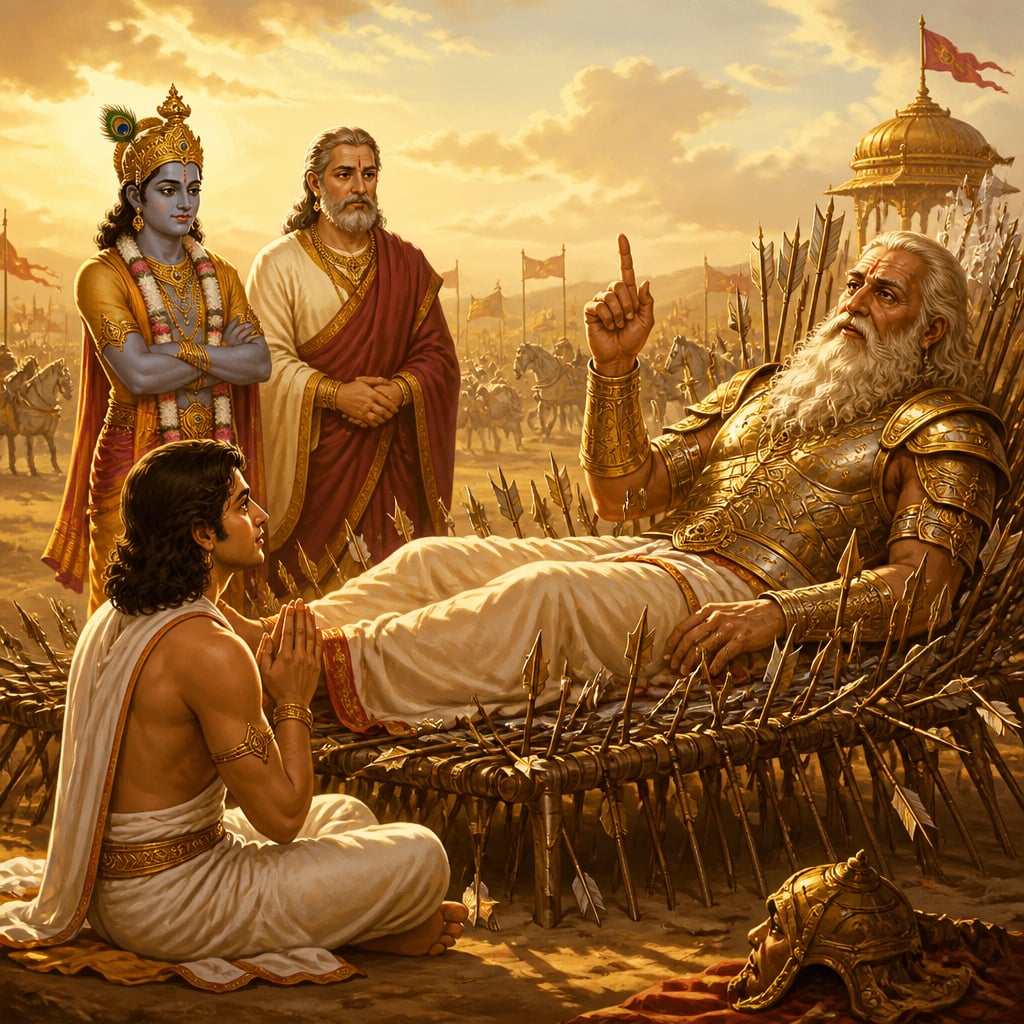
Bhishma raises one finger from his arrow-bed as he enumerates the seven limbs of the state to Yudhishthira.

Limb Function If Neglected
Svamin Decision-making Chaos and contradiction
Amatya Administration Corruption and inefficiency
Janapada Production and loyalty Rebellion and poverty
Durga Security Vulnerability to enemies
Kosha Resources Inability to act
Danda Enforcement Lawlessness
Mitra Extended strength Isolation and weakness

"Notice, Yudhishthira, the king is only one of seven. He may be the head, but a head without a body is nothing. The greatest error of bad kings is imagining that their will alone is sufficient. It is not. A kingdom functions only when all seven limbs work together."

The Selection of Ministers

"Let us begin with what you can most directly control: your ministers. You have already appointed some, Vidura, Sanjaya. But do you know how to choose wisely?"

"I chose those I trusted," Yudhishthira admitted.

"Trust is necessary but not sufficient. I have watched kings trust incompetent friends and distrust capable strangers. Both mistakes destroy kingdoms." Bhishma's voice grew more intense despite his pain.

"A minister should have four qualities:

Loyalty (Bhakti), He must be devoted to the king's welfare, not his own ambition

Ability (Shakti), He must possess the skills his role requires

Integrity (Shuddhi), He must be free from corruption, both financial and moral

Courage (Utsaha), He must be willing to speak truth even when the king does not want to hear it"

Bhishma paused meaningfully. "The last is most important, and most rare. Kings surround themselves with flatterers because flattery feels good. But the minister who only says 'yes' is worse than an enemy. Vidura told Dhritarashtra the truth for decades. Dhritarashtra ignored him. You see the result."

Yudhishthira nodded slowly. "I will listen when my ministers disagree with me."

"Easy to promise. Hard to practice. Every king believes he will welcome criticism, until criticism arrives."

The Story of the Uncritical Minister

"There was once a king," Bhishma continued, "who had a minister so loyal that he agreed with everything the king said. If the king said the moon was made of silver, the minister said, 'Yes, Maharaja, pure silver.' If the king said elephants could fly, the minister said, 'Indeed, they fly most gracefully.'

"The king loved this minister. He felt understood, supported, validated.

"One day, the king decided to invade a neighboring kingdom. The terrain was difficult, the enemy strong, the treasury low. Any fool could see the campaign was doomed. But when the king asked his minister, the loyal man said, 'A splendid idea, Maharaja. Victory is assured.'

"The campaign was a disaster. The army was destroyed. The king barely escaped with his life.

The fleeing king and his uncritical minister in the mountain pass

"As they fled through the mountains, the king turned to his minister: 'Why did you not warn me?'

"'You never asked me to warn you,' the minister replied. 'You asked me to agree with you.'"

Bhishma looked at Yudhishthira. "Do you understand?"

"I must ask for truth, not for agreement."

"More than ask. You must reward truth and punish flattery. If ministers learn that honesty brings punishment and flattery brings promotion, you will soon have only flatterers. And then you will make decisions in the dark, believing yourself in light."

The Mandala: Circles of Relationship

"Beyond your ministers, you must understand the mandala, the circles of relationship that surround every king."

Bhishma sketched an invisible diagram in the air:

"At the center is you. In the next circle are your ministers and family. Beyond that, your immediate allies. Beyond that, your enemies. Beyond that, your enemies' enemies, who may become your friends. And beyond that, still more circles extending to the edges of the world."

"The fundamental law of the mandala is this: your neighbor is often your enemy, and your neighbor's neighbor is often your friend."

"Why?" Yudhishthira asked.

"Because your neighbor and you compete for the same resources, the same influence, the same trade routes. But your neighbor's neighbor is your neighbor's rival, which makes him your potential ally. Duryodhana understood this instinctively; that is why he cultivated friends in distant kingdoms while fighting you, his closest kin."

The teaching was cold, strategic. Yudhishthira felt uncomfortable.

"But grandfather, should I view all neighbors as enemies? That seems contrary to dharma."

"Not enemies to be hated," Bhishma corrected. "Competitors to be watched. You can have peaceful, even friendly relations with neighbors, but never forget that their interests and yours may diverge. A king who trusts blindly dies blind."

The Art of Taxation

Krishna, who had been listening silently, spoke: "Tell him about taxation, Pitamaha. That is where kings most often fail."

Bhishma smiled grimly. "Ah, yes. The art of taking money from people who would rather keep it. This is where more kingdoms are lost than on any battlefield."

He gathered his thoughts.

A milkmaid milking her cow, the metaphor for just taxation

"Taxation, Yudhishthira, is like milking a cow. If you milk too much, you harm the cow and eventually get no milk at all. If you milk too little, the cow suffers from excess and you gain nothing. The art is to take exactly what can be taken without harm."

Bhishma's principles of taxation:

  1. Take only what people can afford to give, If they must choose between taxes and survival, they will choose survival, and you will get rebellion instead of revenue

  2. Take proportionally, The wealthy merchant can pay more than the poor farmer; the same rate applied to both is unjust

  3. Take predictably, Uncertainty is worse than high taxes; when people know what to expect, they can plan

  4. Take visibly, Show the people what their taxes build: roads, wells, temples, protection. Otherwise they see only loss, not exchange

  5. Never take from those who have nothing, The destitute pay no tax; they receive from the treasury, not give to it

"Duryodhana taxed heavily but spent on his own pleasures," Bhishma observed. "The people saw gold flowing into the palace and nothing coming out. They would not have fought for him; they only tolerated him because they feared his army. You must be different. Every tax must be earned by service returned."

The King's Day

"How should a king spend his time?" Yudhishthira asked. "I do not even know what a king does with his hours."

Bhishma described the traditional royal day:

Dawn (Brahma Muhurta):

Morning:

Midday:

Afternoon:

Evening:

Night:

"Notice," Bhishma said, "how little time is for the king's pleasure. A king who rules well has less freedom than a common laborer. The laborer works his hours and then rests; the king's work never ends. Even in sleep, he must be ready to wake. Even in recreation, he must watch for danger."

The Weight of the Crown

"This is what I wished you to understand, Yudhishthira." Bhishma's voice grew tired but remained intense. "When you asked to renounce the kingdom, you thought you were escaping burden. But now you see: kingship is burden. Every pleasure is poisoned by responsibility. Every moment of rest is stolen from duty. The throne is not a seat of power; it is a seat of endless obligation."

Yudhishthira felt the truth of this pressing down on him. The crown he had so reluctantly accepted grew heavier in his mind.

"Then why," he asked quietly, "should anyone want to be king?"

"Some want it for the power, they are fools who do not understand what power costs. Some want it for the glory, they are children who do not understand how quickly glory fades. The only worthy reason to be king is this: because someone must be, and you can be a good one."

Bhishma's eyes met Yudhishthira's.

"The kingdom needs a king. The people need protection. The dharma needs a champion. If you can fulfill these needs, your life has meaning. If you cannot, or will not, someone worse than you will take the throne and the people will suffer. That is why you must rule, not for yourself, but for them."

The First Day Ends

The sun was setting over Kurukshetra. Bhishma had been teaching for hours, each word extracted from a body that should have died weeks ago.

"We will continue tomorrow," he said. "There is much more: punishment, justice, war and peace, the duties of each varna, the king's relation to Brahmins and to gods. But you have absorbed enough for one day."

Yudhishthira prostrated again before rising.

"Grandfather, how can I thank you? Every word costs you pain, and still you speak."

"Thank me by ruling well." Bhishma's smile was faint but genuine. "Thank me by becoming the king I always hoped a son of this dynasty could become, just, wise, protective. If you do that, my suffering here is the best investment I ever made."

As the Pandavas withdrew to their camp, Yudhishthira walked in silence, his mind full of seven limbs and circles of friendship and the weight of a crown he was only beginning to understand.

The teaching would continue tomorrow.

Living traditions

The Shanti Parva's political teachings continue to influence Indian governance discourse. Public administration courses reference saptanga theory. Political scientists analyze mandala concepts in relation to South Asian geopolitics. Business schools use the amātya teachings to discuss organizational culture and truth-telling. When Indian leaders speak of 'sabka saath, sabka vikas' (together with all, development for all), they echo the praja-palana (protection of subjects) principle Bhishma emphasized. The ancient teachings remain alive in modern debates about what governance should be.

Reflection

More in Shanti Parva

All lessons in Shanti Parva · The Mahabharata course