Raja Dharma: The Reluctant King

Krishna convinces Yudhishthira

Krishna, Vyasa, Narada, and the great sages marshal their arguments against Yudhishthira's despair. Through stories of ancient kings, visions of a world without dharma, and the brutal truth of matsya nyaya, the law of the fish where the strong devour the weak, they challenge his desire to renounce. But convincing a man who has lost faith in himself requires more than logic.

The Gathering of Counselors

Word spread quickly through the remnants of both camps: the Pandava king refused his throne.

They came to Hastinapura like rivers flowing toward the sea, sages, ministers, warriors, survivors of the great carnage. Narada, the wandering celestial who traveled between worlds. Devasthana, priest of the Kuru house. Kanva and Dhaumya, who had guided the Pandavas through exile. Even Vidura, exhausted from years of being ignored, came to offer what wisdom he could.

And at the center of them all stood Krishna, still wearing the dust of Kurukshetra, his eyes holding a knowledge that seemed to span ages.
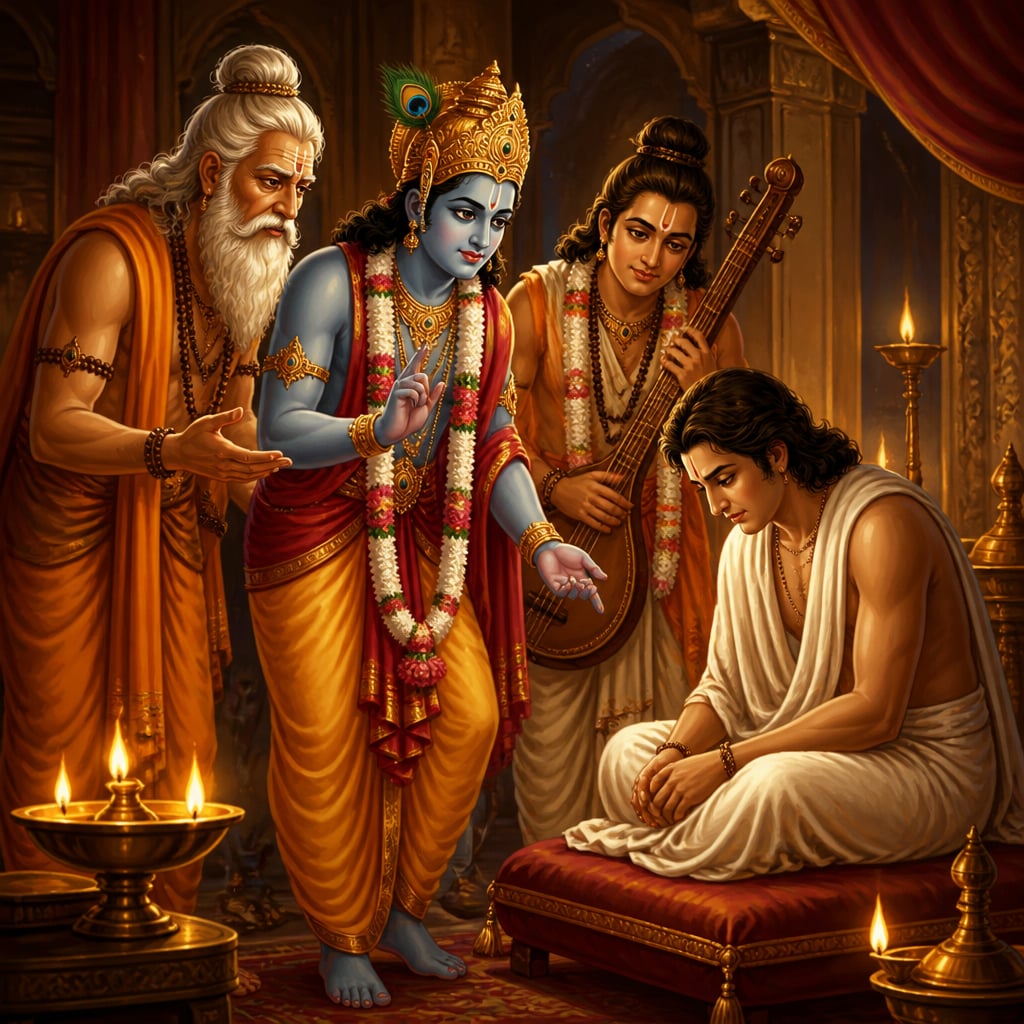
Krishna, Vyasa, and Narada stand in grave counsel before a hunched Yudhishthira in the dim palace chamber.

"He cannot do this," said Bhima, pacing the broken courtyard. "Seventeen years of exile. Eighteen days of slaughter. And now he wants to throw it all away?"

"Peace, Vrikodara," Krishna said gently. "Your brother is not mad. He is asking the question every warrior must eventually face: Was it worth it? Until he finds an answer, no crown will sit comfortably on his head."

Krishna's Opening Argument

Krishna found Yudhishthira where he had been for days, seated in a darkened chamber, facing a wall, speaking to no one.

"Dharmaraja," Krishna said, using the title deliberately. "Will you hear me?"

"I have heard enough, Keshava. I heard enough when you told me to speak the half-truth that killed Drona. I heard enough when you advised Bhima to strike Duryodhana's thighs."

"Yes," Krishna agreed. "I gave that counsel. And I would give it again."

Yudhishthira turned, his eyes blazing. "How can you say that? We violated the sacred rules of combat. We killed our teachers through deceit. And you would do it again?"

"Tell me, Yudhishthira, what was the alternative?"

Silence.

"Drona had sworn to capture you. His divine weapons were cutting through your army by the thousands. If he had taken you, the war would have ended with Duryodhana's victory. Was that dharmic? Would that have been just?"

"There must have been another way, "

"There was not." Krishna's voice was firm but not harsh. "And you know this. In war, choices are never between good and evil. They are between lesser evils. The question is not whether you sinned, you did. The question is whether your sin served dharma better than the alternative."

The Story of King Shibi

When argument alone could not move Yudhishthira, Narada the celestial sage stepped forward.

"Dharmaraja, will you hear an ancient tale?"

Yudhishthira nodded wearily. Stories, at least, required nothing of him.

"There was once a king named Shibi, renowned throughout the three worlds for his righteousness. The gods themselves decided to test him. Indra took the form of a hawk, and Agni took the form of a dove.

"The dove flew into Shibi's lap, trembling, begging for protection. 'Great king, the hawk pursues me! Save my life!'

"But the hawk landed on the palace steps and spoke: 'This dove is my lawful prey. I am hungry. My children are hungry. Will you deny me my food and let my family starve?'"

"Shibi faced an impossible choice: protect the refugee and starve the hunter, or surrender the innocent to death."

Narada paused. "What did the king do, Yudhishthira? What would you do?"

"I don't know," Yudhishthira admitted.

King Shibi cutting flesh from his thigh to save the dove

"Shibi offered the hawk his own flesh, cut from his thigh, weighed against the dove's body, to feed the hawk without sacrificing the innocent. He was prepared to carve away his entire body piece by piece."

"And then?"

"The gods revealed themselves. It was a test. But the lesson remains: a king who would rule others must be prepared to sacrifice himself for them. You want to flee to the forest, Yudhishthira. But that is not sacrifice, that is escape. Shibi did not run from his duty. He bled for it."

Matsya Nyaya: The Law of the Fish

Vyasa spoke next, his voice carrying the weight of ages.

"Do you know what happens when there is no king, Yudhishthira?"

"The people govern themselves."

"No." Vyasa's eyes were hard. "They devour each other. This is matsya nyaya, the law of the fish. The strong eat the weak. The powerful prey upon the helpless. Without a king to enforce dharma, there is only appetite."

He painted a picture that made Yudhishthira's blood run cold:

With a Dharmic King Without a King
Laws protect the weak Might makes right
Brahmins study, kshatriyas guard All become warriors or victims
Merchants trade fairly Robbery replaces commerce
Women and children are safe The vulnerable are prey
Dharma is upheld Chaos reigns

"You think your sins disqualify you from ruling," Vyasa continued. "But consider: who else will rule? Bhima, who drank Duhshasana's blood? Arjuna, who killed Karna when his chariot wheel was stuck? No one in this war has clean hands, Yudhishthira. The question is not who is pure. The question is who will try to build something better."

The Weight of the People

Draupadi had remained silent through the sages' arguments. Now she spoke.

"Husband, look outside."

Draupadi leading Yudhishthira to see the waiting people

She led Yudhishthira to the palace balcony. Below, in the ruined city, people were gathered, not warriors, but common folk. Merchants whose shops had been destroyed. Farmers whose fields had been trampled. Women carrying children, their husbands dead on Kurukshetra.

"They came for the coronation," Draupadi said. "They heard the king had returned. They have waited for days."

"For me?" Yudhishthira's voice was incredulous. "Why would they want me after what I've done?"

"Because you are all they have." Draupadi's voice was neither harsh nor gentle, simply true. "These people did not ask for war. They did not gamble their lives in a dice game. They only want to know: will there be law? Will there be protection? Will someone care whether they live or die?"

She turned to face him fully.

"You speak of your guilt, Yudhishthira. But guilt that serves only itself is self-indulgence. What will you do with your guilt? Will you carry it to the forest and sit with it while your people suffer? Or will you transform it into service, rule so well that the dead are honored by what you build?"

Krishna's Final Truth

When night fell, Krishna returned alone.

"I will tell you something I have told no one, Yudhishthira. Not even Arjuna."

Yudhishthira looked up.

"I am not untouched by what happened at Kurukshetra. I guided Arjuna's hand. I counseled strategies that bent the rules of war. I knew Abhimanyu would die in the Chakravyuha, and I let it happen because his death would force Arjuna to kill Jayadratha, which would break the Kaurava morale."

Yudhishthira stared. "You knew?"

"I saw many paths. I chose the path with the least suffering, not no suffering, but the least. Do you think that sits easily with me? Do you think I do not see Abhimanyu's face when I close my eyes?"

Krishna moved closer.

"The difference between us, Yudhishthira, is that I accept the weight. I do not run from it. I do not pretend I am pure, and I do not let guilt paralyze me into inaction. The world needs those who can act despite moral impurity, because waiting for purity means waiting forever."

The Crack in the Wall

For the first time in days, Yudhishthira did not reject what he heard. Something in Krishna's admission had touched him, not because it made his own sins smaller, but because it showed him a different way to carry them.

"If I become king," he said slowly, "what changes? I will still have killed my grandfather. I will still have lied to my teacher. The dead will still be dead."

"Yes," Krishna agreed. "But new lives will be protected. New justice will be administered. New dharma will be taught. You cannot undo the past, Yudhishthira. You can only build the future."

"And if I fail? If I rule badly? If the kingdom falls despite my efforts?"

"Then you will have failed while trying to do right. Is that not better than succeeding at running away?"

The question hung in the air.

Outside, the people still waited. The sages still prayed. The kingdom still needed its king.

And somewhere inside Yudhishthira, beneath the crushing weight of guilt, something began, very slowly, to shift.

The Night Before Dawn

Yudhishthira did not accept the throne that night. But he stopped refusing it.

"Let me think," he said to Krishna. "Let me speak to Bhishma."

"The grandsire lies on his bed of arrows, waiting for the sun to turn north. He will not die until he has passed on his wisdom. Go to him, Yudhishthira. Learn what he has to teach. Then decide."

It was not a victory for Krishna and the sages, not yet. But it was the first crack in Yudhishthira's wall of despair. He had asked to see Bhishma. He was thinking of the future.

For a man who had wanted only death, this was progress.

As dawn approached over Hastinapura, Yudhishthira stood on the balcony alone, watching the first light touch the ruined city. Below, a child was playing in the street, laughing, chasing something, alive.

The living, he thought. What do I owe the living?

The question would take more than a night to answer. But at last, he was asking it.

Living traditions

The arguments made to Yudhishthira, especially about the dangers of abandoning responsibility, resonate strongly in modern discourse on leadership and mental health. Executive coaches cite the concept of transforming guilt into service. Therapists working with survivors' guilt reference the sages' teaching that withdrawal is not healing. The Shanti Parva's approach, taking guilt seriously while refusing to let it become paralysis, anticipates modern approaches to moral injury treatment that emphasize meaningful action over mere processing of feelings.

Reflection

More in Shanti Parva

All lessons in Shanti Parva · The Mahabharata course