Apad Dharma: Ethics in Crisis
Dharma when rules break down
Bhishma teaches Yudhishthira the revolutionary doctrine of apad dharma - emergency ethics that apply when normal circumstances collapse. Through powerful stories of sages, kings, and ordinary people facing impossible choices, the grandsire explores what dharma permits when survival itself is at stake.
When Normal Rules Fail
Yudhishthira had absorbed Bhishma's teachings on governance, justice, and the duties of kings. But a deeper question troubled him.
"Grandfather, you have taught me the rules of dharma - how to govern, when to punish, how to maintain order. But what happens when the world itself breaks down? In famine, in invasion, in desperate circumstances - do the same rules apply?"
Bhishma's eyes grew thoughtful. "Now you ask about apad dharma - the dharma of emergency, the ethics of crisis. This is perhaps the most difficult teaching of all, for it acknowledges that sometimes, following ordinary dharma perfectly would lead to disaster."
The Hierarchy of Values
"First understand this," Bhishma said. "Dharma is not a single rule but a hierarchy of values. In ordinary times, we can honor all of them. In crisis, we must choose which to preserve.
The hierarchy, from highest to lowest:
- Preservation of life - especially of the virtuous and the helpless
- Protection of family - continuation of lineage and care for dependents
- Maintenance of social order - stability of the community
- Observance of ritual purity - ceremonial duties and prohibitions
- Following one's occupational duties - work appropriate to one's station
In normal times, a person can honor all five. In crisis, the higher values may require temporarily abandoning the lower."
The Story of Vishvamitra and the Chandala
Bhishma told one of the most famous stories in all of dharma literature:
"There was once a terrible famine that lasted twelve years. Rivers dried up. Crops failed. People perished by the thousands. Even the great sage Vishvamitra wandered the land, starving.
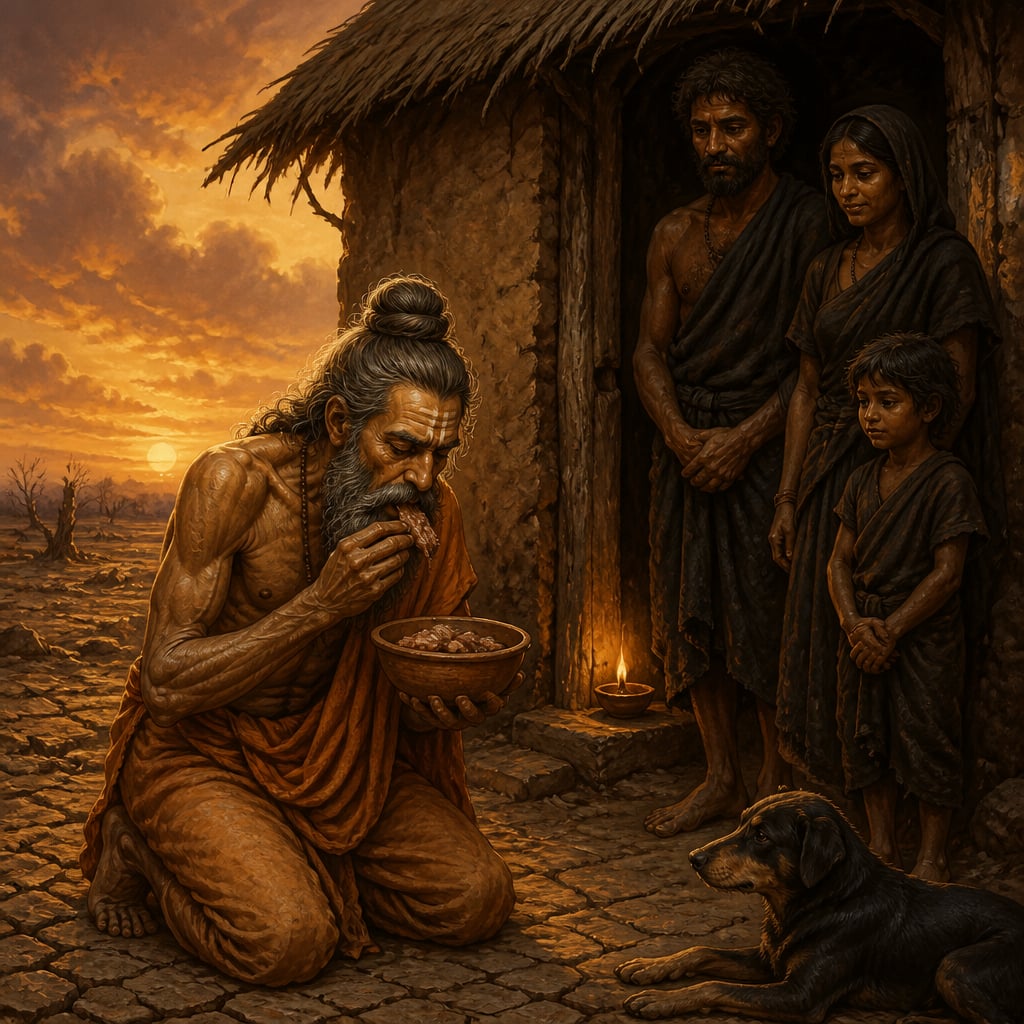
One day, near death from hunger, Vishvamitra came upon a chandala's hut. The chandala - a person of the lowest caste, an outcaste - had some dog meat hanging in his home.
Now, for a brahmin sage to eat meat was forbidden. To eat dog meat was abhorrent. To take food from a chandala was pollution itself.
But Vishvamitra thought: 'If I die, the knowledge I carry dies with me. My disciples will have no teacher. The Vedas I have memorized will be lost. Is my ritual purity more important than all of this?'
He ate the chandala's dog meat.
When the famine ended, Vishvamitra performed proper purification. But he never apologized for his choice. He had preserved what was most precious - life and knowledge - by temporarily abandoning what was less essential."
Yudhishthira was shaken. "A brahmin eating dog meat from a chandala's hands?"
"In extremity," Bhishma replied, "the preservation of life supersedes all ritual considerations. The sage who dies for the sake of purity abandons the higher dharma of preserving knowledge and life."
The Three Levels of Crisis
Bhishma explained that apad dharma operates at different levels:
| Crisis Level | Conditions | Permitted Actions |
|---|---|---|
| Mild | Temporary difficulty | Postpone rituals, borrow money, reduce donations |
| Moderate | Extended hardship | Take up another occupation, eat forbidden foods, accept help from lower castes |
| Severe | Survival at stake | Almost anything that preserves life without harming innocents |
"The key," Bhishma emphasized, "is proportionality. You do not invoke severe emergency rules for mild difficulties. And you return to normal dharma the moment the crisis passes."
The Brahmin Who Could Not Lie
Bhishma told another story, this one a warning:
"There was a brahmin named Kaushika who took a vow never to speak untruth. He considered this the highest dharma and kept it absolutely.

One day, Kaushika sat at a crossroads when a group of terrified travelers ran past him, fleeing into the forest. Moments later, a band of murderous robbers appeared.
'Brahmin!' the robbers demanded. 'Did you see people pass this way? Where did they go?'
Kaushika thought: 'I cannot lie. Truth is my dharma.' And he pointed to the forest where the innocent travelers hid.
The robbers found and killed them all.
Kaushika had kept his vow. But the scriptures say he earned great sin, for he had placed his personal commitment to truthfulness above the lives of innocent people. His 'truth' was actually a lie against dharma itself."
The letter of dharma must sometimes yield to its spirit. Truth that causes the death of innocents is not dharma but its opposite.
When Occupations May Change
Yudhishthira asked, "What of a person's livelihood? If a brahmin cannot earn through teaching, can he become a warrior? If a kshatriya loses his kingdom, can he become a merchant?"
Bhishma nodded. "In times of distress, one may take up the occupation of a lower varna to survive. A brahmin may fight or trade. A kshatriya may farm or do business. This is permitted when:
- Legitimate livelihood becomes impossible
- Family members face starvation
- No other option exists
But there are rules even here:
- Never adopt the occupation of the varna just below yours (it creates confusion)
- Never cause harm to innocents through your emergency occupation
- Return to your proper duty when the crisis ends
- Perform purification after the emergency passes
The Pandavas themselves lived this during their exile - princes serving as servants, the mighty Bhima working as a cook."
The Story of the King and the Famine
Bhishma told of an ancient king:
"King Saudasa ruled during a terrible drought. His treasury emptied. His granaries stood bare. His people began to die.
His minister said: 'Let the weak perish. We must preserve the strong - the warriors, the priests, the nobles - who can rebuild when the rains return.'
But Saudasa replied: 'What kind of kingdom preserves only the powerful? The weak are my children as much as the strong. I will share equally what little remains.'

He opened the royal granaries and distributed the last grain equally - to brahmin and chandala, to warrior and farmer, to noble and beggar alike.
When some nobles protested, Saudasa said: 'In ordinary times, hierarchy has its place. In crisis, we are all simply humans struggling to survive. The dharma of emergency is the dharma of our common humanity.'
The famine passed. And Saudasa's kingdom recovered faster than any other, because he had preserved his people - all of them - rather than sacrificing the many for the few."
What Even Crisis Does Not Permit
Bhishma was careful to set limits:
"Apad dharma does not mean 'anything goes.' Even in the severest emergency, certain actions remain forbidden:
- Harming innocents - You may steal to survive, but not murder for convenience
- Betraying those who trust you - A teacher may not sacrifice students to save himself
- Abandoning the helpless - Parents may not abandon children, though all face death
- Destroying the future - You may not poison wells or burn forests that future generations need
The purpose of emergency ethics is to preserve life so that dharma can be fully practiced again. Actions that make future dharma impossible defeat the purpose entirely."
Returning to Normal Dharma
Bhishma concluded with crucial guidance:
"When the crisis ends, ordinary dharma must resume immediately. The person who ate forbidden food must purify themselves. The brahmin who fought must return to teaching. The king who suspended normal law must restore it.
The danger of apad dharma is that some grow comfortable with emergency exceptions. They find reasons to extend the crisis, to keep the relaxed rules in place. This is a corruption of the teaching.
Emergency ethics exist to bridge impossible moments, not to become permanent policy. The sign of wisdom is knowing both when to invoke them and when to set them aside."
Yudhishthira reflected on the war just ended. How many impossible choices had been made? How many rules of combat broken? Perhaps the entire conflict had been one long apad dharma - and now it was time to return to the dharma of peace.
The Compassion Behind the Rules
Bhishma's final words on apad dharma revealed its deeper purpose:
"Some think these emergency provisions show that dharma is arbitrary - that the rules can be broken when convenient. They misunderstand completely.
Apad dharma exists because the purpose of all dharma is the welfare of beings. When following ordinary rules would cause greater harm than breaking them, the rules themselves demand flexibility.
A parent who lets a child die rather than steal medicine has not upheld dharma - they have betrayed its very essence. The essence is compassion, protection, the flourishing of life. The rules are means to that end, not ends in themselves.
Remember this, Yudhishthira: dharma is not a rigid code but a living wisdom. It bends without breaking, adapts without abandoning its core. This flexibility is not weakness but the supreme strength of dharma itself."
Living traditions
The principles of apad dharma remain urgently relevant. The COVID-19 pandemic forced societies worldwide to confront ancient questions: When do emergency powers end? Who decides when normal rules resume? How do we balance individual rights against collective survival? Legal systems recognize 'necessity defenses' for actions taken under duress - modern codifications of what Bhishma taught. Hindu scholars cite the Vishvamitra story in bioethics discussions about extreme measures. The teaching that dharma's purpose (welfare of beings) takes precedence over its letter (specific rules) informs contemporary debates about when rigid adherence to principle causes more harm than good.
- Emergency Medical Ethics: Modern hospital ethics committees regularly invoke principles similar to apad dharma when making triage decisions. The question 'what is normally forbidden but permitted in emergency?' arises in medical contexts constantly - from resource allocation during pandemics to decisions about treatment for patients who cannot consent.
- Vishvamitra Ashram, Buxar: Traditional site of Vishvamitra's ashram where, according to legend, he performed austerities and taught students including Rama and Lakshmana. The sage whose emergency ethics are praised in the Shanti Parva is honored here for his transformation and wisdom.
- Dharmasthala Temple, Karnataka: A unique temple where the management is Jain but the deity is Hindu, embodying the principle that dharma transcends rigid categories. The temple's legendary commitment to feeding all visitors regardless of caste reflects the Shanti Parva's teaching that common humanity supersedes ritual distinctions in times of need.
Reflection
- Vishvamitra ate forbidden food to survive a famine. Kaushika told the truth and caused innocent deaths. Both followed their understanding of dharma - yet one is praised and one criticized. Have you ever faced a situation where following a rule literally would have caused more harm than breaking it?
- Bhishma says certain things remain forbidden even in emergency - harming innocents, betraying trust, abandoning the helpless. When you think about your own moral limits, are there lines you believe you would never cross regardless of circumstances? How do you know?
- King Saudasa distributed grain equally in famine rather than prioritizing the powerful. Some would call this wise leadership; others might call it sentimental weakness that ignores who is most valuable to the kingdom's survival. Which view do you find more compelling, and why?