Moksha Dharma: The Path to Liberation - Part 1
Liberation through knowledge
Bhishma transitions from worldly governance to the deepest questions of existence. He explains the nature of the soul, the three gunas that bind consciousness to matter, and how karma chains beings to the cycle of rebirth. Through stories and philosophical teachings, the grandsire begins illuminating the path to moksha - liberation from suffering.
Beyond Worldly Dharma
Yudhishthira had listened to Bhishma's teachings on governance, justice, and crisis ethics. But a deeper restlessness stirred within him.
"Grandfather, you have taught me how to rule a kingdom. But I still ask myself - what is the point? We fought a terrible war to win this kingdom, and soon enough I too will die. My descendants will rule, and then they will die. What is the purpose of all this activity?"
Bhishma's eyes brightened. "Now, Dharmaraja, you ask the question that matters most. You are ready for moksha dharma - the teachings on liberation. For what use is ruling a kingdom well if the ruler remains trapped in the cycle of birth and death?"
The Chain of Existence
"First understand," Bhishma said, "what binds us to this world. Every being is an atman - an eternal soul - that has become entangled with matter. Like a bird caught in a net, the soul struggles but cannot free itself.
This entanglement creates the cycle of samsara:
- The soul takes birth in a body
- Through that body, it acts - for good or ill
- Those actions create karma - consequences that must be experienced
- When the body dies, the soul carries its karma to a new birth
- The cycle continues endlessly
A king may be reborn as a servant. A servant may be reborn as a king. A human may be reborn as an animal. Round and round the wheel turns."
The soul is neither born nor does it die. It is eternal, unchanging. Only the bodies change, like garments that are worn and discarded.
The Three Gunas
Bhishma explained the forces that bind souls to matter:
"All of material nature is composed of three qualities - the gunas:
| Guna | Quality | Manifestation |
|---|---|---|
| Sattva | Purity, light | Knowledge, peace, clarity, virtue |
| Rajas | Passion, activity | Ambition, desire, restlessness, attachment |
| Tamas | Darkness, inertia | Ignorance, laziness, delusion, confusion |
Every person has all three gunas, but in different proportions. The guna that dominates determines our character:
- A sattvic person seeks knowledge and righteousness
- A rajasic person seeks power, pleasure, and achievement
- A tamasic person is ruled by sloth and confusion
The gunas bind us because we identify with them. We think 'I am wise' or 'I am ambitious' or 'I am tired.' But the true Self is beyond all gunas."
The Story of the Two Birds
Bhishma told an ancient parable:
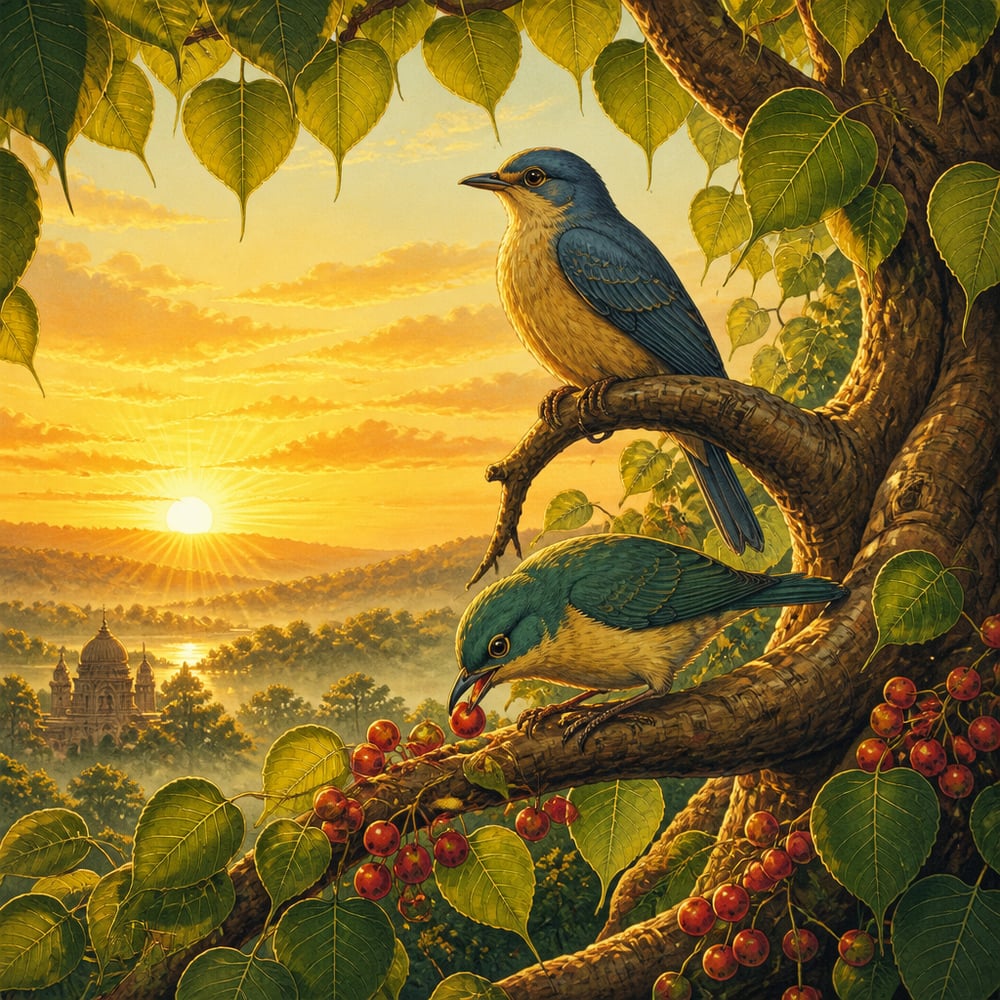
"On a peepul tree sat two beautiful birds. They looked identical - same plumage, same size, same form.
One bird was busy eating the fruits of the tree. Some fruits were sweet, and the bird was happy. Some fruits were bitter, and the bird suffered. Up and down it went, chasing sweet fruits, fleeing bitter ones, never at rest.
The other bird sat calmly, watching. It ate nothing. It desired nothing. It simply observed its companion's endless activity with serene compassion.
Yudhishthira, these two birds represent the two aspects of every being:
- The eating bird is the jiva - the embodied soul caught up in experience, pleasure, and pain
- The watching bird is the atman - the true Self that merely witnesses, untouched by any experience
The tragedy is that the jiva has forgotten the atman. It thinks it IS the eater, the sufferer, the enjoyer. It doesn't realize that its true nature is the peaceful witness who was never bound at all.
Liberation happens when the eating bird turns and recognizes the watching bird as its own true self."
How Karma Binds
Yudhishthira asked, "How exactly does karma chain us to rebirth?"
Bhishma explained: "Karma is not merely action - it is action with attachment to results.
When you act with desire - 'I want this outcome' - you create a debt that must be paid. If you seek pleasure, you must experience pleasure and then lose it. If you cause suffering, you must experience suffering in return.
This is why even good karma binds. The king who rules justly hoping for heaven must go to heaven - but then must return when that merit is exhausted. The chain continues.
The only action that does not bind is nishkama karma - action without desire for fruits:
- The farmer who farms because farming is his duty, not because he craves wealth
- The warrior who fights because protection is his dharma, not because he desires victory
- The teacher who teaches for the sake of knowledge, not for fame or payment
Such action purifies rather than binds. It exhausts old karma without creating new chains."
The Parable of the Chariot
Bhishma used another ancient image:

"Imagine a chariot racing along a dangerous road:
- The chariot is the body
- The horses are the senses
- The reins are the mind
- The charioteer is the intellect (buddhi)
- The passenger is the atman - the true Self
In most people, the horses run wild. The senses drag the chariot wherever they wish - toward pleasure, away from pain, into danger. The reins are loose. The charioteer is asleep.
The wise person awakens the charioteer. The intellect takes firm hold of the mind. The mind controls the senses. The chariot moves purposefully toward its destination.
But even this is not the highest state. In liberation, the passenger realizes he was never in the chariot at all. The atman merely watched the whole journey - never moving, never endangered, eternally free."
The Three Paths
Bhishma taught that liberation could be approached in different ways:
Karma Yoga - The Path of Action
"For those of active temperament, the path is nishkama karma - selfless action. Work diligently in the world, but dedicate all results to the divine. Let go of attachment to outcomes. Gradually, the doer dissolves and only action remains."
Jnana Yoga - The Path of Knowledge
"For those of contemplative temperament, the path is discrimination - constantly asking 'Who am I?' Not the body, for it changes. Not the mind, for thoughts come and go. Not the ego, for that is merely a collection of identifications. What remains when all that is 'not-Self' is removed? That remaining awareness is the atman."
Bhakti Yoga - The Path of Devotion
"For those of emotional temperament, the path is love of the divine. Surrender completely to Ishvara - the Supreme. Let every thought, every action, every breath be an offering. In total devotion, the ego dissolves into the beloved, and liberation dawns."
"These three paths are not separate," Bhishma said. "They interweave like threads in a rope. The karma yogi develops devotion. The jnana yogi acts selflessly. The bhakta gains knowledge through love. All paths lead to the same destination."
The Story of King Janaka
Bhishma told of a king who achieved liberation while ruling:
"King Janaka of Videha was a householder, a ruler, a man of the world. Yet the sages called him a jivanmukta - one liberated while still living.
How was this possible?
Janaka once explained: 'I rule this kingdom as an actor plays a role. I make decisions, I wage wars, I celebrate festivals - but I never forget that I am not the role. The actor remains unchanged whether he plays a king or a beggar. So I remain unchanged whether ruling or sleeping, winning or losing.'

'My kingdom is burning!' his attendants cried one day, testing him. 'The city is on fire!'
Janaka replied calmly: 'Nothing of mine is burning. The body is not mine. The kingdom is not mine. Only the Self is mine, and the Self cannot burn.'
When they revealed it was a test, Janaka smiled. 'I knew it was false. But had it been true, my response would be the same. This is the fruit of knowledge.'"
Yudhishthira was amazed. "A king, liberated? Then I too might hope..."
"Anyone can be liberated," Bhishma assured him. "Liberation depends not on your station but on your understanding. The sage in the forest who is attached to his hut is more bound than the king who rules without attachment."
The Nature of Liberation
"What is moksha actually like?" Yudhishthira asked.
Bhishma was silent for a moment. "It cannot truly be described, for description uses words, and words arise from the mind, and the liberated state is beyond the mind.
But I can say what it is NOT:
- It is not annihilation - the atman continues to exist
- It is not a place like heaven - it is a state of being
- It is not eternal pleasure - it is beyond pleasure and pain
- It is not unconsciousness - it is supreme awareness
The liberated being is like a wave that realizes it was always the ocean. Nothing changes, yet everything changes. The wave is still there - but the fear of death, the grasping for permanence, the suffering of separate existence - all dissolve.
The liberated being may continue to live in the world, or may leave the body at will. Either way, there is no more binding karma, no more compulsory rebirth, no more wheel of samsara.
This is the ultimate goal - greater than any kingdom, greater than heaven itself."
Living traditions
The philosophical framework of moksha dharma remains central to Hindu spiritual practice today. Meditation retreats teach practitioners to observe their thoughts as the 'watching bird.' Karma yoga inspires millions who serve selflessly in ashrams and charitable organizations. The Bhagavad Gita, containing these same teachings, is the most widely read Hindu scripture globally. Modern teachers from Swami Vivekananda to contemporary gurus continue to explain the three gunas as a psychological framework for understanding human behavior. The concept of jivanmukti - liberation while living - inspires spiritual seekers who cannot or do not wish to renounce worldly life, offering hope that enlightenment is available to householders and professionals, not just monks.
- Meditation and Self-Inquiry: The practice of witnessing thoughts and emotions - becoming the 'watching bird' - is central to modern meditation traditions. Vipassana, mindfulness, and Advaita self-inquiry all draw on the moksha dharma teaching that awareness is prior to and untouched by experience.
- Janakpur, Nepal: Traditional capital of King Janaka's kingdom of Videha, and birthplace of Sita. The city honors the memory of the jivanmukta king whose example taught that liberation does not require renunciation. Multiple temples commemorate Janaka and his philosophical legacy.
- Chinmaya Mission Centers: Founded by Swami Chinmayananda to spread Vedantic teachings to householders. The mission embodies Janaka's example - teaching that spiritual wisdom is for everyone, not just renunciates. Study groups worldwide explore the Gita and Upanishads containing moksha dharma teachings.
Reflection
- The parable of the two birds describes one bird eating and suffering while the other watches peacefully. Can you identify moments in your own life when you were the 'watching bird' - observing your thoughts and emotions rather than being swept away by them? What allowed that perspective?
- King Janaka said 'Nothing of mine is burning' when told his kingdom was on fire. Some call this wisdom; others might call it callous detachment. What do you think is the difference between healthy non-attachment and unhealthy disconnection? Where is the line?
- Bhishma describes three paths to liberation - action (karma yoga), knowledge (jnana yoga), and devotion (bhakti yoga). Which approach most resonates with your temperament? Why do you think different paths suit different people?