Paapa: The Weight of Victory
Yudhishthira refuses to rule
The war is won, but Yudhishthira finds no joy in victory. Haunted by the faces of Bhishma, Drona, Karna, and millions of dead soldiers, he refuses the throne he fought to reclaim. Standing among the ashes of Kurukshetra, he asks the question that begins the Shanti Parva: Can any kingdom be worth such a price?
The Throne No One Wanted
The funeral pyres had finally stopped burning.
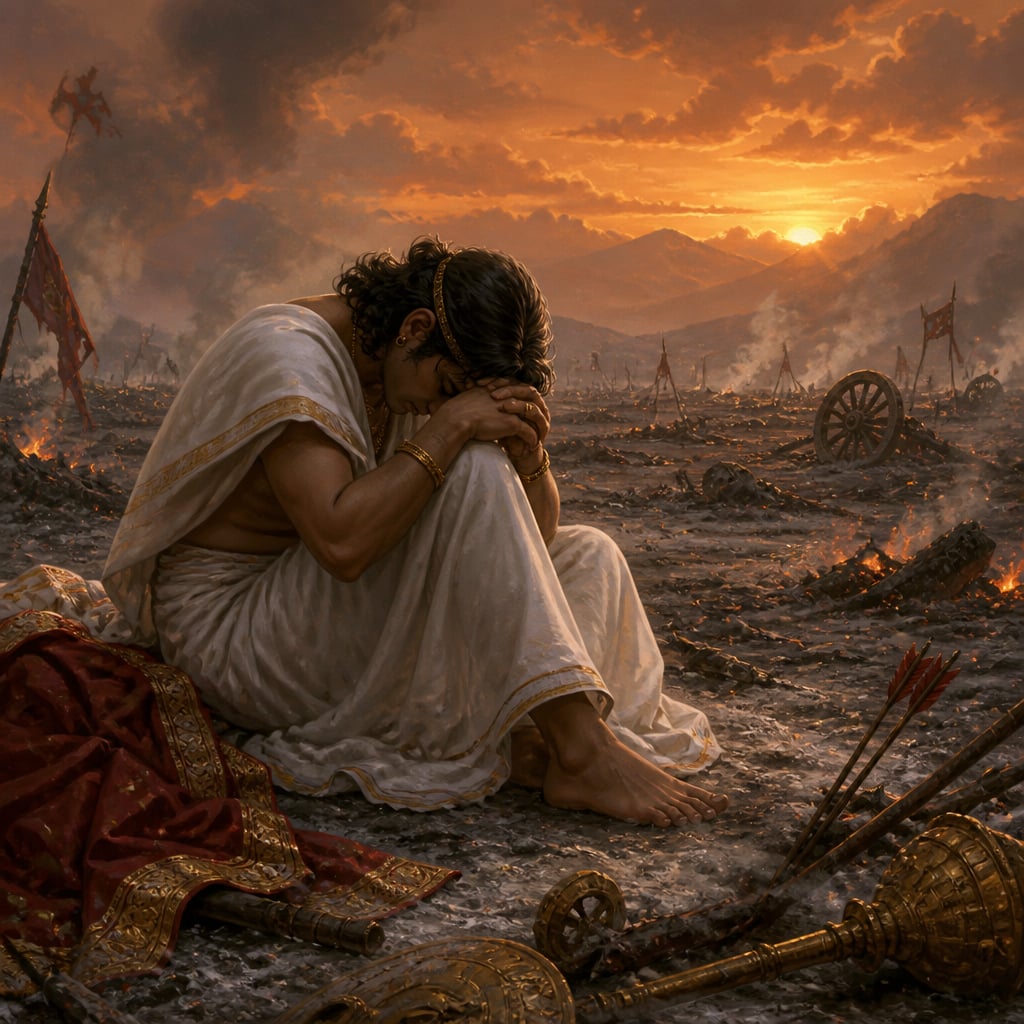
For days, the fires had consumed the dead of Kurukshetra, eighteen akshauhinis of warriors, nearly four million men, reduced to ash and memory. The women had walked among the bodies, had identified sons and husbands and fathers by the ornaments they wore. The rites had been performed. The living had begun the long work of grief.
Now the ministers of Hastinapura came to Yudhishthira with words he did not want to hear.
"Maharaja, the kingdom awaits you. The throne is empty. The people need a ruler."
Yudhishthira looked at them as if they spoke a foreign language. Maharaja. Great king. He had fought for that title. He had gambled everything for it, literally wagered his kingdom, his brothers, his wife on a throw of dice. And when the dice failed him, he had waged a war that killed everyone he loved.
"The throne," he repeated, his voice hollow. "You want me to sit on a throne built of my grandfather's bones?"
The Catalogue of Sin
In the weeks that followed, Yudhishthira withdrew from everyone. He would not eat. He would not speak to his brothers. He would not touch Draupadi. He sat alone in a corner of the ruined palace, counting his sins like beads on a mala.
Bhishma. The grandsire who had protected him as a child, who had taught him dharma, struck down by arrows while Yudhishthira hid behind Shikhandi's shield.
Drona. The teacher who had given him the knowledge of kings, who had loved Arjuna like a son, killed by a lie from Yudhishthira's own lips. "Ashwatthama is dead." The half-truth that broke a Brahmin's heart.
Karna. His own brother, though he had not known it during the war, slain while his chariot wheel sank into the earth, killed in violation of every rule of combat.
Abhimanyu. His nephew, barely sixteen, trapped in the Chakravyuha while the elders watched helplessly. Dead because Yudhishthira could not protect him.
And these were only the ones with names. Behind them stretched an ocean of the nameless:
| The Dead | The Survivors |
|---|---|
| 4 million warriors | A handful of Pandavas |
| 100 Kauravas | One grieving blind king |
| Countless horses and elephants | Widows beyond counting |
| An entire generation | Orphans who would never know their fathers |
All of this, Yudhishthira thought, for a kingdom I never truly wanted.
Arjuna's Argument
Arjuna was the first to confront his brother.
"You cannot do this," Arjuna said, finding Yudhishthira in the ruined garden where they had once played as children. "We fought this war so you could be king. We killed our teachers and elders so you could rule. If you refuse the throne, their deaths mean nothing."
Yudhishthira turned eyes full of pain toward his brother. "Their deaths already mean nothing, Arjuna. What meaning is there in slaughter? What dharma is there in killing a grandfather who would not fight back against us?"
"Krishna said, "
"Krishna." The name came out bitter. "Krishna told you to fight. He told me to lie about Ashwatthama. He told Bhima to strike Duryodhana's thighs, a blow forbidden by every law of mace combat. Where was dharma in all of that?"
Arjuna had no answer. The Gita's wisdom, so clear on the battlefield, seemed distant now amid the ash and grief.
"I am going to the forest," Yudhishthira continued. "I will become a vanaprasthi, a forest dweller. I will eat roots and leaves and pray for forgiveness until death takes me. Let Bhima be king, he has no guilt. Let you be king, you only followed orders. But I will not rule over the graves of those I murdered."
Bhima's Fury
When Bhima heard of this, his response was not gentle.

"You would make our victory meaningless?" he roared, storming into Yudhishthira's chamber. "I killed Duhshasana with these hands. I drank his blood to fulfill my vow. I shattered Duryodhana's thighs while he cursed me with his dying breath. All of this I did for YOU, brother, so you could be king. And now you want to sit in a forest and feel sorry for yourself?"
"Those vows were yours, Bhima. Not mine."
"They were for DRAUPADI!" Bhima's voice echoed through the empty halls. "They were for her honor, which was YOUR responsibility as eldest husband. You wagered her in the dice game. You watched silently while Duhshasana dragged her by the hair. You said nothing while they tried to strip her before the court. And when we finally avenged that humiliation, you want to throw away the victory?"
The words struck like physical blows. Yudhishthira had no defense against them.
"I know," he whispered. "I know what I did. That is why I cannot be king. A man who gambled away his wife has no right to rule others."
Draupadi's Silence
Draupadi did not come to argue. She came to sit beside her husband in the ruined garden, saying nothing for a long time.
Finally, she spoke:
"Do you remember what I asked you in the court that day? When they dragged me by the hair, when Duhshasana pulled at my garments, I asked a question of dharma. 'Did Yudhishthira lose himself first, or did he stake me while still possessing himself?'"
"I remember."
"No one could answer. Bhishma said dharma is subtle. Vidura said the stake was invalid. But you, you said nothing. You sat there, my husband, and you said nothing."
Yudhishthira closed his eyes. "I know."
"I swore then that I would not braid my hair until it was washed in Duhshasana's blood. Bhima fulfilled that vow. My hair is braided now." She touched her oiled locks, gleaming in the evening light. "But you know what I learned, husband? Vengeance does not heal. The braiding of my hair did not unbraid the years of humiliation. Duhshasana's death did not erase the memory of his hands on my clothes."
She turned to face him fully. "And yet, I am still here. We are still here. The question is not whether we can erase the past. The question is whether we will let the past erase the future."
Vyasa's Arrival
Word of Yudhishthira's despair reached Vyasa, the sage who had authored their entire story, who had fathered their fathers, who watched the Bharata line from a height that encompassed lifetimes.
He came to Hastinapura not as a grandfather but as a teacher.
"Yudhishthira," Vyasa said, "I have seen this before. Every great war produces victors who cannot bear their victory. This is the nature of vijaya, conquest always costs more than it gains."
"Then why do we fight?" Yudhishthira asked. "If victory is poison, why wage war at all?"

"Because sometimes the alternative is worse." Vyasa sat beside the king-who-refused-to-be-king. "Tell me, if you had not fought, what would have happened?"
Yudhishthira considered. "Duryodhana would rule."
"And how would he rule?"
"Badly. Cruelly. He would, " Yudhishthira stopped.
"Go on."
"He would have continued what he began. More injustice. More suffering. The dharma that Hastinapura once represented would have died forever."
"So you fought to preserve something," Vyasa said. "Not just to gain a kingdom, but to preserve a principle. That principle cost millions of lives, yes. But its loss would have cost something worse: the future's hope that justice can prevail."
The Choice Ahead
Vyasa did not command Yudhishthira to accept the throne. Instead, he posed a question:
"Your guilt is real, Yudhishthira. The blood on your hands will never fully wash away. But consider: if you abandon the kingdom now, who rules?"
"I don't know. Bhima, perhaps."
"Bhima is a warrior, not a king. Arjuna is a warrior. Nakula and Sahadeva are too young. If you do not rule, this kingdom that cost so many lives will fall into chaos. The sacrifice will be truly meaningless. Is that what you want?"
"No," Yudhishthira admitted.
"Then perhaps your penance is not the forest. Perhaps your penance is the throne itself, ruling with such wisdom and justice that the dead are honored by what you create. Perhaps your prayaschitta, your atonement, is not to run from responsibility but to bear it so well that the future says: 'Yes, the price was terrible, but look what was built from those ashes.'"
Yudhishthira did not answer immediately. The weight of Vyasa's words pressed against the weight of his guilt, and somewhere in between, a possibility began to stir.
The Parva Begins
The Shanti Parva, the Book of Peace, takes its name not from the peace that follows war but from the peace that must be made in the soul of the survivor.
Yudhishthira's journey in this parva is the journey from vishada (despair) to shanti (peace), but it is not a quick journey. Krishna would come with arguments. Bhishma, dying on his bed of arrows, would share the wisdom of lifetimes. Ministers and sages would offer counsel.
But all of that lay ahead.
For now, there was only a man sitting in the ashes of his victory, knowing that he had won everything and lost himself, wondering if the two could ever be reconciled.
"A kingdom built on bones," he whispered to no one. "A throne purchased with teachers' blood. A crown that sits on a head full of the screams of the dying."
Outside, the sun set over Hastinapura. The kingdom waited for its king. And the king waited for something he could not name, a reason, perhaps, to believe that anything good could come from so much destruction.
The Shanti Parva had begun.
Living traditions
The Shanti Parva's exploration of post-war trauma and moral injury has found new relevance in modern discussions of veteran care and the ethics of warfare. Military chaplains and ethicists reference its insights when working with soldiers struggling with guilt over combat actions. The parva's central question, 'How does one live after doing terrible things for good reasons?', remains urgently relevant in an age of asymmetric warfare, drone strikes, and moral complexity in conflict. Universities and think tanks studying just war theory increasingly include the Shanti Parva in their curricula.
- Prayaschitta Rituals: Hindu tradition developed elaborate systems of atonement for various sins. The Dharmasutras and Dharmashastras prescribe specific penances, fasting, pilgrimage, charity, meditation, for different violations. These rituals provide a structured path from guilt to restoration, acknowledging that moral wounds require intentional healing.
- Hastinapura Archaeological Site: The ancient capital of the Kuru kingdom, where Yudhishthira eventually took his throne. Archaeological excavations have revealed settlements dating to the painted grey ware culture (1200-600 BCE), consistent with the traditional dating of the Mahabharata era. The modern town includes temples and sites associated with the epic.
- Jyotisar: The site where Krishna spoke the Bhagavad Gita to Arjuna. A sacred banyan tree marks the traditional location. Pilgrims visit seeking the wisdom that convinced Arjuna to fight, and the Shanti Parva's continuation that convinced Yudhishthira to rule after fighting.
Reflection
- Yudhishthira felt disqualified from leadership because of his wartime actions. Have you ever felt that past actions disqualified you from future opportunities? How did you resolve (or fail to resolve) that feeling?
- Vyasa suggested that ruling justly might be a greater penance than forest exile. When have you faced a choice between escaping responsibility and transforming it? Which did you choose?
- Draupadi told Yudhishthira that vengeance did not heal her humiliation, 'the braiding of my hair did not unbraid the years.' What desires have you pursued, only to find their fulfillment empty?