Jnana: The Path to Liberation - Part 2
Stories of sages and wisdom
Bhishma continues his moksha dharma teachings through powerful stories of sages who transformed knowledge into liberation. The tale of Shuka, son of Vyasa, reveals how even the most learned may need a final push from an unexpected teacher. Through dialogues between seekers and masters, the grandsire shows that true wisdom is not information but transformation.
Knowledge and Wisdom
Yudhishthira had absorbed Bhishma's philosophical teachings - the nature of the soul, the three gunas, the paths to liberation. But he sensed there was something more.
"Grandfather, I have heard your explanations of moksha. But knowing about liberation and actually being liberated seem like very different things. How does understanding become realization?"
Bhishma smiled. "Now you ask the crucial question. Jnana - knowledge - comes in two forms:
- Paroksha jnana - indirect knowledge, learned from books and teachers
- Aparoksha jnana - direct knowledge, the immediate experience of truth
The first is like hearing about fire. The second is being burned by it. Let me tell you stories of how sages moved from one to the other."
The Story of Shuka: The Son of Vyasa
Bhishma began the most famous story in the Moksha Dharma:
"You know that the sage Vyasa compiled the Vedas, wrote the Mahabharata, and taught countless disciples. His own son, Shuka, was born with extraordinary spiritual gifts.
From childhood, Shuka showed no attachment to worldly things. While other children played, he meditated. While others craved sweets, he fasted. By the time he was a young man, Shuka had mastered all the scriptures and could explain the most subtle philosophies.
Yet Shuka came to his father with a troubled heart.
'Father, I have studied everything you taught. I understand the nature of the atman, the three gunas, the paths to liberation. But I do not feel liberated. Something is missing.'
Vyasa, the greatest sage of the age, considered his son's words carefully. Then he said something that shocked Shuka:
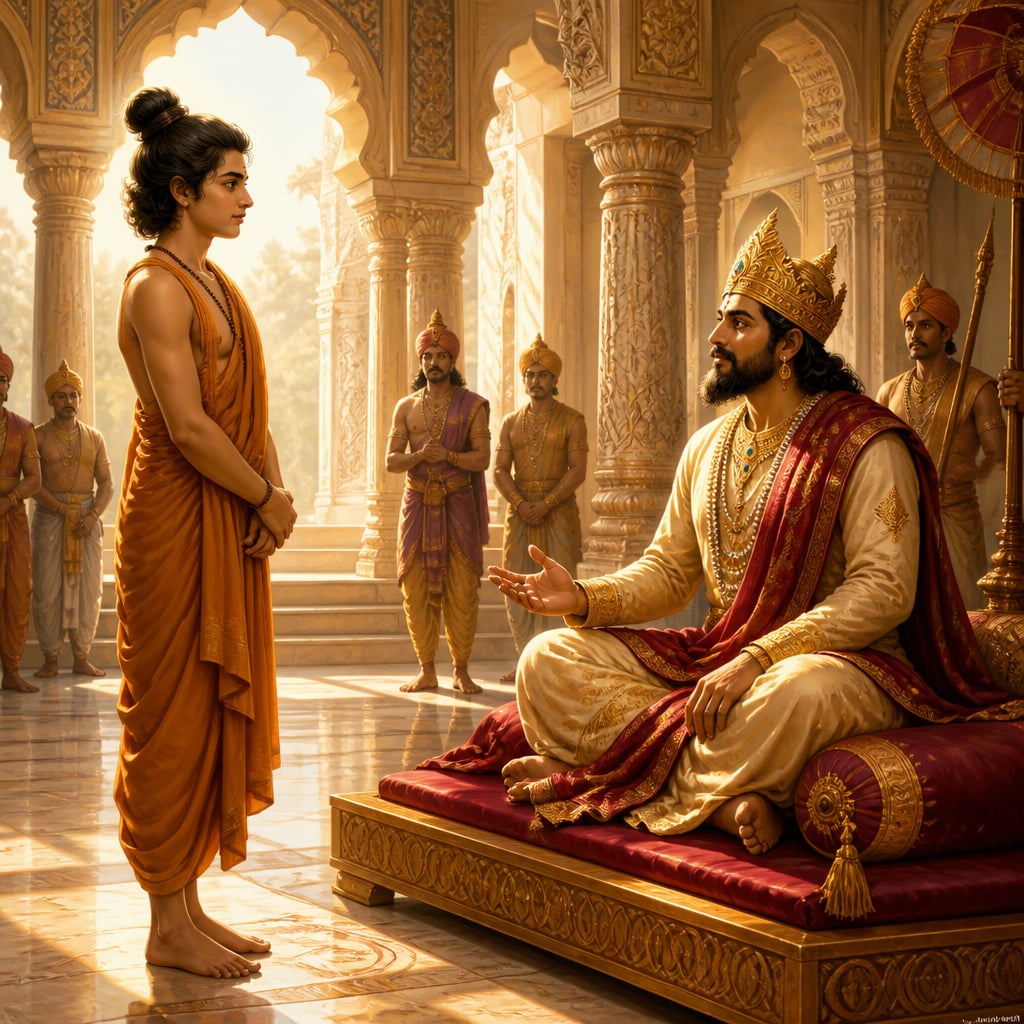
'Go to King Janaka. He can teach you what I cannot.'"
The Seeker and the King
"Shuka was astonished. 'A king? What can a householder teach me that you, the compiler of the Vedas, cannot?'
'That is what you must discover,' Vyasa replied.
Reluctantly, Shuka traveled to Videha and presented himself at Janaka's palace. But the king did not receive him immediately. Shuka was made to wait - first outside the gate, then in the outer courtyard, then in increasingly comfortable chambers.
For seven days, Shuka waited. Beautiful maidens attended him. Musicians played. Exquisite food was offered. Luxuries that would tempt any man surrounded him.
Shuka remained unmoved. He sat in meditation, accepting nothing, desiring nothing.
Finally, King Janaka summoned him."
The King's Teaching
"'So,' Janaka said, regarding the young sage. 'You remained undisturbed by the pleasures I offered. You are indeed advanced.'
'I seek the teaching you can give that my father could not,' Shuka said.
Janaka raised an eyebrow. 'What teaching could a king give that Vyasa himself could not? I know no scripture he does not know. I have realized no truth he has not realized.'
'Then why did he send me to you?'
Janaka smiled. 'Perhaps because I can show you something through my life that his forest hermitage could not demonstrate. Tell me - as you sat amid the pleasures and temptations, were you disturbed?'
'No.'
'Were you congratulating yourself on your non-attachment?'
Shuka paused. 'Perhaps... a little.'
'There is your bondage. You were attached to your detachment. You were proud of your lack of pride. This subtle ego is the last chain - and the hardest to break.'"
The Final Release
"Janaka continued: 'Your father lives in a forest, away from temptation. His detachment has never been tested by continuous exposure to pleasure. I live in a palace, surrounded by everything the world offers - yet I am free.
'The difference is this: I have no sense of being detached. There is no one here being non-attached. There is no Janaka who is liberated. There is only life flowing through this form, actions happening, thoughts arising and passing.
'You see yourself as a great sage who has renounced the world. I see myself as nothing at all. That nothingness is freedom.'
In that moment, something shifted in Shuka. The last subtle pride dissolved. He saw that he had been holding onto the identity of 'one who is spiritual' as firmly as others hold onto wealth or pleasure.
Shuka laughed - a clear, free laugh. 'I understand now. My father sent me to you because only in the middle of the world could this final lesson be learned. In the forest, I could believe I was detached. Here, facing everything, the pretense could not survive.'
Shuka returned to Vyasa, now truly liberated. He later attained such freedom that he merged entirely with the absolute, his individual existence dissolving like a river into the ocean."
The Dialogue of the Learned
Bhishma continued with another teaching story:
"A group of learned scholars once gathered to debate the nature of liberation. Each was proud of his knowledge, each certain his understanding was correct.
One said: 'Liberation comes through perfect performance of ritual. I have performed a thousand fire ceremonies.'
Another countered: 'Liberation comes through knowledge of scripture. I have memorized all four Vedas and their commentaries.'
A third declared: 'Liberation comes through austerity. I have fasted and done penance until my body is like a dry stick.'

As they argued, an old woman passed by, carrying water from the well. She paused to listen to their grand debate.
'Learned ones,' she said, 'I am an illiterate servant woman. I know no scriptures and have performed no great rituals. But when I draw water, I only draw water. When I walk, I only walk. My mind does not wander to yesterday or tomorrow. Is this not what you seek with all your learning?'
The scholars were silenced. The old woman had demonstrated what they merely discussed."
True jnana is not accumulation of knowledge but simplicity of being. The unlettered servant may be more liberated than the learned scholar.
The Sage and the Butcher
Bhishma told another surprising story:
"A brahmin named Kaushika, proud of his learning and austerities, was once meditating under a tree when a crane dropped excrement on him. In anger, he looked up, and his fierce gaze burned the bird to ashes.
Kaushika was pleased with his power until he went to the village to beg for food. A housewife asked him to wait while she attended to her husband. When she finally came with food, Kaushika glared at her.
The woman said calmly: 'I am not a crane to be burned by your anger. If you want to learn real dharma, go to the butcher Dharmavyadha in the next town.'
Shocked that a woman knew of his crime with the crane, Kaushika traveled to find this butcher. He found him in the meat market, selling flesh.

Yet when Dharmavyadha spoke, wisdom poured from him. He taught Kaushika about duty, about serving one's parents, about finding the divine in whatever work life assigns you.
'How can you know such things?' Kaushika asked in wonder. 'You are a butcher!'
'My father was a butcher, and his father before him. This is my assigned duty. I perform it without attachment, care for my elderly parents, and keep my mind fixed on the Lord. Your pride in learning led you to murder a bird. My humble work has kept my heart pure.'
Kaushika learned that liberation has nothing to do with one's social position and everything to do with the quality of one's consciousness."
The Three Obstacles to Wisdom
Bhishma summarized the patterns in these stories:
"There are three great obstacles that prevent knowledge from becoming liberation:
1. Pride in Knowledge
The scholar who knows many texts may be more bound than the illiterate person. Knowledge that inflates the ego increases bondage rather than breaking it. Shuka had to release his pride in being Vyasa's son and a great sage.
2. Attachment to Method
Some become attached to their spiritual practice itself - their meditation technique, their ritual expertise, their years of study. The method is a boat to cross the river, not a home to live in forever. Once across, the boat must be left behind.
3. Subtle Spiritual Ego
The most dangerous trap is thinking 'I am liberated.' The moment you claim liberation, you have created an 'I' to claim it. Janaka taught Shuka that true freedom has no one to be free."
How Knowledge Transforms
Yudhishthira asked, "Then what use is learning? Why study if knowledge does not free us?"
Bhishma replied: "Knowledge is the kindling. But kindling alone does not make fire - it needs a spark.
Study prepares the mind. It clarifies concepts, removes gross misconceptions, points in the right direction. But the final transformation happens through:
- Shravanam - deep listening to truth from a realized master
- Mananam - reflecting on that truth until doubts dissolve
- Nididhyasana - continuous meditation until the truth becomes your very being
The servant woman at the well had natural nididhyasana - her mind remained in the present without effort. The learned brahmins had only shravanam - they had heard but not absorbed.
Knowledge becomes wisdom when it moves from the head to the heart, from memory to being."
The Final Teaching
Bhishma concluded:
"Yudhishthira, you have heard these stories. Now ask yourself:
- Am I proud of my dharmic nature? Then that pride is a chain.
- Do I identify as a 'spiritual person'? Then that identity binds me.
- Do I seek liberation as an achievement to add to my list? Then I have not understood.
True jnana is recognizing what you already are - the awareness in which all experience arises. You do not become liberated. You recognize you were never bound.
The bird was always free. It only dreamed of the cage."
Yudhishthira sat in silence, absorbing not just the words but the living wisdom Bhishma had transmitted through these stories. Perhaps, in that very moment of receptive silence, some small shift occurred - the beginning of that transformation from knowledge to realization that the stories described.
Living traditions
The teaching of shravanam, mananam, and nididhyasana remains the formal path of jnana yoga practiced in Advaita Vedanta today. Spiritual teachers still use the Shuka-Janaka story to warn against spiritual pride. The Dharmavyadha story is invoked to counter caste discrimination in spiritual matters. Contemporary teachers like Nisargadatta Maharaj, who ran a small shop while teaching the highest non-dual wisdom, embodied the lesson that external circumstances do not determine internal freedom. The insight that the seeker is the last obstacle - that there is no one to be liberated - forms the core teaching of modern non-dual movements worldwide.
- Shravana-Manana-Nididhyasana Practice: The three-stage path of jnana yoga remains the formal method of Advaita Vedanta today. Students first hear teachings from a guru (shravana), then systematically reflect to remove doubts (manana), then meditate continuously until the truth becomes their very being (nididhyasana).
- Shukadeva Ashram, Vrindavan: Traditional site associated with Shuka, near where he is believed to have narrated the Bhagavata Purana to King Parikshit. The ashram honors the sage who learned from a king that spiritual pride is the final bondage.
- Ramakrishna Mission Centers: Swami Vivekananda's mission emphasizes that householders can achieve liberation, citing Janaka as the model. The teaching that external circumstances do not determine internal freedom - central to this lesson - is a core principle of the mission's approach.
Reflection
- Janaka told Shuka that being proud of non-attachment is itself attachment. Can you identify areas in your own life where you take pride in your lack of pride - spiritual accomplishments, moral standards, or lifestyle choices that make you feel superior to others?
- The servant woman and the butcher achieved wisdom through ordinary life, not special practices. What does this suggest about the relationship between spiritual attainment and lifestyle or occupation? Can liberation happen anywhere, or do certain conditions help?
- Bhishma says knowledge must move 'from the head to the heart, from memory to being.' Have you experienced moments when understanding something intellectually suddenly became something you knew in a deeper, more embodied way? What triggered that shift?