Guru Darshana: At the Grandfather's Feet
Pandavas visit dying Bhishma
The newly crowned king journeys to Kurukshetra, where his grandfather lies on a bed of arrows, waiting for an auspicious death. What follows is one of the most remarkable scenes in world literature: a defeated warrior teaching the army that defeated him, a dying elder passing wisdom to those who killed him. At Bhishma's feet, Yudhishthira becomes a student again, and receives teachings that will shape Indian civilization for millennia.
The Return to Kurukshetra
They had left this field as warriors. They returned as pilgrims.
The road from Hastinapura to Kurukshetra was short, perhaps a day's journey, but to Yudhishthira, it felt like crossing between worlds. Every tree they passed, every village they entered, held memories of the march to war. The same sky that had watched eighteen days of slaughter now watched a king seeking wisdom.
Arjuna rode beside his brother in silence. The battlefield where he had killed thousands was now a graveyard. The blood had soaked into the earth; the bones had been collected for the funeral pyres. But the land itself seemed wounded, as if the soil remembered what had happened upon it.
"This is where I killed Bhishma," Arjuna said quietly as they passed a particular rise. "I hid behind Shikhandi and shot arrow after arrow into the grandfather who would not raise his bow against me."
"You did what had to be done," Yudhishthira replied.
"Did I?" Arjuna looked at his hands, the hands that had drawn the Gandiva bow, the hands that had sent his grandsire to his arrow-bed. "Or did I hide behind a technicality while committing murder?"
Krishna, riding nearby, spoke gently: "Bhishma himself created the conditions of his defeat. He revealed to you the secret of his death. He wanted to fall, Arjuna. He was tired of living a life that forced him to fight against those he loved."
"That does not make me innocent."
"No. It makes you forgiven."
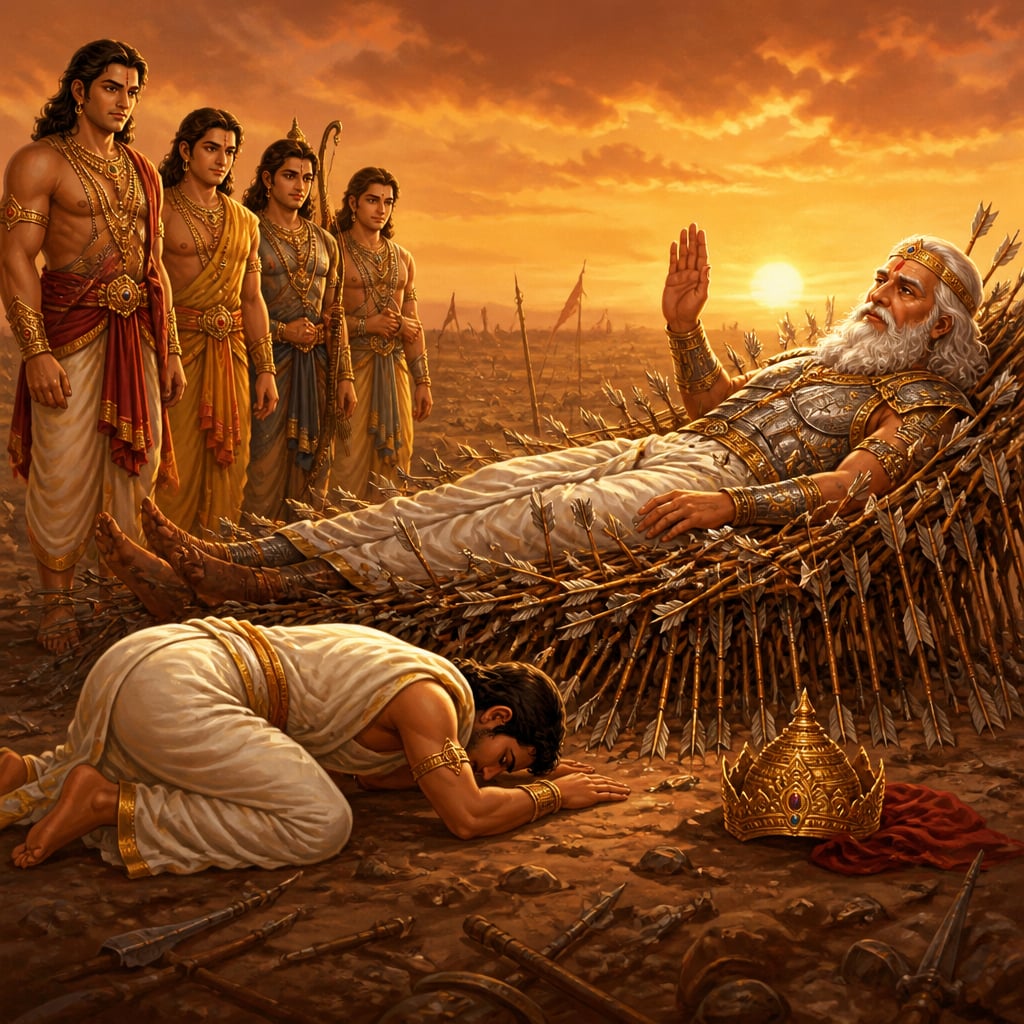
The Shara-Shayya
They found Bhishma where he had fallen, on the northern edge of the great field, his body supported by the very arrows that had pierced him.
The shara-shayya, the bed of arrows, was a sight that defied understanding.
Hundreds of shafts, some from Arjuna, some from Shikhandi, some from warriors whose names had been forgotten, formed a terrible mattress. Bhishma lay upon them, his head supported by a pillow of arrow-shafts that Arjuna had thoughtfully arranged. The barbed points that had entered his body now held him suspended, neither fully of earth nor fully released from it.
| What Bhishma Experienced | What Sustained Him |
|---|---|
| Constant piercing pain | His boon of ichha-mrityu |
| Inability to move | His lifelong discipline |
| Waiting for the Uttarayana | His commitment to duty |
| Watching the aftermath of destruction | His desire to teach one last time |
And yet, and this was what struck Yudhishthira most forcefully, Bhishma's face was serene.
The man who had led the Kaurava forces, who had killed thousands of Pandava soldiers, who had been the mightiest warrior of his age, lay broken on his bed of arrows with an expression of profound peace.
"Grandfather," Yudhishthira said, approaching on foot, leaving his crown and royal symbols behind. "I have come."
Bhishma's eyes opened. Despite the agony of his position, they were clear.
"I know, child. I have been waiting for you."
The Prostration
What happened next was remarkable by any standard.
Yudhishthira, newly crowned emperor of Bharatavarsha, king of the mightiest realm in the land, fell at the feet of the man his army had defeated.
The prostration was complete, not the abbreviated gesture of a king acknowledging an elder, but the full sashtanga pranam of a student submitting to his teacher. Yudhishthira's forehead touched the ground near Bhishma's arrow-pierced body. His hands extended in supplication.
"Grandfather," he said, his voice breaking, "I have come to beg your forgiveness and seek your teaching. Forgiveness for what we did to you. Teaching for what I must now do."
Behind him, his brothers watched in silence. Bhima, who had never truly loved Bhishma for standing with the Kauravas, felt something shift in his chest. Arjuna, who had shot these very arrows, could not look at what they had done. Nakula and Sahadeva wept openly.
"Rise, child," Bhishma said gently. "There is nothing to forgive. I fought for the side I was bound to fight for; you fought for the side you were bound to fight for. Neither of us chose this war. We only chose how to live within it."
Krishna's Intervention
Krishna approached the shara-shayya with the ease of one who knew exactly what was unfolding.
"Pitamaha," he said, addressing Bhishma with the term for great-grandfather, "Yudhishthira has been crowned king. But a crown does not make a ruler. He needs what only you can give: the wisdom of one who has served six kings, who has watched the Kuru dynasty through every triumph and tragedy, who knows the secrets of statecraft that cannot be written in books."
"And you think I will give him this wisdom, Vasudeva?" Bhishma smiled. "You, who orchestrated my defeat?"
"I think you have been waiting to give it," Krishna replied. "I think the teaching you carry is too precious to take to the grave. You could have died on the battlefield; your boon allowed it. Instead, you chose to wait for the sun to turn north. You chose to remain in pain for these months. Why, if not to complete one final duty?"
Bhishma was silent for a long moment.
"You see too clearly, Krishna. As always." He turned his eyes to Yudhishthira. "Come, child. Sit beside me. We have much to discuss, and I do not know how long I have."
The First Questions

Yudhishthira sat beside the arrow-bed, not on a throne but on the bare ground, as a student would sit before a teacher.
"Grandfather, I do not know how to be a king. I know how to fight a war, but I do not know how to build a peace. I know how to win a kingdom, but I do not know how to make it flourish. I know how to defeat my enemies, but I do not know how to govern my people."
Bhishma nodded. "Good. A king who thinks he knows everything is already failing. Ask your questions, Yudhishthira. I will answer what I can."
"Then I ask first: what is the dharma of a king? Not the dharma of a warrior, I learned that on the battlefield, for better or worse. But the dharma of a ruler who sits on the throne in peacetime. What must I be?"
"That is not one question but a thousand," Bhishma replied. "We will address them all. But understand this first: a king's dharma is not his own dharma. When you put on the crown, you ceased to be Yudhishthira the individual. You became Yudhishthira the symbol, Yudhishthira the institution, Yudhishthira the protector of all who shelter under your umbrella."
The Gathering of Listeners

As word spread that Bhishma was teaching the new king, others gathered to listen.
Vidura came, seeking to hear confirmed the principles he had always believed. Narada came, interested in how mortal wisdom compared to celestial knowledge. Vyasa came, already planning to record these teachings for future generations.
And Krishna remained, occasionally prompting Bhishma with questions, occasionally correcting or expanding on points, always ensuring that the teaching would be complete.
"Why are you here, Vasudeva?" Bhishma asked at one point. "You know everything I know and more. Why do you need to hear me speak?"
"Because some wisdom can only come from human experience," Krishna answered. "I know the dharma of kings as the Supreme Being knows it. But you know it as someone who has lived it, who has made mistakes, who has watched others make mistakes, who has seen theory break against the rock of reality. That knowing is different from mine, and Yudhishthira needs it."
The Arrow-Bed as Classroom
The shara-shayya became a classroom unlike any other.
A dying man, unable to move, wracked with constant pain, taught the future of Indian civilization to a traumatized king who could barely forgive himself for existing. Around them gathered the wisest beings of the age, divine, human, and somewhere in between.
Bhishma's voice remained steady despite his suffering. When he grew tired, attendants moistened his lips with water. When the pain became too intense, he closed his eyes and practiced the yoga he had learned in his youth, returning minutes later to continue teaching.
"Why do you endure this?" Yudhishthira asked once. "You could let go. You could choose death and end your suffering."
"I could," Bhishma agreed. "But this pain is my final teaching. Watch me, Yudhishthira. Watch a man bear unbearable suffering for the sake of duty. This is what you must learn to do as king, not on a bed of arrows, but on the throne of responsibility. You will suffer. You will want to escape. You will pray for release. And still you must remain, because your people need you to remain."
The Topics Ahead
Bhishma laid out what he would teach:
Raja Dharma, The fundamental duties of kings: protection, taxation, justice, appointment of ministers, treatment of enemies and allies.
Danda Niti, The science of punishment: when to be severe, when to be merciful, how to maintain order without becoming a tyrant.
Apad Dharma, Ethics in crisis: what happens when normal rules cannot apply, when survival requires breaking the rules that normally govern.
Moksha Dharma, The path to liberation: spiritual wisdom for kings who must act in the world while seeking ultimate freedom.
"These teachings," Bhishma said, "are what I gathered over a lifetime of service. Some I learned from teachers. Some I learned from mistakes. Some I learned from watching others, watching your father Pandu, watching Dhritarashtra, watching the kings before them. All of it I give to you now. Use it well."
The Sun Moves Slowly
Days passed at the arrow-bed.
Yudhishthira stayed, listening for hours each day. His brothers took turns attending; Bhima's skepticism slowly transformed into respect as he heard the depth of Bhishma's wisdom. Arjuna found healing in the grandfather's teachings, a way to believe that the suffering he had caused might somehow be redeemed.
The sun crept toward its northern turning. Bhishma measured his remaining time by its passage.
"When the Uttarayana comes," he told Yudhishthira, "I will let go. The north is auspicious for death; souls travel more easily to heaven. But until then, every moment I have is yours."
"Use me, child. Drain me of everything I know. When I am gone, you will have only your own judgment and the memory of what I taught. Make that memory as complete as possible."
Yudhishthira bowed his head.
"I will not waste your gift, grandfather. I will listen, I will remember, and I will try to rule as you teach me to rule."
"That is all any teacher can ask." Bhishma smiled, and for a moment, despite the arrows, despite the pain, despite everything that had led to this moment, he looked almost happy.
"Now," he said, "let us begin."
Living traditions
The image of Bhishma teaching from his shara-shayya has become an archetype of wisdom transmission under difficult circumstances. Indian political speeches often reference Bhishma's commitment to duty despite suffering. Management literature cites his example when discussing leadership through adversity. The phrase 'teaching from the arrow-bed' has become a metaphor for those who continue contributing to their fields despite terminal illness or extreme difficulty, the professor who lectures through chemotherapy, the leader who guides through personal tragedy. Bhishma's example suggests that our most valuable teaching may come in our most difficult moments.
- Bhishma Ashtami Observance: The eighth day of the bright fortnight of Magha month is observed as Bhishma Ashtami, the day Bhishma finally released his life and departed. Devotees fast and perform shraddha (ancestral offerings) in his honor. The day is also considered auspicious for seeking blessings for wisdom and commitment to dharma.
- Bhishma Kund: A sacred tank associated with Bhishma. According to tradition, when Bhishma complained of thirst on his arrow-bed, Arjuna shot an arrow into the earth and created a spring. This spring is identified with Bhishma Kund. Pilgrims visit seeking blessings for commitment and endurance.
- Bhishma Pitamah Temple: One of the few temples dedicated to Bhishma, honoring him not as a deity but as a supreme devotee and exemplar of dharma. The temple attracts those seeking blessings for celibacy (brahmacharya), commitment, and wisdom in governance. Special services on Bhishma Ashtami.
Reflection
- Yudhishthira sought wisdom from the man he had helped defeat. Have you ever learned important lessons from someone you had 'beaten', a competitor, a predecessor, someone whose position you took? What made that learning possible?
- Bhishma chose to remain in agony for weeks in order to teach. What suffering have you endured, or would you endure, for the sake of passing on something valuable to others?
- Krishna said human experiential wisdom differs from divine theoretical wisdom. When do you trust the advice of someone who has 'been there' over someone with more formal knowledge? What makes lived experience valuable?