Sūrya Namaskāra: Sun Salutation Before Sunrise Yoga Classes
The sacred solar practice that became a global fitness phenomenon
Tracing sūrya namaskāra from Vedic sun worship through its 20th-century systematization by the Raja of Aundh to its current status as the world's most practiced yoga sequence. Explores what's preserved and lost when solar devotion becomes cardio warm-up.
The Sequence That Conquered the World
In any yoga studio, anywhere on earth, the class follows a predictable pattern. Students unroll mats, the teacher dims lights, and within ten minutes, everyone is flowing through the same sequence: arms up, fold forward, step back, lower down, arch up, pike back, step forward, fold, rise. Sun Salutation, Sūrya Namaskāra.
It's the world's most practiced yoga sequence. Millions perform it daily in studios from Los Angeles to Lagos, in living rooms and parks, on YouTube videos with billions of views. It opens virtually every vinyasa class, appears in fitness apps, and anchors morning routines worldwide.
What most practitioners don't know is that this ubiquitous sequence has a remarkably recent origin story, and that its journey from sacred solar worship to studio warm-up reveals much about how traditional practices transform in modern contexts.
The Ancient Roots: Sūrya Upāsanā
Sun worship in India predates recorded history. The Ṛg Veda, among humanity's oldest texts, contains numerous hymns to Sūrya, the solar deity who crosses the sky each day, bringing light, life, and consciousness to the world.
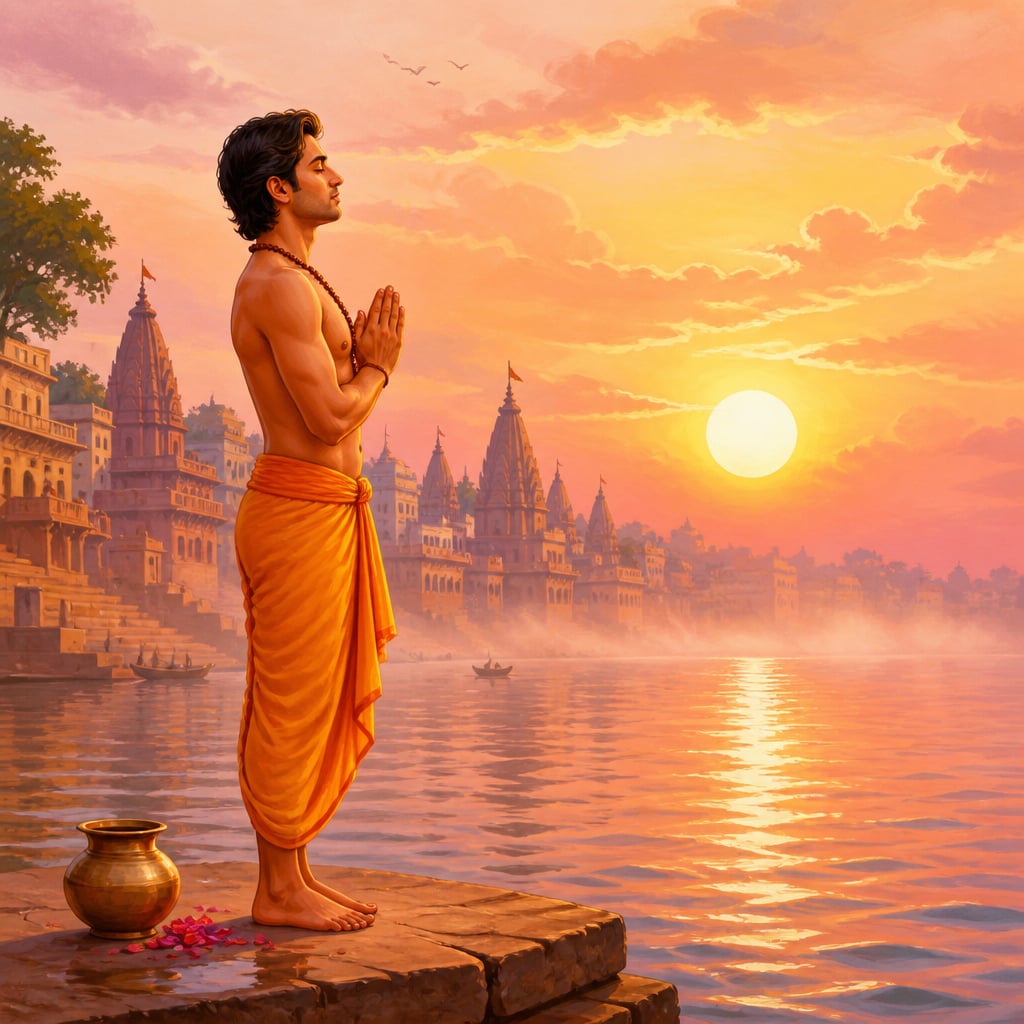
The Vedic understanding saw the sun as more than an astronomical object. Sūrya was the visible face of the divine, the cosmic eye, the source of prāṇa (life-force) that sustains all beings. Facing the rising sun wasn't superstition, it was recognition of the fundamental energy that makes life possible.
Traditional sun worship (sūrya upāsanā) included:
Sūrya Mantra: Recitation of solar mantras, especially the Gāyatrī mantra, which invokes the solar light to illuminate the intellect.
Arghya: Offering water to the sun while standing in a river or with a vessel, the water droplets catching sunlight and creating rainbows, a symbolic connection between earthly and celestial realms.
Prostrations: Physical bowing toward the sun, expressing reverence and surrender to the cosmic power that sustains life.
Sūrya Dhyāna: Meditation on the solar orb, visualizing its qualities of light, warmth, and consciousness entering the practitioner.
These practices were devotional, not exercise. The body's movements served the soul's orientation toward the divine. Physical prostration was an expression of reverence, not a fitness routine.
The Missing Link: Where Did the Sequence Come From?
Here's the surprising truth: the specific 12-position sequence we call Sūrya Namaskāra doesn't appear in classical yoga texts. The Haṭha Yoga Pradīpikā (15th century), the Gheraṇḍa Saṃhitā (17th century), and other foundational texts describe individual āsanas but not this flowing sequence.
So where did it come from?
The answer involves a fascinating convergence of traditional solar worship, physical culture movements, and one remarkable Indian ruler.
The Raja of Aundh: Father of Modern Sūrya Namaskāra

In the early 20th century, Bhavanarao Shriniwasrao Pant Pratinidhi (1868-1951), the Raja of Aundh, a small princely state in what is now Maharashtra, became passionate about physical fitness and traditional practice.
The Raja observed that traditional sun worship existed (the mantras, the prostrations) and that individual yoga poses existed, but they weren't systematically combined. He set out to create a comprehensive sequence that would:
- Honor the traditional 12 names of Sūrya (the sun's aspects for each month)
- Incorporate full-body movement for physical development
- Be accessible to ordinary people, not just yogis or ascetics
- Serve as a complete exercise that could be practiced daily
The Raja systematized the 12-position sequence, associating each position with one of the sun's 12 names and corresponding mantras. He published detailed instructions, promoted the practice throughout his state, and, remarkably, made Sūrya Namaskāra mandatory in Aundh's schools.
His 1928 book on the subject spread the practice beyond Aundh. The Raja traveled, lectured, and advocated for Sūrya Namaskāra as a national exercise that could improve Indian health and vitality. He saw it as both a return to traditional values and a progressive health measure.
The Raja's contribution was systematization and popularization. He took existing elements, solar worship, prostrations, individual poses, and organized them into the specific sequence that would eventually reach every yoga studio in the world.
Krishnamacharya: The Bridge to Modern Yoga
While the Raja popularized Sūrya Namaskāra as a standalone practice, another figure integrated it into what would become modern yoga: Tirumalai Krishnamacharya (1888-1989).
Krishnamacharya, often called the 'father of modern yoga,' taught at the Mysore Palace under the patronage of the Maharaja of Mysore. There, he developed a dynamic, flowing style that linked āsanas together with breath, vinyāsa.
Krishnamacharya incorporated Sūrya Namaskāra as the foundational sequence of his practice. Students would begin with rounds of Sun Salutation to warm the body and focus the mind before proceeding to more complex āsanas. This positioning, Sun Salutation as warm-up and gateway, would become universal in modern yoga.
What Krishnamacharya added was the breath-movement synchronization (vinyāsa) and the integration with a complete āsana practice. The sequence was no longer standalone devotional exercise; it became the opening movement of a comprehensive yoga system.
The Global Spread: Jois, Iyengar, and Beyond
Krishnamacharya's most influential students carried Sun Salutation to the world:
K. Pattabhi Jois (1915-2009) developed Ashtanga Vinyasa Yoga, which begins with Sūrya Namaskāra A and B, five rounds of each before proceeding to the standing sequence. In Ashtanga, Sun Salutation isn't just warm-up; it's the foundation upon which everything builds.
B.K.S. Iyengar (1918-2014) taught Sun Salutation with his characteristic precision, breaking down each position's alignment and teaching modifications for different bodies. His approach made the sequence accessible to those who couldn't flow dynamically.
Indra Devi (1899-2002), often called the 'First Lady of Yoga,' brought the practice to Hollywood in the 1940s and 1950s, teaching celebrities and introducing Americans to Sun Salutation as both spiritual practice and physical conditioning.
Through these teachers and their many students, Sūrya Namaskāra spread globally. By the late 20th century, it had become the universal opener for yoga classes worldwide.
The Modern Transformation

Today's Sun Salutation would be largely recognizable to the Raja of Aundh, but the context has transformed entirely:
What's Preserved:
- The basic 12-position sequence (with variations)
- The flowing, continuous movement
- The connection to breath
- The morning timing (for many practitioners)
- Some physical benefits: flexibility, strength, cardiovascular conditioning
What's Changed:
The solar connection is often absent. Most practitioners never face the actual sun or consider Sūrya as a deity. The 'sun' in Sun Salutation becomes metaphorical at best, absent at worst.
The mantras have disappeared. The 12 solar mantras, one for each position, are rarely taught in Western contexts. The practice becomes purely physical.
The devotional orientation is gone. Traditional Sūrya Namaskāra was worship, an offering to the cosmic power that sustains life. Modern practice is exercise, a warm-up for the 'real' yoga to follow.
The timing has become arbitrary. Traditional practice aligned with sunrise, when solar prāṇa is considered most available. Modern practice happens whenever the class is scheduled.
The sequence has multiplied. Sūrya Namaskāra A, B, C; classical version; Ashtanga version; power yoga version, the 'authentic' sequence varies by tradition and teacher.
The transformation isn't entirely loss. The physical benefits are real. Millions who would never engage in Hindu devotional practice benefit from the sequence. The accessibility that comes from secularization has spread genuine health benefits worldwide.
But something is also missing, the connection to something larger than personal fitness, the orientation toward the cosmic, the understanding that bowing to the sun acknowledges our dependence on forces beyond ourselves.
The Science of Sun Salutation
Modern research has begun validating benefits that traditional practitioners knew experientially:
Cardiovascular Effects: Studies show that vigorous rounds of Sūrya Namaskāra elevate heart rate to aerobic training zones. Twelve rounds performed quickly provides cardiovascular conditioning comparable to cycling or jogging.
Flexibility and Strength: The sequence systematically moves the spine through flexion and extension, stretches major muscle groups, and builds functional strength through bodyweight movement.
Hormonal Effects: Morning practice has been associated with improved cortisol patterns and thyroid function, though research is still preliminary.
Mental Health: Regular practice shows benefits for anxiety and depression in multiple studies, though distinguishing Sun Salutation's specific contribution from yoga generally is difficult.
Breath Capacity: The breath-movement synchronization improves respiratory function and breath awareness.
The science validates what practitioners experience: Sun Salutation works. It's an efficient, complete practice that conditions the entire body in a short time. The question isn't whether it's effective, it's whether physical effectiveness is all that's available.
The Traditional Practice: Sun Salutation as Worship
For those interested in exploring the devotional dimension, traditional practice differs significantly from studio yoga:
Timing: Practice at sunrise (or sunset), facing the actual sun. The timing isn't arbitrary, it aligns the practitioner with cosmic rhythm.
Direction: Face east in the morning (toward the rising sun). This orientation connects the body to the solar path across the sky.
Mantras: Each of the 12 positions corresponds to one of Sūrya's names:
- Oṃ Mitrāya Namaḥ (Friend of all)
- Oṃ Ravaye Namaḥ (The shining one)
- Oṃ Sūryāya Namaḥ (Dispeller of darkness)
- Oṃ Bhānave Namaḥ (The brilliant one)
- Oṃ Khagāya Namaḥ (The sky-mover)
- Oṃ Pūṣṇe Namaḥ (The nourisher)
- Oṃ Hiraṇyagarbhāya Namaḥ (The golden womb)
- Oṃ Marīcaye Namaḥ (Lord of the dawn)
- Oṃ Ādityāya Namaḥ (Son of Aditi)
- Oṃ Savitre Namaḥ (The life-giver)
- Oṃ Arkāya Namaḥ (The radiant one)
- Oṃ Bhāskarāya Namaḥ (The illuminator)
Intention: The practice is offering, giving the body's movement to Sūrya as an expression of gratitude and reverence. The goal isn't fitness improvement but connection to cosmic rhythm.
Integration: Traditional practice often concludes with water offering (arghya) and meditation on the solar qualities entering the practitioner.
This approach transforms the experience. The same physical movements, performed with devotional intention, facing the actual sun, synchronized with mantras, this is a fundamentally different practice than a warm-up sequence in a climate-controlled studio.
The Modern Practice: Sun Salutation as Exercise
For those approaching Sun Salutation primarily as physical practice, optimization looks different:
Variations for Goals: Slow practice with long holds develops flexibility; fast practice with minimal holds develops cardio; held positions (like plank and chaturanga) develop strength.
Breath Coordination: One breath per movement is standard, but advanced practitioners experiment with ratios: longer exhales for calming effect, shorter breaths for energizing.
Repetitions: Traditional 12 rounds (one for each solar name) is a good starting point. Ashtanga practitioners often do 5-10 of each A and B variation. Fitness-focused practitioners might do 20+ rounds for cardio conditioning.
Modifications: Knees down in chaturanga reduces shoulder strain. Blocks under hands in forward fold accommodate tight hamstrings. Knee-down lunges ease hip flexors.
Sequencing: As warm-up, 3-5 rounds prepares for deeper practice. As standalone workout, 12-20 rounds provides complete conditioning. As meditation in motion, fewer rounds with longer holds and mantras creates different effects.
Both approaches, devotional and fitness, produce genuine benefits. The question is what you're seeking from the practice.
The Both/And Possibility
The most interesting possibility isn't choosing between traditional worship and modern exercise, it's integrating both dimensions:
Practice facing the sun when possible. Even without full devotional context, orienting toward the actual sun connects you to the practice's origin and to something larger than yourself.
Learn the mantras. Even if you don't consider Sūrya a deity, the mantras provide focus, rhythm, and connection to the tradition. They transform repetitive movement into something more engaged.
Include the intention of gratitude. Whatever your cosmology, the sun does sustain all life on earth. Acknowledging this through practice isn't religious belief, it's recognition of reality.
Practice at meaningful times. Sunrise isn't always possible, but morning practice aligns with traditional timing and offers different quality than afternoon or evening.
Let the physical serve the contemplative. Rather than 'just exercise,' let the cardiovascular activation and breath coordination quiet the mind. Let the repetition become meditation in motion.
The Raja of Aundh wanted Indians to reclaim their heritage through physical practice. Krishnamacharya wanted to preserve yoga through adaptation. The global yoga movement has made the practice available to billions. Each stage of transmission has preserved something and lost something.
What you receive from the practice depends on what you bring to it. The positions are the same whether you're warming up for yoga class or offering your movement to the solar deity. The difference is awareness, intention, and connection.
The Sun Still Rises
Every morning, whether you practice Sūrya Namaskāra or not, the sun rises. It has risen for 4.6 billion years and will rise for billions more. The cosmic rhythm continues regardless of human attention or neglect.
Traditional cultures oriented daily life around this rhythm, rising with the sun, working during daylight, resting with darkness. Sūrya Namaskāra was one way of consciously participating in this rhythm, acknowledging the source that makes life possible.
Modern life has largely severed this connection. Electric light extends waking hours past sunset. Climate control makes outdoor orientation unnecessary. The sun becomes irrelevant to daily schedule.
Sūrya Namaskāra, even in its most secularized form, preserves a trace of the original connection. The name 'Sun Salutation' reminds us, even if we ignore the reminder, that this practice was once about something beyond flexibility and core strength.
The studio practitioner, flowing through the sequence under fluorescent lights, is still performing movements that humans have used for generations to honor the light that sustains them. The form persists even when the meaning fades.
Perhaps that's enough, the seed preserved until someone waters it. Perhaps the practitioner who begins with 'just exercise' eventually wonders why it's called 'Sun Salutation' and discovers the tradition behind the positions.
The sun continues rising. The practice continues spreading. The connection between them remains available to whoever seeks it.
To practice with traditional orientation: Face east at sunrise (or west at sunset). Recite the 12 solar mantras, one per position, either aloud or mentally. Let each movement be an offering rather than exercise. Conclude by standing quietly, feeling the sun's warmth, acknowledging the light that makes life possible. Even without full devotional belief, this approach transforms mechanical exercise into embodied meditation.
For fitness emphasis: Perform 12 rounds minimum, moving at a pace that elevates heart rate. Hold challenging positions (chaturanga, plank) longer for strength development. Vary speed: slow rounds for flexibility, fast rounds for cardio. Track progress by rounds completed, holds maintained, or breath control achieved. The physical benefits are real and measurable, Sun Salutation is a legitimate workout, not just warm-up.
Key figures
Bhavanarao Shriniwasrao Pant Pratinidhi, Raja of Aundh
Ruler of the princely state of Aundh who systematized the modern Sūrya Namaskāra sequence, published instructional materials, made it mandatory in schools, and promoted it as a national exercise for Indian health.
His 1928 publication spread the practice beyond Aundh. By making Sūrya Namaskāra mandatory in schools, he created a generation of practitioners who carried the practice forward. His framing of the sequence as both traditional and modern, both spiritual and physical, enabled its appeal across different audiences.
Tirumalai Krishnamacharya
The 'father of modern yoga' who integrated Sūrya Namaskāra into vinyāsa-based practice at the Mysore Palace, positioning it as the foundational sequence that opens practice and warms the body.
Through his students (Jois, Iyengar, Desikachar, Indra Devi), Krishnamacharya's approach spread globally. The vinyāsa-style Sūrya Namaskāra he taught became the template for modern yoga practice worldwide. His integration of breath, movement, and traditional knowledge created yoga as most people now know it.
K. Pattabhi Jois
Founder of Ashtanga Vinyasa Yoga, who learned from Krishnamacharya and developed a rigorous system where Sūrya Namaskāra A and B form the essential opening sequence, performed before any other poses.
Through the Ashtanga system and its many derivatives, Jois's approach to Sūrya Namaskāra, fast, athletic, breath-driven, became the dominant style in Western fitness yoga. The athletic Sun Salutation practiced in gyms worldwide traces largely to his influence.
B.K.S. Iyengar
Founder of Iyengar Yoga, who emphasized precise alignment and taught Sūrya Namaskāra with detailed attention to each position's form, making the sequence accessible through modifications and props.
His book Light on Yoga included detailed Sūrya Namaskāra instruction that became a reference standard. The Iyengar approach, slower, more precise, with modifications, provided an alternative to the athletic style, making the practice available to populations who couldn't perform vigorous flows.
Case studies
The Raja of Aundh: How One Ruler Changed Global Exercise
In the 1920s, the princely state of Aundh in Maharashtra faced a problem familiar across colonized India: declining physical vitality among the population. Western observers frequently commented on Indian 'weakness,' and the observation, however prejudiced, contained some truth - nutritional deficiencies and lack of systematic physical culture affected public health. The Raja of Aundh, Bhavanarao Pant Pratinidhi, decided to address this through a practice that was both traditional and modern. He observed that sun worship had ancient roots in Indian culture, that individual yoga āsanas existed, and that physical culture movements in Europe had demonstrated the power of systematic exercise. He would combine all three. The Raja systematized the 12-position sequence, matching each position to one of Sūrya's traditional names. He published detailed instructions with photographs. Most remarkably, he made the practice mandatory in all schools throughout his state - perhaps the first government-mandated yoga program in history. The results, as the Raja reported them, were impressive: improved student health, increased vitality, and renewed connection to traditional practice. He traveled throughout India promoting Sūrya Namaskāra as a national exercise, a way of reclaiming indigenous physical culture while building a healthy nation. The Raja's timing was fortuitous. His work coincided with Krishnamacharya's development of vinyāsa yoga at the Mysore Palace. The two approaches cross-pollinated: the Raja's standalone sequence and Krishnamacharya's integrated system reinforced each other. Through multiple channels, Sūrya Namaskāra entered the mainstream of what would become modern yoga. The Raja died in 1951, just as Indian independence was reshaping the nation. He didn't live to see his practice become a global phenomenon. Today, millions who have never heard of Aundh perform the sequence he systematized, in studios that would have seemed unimaginable to a Marathi prince in the 1920s.
Surya Namaskar integrates principles from multiple classical texts: the Rig Veda's solar hymns, Hatha Yoga Pradipika's asana sequences, and Ayurveda's concept of Vyayama (exercise) as described in Charaka Samhita. The Aundh experiment demonstrated that even one traditional practice, applied consistently across a community, could produce measurable population-level health improvements.
The Raja's motivations - physical health, cultural reclamation, accessible practice - resonate today. His approach demonstrates that tradition and innovation need not conflict. Understanding that Sūrya Namaskāra was consciously designed, not discovered in ancient texts, clarifies what the practice is: a 20th-century synthesis drawing on much older roots. This knowledge liberates practitioners to adapt the sequence for their own contexts while honoring its sources.
The Raja's innovation was synthesis: taking existing elements (solar worship, prostrations, individual āsanas) and organizing them into an accessible, repeatable sequence. This pattern - traditional elements repackaged for modern accessibility - recurs throughout the yoga's journey West. The genius is recognizing what can be preserved when form is adapted for new contexts.
Surya Namaskar is now practiced by an estimated 100 million people worldwide, making it arguably the most successful Indian wellness export in history. The Raja of Aundh's innovation of sequencing existing elements into an accessible daily practice created the template that modern fitness programs continue to replicate.
The Aundh Experiment (1940s-1950s) in Maharashtra demonstrated that a community-wide Surya Namaskar program reduced illness rates by 60% and increased agricultural productivity by 25% over a 5-year period. Modern replications in Indian schools show 30% reduction in student sick days.
Historical context
Vedic Period to Modern Global Practice (c. 1500 BCE - Present)
Living traditions
Sūrya Namaskāra has achieved unprecedented global distribution, practiced daily by millions in studios, gyms, homes, and online. The sequence has become synonymous with yoga itself for many practitioners. While the devotional dimension is often absent in secular contexts, the physical form persists and continues spreading. Traditional practice continues in Hindu households, āśramas, and temples, while the fitness version reaches populations who would never engage in religious practice. Both streams carry the sequence forward, each preserving different aspects of the Raja of Aundh's synthesis.
- K. Pattabhi Jois Ashtanga Yoga Institute (KPJAYI): The source of Ashtanga Vinyasa Yoga, where Sūrya Namaskāra A and B are practiced daily by students from around the world. The early morning led classes begin with Sun Salutation, just as Jois taught for decades. Experiencing the sequence in this context, in Mysore, at dawn, in community, connects modern practitioners to the lineage.
- Konark Sun Temple: The 13th-century temple dedicated to Sūrya represents the architectural expression of sun worship that underlies Sūrya Namaskāra. Designed as a massive chariot carrying the sun god, the temple's alignment with the sun creates dramatic light effects. Visiting at sunrise connects the physical practice to its devotional source.
- Rishikesh Ghats at Dawn: The Ganges ghats in Rishikesh fill with practitioners at dawn, many performing Sūrya Namaskāra facing the rising sun over the river. This living tradition, sun worship in its original context, offers direct experience of what the practice was before it entered studios and gyms.
Reflection
- Do you practice Sun Salutation? If so, have you ever practiced facing the actual sun, or with the solar mantras, or with explicit orientation toward the sun as cosmic presence? What might change if you tried these traditional elements?
- The modern world has largely severed daily life from solar rhythm, artificial light, climate control, indoor living. Sūrya Namaskāra preserves a trace of the ancient connection. Does this matter? Is connection to natural cycles valuable in itself, or is it purely sentimental attachment to pre-modern ways?
- The Raja of Aundh consciously designed the modern sequence in the 1920s, synthesizing traditional elements for modern purposes. Does knowing this affect how you relate to the practice? Is a practice less authentic because it was recently designed rather than anciently discovered?