Rātricarya: Night Routines Before Blue Light Became a Problem
Traditional evening practices for the screen-lit modern night
Āyurvedic guidance on evening practices, sleep timing, and pre-sleep rituals vs. the modern sleep hygiene industry (weighted blankets, sleep trackers, melatonin supplements).
The Hour of Greatest Wakefulness
At eleven in the evening on a Tuesday in April 2024, a thirty-one-year-old founder named Rohan Bhatia sat in his studio apartment in Koramangala, Bengaluru, watching the blue glow of his laptop. His Slack was still open. His calendar had a call at seven in the morning with a client in San Francisco. He had ordered in biryani at nine and eaten half of it. He had promised himself he would be in bed by ten thirty. He was a weighted blanket and a melatonin tablet and a set of blackout curtains away from the life he wanted, which was a life where he slept.
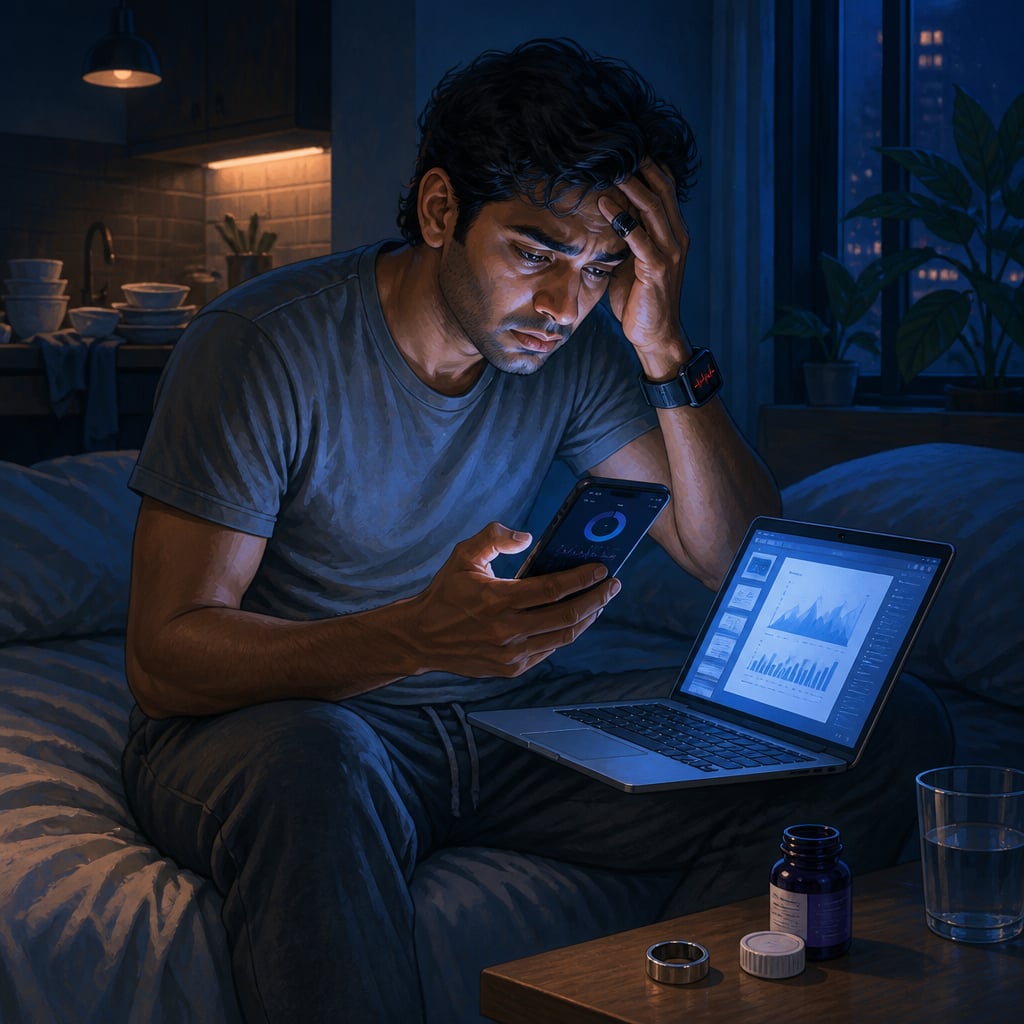
Rohan had already tried most of the things. He had an Oura ring. He had a meditation app. He had a sleep-tracking mattress cover. He had spent the equivalent of three months' rent on products marketed to him by the global sleep industry, which in 2024 was valued at approximately five hundred and eighty-five billion dollars ($585 billion) and was growing at double-digit rates. He was, by every measurable input, trying hard. His sleep score that week was sixty-two out of a hundred.
What none of the apps and rings had told him was that his problem was not a hardware problem. It was a doctrine problem. He had no rātricaryā.
Rātricaryā: Conduct for the Night
The Sanskrit word is rātricaryā. Rātri means night. Caryā means conduct, the way one carries oneself through a stretch of time. Rātricaryā is the classical Ayurvedic protocol for the evening hours, from roughly sunset to sleep, and for what surrounds sleep on either side.
The Caraka Saṃhitā treats it as a subset of dinacaryā, daily conduct. The Aṣṭāṅga Hṛdaya devotes substantial passages to it, because Vāgbhaṭa understood that the quality of a day is set by the quality of the preceding night, and the quality of the night is set by what happens in the two hours before sleep.
The doctrine is straightforward. The hours after sunset belong to rest. The hours of sleep belong to repair. Anything that disrupts either one disrupts the next day. Disruption, repeated night after night, becomes disease.
What the Aṣṭāṅga Hṛdaya Said About Staying Awake
Vāgbhaṭa, writing around 600 CE in Sindh, had seen the consequences of jāgara, staying awake at night, often enough that he gave it a technical place in his pathology.
रात्रौ जागरणं रूक्षं वातपित्तकरं मतम्। दिवास्वप्नश्च कफश्लेष्माणं वर्धयति नित्यशः॥
rātrau jāgaraṇaṃ rūkṣaṃ vāta-pitta-karaṃ matam divā-svapnaś ca kapha-śleṣmāṇaṃ vardhayati nityaśaḥ
Staying awake at night is drying. It aggravates vāta and pitta. Sleeping during the day, in turn, always increases kapha.
Aṣṭāṅga Hṛdaya, Sūtrasthāna 7.55
Two of the three doṣas get worse when you stay awake past your window. Vāta, the doṣa of movement and the nervous system, dries out. The body does not get its moisture and stillness time. Pitta, the doṣa of heat and transformation, is pushed past its cooling window and begins to smoulder. In modern language, the sympathetic nervous system stays switched on and the parasympathetic never gets a turn at the wheel.
This is not a moralistic warning about laziness. It is a statement about physiology. The body has a schedule. When you miss its schedule repeatedly, it begins to charge you.
The Two Windows
Āyurveda divides the evening into two windows, each governed by a different doṣa.
- 6 pm to 10 pm (kapha window): slow, heavy, settling. The body is winding down. Appetite is moderate. The eyes grow heavy early in this window. The natural urge is to eat lightly, rest the body, slow the mind. This is the window in which sleep should begin.
- 10 pm to 2 am (pitta window): hot, processing, repairing. The body moves into its deep repair mode. Liver work peaks. Hormonal resets occur. If you are awake in this window, the pitta that should be repairing the body is instead fuelling wakefulness. Hunger returns. The mind feels oddly sharp. This is the "second wind" that working professionals know well, and it is the wind that steals the next day.
The cue is built in. The drowsiness of nine o'clock is not a distraction from your real work. It is the body opening the door.
Jalpāna and the Evening Meal
The classical texts are specific about the evening meal. It should be lighter than the midday meal. It should be eaten at least three hours before sleep. It should contain something warm and something easily digestible. Heavy curd, raw salads, fried foods, and red meat after sunset are, in Vāgbhaṭa's language, guruvipāka. They carry heavy post-digestive action. The body cannot finish with them before it lies down, and the work continues into sleep.
The evening fluid recommendation is called jalpāna. Warm water or warm herbal preparations, not cold water and not cold drinks. Cold fluids at night arrest the digestive fire that is trying to clear the last meal. A cup of warm water with a few strands of saffron, or a thin slice of ginger, is the classical night drink.
Simple rule: if your dinner still feels present at bedtime, it was too heavy, too late, or both. Retune until the stomach is quiet when the body lies down.
Abhyaṅga and Brāhmī Taila

Before sleep, classical rātricaryā prescribes gentle oil application to specific points. The soles of the feet are oiled with warm sesame or warm brāhmī taila, an oil infused with Bacopa monnieri, a herb shown in multiple modern trials to support cognition and reduce anxiety. Five minutes of slow foot massage at bedtime draws the body's awareness downward, cools the pitta around the eyes, and signals to the nervous system that the day is finished.
पादाभ्यङ्गाद्रात्रौ सुखनिद्रा प्रवर्तते।
pādābhyaṅgād rātrau sukha-nidrā pravartate
From foot massage at night, comfortable sleep comes forth.
Aṣṭāṅga Hṛdaya, Sūtrasthāna 2.8

Brāhmī oil on the crown of the head is prescribed for students, writers, and those whose minds race at bedtime. It is the same oil the Kerala tradition uses for śirodhārā, the slow-streamed oil pour between the eyebrows that has become a popular spa treatment. The spa version is fine. The nightly five-minute self-application is closer to the classical practice and more sustainable.
The Sleep Timing
Classical texts give a specific target. Sleep should begin by the end of the kapha window. Rohan's ten-thirty target was close to the classical recommendation. The Aṣṭāṅga Hṛdaya's implicit model, adjusted for sunset in a temperate location, puts sleep onset between nine-thirty and ten-thirty.
- Before 10 pm: the kapha window still holds. Sleep onset is easy. The first sleep cycle falls inside the body's own repair clock.
- After 10 pm: the pitta window has opened. Sleep onset is progressively harder. Cortisol, which should be trending down, trends up again. This is the physiological basis of the "second wind".
Rohan was going to bed at one. He was eating his last meal at nine. He was looking at a blue-glowing screen until the moment his head hit the pillow. The body had been told, every night for three years, that night was when work happened. The body had finally begun to believe it.
What Rohan Changed
Dr. Kurup, when Rohan eventually found him, gave him six instructions. They did not involve supplements, wearables, or apps.
- Finish the evening meal by seven-thirty. Make it light, warm, and home-cooked whenever possible.
- No screens after nine. Use paper for anything that must continue.
- Oil the soles of the feet for five minutes at nine-forty-five, every night, without exception.
- Sip a small cup of warm water with two strands of saffron at ten.
- Lie down by ten-fifteen. Lights out by ten-thirty.
- On days you break the rules, resume them the next day without guilt. Consistency is the practice.
Rohan's sleep score climbed to eighty within three weeks. His seven-in-the-morning San Francisco calls stopped feeling like punishment. He kept the Oura ring, because he liked the data, but he stopped needing it to tell him when he was sleeping well. His body had started telling him directly.
Modern Echoes
The emerging field of chronobiology has produced a steady stream of findings that echo rātricaryā. In 2017, Matthew Walker's Why We Sleep summarized two decades of research showing that sleep-onset timing matters as much as sleep duration. In 2021, a large British study in the European Heart Journal followed 88,000 adults using wearable devices and found that those who went to sleep between ten and eleven at night had the lowest rates of cardiovascular disease. Risk rose progressively as sleep onset moved later. The researchers did not cite the Aṣṭāṅga Hṛdaya. The Aṣṭāṅga Hṛdaya had named the window fourteen centuries earlier.
The five-hundred-billion-dollar sleep industry is, in one view, the modern symptom of the failure of rātricaryā. A society that has forgotten how to sleep buys tools to fake the memory.
The Door the Body Keeps Opening
At nine-forty-five every night, whether Rohan is at his laptop or not, a small door opens inside him. His eyelids grow slightly heavy. His shoulders drop. His breath slows. This is the body, telling him the day is ready to end.
For three years, he had walked past the door. It had kept opening. He had kept walking past. Rātricaryā is the small act of stopping when the door opens, and going through.
The sleep industry cannot sell him that. The door is already inside him. It always was.
Key figures
Vāgbhaṭa
Provided the most systematic classical presentation of rātricarya in the Aṣṭāṅga Hṛdaya, including detailed guidance on evening routines, sleep timing, sleeping direction, and the consequences of disrupted sleep patterns.
Caraka
Established sleep as one of the three pillars (upastambhas) of life alongside food and brahmacarya, elevating its status to essential rather than optional. Provided doṣic analysis of sleep disturbances.
Matthew Walker
Neuroscientist whose book 'Why We Sleep' (2017) brought sleep science to mainstream attention, documenting the devastating effects of sleep deprivation and the mechanisms of sleep's restorative functions.
Case studies
Rohan Bhatia and the Door the Body Keeps Opening
At 11 pm on a Tuesday in April 2024, Rohan Bhatia, a 31-year-old founder in Koramangala, Bengaluru, sat watching the blue glow of his laptop. His Slack was open. His calendar had a 7 am call with a client in San Francisco. He had tried most of the sleep products the $585 billion global sleep industry had to sell: an Oura ring, a sleep-tracking mattress cover, blackout curtains, melatonin tablets, a meditation app. His sleep score that week was 62 out of 100. His problem, he eventually learned, was not a hardware problem. It was a doctrine problem. He had no rātricaryā.
Historical context
Classical Āyurvedic Period (c. 600 BCE to 600 CE) and the Modern Sleep-Medicine Era
Living traditions
Rātricaryā's legacy is the modern sleep-medicine consensus that re-discovered what the Aṣṭāṅga Hṛdaya named in 600 CE: sleep onset before the kapha window ends is easier and healthier than sleep onset inside the pitta window. Matthew Walker's Why We Sleep, the 2021 European Heart Journal study of 88,000 adults, and the chronobiology literature all point in the same direction. The $585 billion sleep industry is the modern symptom of the classical doctrine's absence.
Reflection
- The classical kapha window runs from 6 pm to 10 pm, the body's natural opening to sleep. On your most recent evening, did you enter sleep inside that window, or did you push into the pitta window (10 pm to 2 am)?
- The lesson quotes the Aṣṭāṅga Hṛdaya 7.55: jāgara (staying awake at night) aggravates vāta and pitta. Can you identify the physical signs of that aggravation in yourself the day after a late night?
- The $585 billion global sleep industry sells products for a problem that our lifestyles create. What does this reveal about our culture's preferred relationship with the body: do we want to listen to it or override it?
- Rohan's six-step routine included no supplements, no wearables, no apps. Which of the six feels most natural to adopt in your own life, and which feels hardest? Start with the easiest for one week.
- The Aṣṭāṅga Hṛdaya 2.8 promises sukha-nidrā (comfortable sleep) from pādābhyaṅga (oiling the feet). Try it for five nights. Describe what changed and whether the classical claim holds up for you.