Ṛtucarya: Seasonal Living in a Season-Less World
Ancient seasonal regimens meeting climate-controlled modern life
How ṛtucarya (seasonal regimens) offers wisdom for reconnecting with natural cycles in an artificially regulated world.
The Season That Never Arrived

In June of 2023, an IT project manager in Bengaluru named Ananya Rao noticed she was tired all the time. She was thirty-four. She ate well. She slept eight hours. She exercised three times a week. Her office was cooled to twenty-two degrees Celsius year-round. Her grocery store carried the same strawberries in January that it carried in June. Her life, measured by the metrics she cared about, was going fine. But her body was telling her something was off.
Her family doctor ran the usual tests. Thyroid normal. B12 normal. Blood sugar normal. CBC clean. He shrugged and suggested she try yoga.
Instead, she went to see Dr. Venugopal Kurup, a Kerala-trained Ayurvedic physician whose clinic sat above a medical shop on a narrow lane off MG Road. Dr. Kurup asked her one question her family doctor had not asked. He asked her what she had eaten for the last three days. Then he asked her what the weather had been like. Then he told her something she had never heard from any physician before.

"Your body," he said, "thinks it is still spring. But your stomach thinks it is winter. And your mind does not know what season it is at all."
What Dr. Kurup was diagnosing was not a disease her blood tests could detect. It was a condition that Indian medicine has a name for, and that modern life makes almost universal. Her body had lost its sense of time.
Ṛtucaryā: Conduct According to Season
The Sanskrit word is ṛtucaryā. Ṛtu means season. Caryā means conduct, regimen, the way one carries oneself. Ṛtucaryā is the system of adjustments, in diet, sleep, exercise, and daily ritual, that keep the body aligned with the cycle of the year.
It is one of Āyurveda's oldest preventive doctrines. The Caraka Saṃhitā, compiled by the first century CE, gives it a full chapter. The Aṣṭāṅga Hṛdaya of Vāgbhaṭa, written around 600 CE, treats it as the cornerstone of all preventive medicine. The idea is simple. The body is a small weather system nested inside a large weather system. What happens in the large one changes what should happen in the small one.
Modern medicine is starting to catch up with this. In 2017, Jeffrey Hall, Michael Rosbash, and Michael Young received the Nobel Prize in Physiology or Medicine for discoveries about the molecular clocks that regulate daily and seasonal rhythms in living organisms. They showed what Vāgbhaṭa had asserted without molecular tools. The body is a rhythm machine. The rhythm is set by the sun.
The Six Seasons
Where modern meteorology counts four seasons, Indian medicine counts six. Each lasts approximately two months. Each has a distinctive quality and demands its own conduct.
- Vasanta (spring, mid-March to mid-May): the season of flowering, warming, kapha dissolution
- Grīṣma (summer, mid-May to mid-July): the season of heat, sweating, fluid loss
- Varṣā (monsoon, mid-July to mid-September): the season of rain, digestive weakness, vāta aggravation
- Śarad (autumn, mid-September to mid-November): the season of clearing skies, pitta provocation
- Hemanta (early winter, mid-November to mid-January): the season of cold, strong digestion, deep nourishment
- Śiśira (late winter, mid-January to mid-March): the season of biting cold, continued strength, preparation for spring
This six-fold division is not an ornamental refinement. It encodes something about the Indian subcontinent that the four-season model cannot. India has a monsoon. A single category called "summer" conflates the dry scorch of May with the cool drench of August. To a body trying to stay well, they are not the same season.
When Agni Is Strongest
One of Ṛtucaryā's most counterintuitive teachings concerns digestion. Modern popular wisdom holds that winter makes you lazy and sluggish. Āyurveda says the opposite. In winter, specifically in hemanta and śiśira, your digestive fire, agni, is at its strongest.
The logic is simple. When the external environment is cold, the body draws heat inward. The skin contracts. The pores close. Blood concentrates in the core. The digestive furnace burns hot because the body has no choice. It must generate its own warmth from within, and food is the fuel.
उष्मा स्वस्थानसंस्थितः शीते संवर्ध्यते बलम्। तस्माद्धेमन्तशिशिरयोर्बलवान्भवति नरः॥
uṣmā svasthāna-saṃsthitaḥ śīte saṃvardhyate balam tasmād dhemanta-śiśirayor balavān bhavati naraḥ
The body's heat, gathered at its own seat, strengthens in the cold. Therefore in hemanta and śiśira, a person is strong.
Aṣṭāṅga Hṛdaya, Sūtrasthāna 3.2
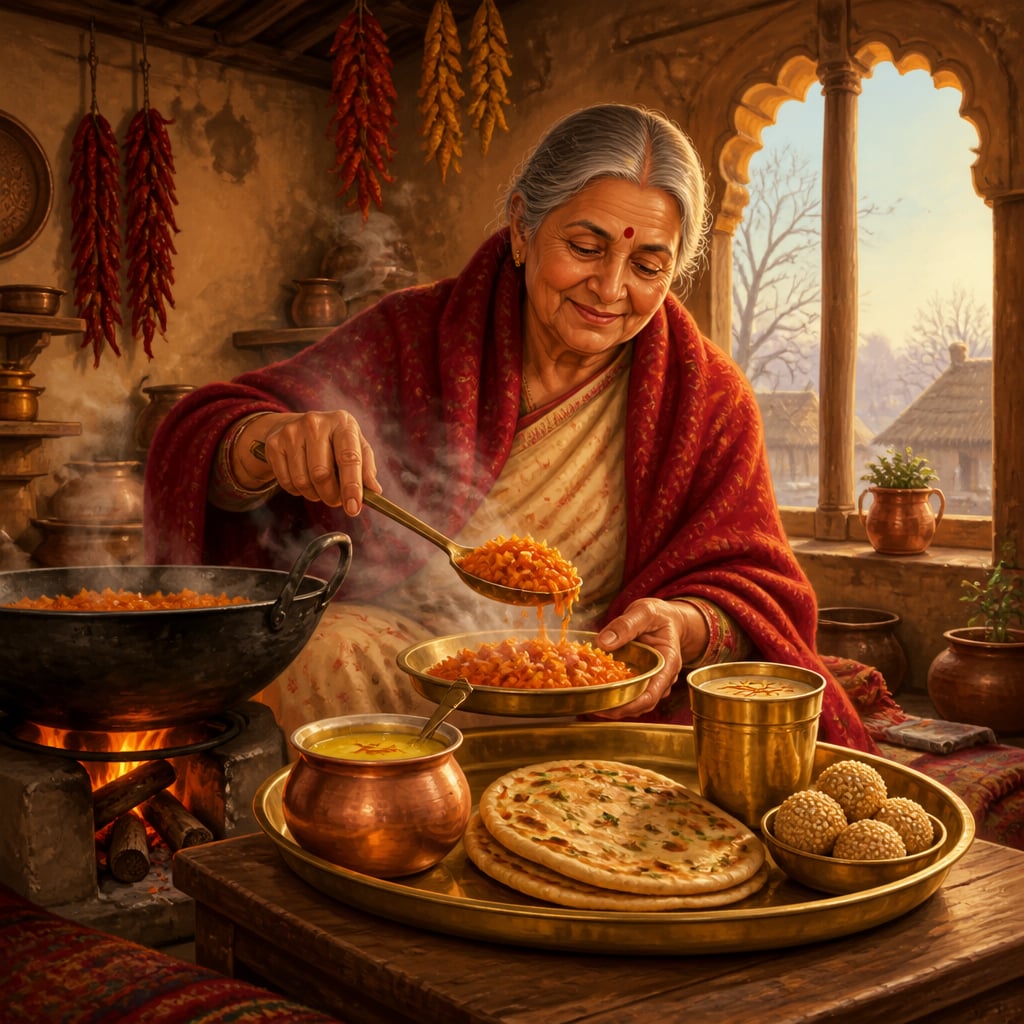
This is why traditional Indian kitchens, from Punjab to Kerala, serve their heaviest and most ghee-rich foods in winter. Gajar ka halwa. Masala khichdi loaded with ghee. Til laddus. Urad dal. Sesame sweets. Long-cooked meat preparations. The body in winter can handle them, because agni is ready for them.
In summer the opposite pattern holds. The external heat pushes the body's warmth outward. Blood concentrates at the skin to dump heat. The core cools. Agni weakens. This is why a heavy winter meal in July feels like an anvil in the stomach. The stove is running low, and you have piled wood on it.
Rule of thumb: eat heaviest in winter, lightest in summer. Let the season tell the stomach what it wants.
Ṛtu Sandhi: The Dangerous Junctions
Between each season sits a bridge. The Sanskrit term is ṛtu sandhi. Sandhi means junction, seam, the place where two things meet. The seven days on each side of each seasonal transition, fourteen days in all, form the ṛtu sandhi window.
The ancient physicians warned that this is where most disease begins. The body has not yet adjusted to the new season. The old routine is still running. The new routine has not started. Agni wavers. Immunity dips. Old conditions flare. New conditions seed.
What to do in ṛtu sandhi:
- Shift diet and routine gradually over the fourteen days, not abruptly on day one of the new season.
- Drop the previous season's habits before adding the next season's habits.
- Avoid heavy foods, late nights, and intense exercise during the junction.
- Watch the body's signals more carefully than usual.
- If panchakarma is planned, time it to fall just before or just after a ṛtu sandhi, not during it.
Dr. Kurup told Ananya that ninety percent of the patients who walked into his clinic had become ill in a ṛtu sandhi window. They had eaten summer food on the first cool evening of October. They had kept up their winter ghee into the first hot week of April. The body had not been given time to change gears.
The Season for Panchakarma
Classical Āyurveda does not prescribe panchakarma year-round. Each of the five cleansing therapies has its ideal season.
| Therapy | Action | Ideal Season |
|---|---|---|
| Vamana (therapeutic emesis) | Expels excess kapha | Vasanta (spring) |
| Virechana (purgation) | Expels excess pitta | Śarad (autumn) |
| Basti (medicated enema) | Pacifies vāta | Varṣā (monsoon) |
| Nasya (nasal therapy) | Clears head and sinuses | Ṛtu sandhi windows |
| Raktamokṣaṇa (bloodletting) | Clears rakta and pitta | Śarad (autumn) |
The reason is biological. Each doṣa reaches its natural seasonal peak, and cleansing at peak is easier than cleansing at trough. Kapha accumulates through winter and melts in spring, which is why traditional Kerala clinics run vamana camps in March and April. Pitta accumulates through monsoon and peaks in autumn, which is why virechana camps fill in September and October.
A modern wellness spa that offers "panchakarma" in every month of the year is not doing panchakarma. It is doing massage and steam treatments under a classical name. The classical practice is not year-round. It is keyed to the calendar of the sky.
What Ananya Changed
When Ananya walked out of Dr. Kurup's clinic that first evening, she had a one-page handwritten sheet. It did not contain any supplements. It did not contain any lab tests. It contained six instructions.
- Eat the season's produce. If it does not grow in Karnataka in June, do not eat it in Karnataka in June.
- Drink warm water for the first month. Cold water will return after your agni has re-tuned.
- Turn off the AC at home. Use a fan. Let the body feel the season it is actually in.
- Stop eating after sunset for three weeks. Let dinner slide to an early, light meal.
- Walk for twenty minutes at sunrise, outdoors, without earphones, without a phone.
- Come back in six weeks.
She came back in six weeks. She was sleeping better. She had lost the low-grade headache she had carried for two years. She had energy after lunch again. Her family doctor ran her bloodwork again and found nothing different. Her body had not changed. Her alignment with time had changed.
Modern Echoes
The Nobel-winning chronobiology work of Hall, Rosbash, and Young is one parallel. Another is the emerging field of seasonal nutrition, which is rediscovering what Indian kitchens never forgot. Satchidananda Panda at the Salk Institute has spent two decades showing that meal timing, circadian rhythm, and seasonal light exposure alter metabolism at the level of gene expression.
In 2019, a large Italian cohort study published in Nutrients found that adherence to seasonal, local diets correlated with significantly lower incidence of metabolic syndrome, independent of total caloric intake. The authors did not cite Vāgbhaṭa. But Vāgbhaṭa had made the same claim in 600 CE. The body eats time as much as it eats food.
The Season Was Always Trying to Reach Her
Ananya's body had not been broken. It had been ignored. The cooling vents of her office, the year-round berries, the climate-controlled gym, the screens that mimicked daylight at eleven at night: all of it had told her body the same misleading story. That time had stopped. That every day was the same day. That there were no seasons to adjust to. Her body, being older than her calendar, had disagreed.
The season was still reaching her. She had stopped listening. Ṛtucaryā is the listening, resumed.
Key figures
Caraka
Provided the most comprehensive classical exposition of ṛtucarya in the Sūtrasthāna (Chapter 6), detailing dietary and lifestyle prescriptions for each season with underlying doṣic rationale. Established the Ādāna-Visarga framework for understanding half-yearly cycles.
Suśruta
Added surgical considerations to seasonal practice,identifying which procedures are safer in which seasons. Contributed the concept that seasonal awareness extends to medical interventions, not just diet and lifestyle.
Vāgbhaṭa
Synthesized and systematized Caraka and Suśruta's seasonal teachings in accessible verse form. His Aṣṭāṅga Hṛdaya's ṛtucarya chapter became the standard teaching text for practical seasonal application.
Jeffrey Hall, Michael Rosbash, and Michael Young
Awarded the 2017 Nobel Prize in Physiology or Medicine for discovering the molecular mechanisms that control circadian rhythm. Their work demonstrated in modern molecular terms what Vāgbhaṭa had asserted without molecular tools: the body is a rhythm machine, and its rhythm is set by the sun.
Satchidananda Panda
Professor at the Salk Institute for Biological Studies whose two decades of research has shown that meal timing, circadian rhythm, and seasonal light exposure alter metabolism at the level of gene expression. His work on time-restricted eating mirrors classical Āyurvedic teachings on when and how to eat through the day and year.
Case studies
The Tired Professional: How Ananya Rao Rediscovered Seasonal Timing
In June 2023, Ananya Rao, a 34-year-old IT project manager in Bengaluru, noticed she was tired all the time despite eating well, sleeping eight hours, and exercising regularly. Her office was climate-controlled to 22 degrees Celsius year-round. Her grocery store carried the same strawberries in January and June. Her family doctor ran standard blood work and everything was normal. He suggested yoga. Instead, she visited Dr. Venugopal Kurup, a Kerala-trained Ayurvedic physician. His diagnosis was neither a disease nor a deficiency. Her body, he told her, had lost its sense of time.
Historical context
Classical Āyurvedic Period (600 BCE to 600 CE) and the Modern Chronobiology Era
Living traditions
Ṛtucarya's legacy shows up wherever modern life rediscovers seasonal timing: in the chronobiology laboratories at the Salk Institute, in the 2017 Nobel citation for Hall, Rosbash, and Young, in the seasonal-diet research validating what Vāgbhaṭa wrote in 600 CE, and in Kerala panchakarma centres that still schedule therapies by the calendar of the sky. The modern conversation about 'seasonal eating' is not new. It is classical Āyurveda returning through a scientific vocabulary.
Reflection
- How many of the foods you ate this week actually grew in your region during this season? What does your answer reveal about your alignment with ṛtucarya?
- The lesson claims that hemanta and śiśira (winter) are when agni (digestive fire) is strongest. Think about the last winter meal you ate. Does your experience match classical Āyurveda's claim, or does modern life obscure this signal?
- Ṛtu sandhi, the fourteen-day junction between seasons, is identified as the most disease-prone window. Can you recall a recent illness or slump? Did it coincide with a seasonal transition?
- If your work requires fixed year-round hours and climate-controlled environments, which classical ṛtucarya principles can still be honored, and which are genuinely out of reach?
- Dr. Kurup's prescription to Ananya contained no pills, no lab tests, no supplements. Which of his six instructions feels most useful for your own life right now, and which feels most difficult to implement?