Dinacaryā Kriyās: Morning Rituals Before They Went Viral

Traditional morning cleansing practices now trending as wellness hacks

Oil pulling, tongue scraping, neti, and other dinacaryā practices that have found new life in modern wellness culture. Traces how ancient cleansing rituals became Amazon bestsellers and Instagram trends.

The Wellness Aisle Time Machine

Whole Foods wellness aisle of Ayurvedic products

Walk down the wellness aisle of any Whole Foods, Target, or pharmacy in America. You'll find copper tongue scrapers in minimalist packaging ($15-30), organic sesame oil marketed for 'pulling' ($20+), stainless steel neti pots ($25), and dry brushes made from cactus fiber ($35). The combined market for these products exceeds $200 million annually in the US alone.

The marketing copy speaks of 'ancient detox secrets,' 'Ayurvedic wisdom,' and 'traditional self-care.' What it doesn't mention is that these practices were part of an integrated morning routine documented in Sanskrit texts over 1,500 years ago, a system called dinacaryā kriyās.
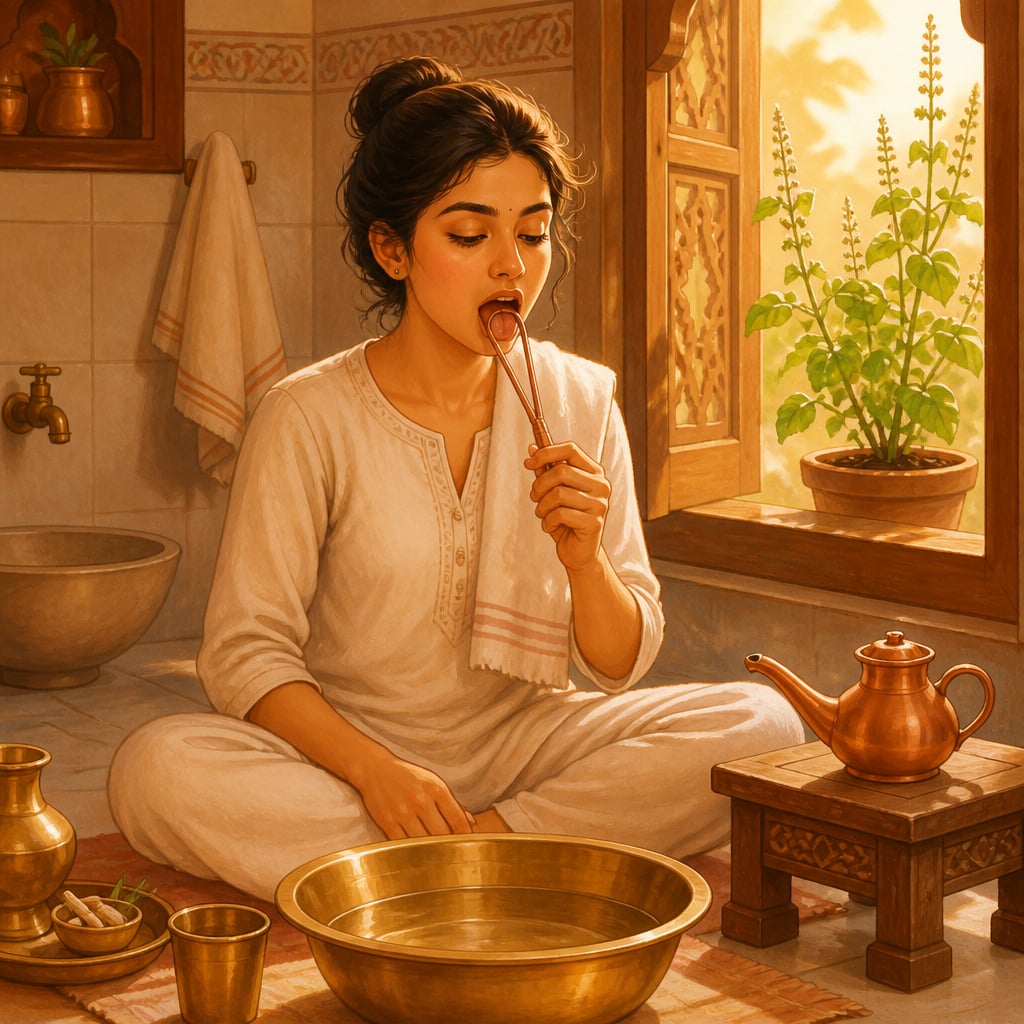
Young woman performing tongue scraping at a brass basin at dawn

These aren't isolated 'wellness hacks.' They're fragments of a comprehensive morning cleansing sequence that traditional Āyurveda prescribed for maintaining health and preventing disease. The modern wellness industry has extracted individual practices, repackaged them with premium branding, and sold them back to consumers searching for what traditional cultures never lost.

The story of how morning rituals went viral reveals the peculiar way ancient wisdom travels into modern life, one Instagram post at a time.

The Complete Traditional Morning Sequence

To understand what the wellness industry extracted, we must first see what the complete system contained. The Aṣṭāṅga Hṛdaya outlines a morning sequence designed to cleanse the sense organs and prepare the body for the day:

1. Uṣaḥpāna (Dawn Water) Upon waking, drink water stored overnight in a copper vessel. The water absorbs trace copper ions that support digestive fire. This practice, now sold as 'copper water', prepared the system for elimination.

2. Mala Visarjana (Elimination) The texts emphasize attending to natural urges immediately upon rising. Suppressing the urge to eliminate was considered a major cause of disease.

3. Danta Dhāvana (Teeth Cleaning) Cleaning teeth with twigs from specific trees, neem, babul, or licorice, that have both mechanical cleaning action and medicinal properties. The modern toothbrush with commercial paste is a pale substitute.

4. Jihvā Nirlekhana (Tongue Scraping) Using a curved metal scraper (gold, silver, copper, or stainless steel) to remove the coating (āma) accumulated on the tongue overnight. This coating was considered toxic residue reflecting the state of digestion.

5. Gaṇḍūṣa/Kavala (Oil Holding/Swishing) Holding or swishing warm sesame oil in the mouth to strengthen gums, teeth, and jaw, and to draw toxins from the oral cavity. The duration and technique differed based on therapeutic goal.

6. Añjana (Eye Cleansing) Applying medicated substances to the eyes to clear vision and prevent eye diseases. Different preparations for daily use versus therapeutic use.

7. Nasya (Nasal Drops) Instilling medicated oil in the nostrils to keep nasal passages clear, nourish the brain, and prevent diseases of the head. This daily practice (pratimarśa nasya) used small amounts of sesame oil or ghee.

8. Abhyaṅga (Oil Massage) Self-massage with warm sesame oil before bathing. The oil nourishes skin, calms Vāta, and supports the nervous system.

9. Snāna (Bathing) Bathing after oil massage, ideally with warm water for the body and cooler water for the head.

This sequence took perhaps 30-45 minutes, a significant investment by modern standards, but traditional cultures built daily life around such routines rather than treating health as separate from living.

Tongue Scraping: The $50 Million Sensation

Of all the dinacaryā kriyās, tongue scraping has perhaps the most straightforward journey to mainstream acceptance. The practice is simple, the benefits are immediately observable, and the product is easy to manufacture and sell.

The Traditional Practice (Jihvā Nirlekhana)

The Caraka Saṃhitā states that the tongue should be scraped gently with a curved metal instrument to remove 'mala' (waste matter) accumulated overnight. The coating on the tongue, white, yellow, or brown, was read as diagnostic information about digestive health. Heavy coating indicated āma (undigested toxins); no coating indicated healthy digestion.

Traditional scrapers were made from precious metals (gold, silver) for those who could afford them, or copper and brass for common use. The metal mattered: gold was considered most sattvic, silver cooling, copper antimicrobial.

The Western Discovery

Tongue scraping entered Western awareness through two channels. Dental research in the 1990s and 2000s began confirming that tongue bacteria contributed significantly to bad breath and oral health issues. Simultaneously, yoga practitioners returning from India began sharing Āyurvedic practices with American audiences.

The wellness industry recognized opportunity. Copper tongue scrapers appeared on Amazon around 2015, initially sold by Āyurveda-focused brands. By 2020, major wellness companies had entered the market. The hashtag #tonguescrap generated over 100 million views on TikTok.

What's Preserved, What's Lost

Modern tongue scraping preserves the mechanical action, removing the coating, and the general understanding that this supports oral hygiene. What's often lost:

The $15 copper scraper from Amazon works. But it's a fragment removed from its context, like buying a single puzzle piece and calling it a puzzle.

Oil Pulling: From Gwyneth to Grandmothers

Oil pulling's viral trajectory is more complex. Unlike tongue scraping, which is intuitive, swishing oil in your mouth for 15-20 minutes seems strange to modern sensibilities. It took celebrity endorsement to overcome the 'weirdness factor.'

The Traditional Practice (Gaṇḍūṣa and Kavala)

Āyurveda distinguishes between two practices:

Gaṇḍūṣa: Filling the mouth completely with liquid (oil, medicated decoctions, or other substances) and holding it still until tears flow from the eyes or the mouth fills with secretions. This is a therapeutic practice, not daily hygiene.

Kavala: Swishing a smaller amount of oil gently in the mouth for a specific duration. This is the daily practice, using warm sesame oil (or coconut oil for Pitta constitutions).

The traditional texts describe specific benefits: strengthening teeth and gums, preventing cracked lips, improving voice quality, enhancing taste perception, and drawing out kapha (mucus) from the head. The oil was believed to 'pull' toxins from the tissues, hence the modern name.

The Ukrainian Detour

Oil pulling entered Western awareness through a peculiar route. In 1992, a Ukrainian physician named Dr. F. Karach presented a paper at a Ukrainian oncology conference claiming dramatic healing results from oil swishing. His protocol, sunflower or sesame oil, swished for 15-20 minutes until it turned white, spread through alternative health networks.

Karach's claims were extreme (curing everything from arthritis to cancer), but the practice he described was essentially kavala from Āyurveda. Whether Karach knew of the Āyurvedic origins is unclear; he presented it as a 'ancient Russian folk remedy.'

The Celebrity Amplification

Oil pulling remained a niche practice until the 2010s, when wellness influencers discovered it. Gwyneth Paltrow's Goop featured oil pulling in 2014, calling it a 'morning ritual worth adding to your routine.' The practice exploded: Coconut oil sales surged, 'oil pulling mouthwash' products appeared, and the hashtag generated tens of millions of social media posts.

The Science Situation

Modern research on oil pulling is limited but suggestive. Studies have shown reduction in oral bacteria, improvement in gum health, and decreased bad breath with regular practice. The mechanism isn't mystical 'toxin pulling', it's likely the mechanical action of swishing combined with oil's antimicrobial properties.

What research hasn't confirmed are the dramatic systemic claims (detoxifying the whole body, curing chronic disease). The traditional texts made more modest claims, supporting oral health and preventing kapha accumulation in the head, which align better with the evidence.

What's Preserved, What's Lost

Modern oil pulling preserves the basic practice and achieves some of the oral health benefits. What's lost:

The Economics of Extraction

The dinacaryā kriyās market illustrates a broader pattern in wellness capitalism: traditional practices, freely available in source communities, are extracted, repackaged, and sold at premium prices to consumers disconnected from tradition.

Consider the economics:

This isn't necessarily exploitation, modern companies provide convenience, quality control, and accessibility. But it reveals something about how value gets created and captured when traditional knowledge enters market economies.

The Complete Morning Sequence for Modern Life

How might a modern person practice dinacaryā kriyās authentically, not as isolated hacks but as integrated routine?

Practical Integration (30 minutes)

5:30-5:35 AM: Hydration and Elimination Drink a glass of warm water (from copper vessel if you have one) upon waking. Attend to natural urges.

5:35-5:40 AM: Oral Cleansing Scrape tongue with copper or stainless steel scraper (7-14 gentle strokes). Observe the coating, thick coating suggests incomplete digestion; adjust dinner accordingly.

5:40-5:55 AM: Oil Practices Swish 1 tablespoon of warm sesame oil (or coconut for Pitta types) gently for 10-15 minutes. During this time, you can shower or do light stretching. Spit into trash (not sink, oil clogs drains), rinse with warm salt water.

5:55-6:00 AM: Nasal Care Apply a drop of sesame oil or ghee to each nostril, gently sniffing up. If congested, use neti pot with warm saline solution first.

Man performing abhyanga self-massage with warm sesame oil

6:00-6:15 AM: Self-Massage Apply warm sesame oil to body with firm strokes toward heart. Pay special attention to feet, scalp, and ears. Let oil absorb for 5-10 minutes.

6:15-6:25 AM: Bathing Shower with warm water. The oil creates a protective layer; don't scrub it all off.

6:25-6:30 AM: Dressing and Transition Dress, complete any spiritual practice, prepare for breakfast.

This sequence can be compressed or expanded based on available time. Even 10 minutes of abbreviated practice, tongue scraping, brief oil swishing, warm water, provides benefit. The key is consistency and awareness, not perfection.

Constitutional Adjustments

For Vāta types (tend toward dryness, anxiety, irregular digestion): Use more oil, massage more thoroughly, keep everything warm. Vāta benefits most from abhyaṅga.

For Pitta types (tend toward heat, inflammation, sharp digestion): Use coconut oil instead of sesame in summer or if experiencing heat symptoms. Can reduce oil quantities. Pitta benefits most from cooling nasal practice.

For Kapha types (tend toward heaviness, congestion, slow digestion): Can use less oil, more vigorous dry brushing before oil, and warming spices in water. Kapha benefits most from tongue scraping and neti (clearing mucus).

What the Influencers Don't Tell You

The wellness industry presents dinacaryā kriyās as detoxification and self-care. This framing, while not wrong, misses deeper dimensions:

The Diagnostic Dimension Traditional practitioners read the morning body as information. Tongue coating reveals yesterday's digestion. Stiff joints indicate accumulated Vāta. Congestion points to Kapha imbalance. The kriyās aren't just cleansing, they're daily check-ins with your body's state.

The Preventive Philosophy Āyurveda's core insight: disease is easier to prevent than cure. The morning routine catches small imbalances before they become symptoms. This requires attention, not just action, noticing what you're clearing, not just clearing it.

The Sensory Awareness Each kriyā attends to sense organs: eyes, ears, nose, mouth, skin. Traditional cultures understood that clear senses mean clear perception, and clear perception supports right action. The sequence cultivates embodied awareness that modern life constantly degrades.

The Ritual Dimension The morning routine wasn't purely medical, it was ritual transition from sleep to waking, from personal to social, from night consciousness to day consciousness. This threshold-crossing had spiritual significance that 'self-care hack' framing entirely misses.

The copper tongue scraper works whether or not you understand this context. But understanding transforms a hygienic routine into a practice of self-knowledge.

The Return of the Morning Ritual

Despite the commodification and fragmentation, something genuine is happening. Millions of people are adopting morning practices their great-grandparents might have recognized, not because tradition told them to, but because they feel better when they do.

The wellness industry, for all its excesses, has reintroduced practices that industrial modernity had nearly eliminated. The copper tongue scraper on the bathroom counter, the oil for pulling beside the sink, the neti pot in the shower, these artifacts signal a culture searching for what it lost.

The opportunity now is integration: recognizing these practices as fragments of a coherent system, learning the complete sequence, adapting it to modern life, and understanding why, not just what, traditional cultures prescribed.

The morning ritual never really went away. It went into hiding during the industrial era, preserved in traditional households, Āyurvedic clinics, and yoga āśramas. Now it's emerging again, mediated by Instagram algorithms and Amazon Prime delivery.

The question is whether we'll receive just the products or also the wisdom, whether we'll practice kriyās as wellness hacks or as daily self-knowledge.

The copper scraper awaits. What will you learn from your tongue tomorrow morning?

Even a compressed 15-minute version preserves the integrative benefit. Upon waking: drink warm water (2 minutes), tongue scrape while water is heating (1 minute), oil swish while showering (10 minutes), brief oil application to scalp and feet (2 minutes). The key is sequence and consistency, doing all steps in order, daily, rather than duration of each step.

Practice noticing before cleansing. What does your tongue look like before scraping? (Thick white coating = weak agni, likely too much or too late eating. Yellow coating = Pitta aggravation. No coating = healthy digestion.) What does your body feel like before oil massage? (Stiff joints = Vāta increase, need more oil and warmth. Heavy limbs = Kapha accumulation, need more movement and lighter food.)

Key figures

Vāgbhaṭa

Author of Aṣṭāṅga Hṛdaya, which provides the most comprehensive and practically organized description of dinacaryā kriyās. His systematic presentation became the reference standard for daily routine practices.

The dinacaryā chapter of Aṣṭāṅga Hṛdaya remains the primary reference for traditional practitioners. His integration of oral hygiene, skin care, and sense organ maintenance into a unified morning routine influenced Indian household practice for over 1,000 years.

Dr. F. Karach

Ukrainian physician who presented oil pulling at a 1992 oncology conference, introducing the practice to Western alternative health networks. His dramatic health claims helped spread the practice beyond Āyurvedic circles.

The Karach protocol (sunflower or sesame oil, 15-20 minutes, until oil turns white) became the Western standard for oil pulling. His influence demonstrates how practices can travel through unusual vectors, in this case, a Ukrainian conference rather than direct transmission from India.

Gwyneth Paltrow / Goop

Celebrity actress whose wellness company Goop became a major amplifier of Āyurvedic practices including oil pulling, tongue scraping, and dry brushing to mainstream Western audiences.

Love it or criticize it, Goop's platform accelerated mainstream adoption of traditional practices. The influence demonstrates how celebrity culture functions as a transmission vector for traditional knowledge, though often with emphasis on trendiness over depth.

Dr. Vasant Lad

Āyurvedic physician and founder of The Ayurvedic Institute who has taught authentic dinacaryā practices to Western students for four decades, providing traditional context often missing from wellness industry presentations.

His books (Ayurveda: The Science of Self-Healing, Textbook of Ayurveda series) provide accessible yet authentic instruction in dinacaryā. Practitioners who learn from his materials understand morning practices as part of a coherent system rather than random wellness tips.

Case studies

How Oil Pulling Became a 100-Million-View Trend

In January 2014, Gwyneth Paltrow's lifestyle brand Goop published an article titled 'Oil Pulling: Why I'm Hooked.' The piece described the practice as an 'Ayurvedic technique' involving swishing coconut or sesame oil for 15-20 minutes to 'draw out toxins.' Within weeks, oil pulling was trending on social media. The practice wasn't new - Āyurvedic texts had described gaṇḍūṣa and kavala for over 1,500 years, and Dr. Karach had introduced it to Western alternative health circles in the 1990s. But celebrity endorsement transformed a niche practice into a viral phenomenon. The numbers tell the story: Google searches for 'oil pulling' increased 600% between 2013 and 2015. Coconut oil sales surged. 'Oil pulling mouthwash' products appeared. The hashtag #oilpulling generated over 100 million views on TikTok by 2023. The scientific response was mixed. A 2017 systematic review found some evidence for reduced oral bacteria and improved gum health, but noted the studies were small and methodologically weak. Dental associations warned against replacing standard oral care. The dramatic 'detoxification' claims had no scientific support. What got lost in the viral spread: the distinction between daily kavala and therapeutic gaṇḍūṣa, the constitutional modifications (coconut vs. sesame for different types), the integration with other morning practices, and the traditional understanding of oral health as connected to digestive health and doṣa balance. The practice works - research suggests genuine oral health benefits from regular oil swishing. But what spread virally was a fragment, removed from its context, amplified by celebrity culture, and often practiced without understanding why it works or how to optimize it.

Charaka Samhita (Sutra Sthana 5.78-80) prescribes Kavala Graha (oil pulling) and Gandusha (oil holding) as daily practices using sesame oil (tila taila) for maintaining oral health, strengthening jaw muscles, and preventing dental diseases. The practice is part of a comprehensive morning routine, not an isolated intervention.

For those practicing oil pulling, knowing its traditional context opens new dimensions. The practice isn't primarily about 'detox' - it's about oral tissue health, taste perception, voice quality, and kapha management. Swishing coconut oil because Gwyneth does it is fine; swishing sesame oil with awareness of its effects on agni and doṣa balance is deeper.

Oil pulling's viral journey demonstrates how traditional practices travel in the social media age: celebrity amplification, hashtag proliferation, commercial adaptation, scientific scrutiny, and eventual mainstreaming. Each stage extracts the practice further from its source while making it more accessible. The question is whether accessibility compensates for depth lost.

Oil pulling generated 100 million social media views after Gwyneth Paltrow's endorsement, but clinical studies validate only its oral health benefits, not the 'toxin removal' claims that made it go viral. The actual traditional practice was a modest daily hygiene step, not a miracle detox protocol.

A 2022 systematic review in the Journal of Traditional and Complementary Medicine analyzed 21 RCTs and found that oil pulling with sesame or coconut oil reduced Streptococcus mutans counts by 20-30%, comparable to chlorhexidine mouthwash, with fewer side effects.

The $50 Million Tongue Scraper Market

In 2015, copper tongue scrapers were a niche product sold by Āyurveda-focused companies, primarily to yoga practitioners. By 2023, they were on the shelves of Target, Walmart, and every Whole Foods in America. The U.S. tongue scraper market exceeded $50 million annually. The product's journey from traditional implement to mass-market wellness item followed a predictable pattern: early adoption by yoga/wellness communities, amplification through social media, scientific validation (dental research confirming benefits), celebrity/influencer endorsement, and finally mass-market distribution. The economics are striking. A copper tongue scraper costs approximately $2 to manufacture. Basic models retail for $8-12; premium 'wellness branded' versions sell for $20-35. The markup reflects branding and positioning more than material quality - but consumers happily pay for the association with 'Ayurvedic self-care.' What the market captured: the mechanical practice (scraping the tongue), the material (copper or stainless steel), and the general benefit (oral hygiene, fresh breath). What the market missed: the diagnostic dimension (reading the coating), the sequence context (tongue scraping is step 4 of 9), the constitutional adaptation (different materials for different types), and the understanding of āma (the coating reflects digestive health, not just oral bacteria). The mass market delivers functional benefit with minimal traditional context - a trade-off that makes practices accessible while stripping them of depth.

Charaka Samhita (Sutra Sthana 5.75) prescribes Jihva Nirlekhana (tongue scraping) using gold, silver, or copper scrapers as a daily morning practice. The text describes it as essential for removing mala (waste) that accumulates on the tongue overnight, improving taste perception, and stimulating the digestive organs.

Having a copper tongue scraper is better than not having one - the practice delivers genuine benefit regardless of brand or price. But understanding why you're scraping (removing āma, assessing digestion, preparing for oil pulling) transforms a hygiene routine into a practice of self-knowledge. The premium you pay for the branded scraper could be reinvested in learning the complete tradition.

The tongue scraper market demonstrates how traditional knowledge enters commodity capitalism: the practice is extracted, standardized, branded, and sold at markup. Value accrues to companies that package and distribute rather than to source traditions that developed the knowledge. This isn't unique to Āyurveda - it's how traditional knowledge typically travels into market economies.

The $50 million tongue scraper market demonstrates how traditional knowledge enters commodity capitalism: a copper tool that cost pennies in Indian bazaars for centuries now sells for $15 to $30 at Whole Foods. Value accrues to branding and distribution, not to the tradition that developed the practice.

A 2023 study in the Journal of Clinical Periodontology found that tongue scraping reduced volatile sulfur compounds (the main cause of bad breath) by 75%, compared to 45% reduction from tongue brushing alone. The American Dental Association now includes tongue cleaning in its oral hygiene recommendations.

Historical context

Classical Āyurveda to Instagram Age (c. 500 BCE - Present)

Living traditions

Dinacaryā kriyās have achieved unprecedented global distribution through the wellness industry. Tongue scrapers are in mainstream stores; oil pulling is practiced worldwide; neti pots became common after appearing on Oprah. The practices have been extracted from tradition, repackaged as wellness products, and sold to consumers searching for what traditional cultures never lost. This democratizes access while fragmenting integration. The living tradition continues in Āyurvedic clinics, traditional households, and institutions that teach the complete system, offering depth for those who want more than what the wellness aisle provides.

Reflection

More in Dinacaryā: From Sacred Rhythm to Productivity Hacking

All lessons in Dinacaryā: From Sacred Rhythm to Productivity Hacking · Indian Wellness Traditions: Modern Connections course