Prakṛti Sāmya: Living With Nature, Not Against It
The culminating wisdom of aligning human life with natural rhythms
Synthesizing dinacaryā wisdom into a philosophy of harmonious living that bridges ancient practice and modern sustainability.
The Physician Who Defined Health
Around the year 600 BCE, at a school of surgery on the western bank of the Varuna in Vārāṇasī, a teacher named Suśruta wrote down a single sentence that his students would memorize for the next two and a half thousand years. He had spent most of a long life doing the things surgeons do. Removing cataracts with a bronze needle. Reattaching severed noses with skin grafts from the cheek. Setting fractures with splints of bamboo soaked in clarified butter. He had seen more of human suffering than most men ever do. But he was finishing his textbook on a question that had nothing to do with technique.
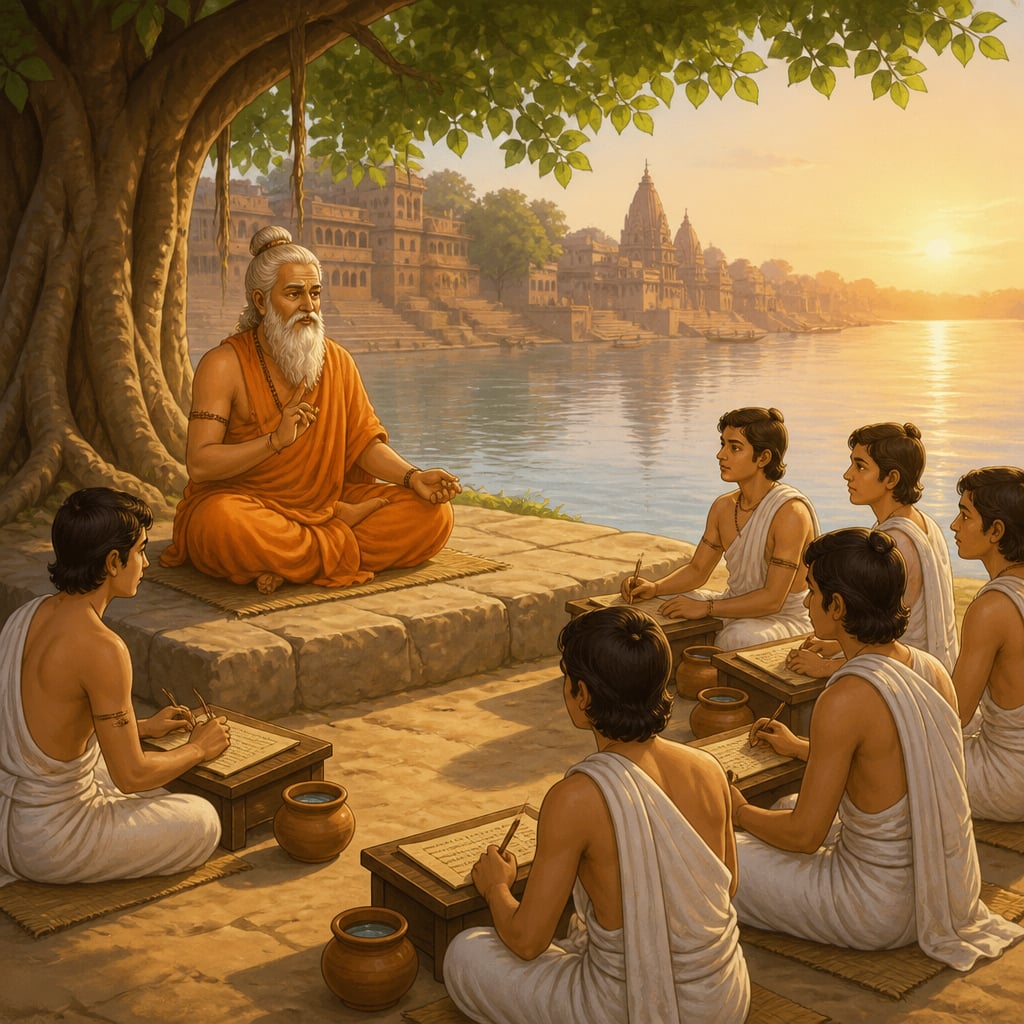
The question was simple. What is health.
His answer was six words of Sanskrit that nobody has improved on since.
समदोषः समाग्निश्च समधातुमलक्रियः। प्रसन्नात्मेन्द्रियमनाः स्वस्थ इत्यभिधीयते॥
sama-doṣaḥ sama-agniś ca sama-dhātu-mala-kriyaḥ prasanna-ātma-indriya-manāḥ svastha ity abhidhīyate
One in whom the doṣas are in equilibrium, whose digestive fire is in equilibrium, whose tissues and elimination are in equilibrium, and whose soul, senses, and mind are clear and content: such a one is called healthy.
Suśruta Saṃhitā, Sūtrasthāna 15.48
The word for "healthy" in that sentence is svastha. Sva means self. Stha means established, standing, abiding. Svastha literally means one who is established in oneself. Health, in the classical Indian formulation, is not the absence of disease. It is a state of being rooted in one's own nature.
Prakṛti Sāmya
The ground of svastha is a second term. Prakṛti sāmya. Prakṛti means nature: the constitutional given, the mix of doṣas and temperament a person is born with. Sāmya means equilibrium, balance, a state that is neither excess nor deficit. Prakṛti sāmya is the state in which a person is in equilibrium with their own nature, and their own nature is in equilibrium with the larger nature of which they are a part.
The doctrine has two halves.
Half one: inside you. Each person has a constitutional prakṛti. It was set at conception by the balance of doṣas at the moment of your formation. It does not change. What changes is the vikṛti, the current state of the doṣas at this moment, which may or may not match your prakṛti. Health is vikṛti tracking prakṛti. Disease is vikṛti drifting away from it.
Half two: outside you. Your prakṛti sits inside a larger prakṛti. The season. The time of day. The latitude where you live. The climate of the region. The food the soil grows there. The quality of the water, the air, the light. Āyurveda's position is that personal prakṛti cannot be maintained in isolation from the prakṛti around it. The two are coupled.
The Course as a Long Argument for Sāmya
This is the last lesson of the course, and it is useful to notice what the course as a whole has been arguing. Every chapter has been pointing at the same thing from a different angle.
Prāṇa vidyā (Chapter 1) argued that the breath is the most direct interface between your inner nature and the outer nature. Each breath, taken with attention, is a small act of sāmya. Each shallow, hurried breath is a small departure from it.
Auṣadhi vidyā (Chapter 2) argued that the plants of the subcontinent are your chemical kin. Turmeric, tulsi, ashwagandha, triphala: these are not products. They are the pharmacology of the land your ancestors' bodies adapted to. Using them is a form of re-entering the ecosystem you belong to.
Dhyāna (Chapter 3) argued that the mind has a natural still state, and that every classical meditation technique is a method of returning to it. Not of imposing a new state, but of allowing the native one to appear.
Āhāra (Chapter 4) argued that food is how the outer becomes the inner. Eating seasonally, constitutionally, in the correct quantities and combinations, is how the coupling between personal prakṛti and universal prakṛti is made material, three times a day.
Śodhana (Chapter 5) argued that a body living in time accumulates residues, and that classical cleansing restores the substrate on which prakṛti sāmya can rest.
Dinacaryā and ṛtucaryā (Chapter 6) argued that the daily and seasonal clocks of the body are synced, by design, with the clocks of the earth and the sun. Sāmya at the level of time is what makes sāmya at the level of body possible.
All of it, together, is one argument. You are not a free-floating organism operating on your own schedule. You are an organism nested in a larger rhythm. Health is the state of that nesting.
What Falls Out of Sāmya

Modern life is structured, in most places, to push a body out of prakṛti sāmya.
- Time is arbitrated by work, not by sun. The office opens at nine regardless of sunrise. The meeting runs to eight regardless of sunset.
- Food is decoupled from season and place. Strawberries in January. Mangoes in October. Foods that grew six thousand kilometres away on a soil your grandparents never stood on.
- Light is manufactured. Fluorescent tubes for work. LED screens for entertainment. The body cannot tell morning from afternoon from night by the quality of the light around it.
- Climate is controlled. The body does not experience the season it is actually in. Its thermoregulatory system, which Āyurveda considers a prime substrate of health, atrophies from disuse.
- Movement is outsourced. Cars, escalators, seated work. The body, which evolved to walk ten to fifteen kilometres a day, moves eight hundred metres between the parking lot and the desk.
- Sleep is fragmented. Screen light in the hour before bed suppresses melatonin. Notifications wake the body in the deep-repair window.
None of this is catastrophic in a single instance. All of it together, repeated for decades, drags the vikṛti slowly away from the prakṛti. A person who has lived this life for twenty years does not recognize the gap any longer, because the gap has become the baseline.
The Five Returns
Restoring prakṛti sāmya is a set of gentle, sustained returns. Every chapter of this course has been teaching one of them.
| Return | Domain | Chapter |
|---|---|---|
| Return to breath | prāṇa | Chapter 1 |
| Return to place | auṣadhi | Chapter 2 |
| Return to silence | dhyāna | Chapter 3 |
| Return to food | āhāra | Chapter 4 |
| Return to cleansing | śodhana | Chapter 5 |
| Return to time | dinacaryā and ṛtucaryā | Chapter 6 |
None of the returns is a technique. Each of them is a posture. A tilt of attention. A willingness, sustained across years, to ask what the body is trying to do and to get out of its way.
What Svastha Feels Like

It is worth naming what prakṛti sāmya feels like from the inside, because modern life has grown so noisy that the signal is easy to miss.
- Sleep comes easily. Morning arrives without alarm.
- Hunger is a clean sensation, not a blur of stress and craving.
- Elimination is regular, effortless, and complete.
- Energy is steady through the day, not a ladder of coffee peaks and afternoon troughs.
- The mind is quiet most of the time, and concentrated when it needs to be.
- The senses are keen. Food tastes like food. Air smells like air. Light looks like light.
- Small joys register. A cool breeze. A phone call from a friend. A well-cooked meal.
- There is a low, persistent sense that life is basically all right.
Suśruta's phrase prasanna-ātma-indriya-manāḥ points at exactly this. A person whose soul, senses, and mind are clear. Not ecstatic. Not high. Just clear.
Modern Echoes
The modern medical framework has been slowly coming around to svastha's position. In 1948, the WHO constitution defined health, famously, as "a state of complete physical, mental, and social well-being, and not merely the absence of disease." It is a secular restatement of Suśruta's twenty-five-centuries-older definition. Both sentences know that health is a positive state, not a negative one. The WHO was right to insist on this. Suśruta had insisted first.
More recent work has sharpened the picture further. Gabor Maté's The Myth of Normal (2022) argues, with modern clinical data, that chronic disease in industrial societies is not a failure of individual biology but a mismatch between human biology and modern life. The Salk Institute's circadian research, led by Satchidananda Panda, has shown that meal timing, light exposure, and sleep timing shape gene expression across the genome. Dan Buettner's Blue Zones research has shown that the five places on earth with the highest rates of healthy longevity share structural features that read like a Sanskrit regimen: seasonal plant-rich diets, daily outdoor movement, strong social bonding, rest aligned with sun, purpose sustained through old age.
The modern evidence is rolling in. The ancient framework has been waiting.
Being Established in Oneself
Suśruta's students, memorizing his definition in Vārāṇasī twenty-five centuries ago, were not being asked to subscribe to a philosophical position. They were being given a clinical target. A patient's treatment was complete, in the Indian system, when the patient was svastha again. Established in themselves. Standing at ease inside their own nature.
That target has not changed. The modern distractions have multiplied. The screens, the flights, the lit cities, the ten thousand decisions a day. But the body that receives all of this is the same body that received the forest air on the Varuna's banks in 600 BCE. Its definition of health is the same. Its path to health is, in broad outline, the same.
The course ends here. Not with a new technique. Not with a final supplement. With a word. Svastha. Established in oneself. The root is in the language. The state is in the body. The way there has been the subject of six chapters. The only work remaining is the work you do, slowly, across the rest of a life.
Good luck. And may you be svastha.
Key figures
Suśruta
Provided the comprehensive definition of health (svastha) that encompasses physical, functional, and psychological equilibrium. His multi-dimensional health definition anticipates modern integrative health concepts.
Gabor Maté
Canadian physician whose 2022 book The Myth of Normal argues, with modern clinical data, that chronic disease in industrial societies is not a failure of individual biology but a mismatch between human biology and modern life. This is a modern clinical restatement of Suśruta's position on prakṛti sāmya.
Dan Buettner
National Geographic fellow who identified the Blue Zones, five places on earth with the highest rates of healthy longevity. The shared features across these zones read like a Sanskrit regimen: seasonal plant-rich diets, daily outdoor movement, strong social bonds, rest aligned with sun, and purpose sustained through old age.
Case studies
Suśruta at Vārāṇasī: The Six Words That Defined Health
Around 600 BCE, at a school of surgery on the western bank of the Varuna river in Vārāṇasī, Suśruta wrote down a definition of health that his students would memorize for the next twenty-five centuries. He had spent a long career removing cataracts with a bronze needle, grafting skin onto severed noses, and setting fractures with bamboo splints. He had seen more suffering than most men ever do. But he closed his textbook on a question that had nothing to do with surgical technique. The question was simple. What is health? His answer was six Sanskrit words that nobody has improved on since.
Historical context
Classical Āyurvedic Period (c. 600 BCE onward) and the Modern Lifestyle-Medicine Era
Living traditions
Prakṛti sāmya's modern legacy is the emerging consensus across lifestyle medicine, chronobiology, and integrative health that the classical Indian framing was empirically correct. The 1948 WHO Constitution restated Suśruta's definition in secular language. Gabor Maté's 2022 The Myth of Normal provided the clinical argument that chronic disease is a biology-lifestyle mismatch. Dan Buettner's Blue Zones provided the empirical demonstration of what a prakṛti-sāmya life looks like at population scale. The modern evidence is rolling in. The ancient framework has been waiting.
Reflection
- Suśruta's definition of svastha includes 'prasanna-ātma-indriya-manas', clear and content soul, senses, and mind. By this definition, can you be physically healthy but not svastha? Which of the five equilibria (doṣas, agni, dhātus, elimination, soul/senses/mind) is most out of balance in your life right now?
- The lesson's Five Returns table maps each chapter of this course to a return: breath (Ch 1), place (Ch 2), silence (Ch 3), food (Ch 4), cleansing (Ch 5), time (Ch 6). Which of these returns is most overdue in your own life?
- The lesson argues that a person who has lived modern life for twenty years no longer sees the gap between their vikṛti and their prakṛti because the gap has become the baseline. Where in your own life might you have normalized a gap that is actually a drift?
- Dan Buettner's Blue Zones have five shared features: seasonal plant-rich diets, daily outdoor movement, strong social bonds, rest aligned with sun, and purpose sustained through old age. How many of the five does your current life embody? Which one is most realistically within reach for you to strengthen this year?
- The course ends with a single word: svastha, established in oneself. What does it mean for you, concretely and specifically, to be 'established in yourself' tomorrow morning, next week, and ten years from now?