Brahma Muhūrta: Sacred Dawn Becomes the '5 AM Club'

The ancient practice of waking before sunrise and its modern wellness revival

Exploring brahma muhūrta - the auspicious pre-dawn hours. Examines how this spiritual practice for sādhana became the commodified '5 AM Club' through bestselling books and courses.

The Alarm Clock That Sold 15 Million Books

In 2018, leadership guru Robin Sharma published The 5 AM Club, a book that would go on to sell over 15 million copies worldwide. The premise was simple and compelling: wake at 5 AM, follow a structured morning routine, and watch your life transform. Corporate executives, entrepreneurs, and self-improvement seekers embraced the message. A global movement was born.

What none of the breathless reviews mentioned, and what Sharma himself only obliquely referenced, was that this 'discovery' had been practiced in India for at least 2,500 years. It had a name: Brahma Muhūrta, the 'Creator's Hour.' And its original purpose wasn't productivity optimization, it was spiritual awakening.
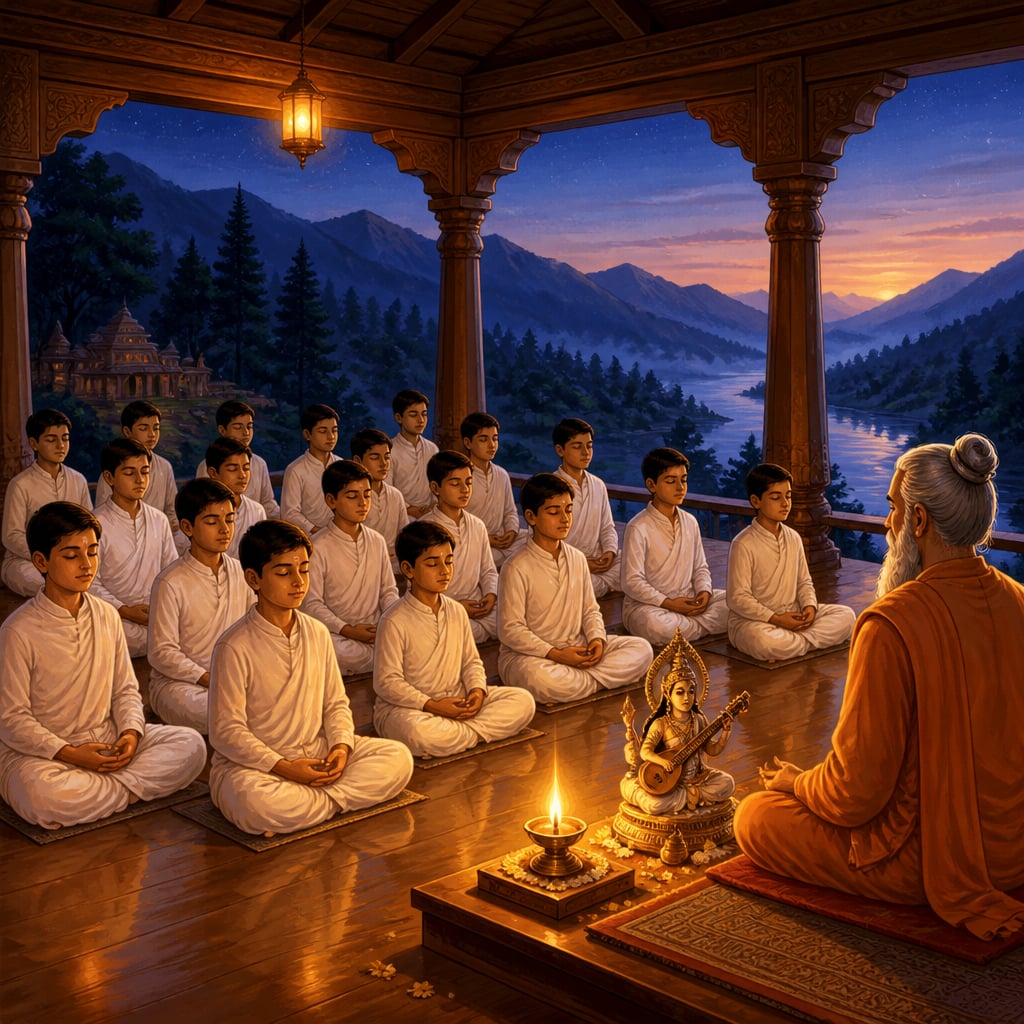
Ashram students seated in dhyana at brahma muhurta before sunrise

The story of how sacred dawn became the 5 AM Club reveals something essential about how ancient wisdom travels into modern life: the techniques arrive, but the purpose often doesn't.

What Is Brahma Muhūrta?

Brahma Muhūrta (ब्रह्म मुहूर्त) literally means 'the time of Brahma', the Creator in the Hindu trinity. It refers to a specific window: approximately 96 minutes before sunrise, or roughly 4:00-5:30 AM depending on season and location.

In the Vedic system of time division, a muhūrta is a 48-minute period, one of 30 muhūrtas that comprise a full day and night. Brahma Muhūrta is considered the most auspicious of all these periods, a time when the veil between ordinary consciousness and higher awareness is thinnest.

The Aṣṭāṅga Hṛdaya opens its chapter on daily routine with a direct command: 'A healthy person should rise during Brahma Muhūrta to protect life.' This isn't poetic suggestion, it's medical prescription. The text immediately connects this timing to both physical longevity and spiritual attainment.

But why this particular window? What did ancient physicians and yogis understand about pre-dawn hours that modern science is only beginning to validate?

The Science of Sacred Dawn

From the Āyurvedic perspective, Brahma Muhūrta falls during Vāta time, the period dominated by the air-space element, characterized by movement, lightness, and subtle energy. The body naturally lightens during these hours; the mind becomes more receptive and malleable.

Several factors converge during this window:

Sattva Predominance: According to Āyurveda, the three guṇas (qualities of nature), sattva (clarity), rajas (activity), and tamas (inertia), cycle through the day. Pre-dawn hours are considered sattvic, the mind is naturally clear, unclouded by the day's accumulations. The world is quiet; the mental chatter hasn't begun.

Prāṇa Availability: The pre-dawn atmosphere is described as 'prāṇa-rich', full of life-force. This isn't mysticism; studies show that air quality and negative ion concentration often peak in early morning hours before human activity pollutes the atmosphere.

Hormonal Alignment: Modern research reveals that cortisol naturally begins rising around 4 AM, preparing the body for waking. Those who rise during this natural ascent feel alert; those who wake later, after the cortisol surge has passed, often feel groggy, fighting their biology.

Melatonin Transition: The pineal gland is most active during the dark hours before dawn. Yogic traditions associate the pineal with the ājñā cakra (third eye) and higher consciousness. Practicing meditation during this transition, between sleep consciousness and waking consciousness, was considered optimal for accessing subtler states.

Digestive Rest: After a full night without food, the body has completed its digestive work. Agni (digestive fire) is at rest, and energy is available for mental and spiritual work rather than being diverted to processing last night's dinner.

The ancient practitioners didn't have cortisol assays or EEG machines. But through systematic observation over generations, they identified this window as uniquely potent, and structured their spiritual practices accordingly.

The Traditional Practice: Brahma Muhūrta for Sādhana

In traditional gurukulas (residential schools), āśramas (spiritual communities), and devout households, Brahma Muhūrta was never about productivity. It was about sādhana, spiritual practice.

The pre-dawn hours were reserved for:

Meditation (Dhyāna): The quiet mind of early morning is ideal for meditation. With less mental chatter, less external stimulation, and a naturally receptive nervous system, practitioners could access deeper states more easily.

Mantra Japa: The repetition of sacred sounds was considered most powerful during Brahma Muhūrta. The Vedic teaching holds that sounds carry different potencies at different times; pre-dawn amplifies mantra power.

Scripture Study (Svādhyāya): Complex philosophical texts, Upaniṣads, Brahma Sūtras, Gītā, were traditionally studied in the early morning when the intellect was fresh and sattvic. The teaching wasn't memorized; it was contemplated deeply.

Prāṇāyāma: Breath practices performed during Brahma Muhūrta were considered especially effective for awakening subtle energy. The prāṇa-rich atmosphere combined with the activated pineal was thought to accelerate spiritual development.

Brahmin priest performing sandhya vandana in Ganges

Sandhyā Vandana: The twilight prayers performed at dawn (and dusk) mark the transition between states, night to day, darkness to light. This liminal time was considered sacred, a doorway between worlds.

The goal was not to 'win the morning' or gain competitive advantage. The goal was mokṣa, liberation, self-realization, union with the Divine. Early rising was a means, not an end. The practice was about becoming receptive to something larger than personal achievement.

The Monastic Tradition: Āśrama Life

To understand Brahma Muhūrta in context, consider how traditional āśramas structure the pre-dawn hours:

3:30-4:00 AM: Wake-up bell. Residents rise, wash face, attend to basic hygiene.

4:00-5:30 AM: Individual sādhana period. Residents practice their assigned meditation, japa, or prāṇāyāma in silence. No talking, no activity beyond inner practice.

5:30-6:00 AM: Group practice. The community gathers for collective chanting, meditation, or ārati (worship with light).

6:00-7:00 AM: Yoga āsanas or walking meditation.

7:00 AM onward: Breakfast, then daily duties.

Notice what's absent: no journaling about goals, no visualization of success, no 'power moves' to dominate the day. The morning is oriented toward transcendence, not achievement. The silence is not productivity technique, it's recognition that the pre-dawn hours offer access to something beyond the chattering mind.

Swami Sivananda, the influential 20th-century teacher, wrote: 'Brahma Muhūrta is extremely favorable for meditation on God. The atmosphere is charged with sattva at this time. There is no hustle and bustle of the world. The mind is refreshed after sleep. It is like a blank sheet of paper. It can be molded easily.'

The metaphor of the blank page is telling. For the spiritual seeker, the empty morning mind is an opportunity for divine imprint. For the modern productivity enthusiast, it's an opportunity for personal programming. Same hour, different purposes.

The Journey West: From Sādhana to Success

How did sacred dawn become the 5 AM Club? The transformation happened gradually, through several key transmissions:

1970s-1990s: Self-Help Discovers Early Rising The American self-help movement noticed that successful people often woke early. Books began recommending early rising for productivity, stripped of any spiritual context. The correlation between early rising and worldly success became a selling point.

2012: Hal Elrod's Miracle Morning Elrod's book codified the modern morning routine into the 'SAVERS' framework: Silence, Affirmations, Visualization, Exercise, Reading, Scribing (journaling). The 5-6 AM recommendation echoed Brahma Muhūrta's timing. The practices vaguely resembled meditation and svādhyāya. But the goal was explicitly personal achievement.

Tech executive performing 5 AM productivity routine

2018: Robin Sharma's 5 AM Club Sharma's blockbuster brought early rising to a global audience. His '20/20/20 formula', 20 minutes of exercise, 20 minutes of reflection, 20 minutes of learning, structured the morning for 'world-class' performance. The book references ancient wisdom but frames it entirely through achievement orientation.

2020s: The Morning Routine Industry Courses, apps, coaches, and merchandise now comprise a multi-billion-dollar industry around morning routines. The promise: follow this protocol, and success will follow.

Each step in this transmission preserved technique while transforming purpose. The timing remained. The discipline remained. What shifted was the 'why', from spiritual awakening to personal achievement, from mokṣa to market success.

What's Preserved and What's Lost

What modern morning routines preserve:

What's often lost:

The modern morning routine movement has helped millions experience the power of structured early hours. This is genuine value. But practitioners often don't know they're drawing from a tradition with very different aims, or that the fuller system might offer something their current practice doesn't.

The Difference Purpose Makes

Consider two practitioners waking at 4:30 AM:

The traditional practitioner rises with awareness of entering sacred time. They wash, sit in meditation without agenda, not to achieve anything, but to open to what is. They might chant, study scripture, or simply rest in awareness. The practice isn't evaluated by outcomes. It's complete in itself.

The modern practitioner rises with tomorrow's meeting on their mind. They meditate for 10 minutes (checking the timer), journal about quarterly goals, visualize closing deals. They exercise with earbuds delivering motivational content. The practice is evaluated by results, did my morning routine make me more productive? More successful? More competitive?

Both wake at the same hour. Both experience some of the same benefits, the quiet, the clarity, the sense of getting ahead. But the orientation differs fundamentally. One practice opens toward transcendence; the other reinforces the ego it claims to transcend.

This isn't to say productivity-oriented morning routines are wrong. They're genuinely helpful for many people. The point is that they're a subset of what the tradition offers, the practical benefits without the spiritual depth.

Practicing Brahma Muhūrta Authentically

How might a modern person engage Brahma Muhūrta as the tradition intended, not as productivity hack, but as spiritual practice?

Start with why. Before the alarm, clarify intention. Are you rising to get ahead? Or to go beyond? There's no wrong answer, but honest awareness matters. The practice works differently depending on orientation.

Adjust for actual sunrise. Traditional Brahma Muhūrta is relative to sunrise, not the clock. In midsummer, it might be 3:30 AM; in midwinter, 5:30 AM. Consider using astronomical data rather than fixed times.

Protect the silence. The power of Brahma Muhūrta comes partly from the world's stillness. Checking email, social media, or news disrupts this. Traditional practitioners maintained absolute silence until after their sādhana. Consider doing the same.

Let practice be complete in itself. Rather than meditating 'to reduce stress' or journaling 'to clarify goals,' experiment with practice without purpose. Sit to sit. Breathe to breathe. This is harder than it sounds, the achievement-oriented mind wants returns on investment.

Include the transcendent. Whether through prayer, mantra, devotional reading, or simply opening to mystery, include something beyond self-improvement. Traditional Brahma Muhūrta always included this dimension.

Honor the full cycle. Brahma Muhūrta only works sustainably when paired with early dinner and early sleep. Rising at 5 AM after sleeping at midnight creates debt, not benefit. The traditional system was integrated; the morning practice requires the evening practice.

Consider the communal. If possible, practice with others. Group meditation at dawn has different quality than solo practice. Online communities have made this more accessible than ever.

The tradition doesn't ask us to reject the practical benefits of early rising. It invites us to explore whether there's something more, something the bestsellers don't mention, something the morning routine apps can't measure.

The Creator's Hour in Modern Life

Brahma Muhūrta persists in multiple forms today:

In thousands of temples across India, priests rise before dawn for the first pūjā of the day. In āśramas worldwide, seekers maintain the 4 AM meditation that monks have practiced for millennia. In Sikh gurdwaras, Amrit Vela (their equivalent practice) begins the day with collective prayer.

Simultaneously, millions of alarm clocks chirp at 5 AM, launching people into power routines designed for market dominance. The same hour serves radically different purposes.

This parallel existence isn't contradiction, it's testimony to the potency of the time itself. Whether you seek liberation or leverage, the pre-dawn hours deliver something. The tradition simply suggests there's more available than what productivity culture extracts.

The executives who've made the 5 AM Club a lifestyle are touching something real. The question is whether they want the whole of what's available, or whether the productivity slice satisfies.

For those who want more, the Creator's Hour still waits, as it has for millennia, offering not competitive advantage but something more radical: the possibility of meeting what's beyond achievement altogether.

Even 30 minutes of spiritually-oriented morning practice can transform the day's quality. Key principles: begin before engaging devices (preserve the sattvic mind), include at least one practice aimed at something beyond personal benefit (prayer, dedication, gratitude), and let the practice be complete in itself rather than instrumental toward goals.

Without adopting full sandhyā rituals, you can cultivate transitional awareness during Brahma Muhūrta. As light begins entering the sky, pause whatever practice you're doing. Watch the transition consciously, the slow shift from dark to light. Recognize you're witnessing the same phenomenon your ancestors watched. Let the liminal quality inform your orientation toward the day.

Key figures

Vāgbhaṭa

Author of the Aṣṭāṅga Hṛdaya, whose opening verse on Brahma Muhūrta became the foundational reference for daily routine in Āyurvedic medicine and influenced Indian culture for over a millennium.

The Aṣṭāṅga Hṛdaya's influence extends far beyond India, it shaped medical traditions in Tibet, Thailand, Sri Lanka, and Indonesia. Vāgbhaṭa's treatment of Brahma Muhūrta as medical necessity (not just spiritual preference) gave the practice lasting authority.

Swami Sivananda

Founder of the Divine Life Society and one of the most influential yoga teachers of the 20th century. His writings extensively promoted Brahma Muhūrta as essential for spiritual practitioners.

His '20 Spiritual Instructions' include waking at 4 AM for meditation, Brahma Muhūrta practice made explicit and accessible. Through his prolific writing, he preserved and transmitted the spiritual dimension of early rising that secular productivity culture would later strip away.

Robin Sharma

Leadership expert and author of The 5 AM Club (2018), which sold over 15 million copies and popularized early rising as a productivity and success strategy in global business culture.

The 5 AM Club introduced millions to the power of early morning structure. While stripping the spiritual dimension, Sharma's work demonstrates that the practical benefits of Brahma Muhūrta timing persist even when the purpose changes, testimony to the genuine potency of the traditional discovery.

Hal Elrod

Author of The Miracle Morning (2012), which codified the modern morning routine movement and sold over 2 million copies before Sharma's 5 AM Club.

The Miracle Morning spawned a movement, community, and industry. Elrod's work demonstrated market demand for morning structure that traditional cultures had always provided but modern life had eroded. His approach, like Sharma's, preserves technique while transforming purpose.

Sadhguru Jaggi Vasudev

Founder of Isha Foundation and contemporary spiritual teacher who articulates the significance of Brahma Muhūrta for spiritual practice to global audiences, maintaining the traditional perspective while engaging modern contexts.

Through books, videos, and the Isha Yoga programs practiced by millions, Sadhguru has kept the spiritual dimension of Brahma Muhūrta visible in contemporary discourse. His explanations of why the time matters, not just that it does, offer depth that self-help approaches lack.

Case studies

Robin Sharma and the $50 Million Alarm Clock

In 2018, Robin Sharma - already successful from The Monk Who Sold His Ferrari (1997) - published The 5 AM Club. The premise was deceptively simple: wake at 5 AM, follow a structured routine, transform your life. The book became a global phenomenon, selling over 15 million copies and generating an estimated $50+ million in direct sales, not counting courses, coaching, and merchandise. Sharma's '20/20/20 formula' structures the hour from 5-6 AM: 20 minutes of intense exercise ('Move'), 20 minutes of reflection including journaling and meditation ('Reflect'), and 20 minutes of learning ('Grow'). The approach promises 'legendary' performance, 'world-class' results, and competitive dominance. The timing echoes Brahma Muhūrta almost precisely. The structure vaguely resembles traditional sādhana - the exercise could be āsana, the reflection includes meditation, the learning resembles svādhyāya (scripture study). Sharma occasionally references 'ancient wisdom' and 'sages' without specifying sources. What the 15 million readers don't learn is that they're practicing an attenuated form of what yogis have done for millennia. The spiritual dimension is entirely absent - no mention of the Divine, transcendence, or purposes beyond personal success. The practice is oriented entirely toward marketplace competition. This isn't necessarily criticism of Sharma. He's helped millions experience the power of morning structure. The question is what remains unavailable when the spiritual dimension is stripped away - and whether those millions might want access to the fuller practice.

Charaka Samhita (Sutra Sthana 5) describes Brahma Muhurta as the period when sattva guna predominates in the atmosphere, making it optimal for meditation, study, and spiritual practice. The text does not prescribe a single wake time for all people but adjusts based on season, constitution, and health status.

For readers of The 5 AM Club, knowing its traditional roots opens new possibilities. The same hour can serve achievement or transcendence - or both. Understanding that morning routine emerged from spiritual practice allows practitioners to experiment with the fuller tradition: What changes if meditation has no goal? What shifts if the practice includes dedication to something beyond self? The 5 AM Club is an entry point; Brahma Muhūrta is the deeper territory.

The 5 AM Club phenomenon demonstrates that the timing and structure of Brahma Muhūrta produce benefits even when the spiritual orientation is removed. This validates the traditional discovery while revealing what happens when practices travel without their context. The practical works; the transcendent is lost. Whether that loss matters depends on what the practitioner is seeking.

The 5 AM Club sold 15 million copies by packaging Brahma Muhurta's timing without its contemplative purpose. Followers who add the spiritual dimension report qualitative differences in their morning experience that productivity metrics alone cannot capture.

A 2022 study in the Journal of Sleep Research found that natural early risers (chronotype-aligned, similar to Brahma Muhurta practitioners) had 20% lower cortisol levels and 15% higher productivity scores than forced early risers who were fighting their natural chronotype.

Historical context

Vedic Period to Modern Self-Help (c. 1500 BCE - Present)

Living traditions

Brahma Muhūrta survives in dual streams: the traditional spiritual practice continuing in ashrams, temples, and devout households; and the secular morning routine movement that extracted timing and structure while discarding spiritual purpose. Both streams testify to the practice's power. The question for modern practitioners is which stream, or what integration of both, serves their deepest needs.

Reflection

More in Dinacaryā: From Sacred Rhythm to Productivity Hacking

All lessons in Dinacaryā: From Sacred Rhythm to Productivity Hacking · Indian Wellness Traditions: Modern Connections course