Śuddhi-Paramparā: How Accuracy Improved Over Centuries
The unbroken lineage of correction, and how ancient eclipse records became a tool to weigh the Earth's slowing spin
No table stays accurate forever. Learn how the Indian tradition kept correcting itself for a thousand years, applying bīja corrections and fresh handbooks like Bhāskara's Karaṇakutūhala to keep eclipse prediction sharp, and how, in a final twist, ancient eclipse records from Babylon to China became a scientific instrument for measuring the slowing of the Earth's spin.
The Handbook That Reset the Clock
In 1183, in his old age, the great Bhāskarācārya wrote a small, practical book with a charming name: the Karaṇakutūhala, the "Delight of Calculation". It was not a grand treatise like his Siddhānta Śiromaṇi. It was a working handbook of tables and shortcuts, built on a fresh starting date, designed so that an ordinary astronomer could compute an eclipse quickly and, above all, accurately. Why did the tradition's greatest living mathematician bother with a book of practical tables? Because he understood something every astronomer eventually learns: no table stays accurate forever.
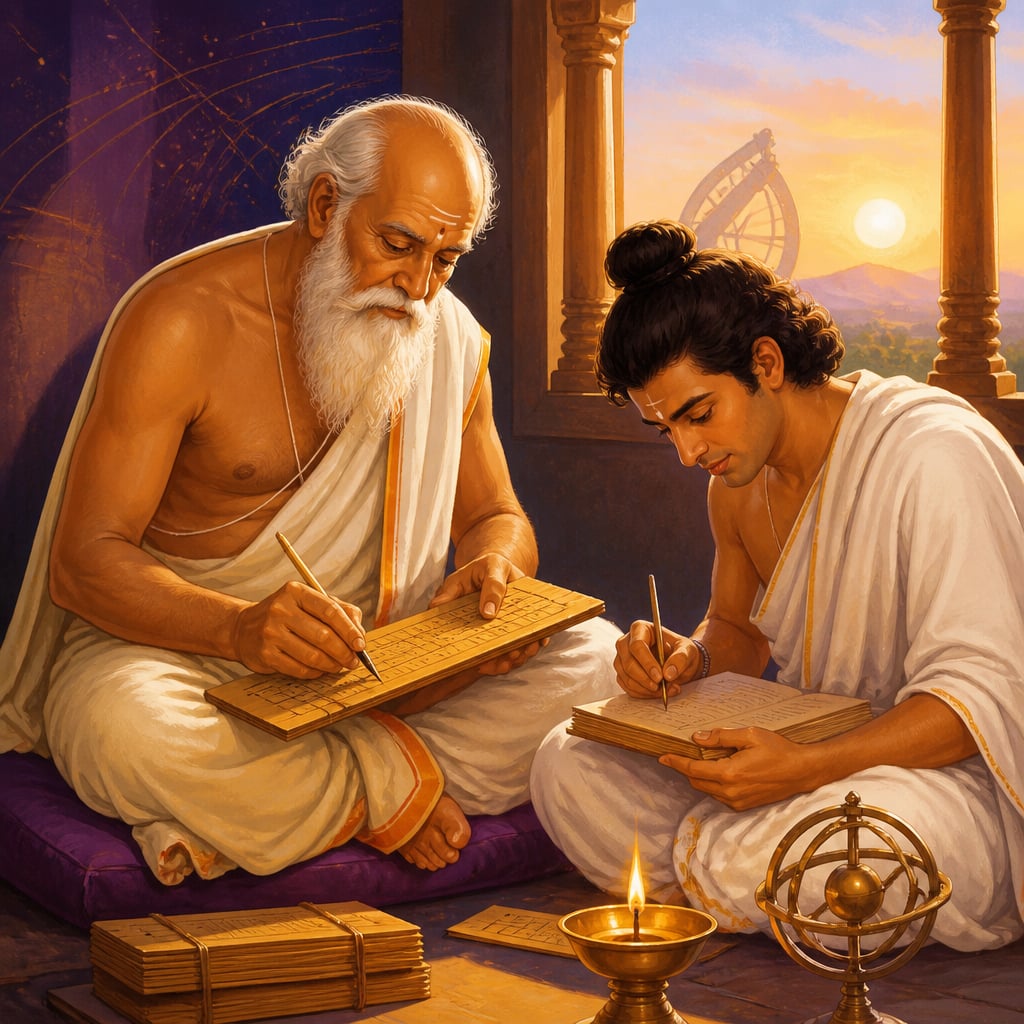
Over centuries, the small imperfections in the old parameters, the mean motions, the sizes of the shadows, quietly accumulate. A method that matched the sky well in 500 CE would, left uncorrected, drift by many minutes by 1200. The eclipse, the sharpest public test in all of astronomy, exposes that drift mercilessly. So the tradition never stood still. It corrected itself, generation after generation, in an unbroken lineage of refinement, the śuddhi-paramparā, the succession of purification. This lesson is about that lineage, and about a remarkable final gift it left to modern science.
The Jewel and the Ocean
Near the close of his masterwork, Āryabhaṭa left an image that captures the whole enterprise.
सदसज्ज्ञानसमुद्रात्समुद्धृतं ब्रह्मणः प्रसादेन। सज्ज्ञानोत्तमरत्नं मया निमग्नं स्वमतिनावा॥
sad-asaj-jñāna-samudrāt samuddhṛtaṃ brahmaṇaḥ prasādena saj-jñānottama-ratnaṃ mayā nimagnaṃ sva-mati-nāvā
By the grace of Brahmā, the sunken, excellent jewel of true knowledge has been raised up by me from the ocean of true and false knowledge, by means of the boat of my own intellect.
Āryabhaṭīya, Golapāda 49
The knowledge of the sky, Āryabhaṭa says, comes mixed, an ocean of the true and the false together, and the astronomer's task is to raise the true jewel from it. That is exactly what the śuddhi-paramparā did across the centuries: it kept diving back into the ocean, sifting the accurate from the drifted, and raising a cleaner jewel each time. No astronomer treated the inherited numbers as final. Each measured the sky afresh, found where the old values had strayed, and corrected them.