Candra-Grahaṇa: Calculating Lunar Eclipses
Entering the Earth's own shadow, and forecasting the very colour the Moon will turn
A lunar eclipse is the Moon sliding into the Earth's long shadow-cone, seen alike by all who face the night. Learn how Indian astronomers computed it, and how they forecast something remarkable: not just the timing, but the colour the eclipsed Moon would turn at each depth of the shadow, from smoky grey to tawny copper.
The Astronomer Who Forecast a Colour
Here is a prediction to sit with. An ancient astronomer, weeks in advance, could tell you not only that on a certain full-moon night the Moon would darken, and at what hour, but roughly what colour it would turn while it was darkened, whether a dull smoky grey, a deep black, or a strange, beautiful coppery red. To forecast the timing of a heavenly event is impressive. To forecast its colour, and then to have the sky obey, is something close to astonishing. Yet the Indian texts do exactly this, in plain verse.
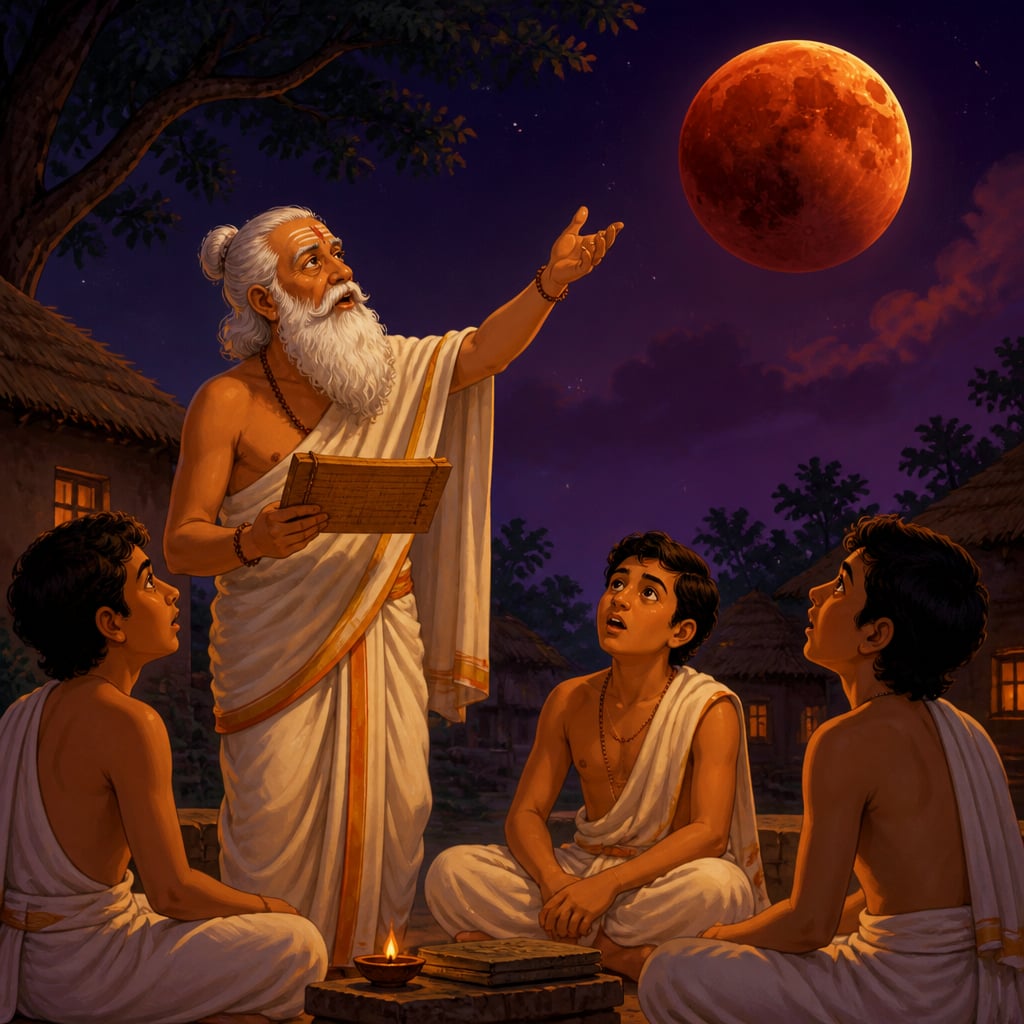
The lunar eclipse is, in one sense, the easier of the two eclipses. It carries none of the local-track trouble of the solar eclipse. When the Moon darkens, everyone on the night side of the Earth sees the same thing at the same instant. But it rewards close attention with a subtlety the solar eclipse does not have: colour. This lesson is about entering the Earth's own shadow, and about how the astronomers read what happens inside it.
Into the Earth's Shadow-Cone
A lunar eclipse is the plainest illustration of the shadow theory. The Earth, lit by the Sun, throws a long dark cone of shadow into space behind it. Once a month, at full moon, the Moon stands opposite the Sun, and if it happens to be near a node, it does not pass above or below that cone but slides directly into it. The Sun's light is cut off, and the Moon goes dark. That cone is the Earth's own shadow, and computing its size at the Moon's distance, against the Moon's size and how far it strays from the exact centre of the shadow, tells the astronomer everything: whether the eclipse will be total or partial, how deep it will go, and how long it will last.