Chāyā-Gaṇita: Shadow Calculations
How a vertical stick and its shadow gave the astronomer the time, the latitude, and the size of the world
Beneath all eclipse mathematics lies the science of the shadow. Learn how Indian astronomers read the time of day, their latitude, the cardinal directions, and even the length of the Earth's own shadow-cone from the humblest of instruments: a vertical stick, the śaṅku, and the shadow it casts.
The World Read From a Stick
Drive a straight stick upright into level ground, in the sunlight, and watch its shadow. It is among the oldest scientific instruments in the world, and one of the most powerful. From that single shadow, and the geometry of the right triangle it forms with the stick, an Indian astronomer could read the time of day, find the exact directions of north and south, measure the latitude of the place he stood, and, scaling the same reasoning up to the heavens, compute the length of the Earth's own shadow that darkens the Moon. The whole science of eclipses, of shadow-cones and coverings, rests on this humble foundation: the mathematics of the shadow, the chāyā-gaṇita.
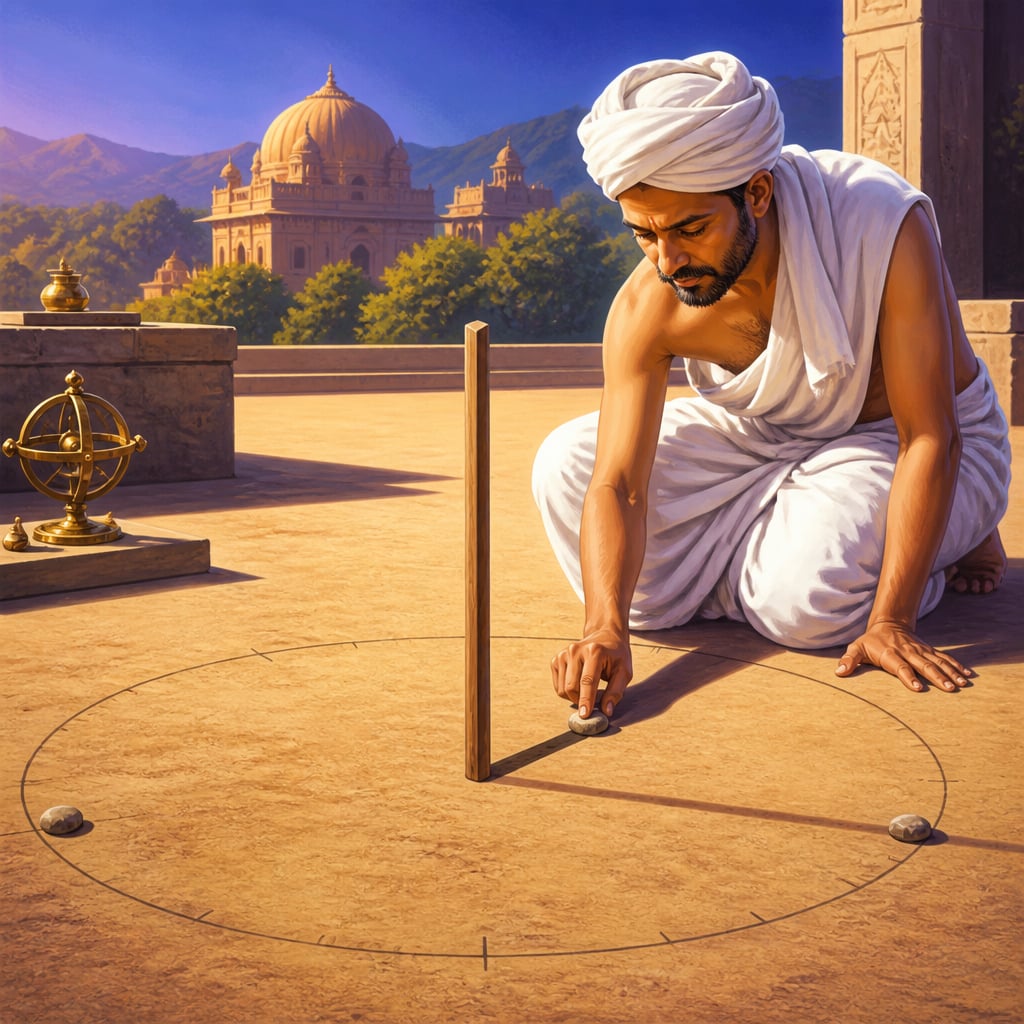
The vertical stick had a name, the śaṅku, the gnomon, and it was the astronomer's constant companion. This lesson is about what could be read from it, and how the same shadow-reasoning that measured a stick measured the world.
The Right Triangle in the Sunlight
The power of the gnomon lies in the triangle. The upright stick is one side, its shadow on the ground is the second, and the line from the tip of the stick to the tip of the shadow is the third, the karṇa, the hypotenuse. As the Sun moves, this triangle changes, and every change carries information.
- The direction of the shadow gives the directions on the ground. Mark where the shadow-tip falls in the morning and again in the afternoon, at equal shadow-lengths, and the line joining the two points runs very nearly east to west. This elegant construction, the "Indian circle", gave the cardinal directions from nothing but a stick and a compass-drawn circle.
- The length of the shortest shadow, at local noon on an equinox day, gives the latitude of the place, the akṣa, since the noon Sun climbs higher in the south and lower in the north.
- The changing shadow through the day gives the time, the principle of every sundial.