Talapatram

The Witnesses

Sun, moon, day, night, your own heart.

The text's startling answer to the unwatched act: a three-tier accountability where even secret deeds have their own judge, and the dharmashastra inventory of witnesses: the sun, the moon, day, night, the waters, your own heart, and dharma itself. Conscience predates the camera.

A Polling Booth for One Voter
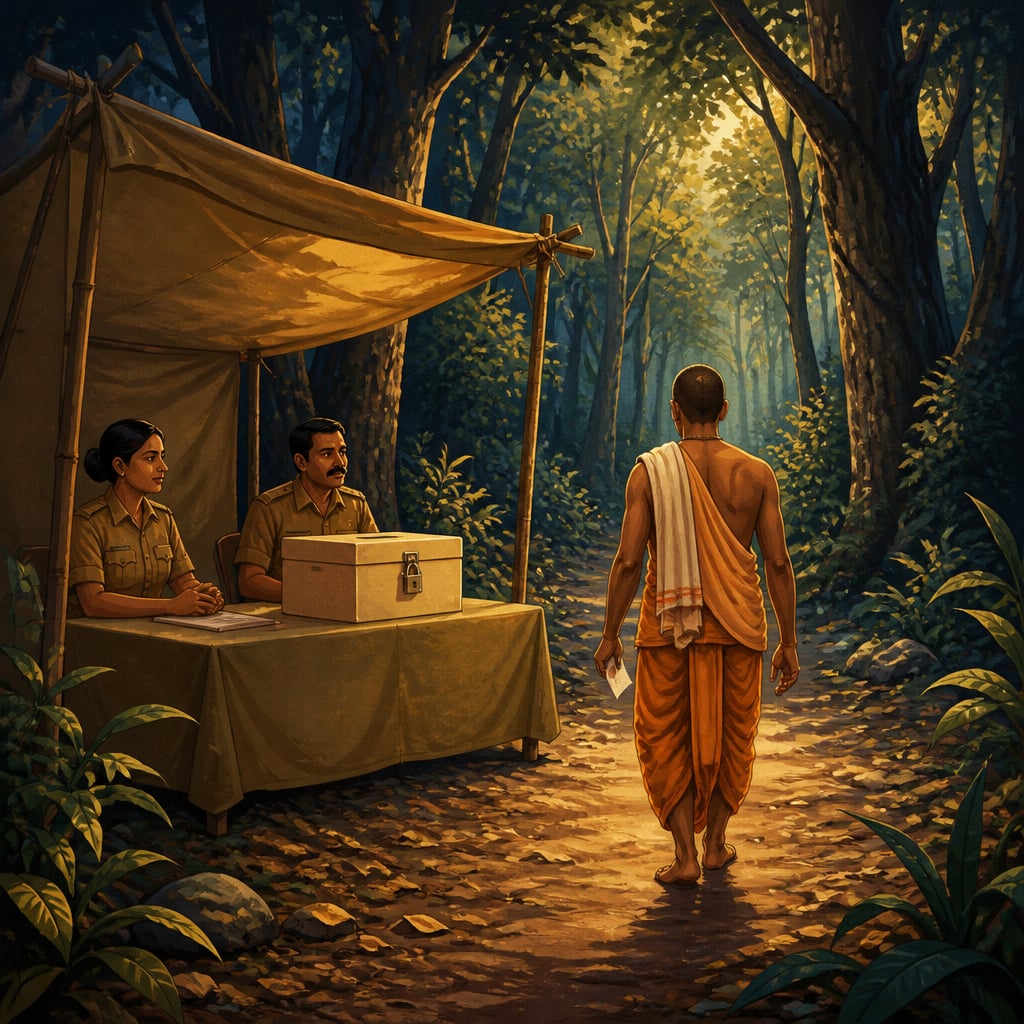
The forest polling booth awaits its single voter

Deep inside Gujarat's Gir forest, home of the last Asiatic lions, stands a small temple at a place called Banej. For every major election across nearly two decades, the Election Commission of India has sent a full polling team into that forest, with machines, officials, and security. Their task: a complete polling booth for exactly one registered voter, the temple's priest.

The rule behind it says no Indian voter should have to travel unreasonably far to vote. The officials could quietly skip the trek; one vote among hundreds of millions will never change a result, and for years almost nobody was watching. They go anyway. The booth opens on time. The single vote is cast, sealed, and counted with the same solemnity as any other in the country.

Why perform a duty perfectly when no audience exists? The officials in that forest would probably shrug: because it is the duty. This lesson is about the tradition that stands behind that shrug.

The Judge of Secret Deeds

The last lesson established karma as impersonal law. But an honest doubt remains, and the text meets it head-on. Some acts really do escape every human system: the theft never discovered, the cruelty behind closed doors, the promise broken where no one could know. What about those?

The Garuda Purana's answer is a precise map of accountability in three tiers:

गुरुरात्मवतां शास्ता राजा शास्ता दुरात्मनाम् । इह प्रच्छन्नपापानां शास्ता वैवस्वतो यमः ॥

gurur ātmavatāṃ śāstā rājā śāstā durātmanām iha pracchanna-pāpānāṃ śāstā vaivasvato yamaḥ

The guru corrects those who govern themselves. The king corrects the wicked. But the corrector of those who sin in secret is Yama, son of Vivasvan.

Garuda Purana, Preta Khanda 46.8

Read the design of that verse. The self-aware need only a teacher's word. Open wrongdoing meets the king, the courts, the visible law. And the hidden act, the one that slips both teacher and court, does not fall through the floor of the world. It has its own appointed judge. Secrecy, in this text, does not remove accountability. It only changes the courtroom.

The verse quietly retires the entire strategy of the secret act. Concealment works on teachers and kings. It has never worked on the third tier, because the third tier was designed for exactly what concealment hides.

The Inventory of Witnesses

And how would the hidden court know? Here the wider dharma tradition, in the Manusmriti's famous verses on false witness, supplies an inventory that has startled readers for two thousand years. When a man says to himself "no one has seen me," the Manusmriti answers: the gods see him, and so does the man within. The sun and the moon, wind and fire, sky, earth and the waters, the heart, day and night, the two twilights, and dharma itself. These, the text says, know the conduct of every embodied being.

Sun and moon witnessed in the river at dusk

Strip the poetry to its claim and it is this: you have never once acted unobserved, because existence itself is the observer. Your act happened in daylight or in darkness, on the earth, inside a body with a heart. Every element of the scene was a witness, because the scene is not separate from the moral order. And the deepest witness on the list is the one you carry: the man within, the heart that was present, taking its own testimony, at everything you have ever done.

This is why the tradition never needed to threaten people with surveillance. It made a stranger claim: that privacy, in the moral sense, has never existed. Not because someone is spying, but because action and world are one fabric, and the fabric records.

Conscience Predates the Camera

Our age has run the experiment from the other side. We know, with data, that people behave better when watched: cameras in the shop, ratings on the ride, screenshots in every argument. The entire architecture of modern trust is external witnessing, and it works, roughly, wherever the cameras reach.

But everyone knows the architecture's failure mode. Behavior calibrated to cameras lasts exactly as far as the cameras. It produces people skilled at finding the blind spots, and a self that splits into a watched performance and an unwatched remainder. The tradition's design has no blind spots to find, because the witness is not an installation. It is the sun you acted under, the night you chose for cover, and the heart that came along. The camera is a recent, weaker copy of a very old idea.

Cincinnatus declines power at his plough

And once in a while a human being demonstrates the older design in public. In 458 BCE, as the Roman historians tell it, the senate begged a farmer named Cincinnatus to become dictator, with absolute power, to save Rome's trapped army. He left his plough standing in the field, took command, and won the war in about fifteen days. Then he did the thing no camera and no constitution forced him to do: he laid down absolute power and walked back to the plough. Rome told the story for centuries, and the American city of Cincinnati carries his name today, because uncompelled integrity, integrity with no watcher and no leverage, is the rarest and most remembered kind.

Modern Echoes

Which returns us to the forest. The officials who carry a polling booth to one priest at Banej are not watched by voters, cameras, or careers. The story surfaces in the news only once in a few years, to a day of mild wonder. Their real witness is the one this lesson names: the duty itself, and the self that performs it. A democracy, like a dharma, is finally made of what its people do in the rooms where no one checks.

The chapter's question is now half answered. Does anything you do matter if no one is watching? The text has answered twice: first, watching was never part of the mechanism; second, "no one is watching" has never once been true. The next lesson meets the being who keeps the records: the accountant of the cosmos, in a palace whose walls are covered with pictures.

Case studies

The Booth at Banej

Under Election Commission rules, no Indian voter should be left without a reasonably reachable polling station. So at every major election for nearly two decades, a full polling team has trekked into the Gir forest, past lion territory, to set up a complete booth at the Banej temple for its priest, the area's single registered voter. The machines are sealed and carried back, and the one vote is counted with the same procedure as any of the hundreds of millions cast that day.

The officials' duty has no audience, no measurable stake, and no career upside; skipping it would change nothing anyone could detect. It is performed anyway, which makes it a living demonstration of the lesson: conduct whose witness is the duty itself and the self that performs it. The tradition would say the sun, the forest, and the officials' own hearts were the polling observers.

The booth has become a quiet national legend, resurfacing each election as proof of a principle: the system's promise is to every voter, not to every crowd of voters. One person's franchise is carried through a lion forest on schedule.

Institutions, like people, are what they do for the single unwatched case. The one-voter booth is the democracy's conscience made visible.

Election Commission teams have set up the single-voter booth at Banej in the Gir forest at every major election since 2007.

Cincinnatus Lays Down Absolute Power

In 458 BCE, with a Roman army trapped and the city in panic, the senate's messengers found Lucius Quinctius Cincinnatus ploughing his small farm and told him he had been named dictator, with absolute authority. As the historians tell it, he took command, relieved the army, and won the campaign in roughly fifteen days. Then, with years of legal absolute power still available to him and no force in Rome able to compel him, he resigned the dictatorship and walked back to his plough.

Every external witness in the story pointed the other way: power in hand, precedent flexible, no institution able to check him. The only working constraint was internal, the witness the dharma texts locate in the heart. Cincinnatus is what the third-tier verse looks like inverted: the man whose hidden self needed no corrector, because it matched his public one.

Rome told the story for centuries as the definition of republican virtue, and it crossed the ocean: George Washington's contemporaries called him a modern Cincinnatus for surrendering command, and the city of Cincinnati bears the farmer's name today.

History barely remembers most wielders of absolute power, and it has remembered for twenty-five centuries a man chiefly for giving it back. The uncompelled act is the immortal kind.

The traditional account places Cincinnatus's dictatorship in 458 BCE, resigned after about fifteen days of a six-month term.

Living traditions

The tradition of the inner witness survives in daily speech: the Hindi phrase "apne dil se poochho," ask your own heart, is the Manusmriti's final witness turned into a proverb. Every oath sworn, every conscience consulted, every duty done in an empty room keeps the inventory alive.

  • Banej Temple, Gir Forest: The forest shrine whose priest is the lone voter of this lesson's opening. Reaching it means entering the Gir sanctuary, the last home of the Asiatic lion. The site has become an unplanned monument to two ideas at once: a democracy's promise to its smallest unit, and a duty performed with no audience but the forest.

Reflection

  • What is your Banej: a duty you perform fully although no one checks? And where is your blind spot: the place your conduct quietly drops when the watching stops?
  • The verse assigns hidden wrongs their own judge. Recall a time you concealed something successfully. What did the concealing itself cost you, separate from the act, and separate from any discovery?
  • If you took the witness inventory literally for one day, acting as if the sun, the night, and your own heart were recording, what would change first?

More in Does Anything I Do Matter?

All lessons in Does Anything I Do Matter? · Garuda Purana ebook course