Talapatram

Chitragupta's Ledger

The recorder of every deed.

The cosmic record-keeper who writes every act, introduced as the tradition's image for a truth we recognize: action leaves residue, and the memory of what we did is inescapable. The internet never forgets; the tradition put the permanent record inside the cosmos before we built one outside it.

The Palace of Pictures
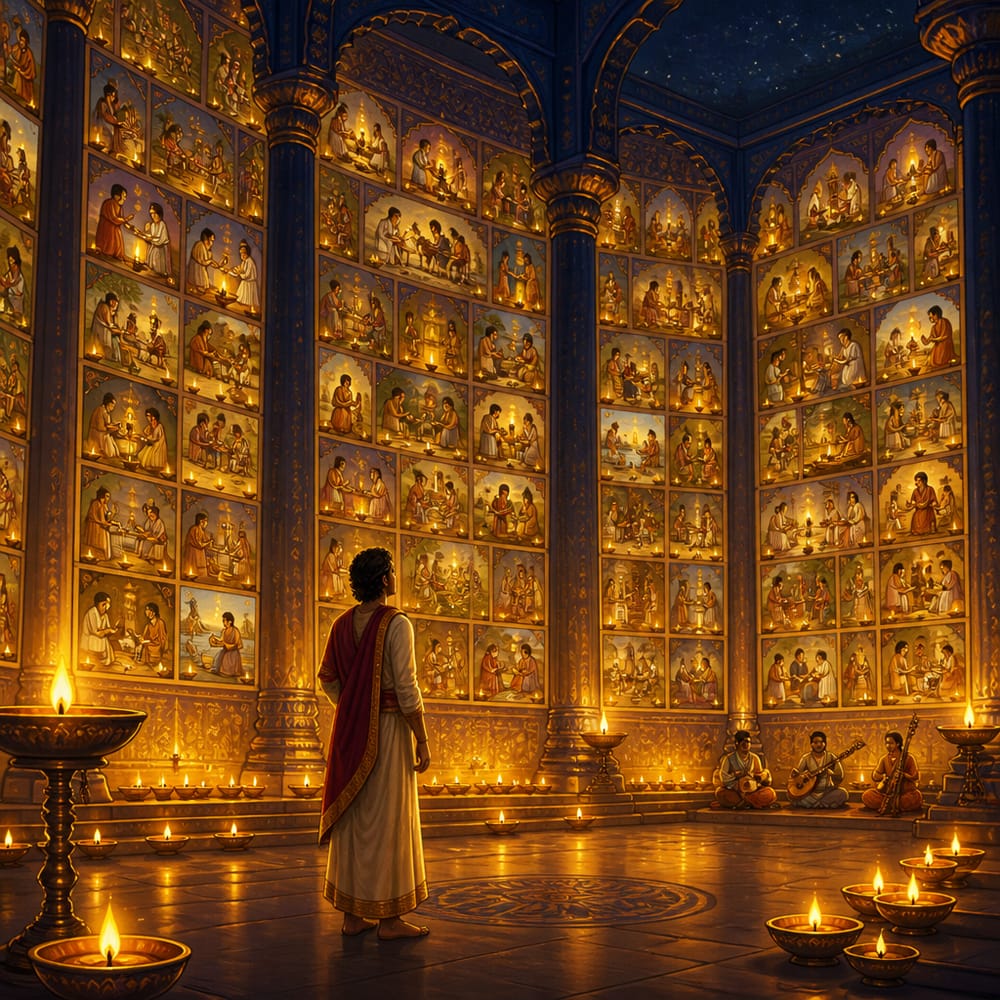
The lamp-lit palace whose walls hold every deed

The Garuda Purana takes its reader, at one point, on a tour of an unexpected building. Not a hell, not a heaven: an office. The text describes it with delight:

दीपिकाशतसाकीर्णा गीतध्वनिसमाकुलम् । विचित्रचित्रकुशलैः चित्रगुप्तस्य वै गृहम् ॥

dīpikā-śata-sākīrṇā gīta-dhvani-samākulam vicitra-citra-kuśalaiḥ citraguptasya vai gṛham

Crowded with hundreds of lamps, filled with the sounds of music, adorned with pictures of every kind by skilled hands: such is the house of Chitragupta.

Garuda Purana, Preta Khanda 33.26

Stop on the strangest detail. The walls of the record-keeper's palace are covered with pictures. The text's own image of the cosmic records is not a dusty register of numbers. It is a gallery. Seated there on a jewelled throne, the text continues, Chitragupta calculates the lifespan and reckons the deeds of every being that lives. And then comes the verse that gives this lesson its spine:

न मुह्यति कदाचित् स सुकृते दुष्कृतेऽपि वा । यद्येनोपार्जिता यावत् तावद्वै वेत्ति तस्य तत् ॥

na muhyati kadācit sa sukṛte duṣkṛte'pi vā yad yenopārjitā yāvat tāvad vai vetti tasya tat

He never errs, in merit or in wrongdoing. Whatever anyone has earned, however much it is, exactly that much he knows of them.

Garuda Purana, Preta Khanda 33.27-28

He never errs. Nothing too small, nothing forgotten, nothing inflated. Whatever was actually done is exactly what is known. This lesson asks what it means that a civilization put an accountant, of all beings, near the centre of its cosmos.

What the Ledger Is a Picture Of

Hold the course's standing rule: the mechanics are taught as the tradition's model. What the model encodes, though, is something you already know from the inside.

Actions leave residue. The unkind sentence said ten years ago that the other person still remembers. The debt repaid that quietly changed how a family speaks your name. The afternoon of work nobody saw that became a skill you still use. Nothing about you today is unearned; it is all, in the verse's word, upārjita, accumulated. Your character is itself a ledger: the running total of what you have practised.

The tradition drew that truth as a person, gave him a palace, and named him with precision. Chitragupta: chitra, picture, and gupta, hidden or guarded. The keeper of the hidden pictures. Every deed you have done is a picture stored somewhere, says the name, and the somewhere is guarded. The gallery on the palace walls is your own biography, painted whether or not you posed.

And note the tone. In the text, his palace has music and hundreds of lamps. The record-keeper is not a horror; among the Kayastha community he is worshipped to this day as a family deity of writing itself. The record is not your enemy. It is simply, incorruptibly, accurate.

Ledgers in Granite

A Chola carver sets the record in granite

Civilizations that believe records matter tend to leave evidence, and few left more than the Cholas. Walk around the great temple of Thanjavur, or the older temples of Uttaramerur, and the walls themselves are ledgers: thousands of inscriptions, carved in granite, recording who gave what. A queen's gift of lamps. A merchant guild's endowment for feeding pilgrims. A village assembly's rules, down to the procedure for drawing lots and disqualifying defaulters from office.

Think about what carving a donation into stone declares: this act is permanent, public, and it outlives the actor. A thousand years later, scholars read those walls and know the donors by name. The Chola engraver and the keeper of the picture-palace are running the same theology: what was actually done deserves a record that cannot be quietly edited later.

The Ledger We Built Outside

Our own age rebuilt Chitragupta, but externally, and without the music. Every message you have sent exists somewhere. Every search, purchase, location, and post accumulates in systems that, famously, never forget. In 2016, a single law firm in Panama had its files leaked: eleven and a half million documents. Suddenly the hidden financial arrangements of presidents, oligarchs, and celebrities across the world stood in daylight, some of them decades old. The owners had every reason to believe those records were beyond reach. Ledgers, it turns out, survive their keepers' intentions.

Here is the difference worth teaching. The modern record is external, owned by others, and indifferent to you; it remembers your data. The tradition's record is intimate: it remembers your conduct, and its accountant never errs in either direction, never omitting the quiet good act the internet has no copy of. Of the two ledgers, the tradition's is at once more complete and more fair. We built the lesser Chitragupta and find it terrifying. The tradition lived with the greater one and put lamps and music in his house.

Modern Echoes

The Panama Papers reporting, coordinated across hundreds of journalists, won the Pulitzer Prize in 2017 and toppled ministers on multiple continents. Its deepest lesson was not about offshore finance. It was the one this lesson began with: records are patient. They wait, complete and exact, for their reading day. The only sovereign response to a world of patient records, ancient or digital, is the one the whole chapter has been building: live so that the reading day holds no surprises.

Back in the palace, the lamps are burning and the walls are filling, one picture per deed, yours among them, painted today. The next lesson opens the catalog those pictures feed: the text's map of which deed ripens into which consequence, and what that map reveals about what this civilization feared most.

Case studies

The Walls That Remember: Chola Inscriptions

Across the Chola centuries, temple walls in the Tamil country became public record: royal gifts of gold and lamps, merchants' endowments to feed pilgrims, land grants, tax settlements, and, at Uttaramerur, a village assembly's complete electoral code, including qualifications for candidates, the drawing of lots, and the disqualification of defaulters. The records were carved in granite, in public, where any literate visitor could read them.

Inscription was accountability by design: an act recorded in stone is permanent, public, and beyond quiet editing, exactly the properties the tradition gives Chitragupta's ledger. A civilization that believed deeds are eternally recorded built its civic life to match, and made its temples double as the community's memory.

A thousand years later, those walls are a primary source of South Indian history: scholars reconstruct queens, guilds, tax systems, and village democracies from them, and the donors are still known by name, precisely as the theology of the permanent record promised.

What you are willing to carve, you are willing to be judged by. Records made uneditable are a civilization's way of promising its own future the truth.

The Uttaramerur inscriptions of the tenth century CE preserve a village assembly's complete written electoral procedure, among tens of thousands of Chola-era temple inscriptions known.

The Panama Papers: Ledgers Outlive Intentions

In 2016, an anonymous source leaked the internal files of Mossack Fonseca, a Panama law firm specializing in offshore companies: 11.5 million documents spanning four decades. Hundreds of journalists across dozens of countries coordinated in secret for a year to read them. When they published, the hidden financial arrangements of heads of state, oligarchs, and celebrities stood in daylight, many built precisely on the assurance that these records would never be read.

Every arrangement in those files was designed around one bet: the record exists, but no one will ever read it. The tradition's model says exactly the opposite: records are patient, and the reading day is part of the record's nature. The leak was Chitragupta's logic executing in the modern world, with one deficiency the text would note: the external ledger records only what was written down, and holds no column for hidden merit.

Prime ministers resigned, investigations opened on multiple continents, and billions in taxes were recovered worldwide. The reporting consortium won the 2017 Pulitzer Prize, and "the papers" became shorthand for a new fact of life: the age of the unread record is over.

Do not build anything on the hope that a record will stay unread. Build so that the reading, whenever it comes, is a vindication.

The Panama Papers comprised 11.5 million documents; the investigation involved about 370 journalists from over 70 countries working in coordinated secrecy.

Living traditions

Chitragupta lives on wherever the tradition honors the written record: in the Kayastha community's worship of pen and ledger, in shopkeepers opening fresh account books at Diwali, and in the enduring instinct, older than any database, that what is truly done deserves to be truly recorded.

  • Sri Chitragupta Swamy Temple, Kanchipuram: One of the rare temples dedicated to Chitragupta himself, in the ancient temple city of Kanchipuram. The record-keeper of this lesson receives worship here, especially on Chitra Pournami, the full moon associated with him, when devotees seek, in effect, a clean page: the settling of the ledger's debits.

Reflection

  • If the gallery of your deeds were displayed, the hidden merit column included, what would surprise people most, and what would surprise you?
  • The Cholas carved their gifts and rules in granite. What in your life would you be willing to record permanently and publicly, and what does your answer tell you?
  • The modern ledger records your data but not your conduct; the tradition's records conduct and never errs. Which of the two do you actually fear more, and what does that reveal?

More in Does Anything I Do Matter?

All lessons in Does Anything I Do Matter? · Garuda Purana ebook course