The Physics of Action
Karma as law, impersonal as gravity.
Karma as the text presents it: not a god rewarding and punishing but cause and effect built into the structure of the world. Nobody keeps score against you; the score keeps itself, and in this model there is no getting away.
The Minister Who Resigned
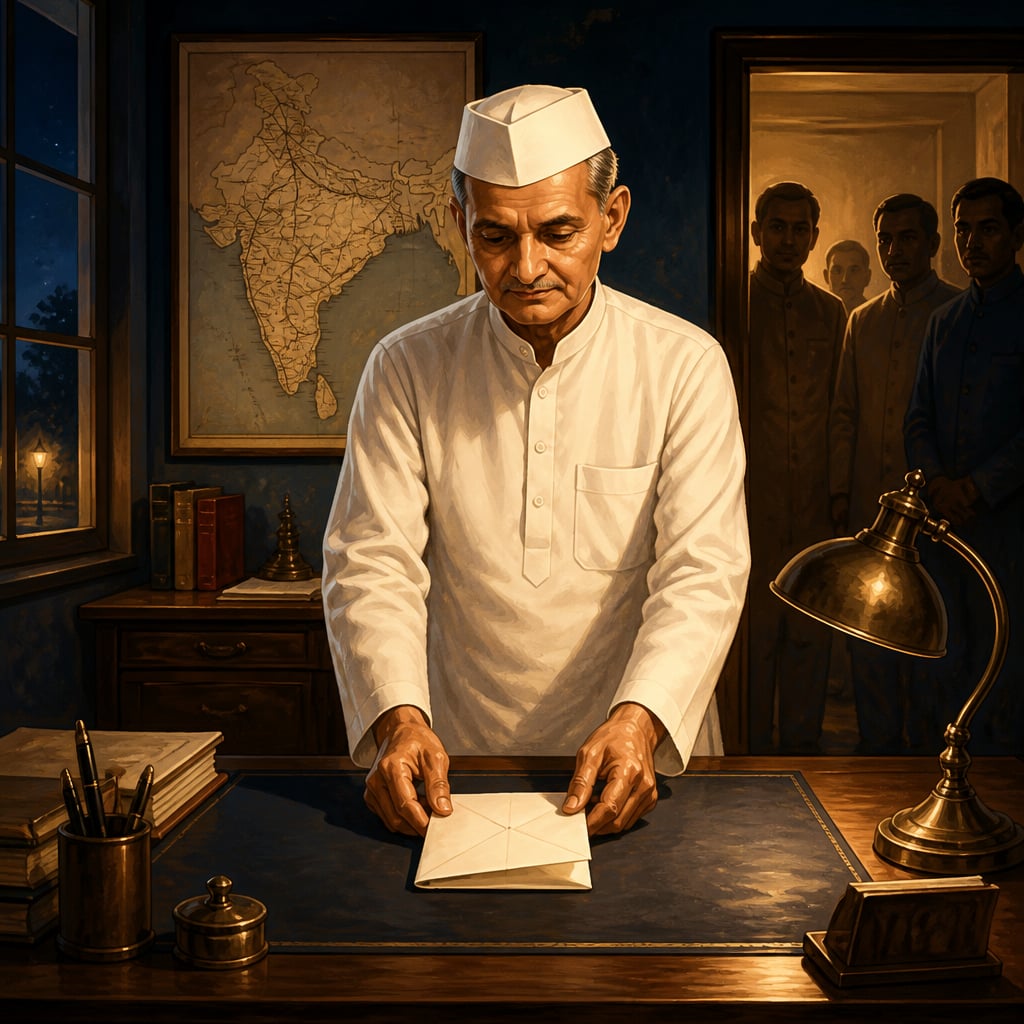
In November 1956, a passenger train plunged off a bridge near Ariyalur in the south, and more than a hundred people died. In Delhi, the Railway Minister sat down and wrote his resignation. His name was Lal Bahadur Shastri.
Understand what he was doing. Shastri had not driven the train. He had not inspected the bridge. No inquiry had named him. Months earlier, after another accident, he had already offered to resign, and Nehru had refused to let him go. This time Shastri insisted, and Parliament watched a minister walk away from power over a consequence no court would ever have pinned on him.
Most people found it baffling then, and would find it more baffling now. We live in the age of the deniable: the unsigned decision, the process failure, the mistakes-were-made statement. Shastri was operating on a different physics. He believed that a consequence belongs to the person whose actions fed it, whether or not any scorekeeper says so.
That physics has a name, and this chapter is about it.
The Law Without a Judge
Ask most people what karma means and you will hear something like: do bad things and God punishes you, do good things and God rewards you. A cosmic headmaster with a cane and a sweet jar.
That is not what this text teaches. Listen to how the Garuda Purana states the law:
देवत्वे मानुषत्वे च दानभोगादिकाः क्रियाः । या दृश्यन्ते वैनतेय तत्सर्वा कर्मजा फलम् ॥
devatve mānuṣatve ca dāna-bhogādikāḥ kriyāḥ yā dṛśyante vainateya tat sarvā karmajā phalam
O Garuda, whatever condition is seen among the gods or among humans, their giving, their enjoyment, all their circumstances: every bit of it is the fruit of karma.
Garuda Purana, Preta Khanda 46.36
Notice what the verse does not say. It does not say a god watches, weighs, and decides. It says the results ARE the fruit of the actions, the way a harvest is the fruit of the sowing. Karma is simply the Sanskrit word for action, from the root kri, to do. The claim of this text is that action and consequence are one continuous event, the way a thrown stone and its arc are one event. No one has to watch the stone for it to land.
And notice the first word: even in godhood, the verse says, circumstance is the fruit of karma. Nobody in this cosmos is above the physics. There is no VIP entrance.
Nobody Is Keeping Score Against You

Sit with what this model actually removes. It removes the persecutor. In this text, there is no one keeping score against you, no ledger-keeper with a grudge, no cosmic enemy waiting for your slip. The score keeps itself, the way your body keeps the score of what you eat whether or not any doctor is watching.
That is a relief, and it is also the most demanding idea in the chapter. A judge can be flattered, bribed, or petitioned. A law cannot. If consequence were a verdict, you could argue with it. Because it is a physics, the only thing that changes outcomes is changing actions. The text's entire practical teaching flows from this: not fear of a punisher, but respect for a law.
The modern mind mostly runs on the opposite assumption. We call it getting away with it. The phrase assumes consequence is a pursuer: something chasing you that can lose your trail if you are clever, quiet, or lucky. Entire careers, and some entire industries, are built on outrunning it.
There Is No Away
In 2015, researchers testing cars on real roads discovered that Volkswagen diesel engines behaved differently in the lab than on the highway. The company, it emerged, had installed software in eleven million cars designed to detect an emissions test and quietly switch the engine into a cleaner mode, then switch back on the open road. It was close to a perfect secret action: invisible, technical, distributed across millions of machines, run for years.
And every one of those cars was pumping its actual exhaust into the actual air the whole time. The cheat concealed the record; it never touched the reality. When the concealment failed, the accumulated consequence arrived at once: tens of billions in fines and settlements, executives prosecuted, a century-old reputation burned. But read the story the way this chapter reads it: the consequence did not begin when they were caught. It began with the act, in the air itself, and merely surfaced later. The exhaust was always real.
That is what the text means. Consequence is not a verdict pronounced at the end. It is exhaust, accumulating from the first act, whether or not anyone has measured it yet. "Getting away" only ever means the measurement has not happened. In the model of the Garuda Purana, there is no away.
Modern Echoes
Shastri understood this physics from the inside, and his countrymen sensed it. That is why the 1956 resignation is still cited in Indian public life, nearly seventy years later, as the benchmark of owning a consequence. He was not performing guilt; the accident was not his deed. He was declaring which physics he lived under: a minister's actions and omissions feed a system, and the system's fruit lands on the person the chair belongs to. When he later became Prime Minister, the country already knew exactly what his word was worth. Integrity, it turns out, compounds like anything else.
So the chapter's question, does anything I do matter if no one is watching, already has its first answer: watching was never part of the mechanism. The stone lands whether or not anyone saw the throw.
But the text has more to say, because a doubt remains. Surely some acts really are unseen, unrecorded, unwitnessed? The next lesson is the tradition's astonishing answer: an inventory of who, exactly, is always watching.
Case studies
The Cheat That Kept Exhausting
For years, Volkswagen diesel cars carried hidden software that recognized when the car was being emissions-tested and switched the engine into a clean mode, reverting on the open road. Eleven million vehicles ran the cheat. It unraveled in 2015 when researchers measured real-world emissions and found the road numbers wildly higher than the lab numbers.
The scheme was a perfect experiment in the modern theory of "getting away with it": total concealment of the record, zero concealment of the reality. Every hidden mile still put real exhaust into real air. In the Garuda Purana's model this is exactly how karma works: the consequence begins with the act and accumulates unmeasured; discovery only sets the harvest date.
The exposure cost Volkswagen tens of billions in fines, settlements, and buybacks, brought criminal charges against executives, and burned a century-old reputation in months. The accumulated fruit of years arrived, compounded, at once.
Concealment postpones measurement, never consequence. The interval between act and harvest is not escape; it is compounding.
About 11 million vehicles worldwide carried the defeat device; the scandal's total cost to Volkswagen has been estimated above 30 billion dollars.
Shastri's Resignation
After the Ariyalur rail disaster of November 1956 killed more than a hundred passengers, Railway Minister Lal Bahadur Shastri resigned, insisting the consequence of the railways' failures belonged to the minister's chair. He had offered to resign after an earlier accident that year and been refused; this time he prevailed, and Nehru accepted, telling Parliament the resignation was accepted as a matter of constitutional propriety and example.
Shastri enacted the lesson's physics in public: he treated consequence as belonging to the actor whose actions and omissions fed the system, not as something to be assigned by an inquiry. No external scorekeeper demanded it; his own accounting did. This is karma understood from the inside: the score keeps itself, so the honest man keeps it too.
The resignation became the enduring Indian benchmark of ministerial accountability, cited for decades. Shastri's moral authority compounded: within a decade the man who gave up power over a bridge failure was Prime Minister of India.
Owning consequences you could have dodged is not loss; it is a deposit in the only account that compounds across a whole public life.
The Ariyalur accident of 23 November 1956 killed over 140 people; Shastri became Prime Minister in 1964, eight years after the resignation.
Living traditions
Karma is now a word the whole world uses, though usually flattened to "what goes around comes around." The text's fuller teaching survives wherever people act on it: consequence begins with the act, belongs to the actor, and ripens on its own calendar, with or without an audience.
- Vijay Ghat, Delhi: The samadhi of Lal Bahadur Shastri, the minister of this lesson who owned a consequence no court assigned him and later led the country. A quiet counterpoint to the grander memorials around it, much like the man: the site of a public life built on the private conviction that the score keeps itself.
Reflection
- Where in your life are you currently "getting away" with something, and what is the exhaust that has been accumulating while the measurement has not happened?
- Shastri owned a consequence no court would have assigned him. Is there an outcome in your world, in your family, team, or community, that is partly the fruit of your actions and omissions, which you have been letting the inquiry assign to someone else?
- If you fully believed that no one keeps score against you, but that the score keeps itself, what would you stop doing tomorrow, and what would you finally start?