Dawn at Dalhousie
Ajit Singh, thirty-eight years in exile, and a death at Dalhousie on the morning of 15 August 1947
Ajit Singh founded the Bharat Mata Society with his brother Kishan Singh, led the 1907 canal colony agitation, and was deported to Mandalay under Regulation III of 1818. He then left India for thirty-eight years, living under a Persian name in Shiraz, eighteen years in Brazil, and later in Italy, where he broadcast to Indian soldiers. He came home on 7 March 1947 and died at Dalhousie in the early hours of 15 August 1947, a few hours into independence.
The Spring Hotel, Half Past Midnight
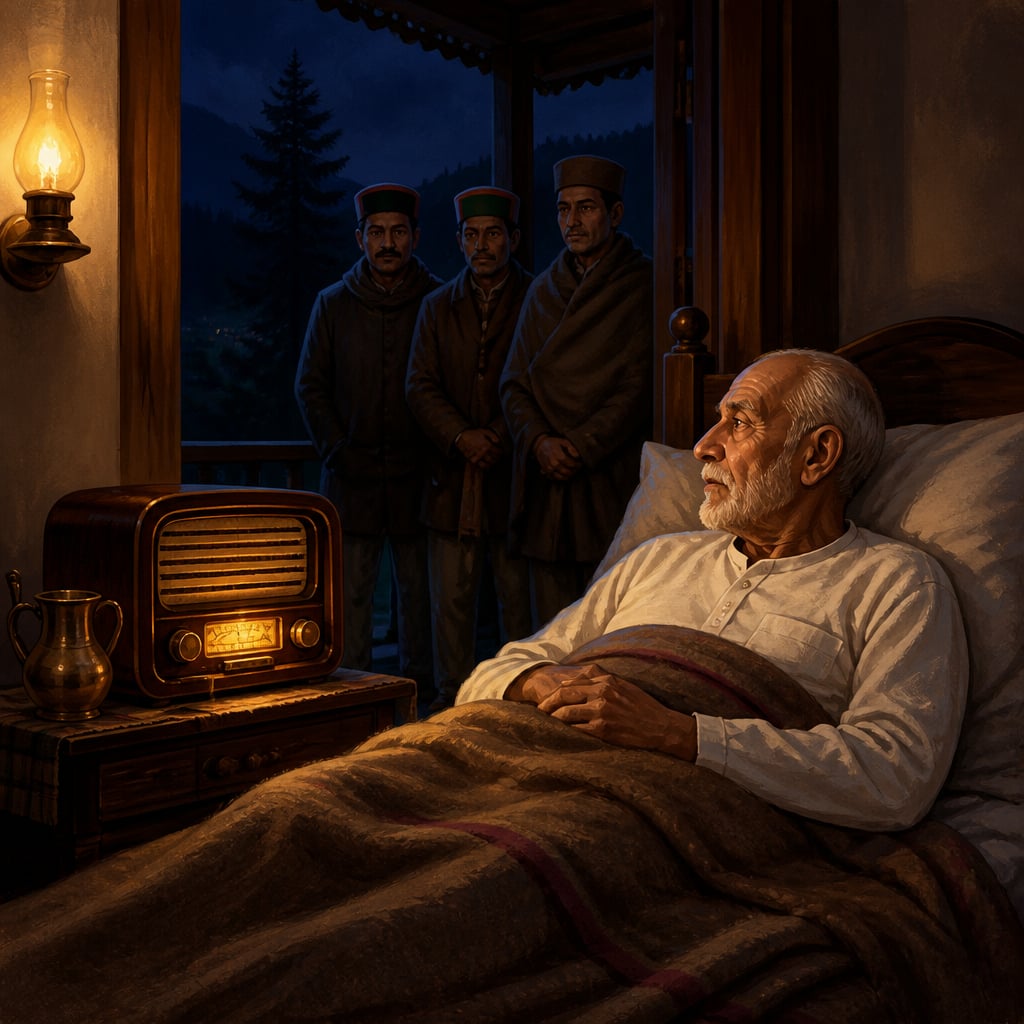
It is the night of 14 to 15 August 1947. In a room at the Spring Hotel at Dalhousie, in the hills above Chamba, a sick man of sixty-six is listening to a radio set. He has been ill since he came up to these hills in July. Outside, a few local people have crowded onto the veranda, because they know who the old man is and they want to hear the broadcast with him.
The voice on the radio is Jawaharlal Nehru's, speaking from Delhi about a tryst with destiny. The man in the room is Ajit Singh, born at Khatkar Kalan in the Jalandhar district on 23 February 1881. He last lived in India as a free man in 1907. In the years between, he has used a Persian name and taught school in Shiraz. He has sold goods in Rio de Janeiro. He has spoken on Italian radio, and sat in an Allied internment cell.
He had come home in March. He had waited four months. A few hours after the broadcast, in the early morning of 15 August 1947, he died in that room.
Most people in India know him, if they know him at all, as the uncle of Bhagat Singh. That is the smallest true thing about him.
The Brothers and the Society
Ajit Singh was one of three brothers, sons of Arjan Singh of Khatkar Kalan. The others were Kishan Singh and Swaran Singh. He went to school in Jalandhar and later read law at Bareilly, and he did not finish it.
In 1906 he went to the Congress session at Calcutta, and came back with a plan that was not a Congress plan. With Kishan Singh and their friend Ghasita Ram he founded the Bharat Mata Society. The Urdu name was Anjuman-i-Mohabban-e-Watan, the association of the lovers of the homeland. It ran a book depot and a journal called Bharat Mata, and it printed pamphlets in Urdu that the Punjab government later produced in court as evidence.