The Prophet of Kambiron
The healer who reformed a faith, told the hills to stop paying tax, and was hanged on a charge his trial could not prove
Jadonang of the Rongmei built a house of worship at Kambiron in 1929 and founded Heraka, a reform of the Zeliangrong faith that cut back sacrifice and gave the hills one God to sing to. Then he told the villages to stop paying the house tax and stop carrying unpaid loads, and named the goal Naga Raj. The Political Agent charged him with ordering four killings he was not present for, prosecuted and judged the case himself, and hanged him at Imphal on 29 August 1931.
The House He Built at Kambiron
It is 1929, in the hills of Tamenglong, in the west of Manipur. In a village called Kambiron, a young man is building a house that is not a house. The posts are heavy timber, cut and hauled up by neighbours who were not paid for it. Inside there is no hearth and no sleeping platform. There is a space to stand and sing in.
The young man is Jadonang, of the Rongmei people, and he is about twenty four years old. He is a farmer's son, the youngest of three. His father died when he was a baby. By the time he was ten the villages around were bringing him their sick, because he had dreams that came true and hands that seemed to heal. They called him Haipou, grandfather, which in these hills is what you call a man you trust with your whole family.
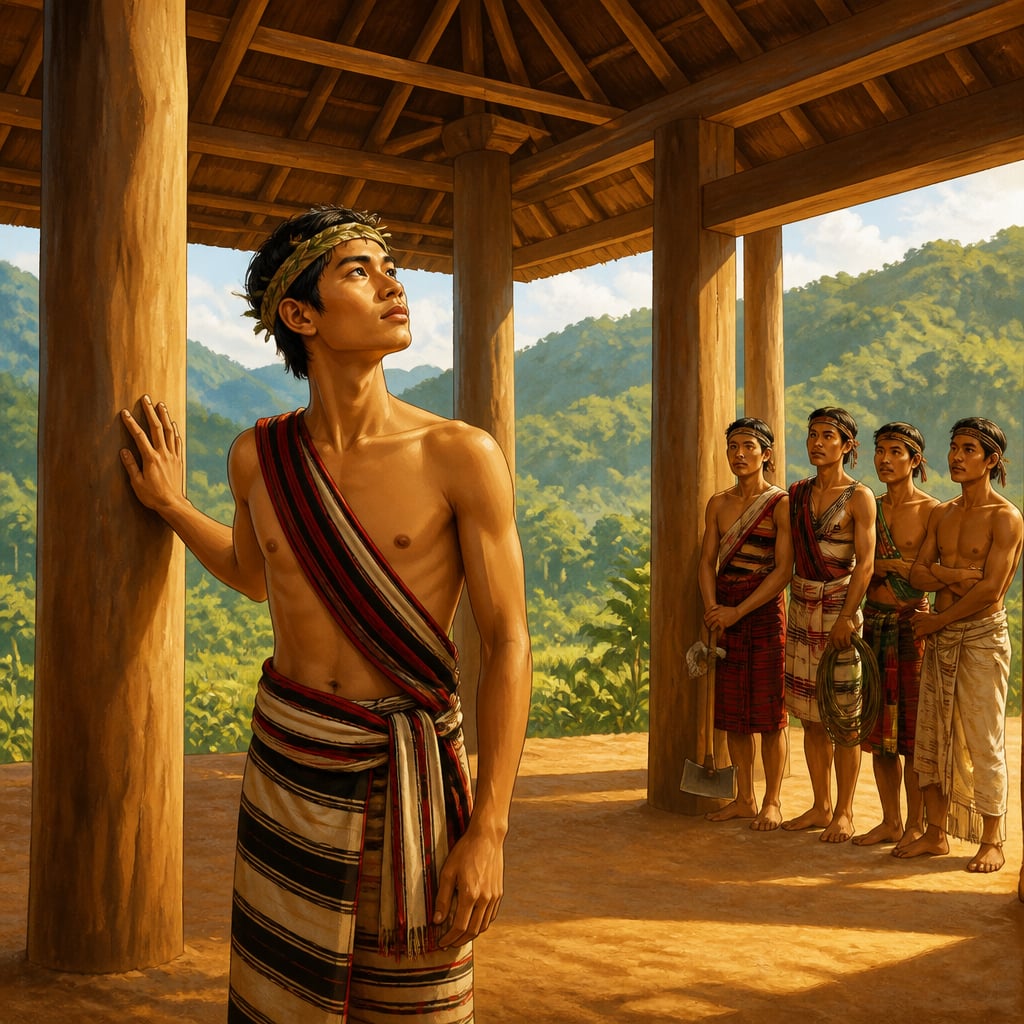
The house is a Rah Kai, a house of God, and it is the first of its kind. Jadonang has told the Zeliangrong people three things that no one in the hills has said out loud before. That there is one supreme God, Tingkao Ragwang, and the small spirits do not need feeding with blood every time a child is born or a dog barks wrong. That the old faith can be cleaned up without being thrown away. And that the British will leave.
That third one is why a Political Agent at Imphal will one day want him dead.
Heraka Means Pure
Jadonang called his reform Heraka, which means pure. It is easy to get this backwards, so be careful here. He was not importing a new religion into the hills. He was reforming the one already there, from the inside, the way reformers have always worked in this civilization.