Chintapalli, 22 August 1922
The man who signed the police register, and the twenty one months that followed
On 22 August 1922 a sannyasi named Alluri Sitarama Raju led three hundred hill people into the Chintapalli police station, took the guns, and wrote the whole inventory into the station diary under his own signature. This lesson follows the raids, the two Gam brothers who commanded with him, the war the Raj fought to end it, and his death without trial at Koyyuru in May 1924.
The Signature in the Station Diary
It is Tuesday, 22 August 1922, late in the afternoon. Chintapalli is a small hill town in the Visakhapatnam Agency, a day's walk from anywhere with a telegraph. The police station is a low building with a tiled roof, a lock-up, and a rack of muskets in a back room.
Perhaps three hundred hill people come out of the trees and surround it. Most carry bows and axes. A few have old guns. The handful of constables inside do not fight for long.
The men take the muskets off the rack and the cartridges out of the store. Then something happens that no police report in the Madras Presidency has ever recorded before. A young man in ochre robes walks to the desk, opens the station diary, and writes in it.
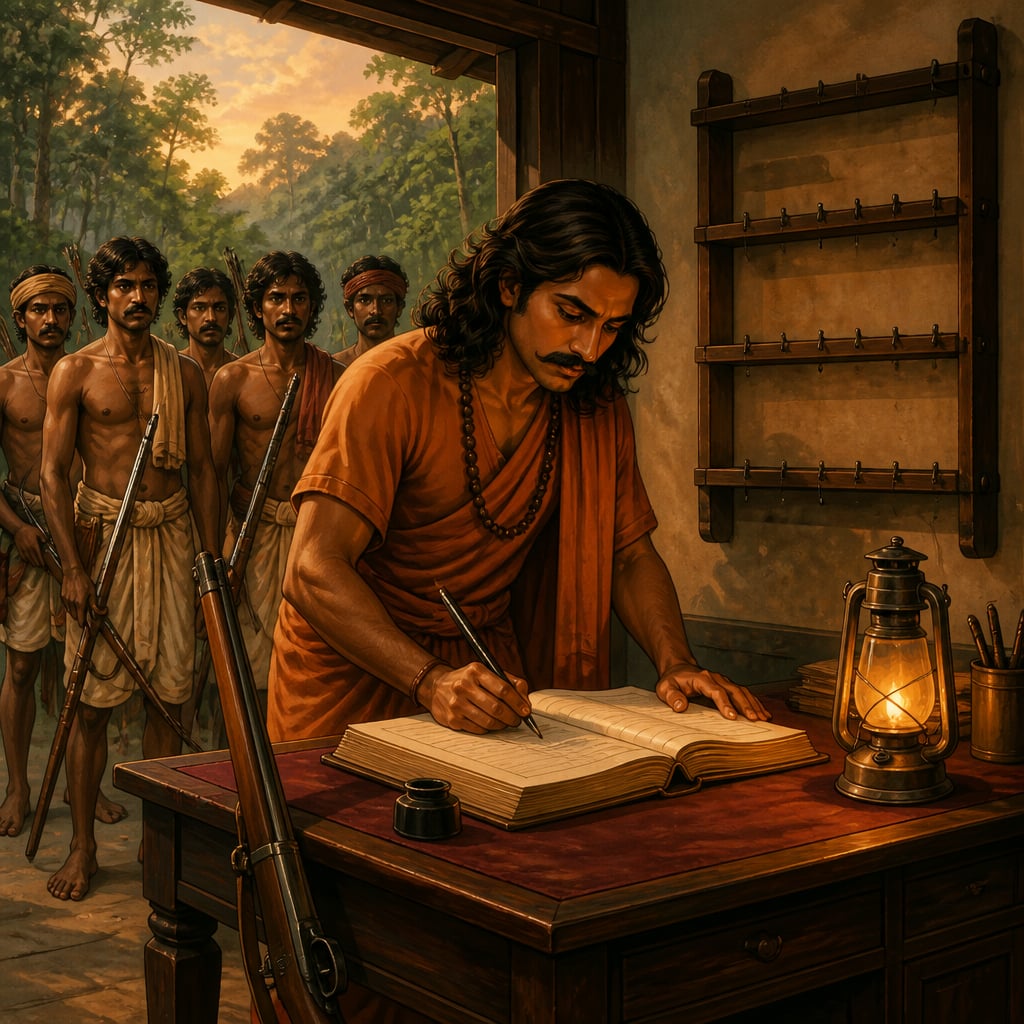
He lists what he has taken: the guns, the number of rounds, the date, the hour. He signs his name at the bottom. Alluri Sitarama Raju. Then he adds a line daring the police to come and get it back.
He was about twenty-five. The next day his men took the station at Krishnadevipeta. The day after that, Rajavommangi. Across three days they carried away twenty-six muskets, six Lee Enfield rifles, a revolver and around 2,500 rounds. Every time, the same entry, the same signature.
The British would spend nearly two years and a great deal of money hunting the man who wrote it. What they never quite understood is why he signed.
What the Hills Had Lost
The reason begins with a law. The Madras Forest Act of 1882, following the all India Act of 1878, turned the forest into government property. The hill people of the Agency lived by podu. They cut and burned a patch of hillside, cropped it for a few years, then let it go back to jungle. Podu was now a crime.