The Hunger Strike at Port Blair
A hunger strike in the Cellular Jail, three men killed by the tube meant to keep them alive, and the ship that finally brought the rest home
On 12 May 1933 the political prisoners of the Cellular Jail at Port Blair stopped eating, asking to be treated as political prisoners rather than convicts. Mahavir Singh, a Lahore Conspiracy Case convict of twenty eight, died under force feeding on 17 May, and Mohan Kishore Namadas and Mohit Moitra died the same way. Their deaths made the Andamans an embarrassment the government could not defend, and by January 1938 every political prisoner there had been shipped back to the mainland.
Cell Block, 17 May 1933
It is the sixth day of the strike. In a cell in the Cellular Jail at Port Blair, a twenty-eight year old from Etawah district lies on the stone floor and will not open his mouth. His name is Mahavir Singh. Four months ago he stepped off a ship into this place with a sentence of transportation for life, which meant he was not expected to leave it.
Four warders hold him down. A doctor forces a rubber tube down his throat. At the other end of it is a funnel, and into the funnel goes warm milk. This is the jail's standard answer to a man who stops eating. It has been done to him before this week and it will be done to others after him.
Something goes wrong. The tube is in the wrong pipe. The milk goes into his lungs instead of his stomach.
He dies on the floor of that cell. Two more men in the same strike, Mohan Kishore Namadas and Mohit Moitra, die the same way within weeks. Three deaths, in a prison built so that no prisoner could see another. The demand sounds almost small when you say it out loud. Give us books, give us paper, and stop harnessing us to the oil mill.
What makes this worth a lesson is what those three deaths bought.
What Transportation Actually Meant
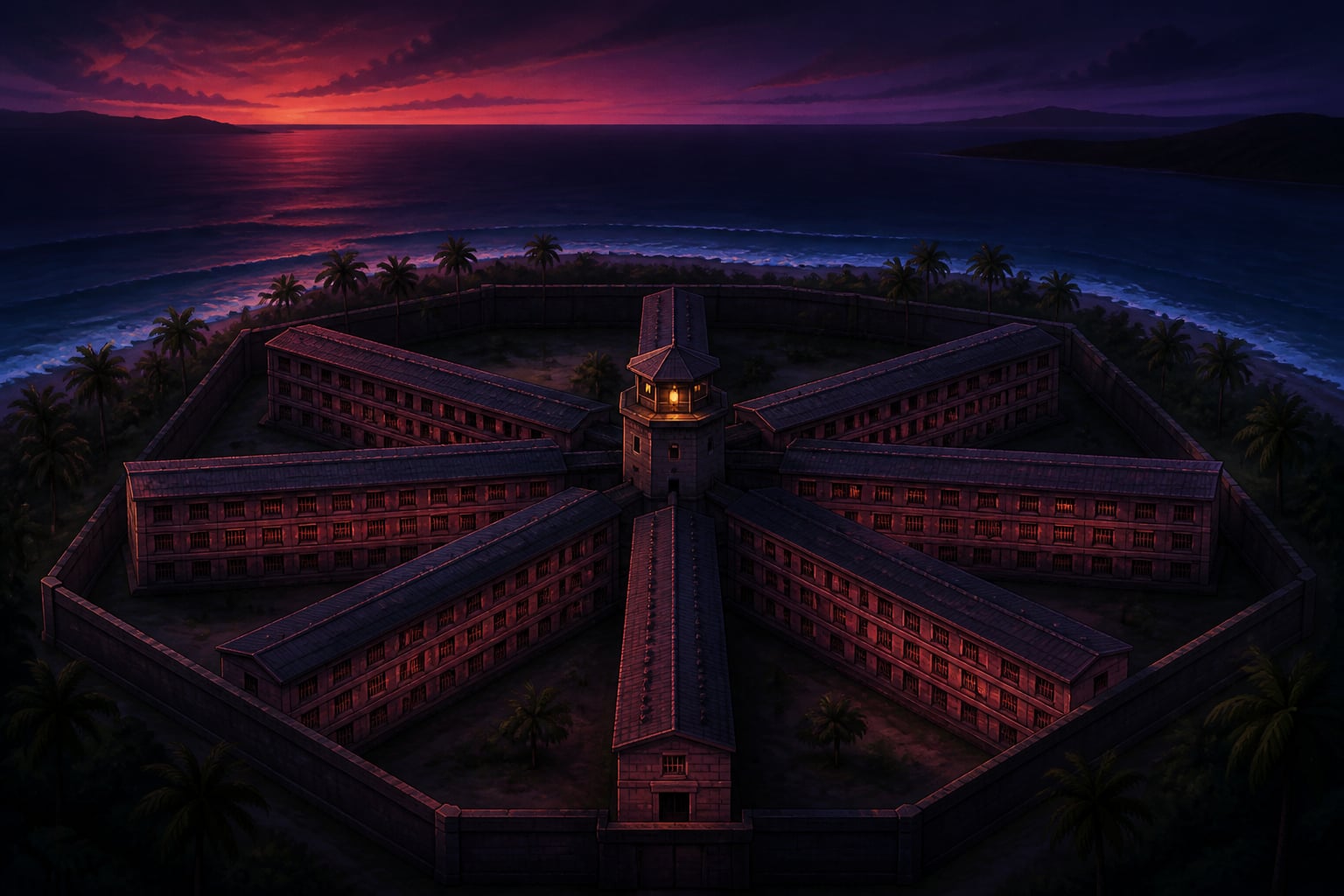
The Cellular Jail was finished in 1906 at Port Blair, in the Andaman Islands, about 1,300 kilometres from the Indian coast. Seven wings radiated from a central watchtower. It had 696 single cells, and the wings were angled so that the front of one faced the back of another. A prisoner could not see, signal or speak to another prisoner. That was the design.