Sukkur, 21 January 1943
The night on the track outside Sukkur, the sentence a military administrator changed, and the four names a nineteen-year-old took to the gallows
On the night of 22 October 1942 Hemu Kalani and four companions tried to pull the fishplates off the railway line north of Sukkur, ahead of a military train running to Quetta. He was the only one caught. A tribunal gave him a term of years, the Martial Law Administrator changed it to death, and mercy was offered on one condition: the names of the other four. He was hanged at Sukkur jail on 21 January 1943, aged nineteen, and the four names never entered the record.
The Track Outside Sukkur
It is late on the night of 22 October 1942, on the railway line running north out of Sukkur, in Sindh. The Indus is a few hundred yards away. The desert air has gone cold the way it does here after dark, and the ballast under the rails is still giving back the heat of the day.
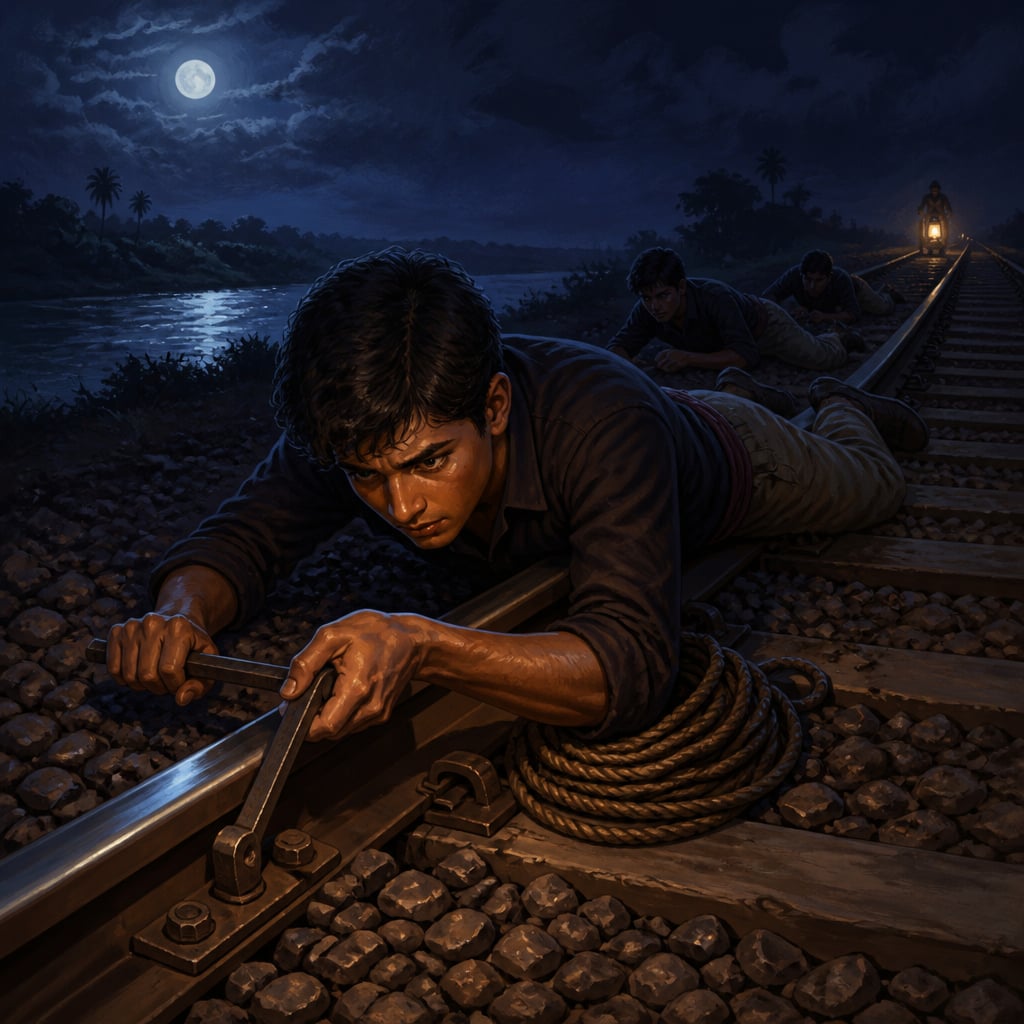
Five young men are lying flat beside the track. They are trying to pull out the fishplates, the steel bars that bolt one rail to the next. They do not have a spanner between them. They are working with a rope and an iron bar, and the bolts are not moving.
The train they are waiting for is a military special, loaded with arms and men, running up the line towards Quetta and the Baloch garrisons. Sindh is under martial law. Somewhere behind them a patrol has already seen movement on the track.
Four of them get away into the dark. The fifth is caught on the line. His name is Hemu Kalani and he is nineteen years old. In the three months that follow, every offer the British make him will come down to one question: who were the other four.
He will die without answering it.
Sindh in the Autumn of 1942
Most people who know the story of 1942 know Bombay, Midnapore, Assam. Sindh is rarely in the telling at all, and it needs a moment of setting.
Sindh had only been a separate province since 1936, cut away from the Bombay Presidency. It had a small Congress, a large landholding class, and something most provinces did not have: a Premier who took the Quit India side. Allah Bakhsh Soomro headed the government at Karachi. In September 1942 he wrote to Winston Churchill and gave back his British titles, the OBE and the Khan Bahadur. It was a protest at how Churchill had spoken of the Indian movement in the Commons. On 10 October 1942 the Governor, Sir Hugh Dow, removed him from office for it.