Sarupathar
The Santi Sena man who argued against cutting the railway, and was hanged in June 1943 for the derailment he had not carried out
On 15 June 1943 Kushal Konwar walked to the gallows at Jorhat jail reading the Gita. He was the only Indian executed for the Quit India movement, convicted of a train derailment near Sarupathar that other men had carried out and that he had argued against. This lesson follows how the Empire chose him.
The Cell at Jorhat
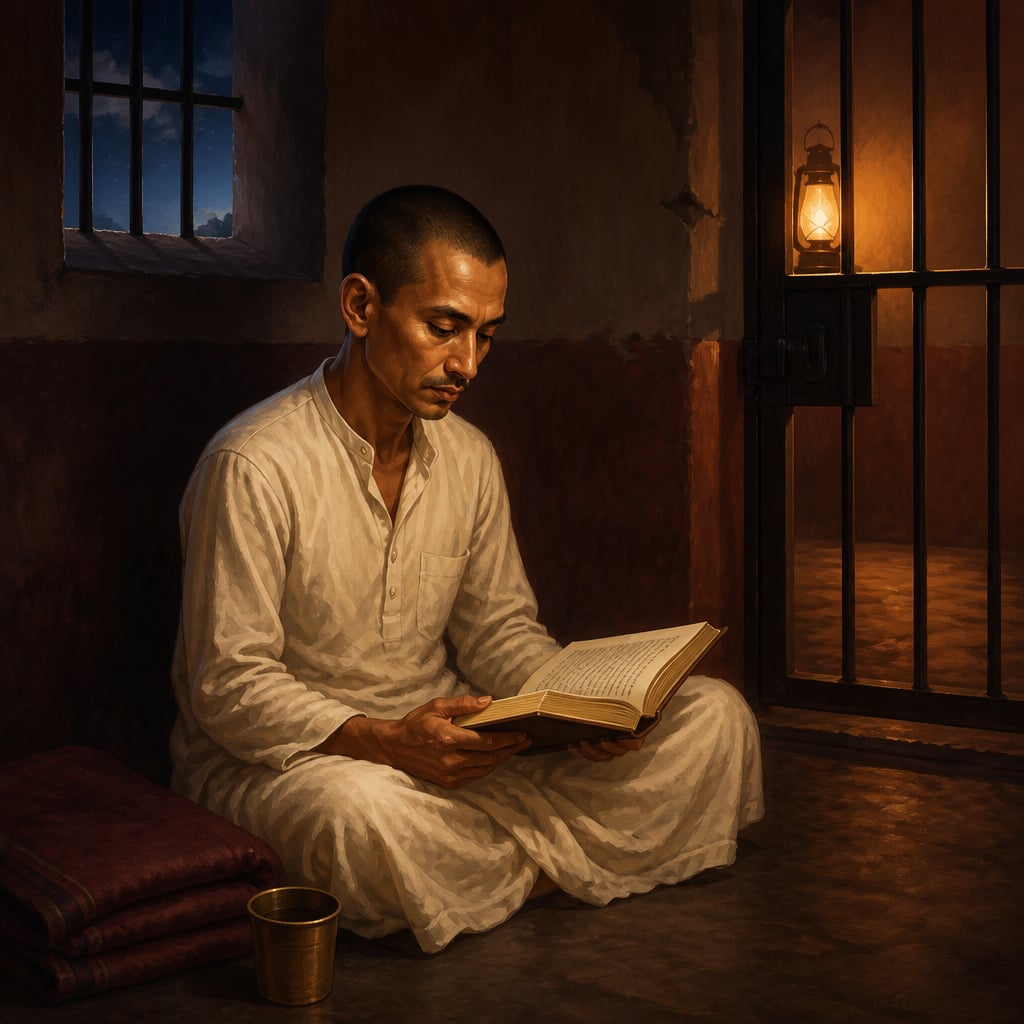
It is a little before half past four in the morning on 15 June 1943. The sky over Jorhat jail, in upper Assam, is not light yet. In a cell on death row a thin man of thirty-eight sits with a copy of the Bhagavad Gita open on his knees. He has read from it every day for a hundred days. He has not eaten meat since 1925. He has not touched salt since 1931, the year Gandhi walked to the sea.
His name is Kushal Konwar. He leads the Sarupathar Congress Committee. In a few minutes the warders will come for him, and he will walk to the gallows reading aloud from the book on his knees.
He is being hanged for derailing a military train.
He did not derail it. He was not there. He had argued against it. The men who actually pulled the fish plates out of the track were still free, and would stay free. Kushal Konwar knew all of this, and he went to the rope anyway. He is the only Indian hanged for the Quit India movement of 1942. This lesson is about how a man who spent his life refusing violence came to die for an act of it.
The Man Who Would Not Fight
Kushal Konwar was born on 21 March 1905 at Chaodang Chariali, in the Ghiladhari area of Golaghat district. His father was Sonaram Konwar. He went to school at Golaghat. In 1921, still a boy, he heard Gandhi's call to stop cooperating with the government. He walked out of his classroom into the movement.

What he did next tells you the shape of the man. He did not go looking for a gun. He started a village school at Bengmai and taught in it without pay. The money ran out and the school closed. He took a clerk's job at the Balijan Tea Estate, in the garden country where Assam's labour was worked hardest, and he kept it until 1936. Then he gave it up to work for the Congress full time.