Vaidya Dharma: Medical Ethics Before Hippocrates
Suśruta's oath, patient care principles, and physician qualifications
Explore Suśruta's oath and patient care principles, concepts of confidentiality, non-maleficence, and consent, and physician qualification and training requirements.
Vaidya Dharma: The Physician's Sacred Duty
Medicine is power, the power to heal or harm, to know intimate secrets, to command trust in moments of vulnerability. Every civilization with advanced medicine has grappled with how to constrain this power ethically. The Hippocratic Oath is often celebrated as the foundation of Western medical ethics. But centuries before Hippocrates, Indian medical texts had developed sophisticated ethical frameworks for the physician's conduct, codified as Vaidya Dharma, the physician's righteous duty.
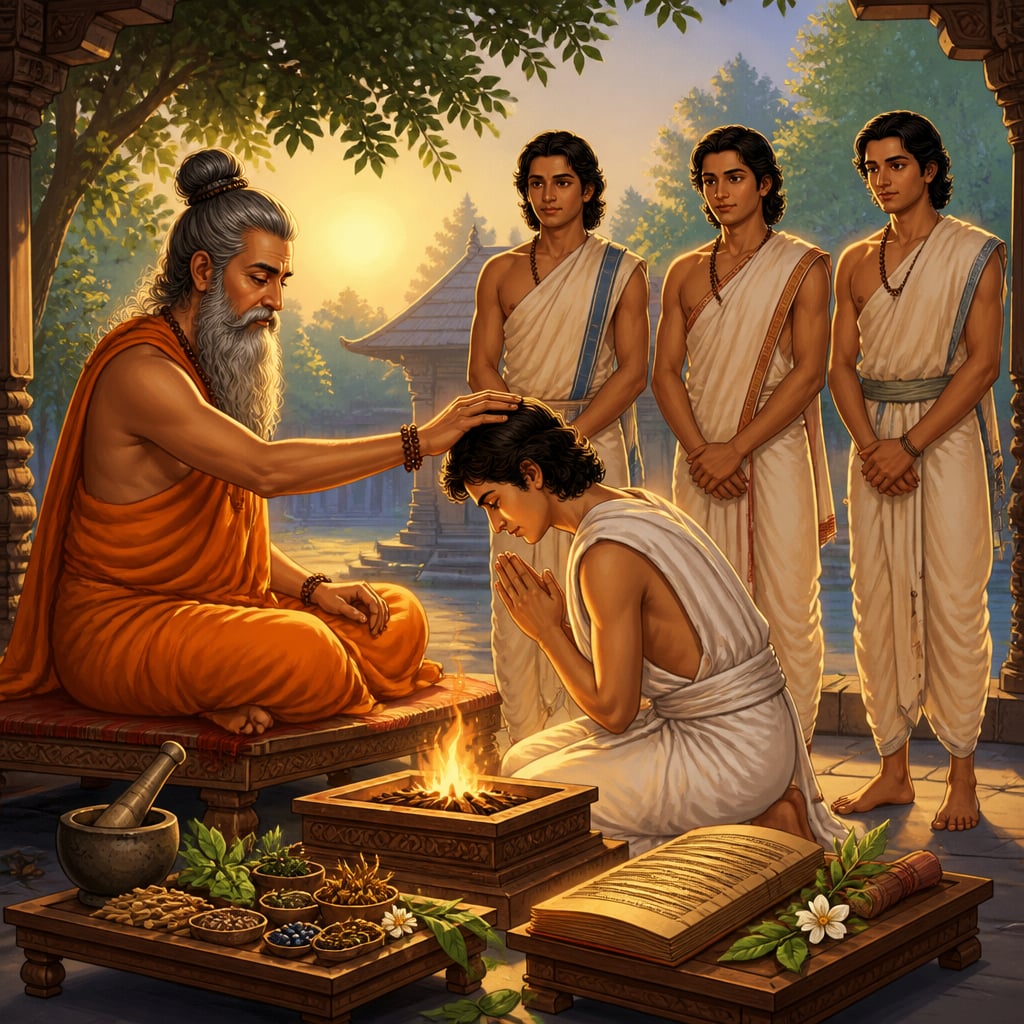
The Initiation Oath
Both Suśruta and Caraka describe formal initiation ceremonies for medical students, including oaths that establish ethical obligations. The Caraka Saṃhitā's initiation oath is particularly comprehensive:
The student pledges to:
- Live a celibate, austere life during training
- Wear simple clothing and avoid ostentation
- Speak only truth and avoid violence
- Obey the teacher in all legitimate matters
- Work day and night for patient welfare
- Never desert patients, even at risk to self
- Never take advantage of female patients
- Keep patient information confidential
- Never use medical knowledge to harm
- Serve all patients regardless of status
The ceremony concludes with the teacher declaring the student fit to practice only after demonstrating competence and ethical commitment.
The Four Pillars of Treatment
Caraka identifies four essential components of successful treatment, each with ethical implications:
1. Bhiṣak (Physician)
The physician must possess:
- Deep scriptural knowledge (śāstra-jñāna)
- Wide practical experience (anubhava)
- Manual skill (kauśala)
- Personal purity (śuddhi)
Ethical requirement: Only those truly qualified should practice. Incompetent treatment, even with good intentions, violates patient trust.
2. Dravya (Medicines)
Medicines must be:
- Pure and properly prepared
- Available in sufficient quantity
- Appropriate for the condition
Ethical requirement: Never use adulterated medicines or substitute inferior ingredients for profit.
3. Upasthātṛ (Attendant/Nurse)
The attendant must be:
- Skilled in patient care
- Kind and compassionate
- Available when needed
- Free from disgust for unpleasant duties
Ethical requirement: Patient care is a team effort; all caregivers share ethical responsibility.
4. Rogī (Patient)
The patient should:
- Follow medical instructions
- Report symptoms truthfully
- Trust the physician
- Maintain prescribed regimens
Ethical requirement: Patients have responsibilities too, healing is a collaborative relationship.
Confidentiality: The Sacred Secret
Indian medical ethics placed extraordinary emphasis on patient confidentiality, termed guptavacana (guarded speech) or rahasya-rakṣaṇa (secret-protection):

"Whatever is seen or heard in the patient's home regarding their disease or personal matters should never be disclosed. The physician who reveals patient secrets is the worst of sinners."
The texts specify particular categories requiring strict confidentiality:
- Disease conditions that might cause social stigma
- Family matters learned during treatment
- Financial circumstances
- Personal habits and behaviors
This ethical obligation predates modern medical confidentiality laws by over two millennia but articulates essentially the same principle: patients must trust that intimate information shared for healing will not be used against them.
Non-Maleficence: First, Do No Harm
Long before the Latin formulation primum non nocere, Indian medicine articulated the same principle:
"The physician should work only for the patient's benefit, never for their harm. Even if offered great wealth, one should refuse to poison an enemy."
Specific prohibitions included:
- Never providing medicines intended to harm
- Never performing unnecessary surgery
- Never experimenting on patients without therapeutic purpose
- Never treating beyond one's competence
Suśruta particularly emphasized that surgical intervention carries inherent risks, the surgeon must honestly assess whether operating serves the patient better than not operating.
Qualification Requirements
Unlike societies where anyone could claim healing powers, Indian medical texts insisted on formal qualification:
Training Requirements:
- Minimum years of study under qualified teachers
- Mastery of theoretical texts
- Practical experience under supervision
- Demonstrated ethical character
- Formal examination and certification
The Four Types of Physicians:
Caraka classifies practitioners into four categories based on their relationship to these requirements:
- Pranabhisak – The true physician: knowledgeable, skilled, experienced, and ethical
- Rogabhisak – Treats diseases but lacks comprehensive knowledge
- Chādmachara – Pretenders who pose as physicians without training
- Rogaparipālaka – Those who merely maintain chronic conditions without curing
The text explicitly warns against the chādmachara, fraudulent practitioners whose treatment causes more harm than the disease.
The Physician-Patient Relationship
Indian medical ethics conceptualized the physician-patient relationship through multiple frames:
As Teacher-Student: The physician educates the patient about their condition and treatment rationale. Healing requires patient understanding and cooperation.
As Parent-Child: The physician accepts responsibility for patient welfare with protective concern, but not paternalistic control that overrides patient dignity.
As Friend: The relationship involves trust, goodwill, and honest communication, the physician is the patient's ally against disease.
As Servant: The physician serves the patient's needs, not their own ego or profit. Service (sevā) is the operative word.
Social Responsibility
Vaidya dharma extended beyond individual patients to society:

Treating the Poor: "The physician should treat the destitute, travelers, and those without family with the same care as wealthy patients. Dharma requires healing all."
Public Health: Physicians had obligations to report epidemic diseases, advise rulers on public health measures, and work for community wellbeing.
Teaching: Knowledge must be transmitted to the next generation. Hoarding medical knowledge violates dharma; teaching qualified students is obligatory.
Comparison with the Hippocratic Oath
The Hippocratic Oath (c. 400 BCE) and Indian medical ethics developed independently but show remarkable parallels:
| Principle | Hippocratic Oath | Indian Medical Ethics |
|---|---|---|
| Non-harm | 'I will do no harm' | 'Never act against patient welfare' |
| Confidentiality | 'What I see or hear... I will keep secret' | Guptavacana (guarded speech) |
| Appropriate treatment | 'According to my ability' | Match treatment to competence |
| No exploitation | No sexual relations with patients | Never take advantage of patients |
| Qualified practice | Teach only to worthy students | Strict qualification requirements |
Key differences:
- Indian ethics embedded in dharmic framework with karmic consequences
- Indian texts more specific about economic ethics (fees, treating poor)
- Indian tradition emphasized physician's lifestyle and character more extensively
The Economics of Medical Practice
Indian medical ethics addressed something the Hippocratic tradition largely avoided, money:
Fair Fees: "The physician should charge according to the patient's means. Taking excessive fees from the poor is sinful; refusing fair payment from the wealthy insults the profession."
Treating Without Pay: The texts enumerate categories deserving free treatment:
- The destitute and poor
- Fellow physicians and their families
- Ascetics and religious practitioners
- Close friends and relatives
- Those who have rendered service to the physician
Forbidden Payments: Physicians were prohibited from accepting payment for:
- Teaching incurable patients false hope
- Providing poisons or abortifacients
- Revealing patient secrets
Penalties for Ethical Violations
Violation of vaidya dharma carried consequences:
Professional: Disgrace, loss of reputation, inability to attract students or patients
Legal: Ancient Indian law codes prescribed penalties for medical malpractice, including fines and prohibition from practice
Karmic: Ethical violations would result in negative karma affecting future lives, a powerful motivator in the dharmic worldview
The Living Relevance
Modern medical ethics grapples with the same fundamental issues Indian texts addressed:
- Who is qualified to practice?
- What obligations protect patients?
- How should economic factors relate to care?
- What are the limits of medical intervention?
- How do we balance individual treatment with public health?
The vaidya dharma framework provides not just historical interest but a sophisticated alternative perspective on these enduring questions. The integration of medical ethics with broader ethical philosophy (dharma) offers a holistic approach that contemporary bioethics, often divorced from philosophical foundations, might benefit from recovering.
The ancient Indian physician was not merely a technician of the body but a practitioner of dharma, righteous action, in the specific domain of healing. This elevated understanding of the medical vocation remains as relevant today as it was in Suśruta's time.
Key figures
Caraka
Hippocrates
Suśruta
Case studies
The Confidentiality Dilemma (Historical Reconstruction)
A scenario discussed in medical texts: A physician treats a woman for a condition that reveals she has been unfaithful to her husband. The husband, who is also the physician's friend, later asks about his wife's health. The ethical analysis: - Revealing the truth would fulfill friendship obligations but violate patient confidentiality - The texts unanimously require confidentiality: 'What is learned in the patient's home stays there' - The physician should provide only general reassurance without specific details - If pressed, the physician may refuse to answer rather than lie or reveal This case illustrates that confidentiality isn't conditional on convenience or relationships - it's an absolute protection of the patient's trust.
This case reflects the deep knowledge tradition of Indian surgery and medicine (Shalya Tantra), where empirical observation and systematic methods were developed centuries before similar Western discoveries.
The knowledge demonstrated in this case study contributed to the broader legacy of Indian surgery and medicine (Shalya Tantra), influencing developments across Asia and eventually the world.
Ethical obligations can conflict. When they do, the specific duties of one's role (vaidya dharma) take precedence over general obligations. The physician's primary loyalty is to the patient.
Doctor-patient confidentiality remains one of healthcare's most contested boundaries. HIPAA in the US, GDPR in Europe, and India's Digital Personal Data Protection Act all codify the same principle that ancient medical ethics established: the physician's duty to the patient overrides social pressure to disclose.
The Sushruta Samhita describes over 300 surgical procedures and 120 surgical instruments, compiled around 600 BCE.
Modern Medical Ethics and Ancient Principles (Comparative Analysis)
Modern bioethics identifies four fundamental principles (Beauchamp & Childress): 1. **Autonomy** – Respect patient's right to decide 2. **Beneficence** – Act for patient's benefit 3. **Non-maleficence** – Avoid causing harm 4. **Justice** – Fair distribution of benefits and burdens Comparison with Indian medical ethics: | Modern Principle | Indian Equivalent | Notes | |-----------------|-------------------|-------| | Autonomy | Limited; more paternalistic | Indian texts emphasize physician guidance | | Beneficence | Sarva-bhūta-hita (welfare of all) | Explicitly stated as physician's purpose | | Non-maleficence | 'Never act against patient welfare' | Clearly articulated prohibition | | Justice | Treating poor without payment | Strong emphasis on access for all | The Indian tradition was strong on beneficence, non-maleficence, and justice but weaker on autonomy as moderns understand it. The physician-patient relationship was more hierarchical.
This case reflects the deep knowledge tradition of Indian surgery and medicine (Shalya Tantra), where empirical observation and systematic methods were developed centuries before similar Western discoveries.
The knowledge demonstrated in this case study contributed to the broader legacy of Indian surgery and medicine (Shalya Tantra), influencing developments across Asia and eventually the world.
Ethical frameworks evolve. While core principles persist across traditions, their relative emphasis shifts with cultural context. Modern autonomy emphasis reflects contemporary individualism.
Bioethics committees at hospitals worldwide debate end-of-life care, genetic testing disclosure, and AI-driven diagnosis using frameworks that map closely to ancient principles. The balance between patient autonomy and physician duty that Caraka navigated remains the central tension in modern medical ethics.
The Sushruta Samhita describes over 300 surgical procedures and 120 surgical instruments, compiled around 600 BCE.
The Initiation Ceremony Today (Living Tradition)
Traditional Āyurveda colleges in India still conduct initiation ceremonies where students take oaths derived from Caraka's formulations. A 2018 study documented the ceremony at a Kerala Āyurveda college: **The Ritual:** - Held at the beginning of clinical training - Fire ceremony (homa) invoking Dhanvantari - Teacher formally accepts the student - Student recites Sanskrit oath passages - Exchange of symbolic items (water, sacred thread) - Community witness to the commitment **Student Perceptions:** Interviews revealed students found the ceremony 'transformative' - marking a transition from ordinary student to one bearing special responsibilities. The ritual made abstract ethics feel concrete and binding. **Comparison with Western Ceremonies:** Many Western medical schools have reintroduced oath ceremonies (often modified Hippocratic oaths) after abandoning them in the 20th century. Research suggests these rituals enhance ethical commitment.
This case reflects the deep knowledge tradition of Indian surgery and medicine (Shalya Tantra), where empirical observation and systematic methods were developed centuries before similar Western discoveries.
The knowledge demonstrated in this case study contributed to the broader legacy of Indian surgery and medicine (Shalya Tantra), influencing developments across Asia and eventually the world.
Ritual and ceremony can make ethical commitments more real and binding. The Indian tradition's formal initiation process was pedagogically sophisticated in using ceremony to shape character.
Medical school white coat ceremonies in the US and UK serve the same function as Caraka's initiation ceremony: marking a transition from student to practitioner, publicly binding the new physician to ethical commitments. Ritual reinforces professional identity in ways that written codes alone cannot.
20th century - referenced in the context of The Initiation Ceremony Today (Living Tradition).
Historical context
Classical Period of Indian Medicine (c. 600 BCE - 600 CE)
Living traditions
- Ānukūlya Saṃkalpa (Commitment to Patient Welfare): Many traditional Āyurvedic practitioners begin each day with a personal recommitment to patient welfare, a living continuation of the ancient vaidya dharma tradition.
- National Medical Commission, New Delhi: India's medical regulatory body, which oversees physician ethics and licensing. The Indian Medical Council's ethical guidelines blend modern bioethics with traditional principles.
- Arya Vaidya Sala, Kottakkal: Traditional Āyurvedic institution founded on principles of ethical practice, providing quality care while maintaining the vaidya dharma of service to all regardless of economic status.
- Kottakkal Āyurveda College: Traditional Āyurveda college where initiation ceremonies including oath-taking continue in modified form. Students learn classical ethics alongside clinical training.
Reflection
- Ancient Indian texts said the physician should treat the poor without payment. In a world of expensive medical technology, how do we balance financial sustainability with the ethical obligation to provide care regardless of ability to pay?
- The texts required physicians to maintain strict confidentiality 'even at the cost of life.' In an age of electronic records and data sharing, how do we preserve the spirit of this protection while adapting to new technologies?
- Caraka prescribed that physicians should live austere, ethical lives, their personal conduct affecting their professional trustworthiness. Do you think a person's private life should affect their professional standing? Where do we draw the line?