Śastra: 125 Surgical Instruments
Forceps, scalpels, catheters, and speculums from ancient India
Explore Suśruta's classification of 125 surgical instruments, their ingenious designs that persisted for millennia, and comparisons with modern surgical tools.
Śastra: The World's First Surgical Toolkit
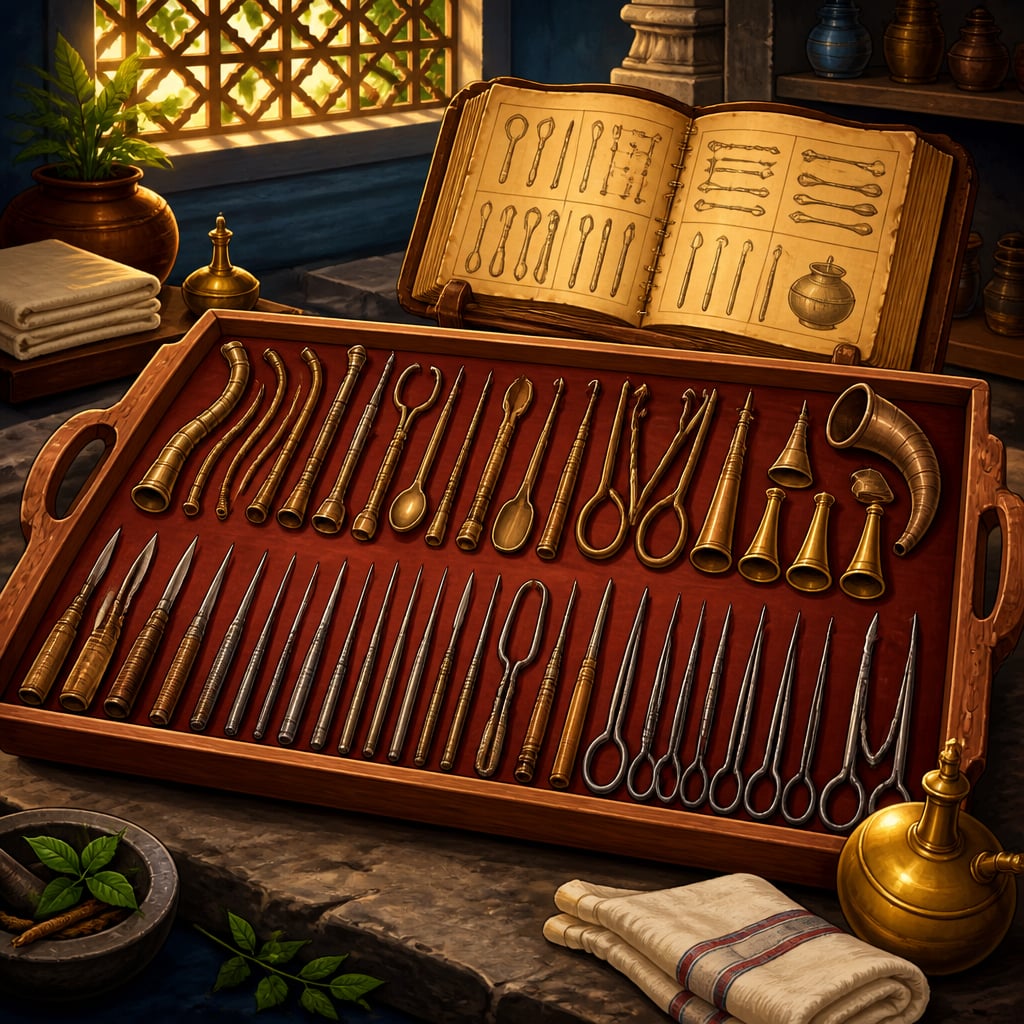
In an era when much of the world relied on crude cutting tools, ancient India produced something remarkable, a comprehensive, categorized system of 125 surgical instruments, each designed with specific anatomical purposes in mind. The Suśruta Saṃhitā doesn't merely list these tools; it provides detailed specifications for their manufacture, maintenance, and precise applications.
The Two Great Categories
Suśruta organized all surgical instruments into two fundamental classes:
Yantra (यन्त्र) – 101 blunt instruments used for extraction, examination, dilation, and manipulation. These include forceps, probes, speculums, hooks, and tubes. The word 'yantra' means 'that which controls or restrains', perfectly describing instruments that hold, grasp, or direct without cutting.
Śastra (शस्त्र) – 20 sharp instruments used for cutting, incising, scraping, and piercing. These include scalpels, scissors, saws, needles, and lancets. The word 'śastra' shares its root with the modern word for weapons, reflecting the precision and power of cutting tools.
This binary classification, blunt versus sharp, remains the fundamental organizational principle in modern surgical instrument catalogs.
The Six Types of Śastra (Sharp Instruments)
Suśruta further classified the 20 sharp instruments into categories based on their cutting action:
1. Vṛddhi-patra (वृद्धि-पत्र) – Scalpels with curved blades for making incisions. The name means 'growth-leaf,' describing the leaf-shaped blade.
2. Maṇḍalāgra (मण्डलाग्र) – Circular-tipped knives for scraping and excising tumors. Used where precision cutting was needed without deep penetration.
3. Karāpatra (करापत्र) – Saw-toothed instruments for bone cutting. The serrated edge was specifically designed for hard tissue.
4. Sūcī (सूची) – Needles of various sizes for suturing and puncturing. Some were straight, others curved, each for different tissue types.
5. Kuśapatra (कुशपत्र) – Lancets for venesection (bloodletting) and draining abscesses. Named after kusha grass for their sharp, grass-blade shape.
6. Āra (आरा) – Awls and trocars for piercing and drainage of fluid accumulations.
Ingenious Yantra Designs
The 101 blunt instruments reveal extraordinary engineering sophistication:
Nāḍī-yantra (नाडी-यन्त्र) – Tubular instruments, the ancestors of modern catheters. Made from gold, silver, or iron depending on application. Some were graduated for measuring depth of wounds or cavities.
Śalākā (शलाका) – Probes of various shapes, straight, curved, hooked, or bulb-ended. Used for exploring wound tracks, applying medications deep in cavities, and examining fistulas.
Sandaṃśa (संदंश) – Forceps with various jaw designs. The text describes forceps shaped like lion's mouth, crocodile's jaw, and crane's beak, each anatomically suited for different grasping needs.
Tāla-yantra (ताल-यन्त्र) – Speculums for examining body cavities. Suśruta describes three-bladed speculums nearly identical to modern designs.
Śṛṅga (शृङ्ग) – Cupping horns for blood extraction through vacuum suction. Made from cattle horns, these represent early understanding of negative pressure therapeutics.
The Animal-Inspired Design Philosophy
One of the most striking features of Suśruta's instruments is their zoomorphic naming and design. Instrument tips and jaws were consciously modeled after animal mouths and beaks:

- Siṃhamukha (lion's mouth) – for grasping firmly
- Makaramukha (crocodile's mouth) – for pulling tissue
- Kākamukha (crow's beak) – for picking small objects
- Vṛhīmukha (paddy/rice grain shape) – for delicate extraction
This biomimetic approach, learning from nature's designs, is today recognized as a sophisticated engineering methodology. Ancient Indian surgeons understood that millions of years of evolution had perfected certain mechanical forms.
Materials and Manufacturing
The Suśruta Saṃhitā provides remarkably specific instructions for instrument manufacture:
Iron (Loha) – The primary metal for sharp instruments. The text specifies that surgical iron should be smelted with particular herbs to improve hardness and reduce brittleness.
Steel (Tikṣṇa-loha) – For instruments requiring exceptional sharpness and edge retention.
Gold and Silver – For instruments contacting delicate internal tissues, as these metals were understood to be non-corrosive and 'compatible with the body.'
Copper – For certain speculums and tubes.
Bamboo – For disposable lancets and splints.
The text even describes quality control: instruments should ring clearly when struck, hold an edge through multiple uses, and show no rust spots or pitting.
Sharpening and Maintenance
Suśruta emphasizes that a surgeon is only as good as his instruments' sharpness:
"An instrument that has lost its edge is like a snake without fangs, useless and potentially harmful."
The text prescribes specific sharpening stones, oiling procedures, and testing methods. Instruments were tested on vegetable materials before use on patients, a practice that continued in the Western surgical tradition well into the 20th century.
Comparison with Contemporary Civilizations
When Suśruta compiled his instrument catalog (circa 600 BCE), the surgical tools available elsewhere were remarkably primitive:
Egypt – Possessed bronze knives and simple probes, but lacked categorization or specialized designs.
Greece – Hippocrates (460-370 BCE), writing after Suśruta, describes far fewer instruments with less specialization.
Rome – The Pompeii surgical kit (79 CE) shows Greek-influenced instruments, but the variety and sophistication still lag behind the Suśruta catalog.
China – Early Chinese medical texts focus on acupuncture needles rather than surgical instruments.
The Indian tradition's emphasis on surgical intervention, and the tool-making this required, reflects a fundamentally different medical philosophy that accepted invasive procedures as legitimate therapy.
Archaeological Evidence
While few ancient instruments survive intact, archaeological discoveries have confirmed many details:

Taxila Excavations (1920s-1940s) – Revealed surgical instruments matching Suśruta's descriptions, dating to 2nd century BCE.
Mohenjo-daro and Harappa – Bronze surgical tools predating even Suśruta, suggesting a continuous instrument-making tradition.
South Indian Temple Inscriptions – Record donations of surgical instruments to medical establishments, listing names matching the Saṃhitā.
Legacy in Modern Surgery
Many of Suśruta's instruments have direct modern descendants:
| Ancient Instrument | Modern Equivalent |
|---|---|
| Nāḍī-yantra | Catheter |
| Sandaṃśa | Surgical forceps |
| Tāla-yantra | Speculum |
| Sūcī | Surgical needle |
| Śalākā | Surgical probe |
| Vṛddhi-patra | Scalpel |
The fundamental forms have barely changed because the anatomical challenges remain identical. A human body in 2024 requires the same instrument shapes as one in 600 BCE.
The Philosophy of Precision
Behind the instrument catalog lies a deeper philosophy: that surgical intervention is a precise science requiring exact tools. Suśruta rejects improvisation with whatever implements are available. He insists on purpose-built instruments because "the hand follows the tool, and the tool shapes the outcome."
This commitment to specialized instrumentation, rather than making do with general-purpose implements, marks a crucial transition from folk healing to systematic medicine.
The 125 instruments of the Suśruta Saṃhitā are not merely a historical curiosity. They represent humanity's first comprehensive surgical toolkit, designed with principles that remain valid after two and a half millennia. Every modern operating room, with its precisely categorized instrument trays, is a descendant of Suśruta's systematic approach to the tools of healing.
Key figures
Suśruta
John Marshall
Vāgbhaṭa
Case studies
The Taxila Surgical Kit (Archaeological Validation)
In the 1920s-1930s, excavations at Taxila (in present-day Pakistan) unearthed a remarkable collection of surgical instruments dating to the 2nd century BCE. The find included forceps, probes, catheters, and scalpels whose designs matched descriptions in the Suśruta Saṃhitā with striking precision. The collection featured sandaṃśa (forceps) with serrated jaws, śalākā (probes) with bulb-shaped ends, and nāḍī-yantra (tubular catheters) of various diameters. Metallurgical analysis revealed sophisticated iron and copper alloys. This archaeological evidence confirmed that Suśruta's text described actual instruments in clinical use - not idealized or theoretical designs. The Taxila kit demonstrated a mature surgical tradition with standardized instruments manufactured to precise specifications.
This case reflects the deep knowledge tradition of Indian surgery and medicine (Shalya Tantra), where empirical observation and systematic methods were developed centuries before similar Western discoveries.
The knowledge demonstrated in this case study contributed to the broader legacy of Indian surgery and medicine (Shalya Tantra), influencing developments across Asia and eventually the world.
Archaeological evidence validates textual descriptions. The continuity between text and artifact proves that ancient Indian surgical knowledge was practical, not merely theoretical.
Medical device companies today use the same validation loop: design instruments, test them clinically, refine based on outcomes. The Taxila finds prove this iterative design process existed over two millennia ago. Good engineering methodology transcends any particular era's technology level.
2nd century - referenced in the context of The Taxila Surgical Kit (Archaeological Validation).
Modern Forceps Design Study (Scientific Validation)
A 2019 study published in the Indian Journal of Surgery examined Suśruta's forceps designs using modern biomechanical analysis. Researchers created 3D models of the lion-mouth (siṃhamukha), crocodile-jaw (makaramukha), and crane-beak (kākamukha) forceps described in the text. Finite element analysis revealed that each design optimized different grasping parameters: the lion-mouth provided maximum grip strength, the crocodile-jaw offered optimal tissue pulling mechanics, and the crane-beak excelled at precision grasping of small objects. The study concluded that the zoomorphic naming wasn't merely poetic - it reflected genuine biomechanical understanding. Ancient surgeons had intuitively discovered optimal force distribution patterns that modern engineering confirms.
This case reflects the deep knowledge tradition of Indian surgery and medicine (Shalya Tantra), where empirical observation and systematic methods were developed centuries before similar Western discoveries.
The knowledge demonstrated in this case study contributed to the broader legacy of Indian surgery and medicine (Shalya Tantra), influencing developments across Asia and eventually the world.
Traditional knowledge can encode sophisticated engineering principles. Biomimetic design - learning from nature - is validated by modern analysis of ancient instruments.
Biomimetic design is now a $1.5 billion industry. Velcro (inspired by burrs), bullet train noses (inspired by kingfisher beaks), and surgical robots (inspired by octopus arms) all learn from nature. Sushruta's animal-inspired forceps anticipated this entire field by 2,500 years.
The Sushruta Samhita describes over 300 surgical procedures and 120 surgical instruments, compiled around 600 BCE.
Roman Pompeii Kit vs. Suśruta System (Comparative Study)
The surgical kit preserved at Pompeii (79 CE) offers a valuable comparison with Suśruta's system documented several centuries earlier. The Roman kit contained approximately 40 instruments - scalpels, forceps, probes, and hooks. Key differences emerge: While the Roman instruments show excellent craftsmanship, they lack systematic categorization. There's no evidence of the yantra/śastra division or functional sub-categories. The Roman approach was more ad hoc - good individual tools without organizing principles. The Indian system's advantage was conceptual: by classifying instruments into categories based on function (cutting, grasping, probing, dilating), surgeons could reason about which tool was needed rather than simply remembering individual instruments. This systematic approach made knowledge transferable across generations and geographies.
This case reflects the deep knowledge tradition of Indian surgery and medicine (Shalya Tantra), where empirical observation and systematic methods were developed centuries before similar Western discoveries.
The knowledge demonstrated in this case study contributed to the broader legacy of Indian surgery and medicine (Shalya Tantra), influencing developments across Asia and eventually the world.
Systematic classification enhances practical knowledge. The Indian contribution wasn't just better tools - it was a better way of thinking about tools.
Modern surgical instrument catalogs classify tools by function, anatomical target, and procedure type, exactly mirroring Sushruta's classification system. The organizational framework matters as much as the tools themselves, because systematic categorization enables teaching, innovation, and quality control.
79 CE - referenced in the context of Roman Pompeii Kit vs. Suśruta System (Comparative Study).
Historical context
Classical Period of Indian Medicine (c. 600 BCE - 600 CE)
Living traditions
- Raktamokṣaṇa (Bloodletting) Practice: Traditional Āyurvedic bloodletting therapy still practiced using instruments derived from Suśruta's designs, including the śṛṅga (horn for cupping) and jalauka (leech application).
- National Museum, New Delhi: Houses a collection of ancient medical instruments including replicas of Suśruta's surgical tools. The archaeology section displays actual instruments recovered from Taxila and other excavations.
- Dhanvantari Museum, Haridwar: Dedicated museum of Āyurvedic medicine with reconstructions of ancient surgical instruments based on Suśruta Saṃhitā descriptions. Features interactive displays explaining instrument use.
- Government Āyurveda College Museum, Thiruvananthapuram: One of India's oldest Āyurveda colleges with a museum displaying traditional surgical instruments still used in Kerala's living Āyurvedic tradition.
Reflection
- Suśruta's instruments were named after animal body parts (lion's mouth, crane's beak). What does this biomimetic approach tell us about how ancient Indians learned from nature? Where do you see similar nature-inspired design in modern technology?
- Suśruta insisted on purpose-built instruments rather than improvising with general tools. How does having 'the right tool for the job' apply in your own life, whether in studies, work, or creative pursuits?
- The text says 'protect your instruments as you would protect your own life.' What tools or resources in your life deserve this level of care? What happens when we neglect maintenance of things we depend on?