Netra Cikitsā: Cataract Surgery Excellence

The 'couching' technique that spread to Greece, Arabia, and Europe

Explore the cataract surgery technique documented around 800 BCE, its spread to other civilizations, and the evolution to modern cataract surgery.

Netra Cikitsā: Restoring Sight to the Blind

Imagine living in a world where blindness from cataracts was considered irreversible, a curse of old age or divine punishment. Then imagine a surgeon who could restore sight through a precise procedure performed in minutes. This was the reality of ancient Indian ophthalmology, documented in the Suśruta Saṃhitā around 600 BCE, and this knowledge would eventually reach every corner of the ancient world.
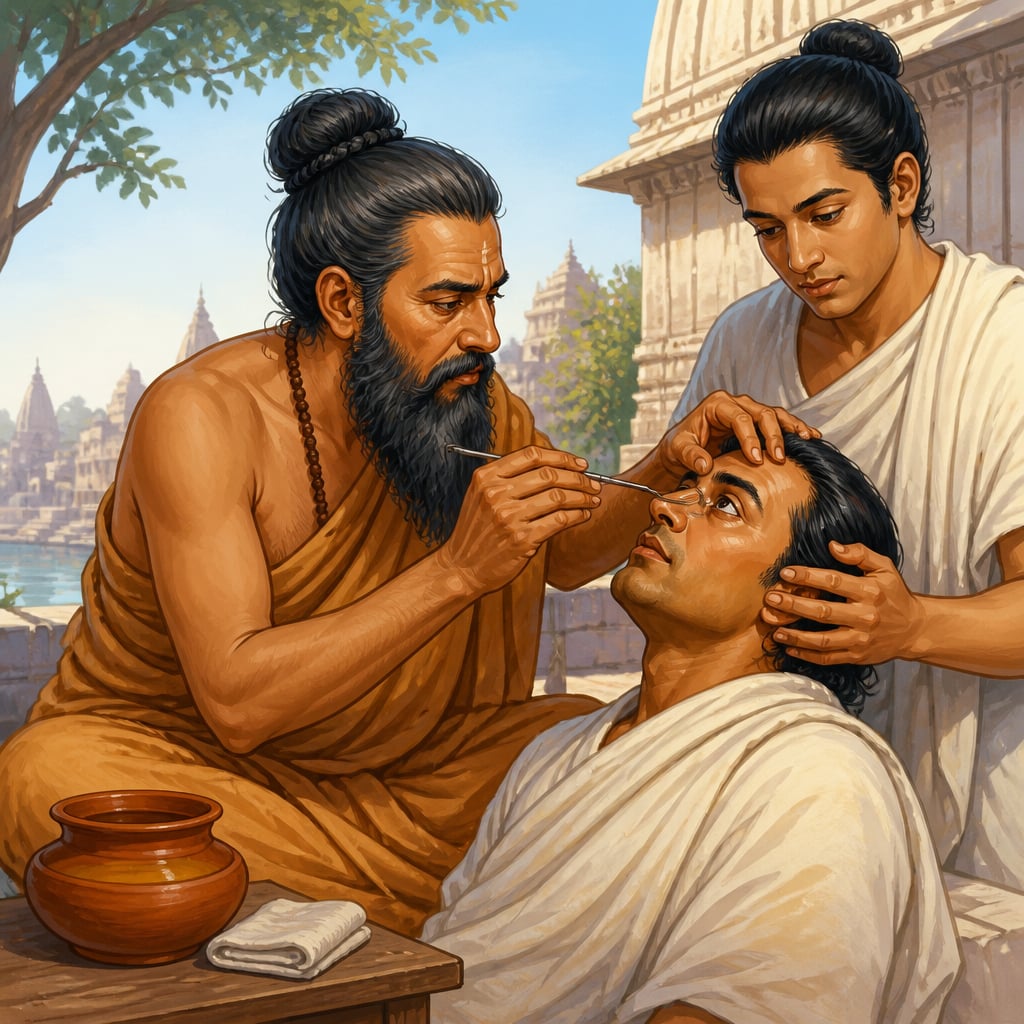
Sushruta performing cataract couching with jabamukhi needle

Understanding Cataracts

A cataract is the clouding of the eye's natural lens, blocking light from reaching the retina. Today we know it results from protein aggregation in the lens. Ancient Indians, without microscopes, recognized the condition through careful clinical observation: the patient described progressive vision loss, and the physician could see the grey-white opacity appearing in the pupil.

Suśruta called this condition liṅganāśa (destruction of the sign/mark) or paṭala (film/membrane), describing how a film seemed to cover the eye. He identified it as one of 76 eye diseases, a remarkable catalog that demonstrates sophisticated ophthalmological observation.

The Jabāmukhi Śalākā: The Cataract Needle
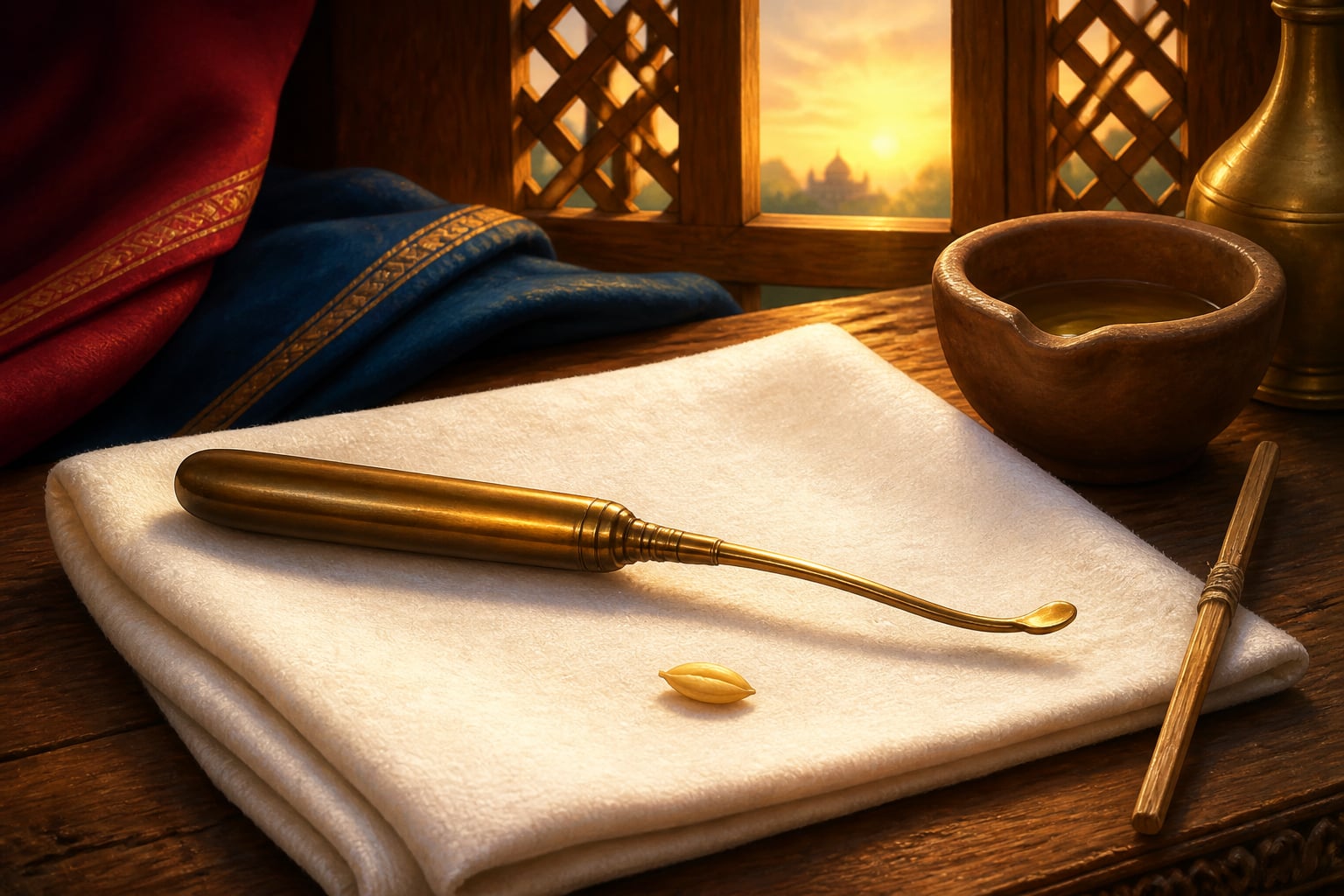
The barley-grain jabamukhi cataract needle on a surgeon's cloth

At the heart of Indian cataract surgery was a specialized instrument: the Jabāmukhi Śalākā, a curved needle named for its resemblance to a barley grain (Java = barley, mukhi = faced). This wasn't a simple pointed stick, it was a precision instrument with specific design requirements:

The instrument's design shows deep understanding of ocular anatomy. The curvature allowed the surgeon to approach the lens from the side, avoiding the central visual axis.

The Couching Procedure

Suśruta provides remarkably detailed procedural instructions. The technique, known in Western literature as couching (from French 'coucher', to lay down), involved displacing the opaque lens from the visual axis:

Preparation:

The Procedure:

  1. The surgeon holds the patient's head steady
  2. The patient fixes gaze on their own nose tip (to stabilize the eye)
  3. The Jabāmukhi Śalākā enters at a point between the pupil's edge and the eye's outer corner, approximately where modern surgeons make the incision
  4. With careful manipulation, the needle tip contacts the opaque lens
  5. The surgeon applies gentle, steady pressure to displace the lens downward
  6. When successful, 'the eye becomes clear as a cloudless sky'
  7. The needle is withdrawn, ghee is applied, and the eye is bandaged

Post-operative Care:

The Science Behind Couching

Why did this procedure work? The cataractous lens was pushed from its position in the pupillary aperture into the vitreous cavity (the gel-filled space behind the lens). With the opaque lens displaced, light could again reach the retina.

The patient didn't regain perfect vision, without a lens, they had severe farsightedness. But compared to near-total blindness, even blurry vision was transformative. Patients could see faces, navigate independently, and perform many daily tasks.

Modern ophthalmologists note that couching actually worked, it was a legitimate surgical intervention, not mere placebo. The success rate in skilled hands was estimated at 50-70%, remarkable for any ancient surgical procedure.

The Global Spread

Indian cataract surgery didn't remain confined to the subcontinent. Its transmission routes reveal the interconnectedness of the ancient world:

To Greece and Rome: Galen (129-216 CE), the most influential physician of antiquity, describes a couching procedure strikingly similar to Suśruta's. The Greek term was 'paracentesis', piercing beside. Roman surgical instruments recovered at Pompeii include cataract needles.

To Arabia: When Greek medical texts were translated into Arabic during the Islamic Golden Age, they carried Indian ophthalmological knowledge with them. The great Arab surgeon Al-Mawsili (10th century CE) developed an improved technique: actual lens extraction using a hollow tube (the forerunner of modern extraction).

A medieval European coucher with an Indian-descended cataract needle

To Europe: Arab medical knowledge reached medieval Europe through Spain and Sicily. The couching technique was practiced by European surgeons well into the 18th century, often by traveling 'couchers' who went from town to town performing the procedure.

Evidence of Primacy

How do we know the technique originated in India? Several lines of evidence converge:

  1. Chronological: Suśruta's descriptions (c. 600 BCE) predate all other civilizations' records of cataract surgery.

  2. Technical sophistication: The Indian procedure is most detailed, suggesting a mature tradition rather than a borrowing.

  3. Specialized instrumentation: The Jabāmukhi Śalākā's unique design has no parallel in other traditions' surgical instruments.

  4. Transmission patterns: The technique appears in Greece after Alexander's campaigns brought sustained contact with India; in Arabia after the translation movement that included Sanskrit medical texts.

  5. Nomenclature: Some Arabic terms for eye surgery appear to derive from Sanskrit through Prakrit intermediaries.

Suśruta vs. Modern Cataract Surgery

While the principle differs (modern surgery removes the lens rather than displacing it), remarkable continuities exist:

Suśruta's Approach Modern Approach
Entry point lateral to pupil Incision location similar
Patient fixation (nose-gazing) Patient fixation required
Minimal instruments Microscopic instruments
Post-op rest Post-op recovery
Diet regulation Medication compliance

The biggest advancement: intraocular lens implants (IOLs) restore focusing ability, giving modern patients clear vision rather than the extreme farsightedness couching produced.

Complications and Limitations

Suśruta was honest about risks. He describes possible complications:

He emphasized patient selection, not everyone with cataracts was a surgical candidate. Young, healthy patients with mature cataracts had the best outcomes.

The Eye as Window to Indian Medical Philosophy

Ophthalmology held special significance in Indian medicine. Vision was considered the most important sense, and its restoration one of the highest services a physician could render. The Suśruta Saṃhitā devotes an entire section to eye diseases, 76 conditions meticulously categorized by affected tissue, appearance, and treatability.

This wasn't merely mechanical repair. Restoring sight had spiritual dimensions: enabling the patient to see sacred images, to read scriptures, to perceive the beauty of creation. The surgeon who restored vision performed both medical and spiritual service.

Legacy

Cataract surgery stands as perhaps the most successful example of Indian surgical knowledge's global impact. For over two thousand years, the basic couching technique pioneered by Suśruta and his school remained the only treatment for cataracts across the Old World.

When Jacques Daviel performed the first modern cataract extraction in Paris in 1747, he was building on foundations laid in ancient Varanasi. Today, cataract surgery is the most commonly performed surgical procedure in the world, over 20 million operations annually. Every one of them owes a debt to the Indian surgeon-sages who first dared to operate on the human eye.

Key figures

Suśruta

Ammar ibn Ali Al-Mawsili

Jacques Daviel

Case studies

The Traveling 'Couchers' of Medieval Europe (Historical Reconstruction)

From the 12th to 18th centuries, itinerant cataract surgeons - called 'couchers' or 'oculists' - traveled across Europe performing the Indian-derived procedure. These practitioners moved from town to town, advertising their services in market squares. A typical encounter: The coucher would set up in a public space, demonstrating the procedure on brave (or desperate) volunteers. Success meant immediate testimonials; failure meant a quick departure. Some were skilled surgeons; others were charlatans. The technique they used was recognizably Suśruta's: patient seated facing operator, needle entering at the scleral-corneal junction, lens pushed downward out of the visual axis. The terminology even preserved Sanskrit roots through Arabic intermediaries. This practice continued until Daviel's extraction method proved superior in the mid-18th century, ending a 2,400-year tradition that began in ancient India.

This case reflects the deep knowledge tradition of Indian surgery and medicine (Shalya Tantra), where empirical observation and systematic methods were developed centuries before similar Western discoveries.

The knowledge demonstrated in this case study contributed to the broader legacy of Indian surgery and medicine (Shalya Tantra), influencing developments across Asia and eventually the world.

Medical knowledge travels across civilizations, adapting to local contexts while preserving core techniques. The couchers represent the grassroots transmission of Indian surgery to European populations.

Mobile health clinics and telemedicine bring medical procedures to underserved areas today, much as traveling couchers did in medieval Europe. The challenge of delivering surgical care outside fixed hospitals remains relevant in rural India, sub-Saharan Africa, and other regions with limited medical infrastructure.

18th century - referenced in the context of The Traveling 'Couchers' of Medieval Europe (Historical Reconstruction).

Modern Biomechanical Analysis of Couching (Scientific Validation)

A 2017 study in the journal *Clinical Ophthalmology* analyzed the biomechanics of couching using modern eye models. Researchers found that Suśruta's recommended entry point - between the pupil's edge and the eye's outer corner - precisely targets the 'pars plana,' still the preferred entry point for modern vitreoretinal surgery. The study also validated the nose-gazing instruction: this eye position rotates the globe to expose the optimal surgical approach while stabilizing the eye through muscle tension. Perhaps most remarkably, the recommended angle of needle insertion matches modern calculations for minimizing trauma while achieving lens displacement. Ancient surgeons, through careful observation and refinement, had discovered optimal parameters that modern physics confirms. The study concluded: 'The Suśruta technique demonstrates sophisticated understanding of ocular anatomy and surgical approach that remains valid in contemporary terms.'

This case reflects the deep knowledge tradition of Indian surgery and medicine (Shalya Tantra), where empirical observation and systematic methods were developed centuries before similar Western discoveries.

The knowledge demonstrated in this case study contributed to the broader legacy of Indian surgery and medicine (Shalya Tantra), influencing developments across Asia and eventually the world.

Empirical refinement over generations can achieve remarkably precise solutions. Ancient practitioners lacked our theoretical framework but arrived at similar conclusions through careful observation and iterative improvement.

Robotic surgery systems like da Vinci use optimal entry points and angles determined through biomechanical analysis. The same analytical approach, applied to Sushruta's couching technique, confirmed that ancient practitioners had empirically discovered what modern simulations now validate computationally.

The Sushruta Samhita describes over 300 surgical procedures and 120 surgical instruments, compiled around 600 BCE.

Couching vs. Modern Extraction: Comparative Outcomes (Comparative Study)

Couching is still practiced in parts of Africa and Asia where modern surgical facilities are unavailable. This provides unfortunate but scientifically valuable comparison data. A WHO-supported study in sub-Saharan Africa compared outcomes: - Traditional couching: 50-70% visual improvement initially, but high rates of complications including inflammation, infection, and recurrence - Modern phacoemulsification: 95%+ success rate with minimal complications However, the study revealed a crucial historical insight: in populations without antibiotics, sterile technique, or corrective lenses, couching offered something modern surgery cannot replicate - immediate, portable treatment without infrastructure. Suśruta's technique succeeded because it required only a skilled surgeon with a needle - no hospital, no electricity, no supply chain. For millennia, this accessibility made couching the only cataract treatment available to most humanity.

This case reflects the deep knowledge tradition of Indian surgery and medicine (Shalya Tantra), where empirical observation and systematic methods were developed centuries before similar Western discoveries.

The knowledge demonstrated in this case study contributed to the broader legacy of Indian surgery and medicine (Shalya Tantra), influencing developments across Asia and eventually the world.

Context determines appropriate technology. Suśruta's couching was optimized for its era's constraints, achieving remarkable results within those limitations.

The WHO estimates 17 million people worldwide are blind from cataracts, mostly in low-resource settings. Modern lens implant surgery is the gold standard, but understanding historical techniques helps design simpler procedures for field hospitals and mobile surgical units where advanced equipment is unavailable.

70% - referenced in the context of Couching vs. Modern Extraction: Comparative Outcomes (Comparative Study).

Historical context

Classical Period of Indian Medicine (c. 600 BCE - 600 CE)

Living traditions

Reflection

More in Śalya: Surgery and Medicine That Healed the World

All lessons in Śalya: Surgery and Medicine That Healed the World · Bharatiya Vigyan: Inventions & Discoveries course