Śalya Kriyā: Surgical Procedures Catalog

8 types of operations, wound management, and early anesthesia

Explore the 8 types of surgical operations classified by Suśruta, wound management and suturing techniques, and early documentation of anesthesia using wine and cannabis.

Śalya Kriyā: A Complete Surgical System

Surgery is not merely cutting, it's a systematic approach to addressing pathology through physical intervention. The Suśruta Saṃhitā presents perhaps the world's first comprehensive classification of surgical procedures, organizing all operations into eight fundamental types. This framework, the aṣṭavidha śastra karma (eight-fold surgical action), remains remarkably relevant to modern surgical categorization.
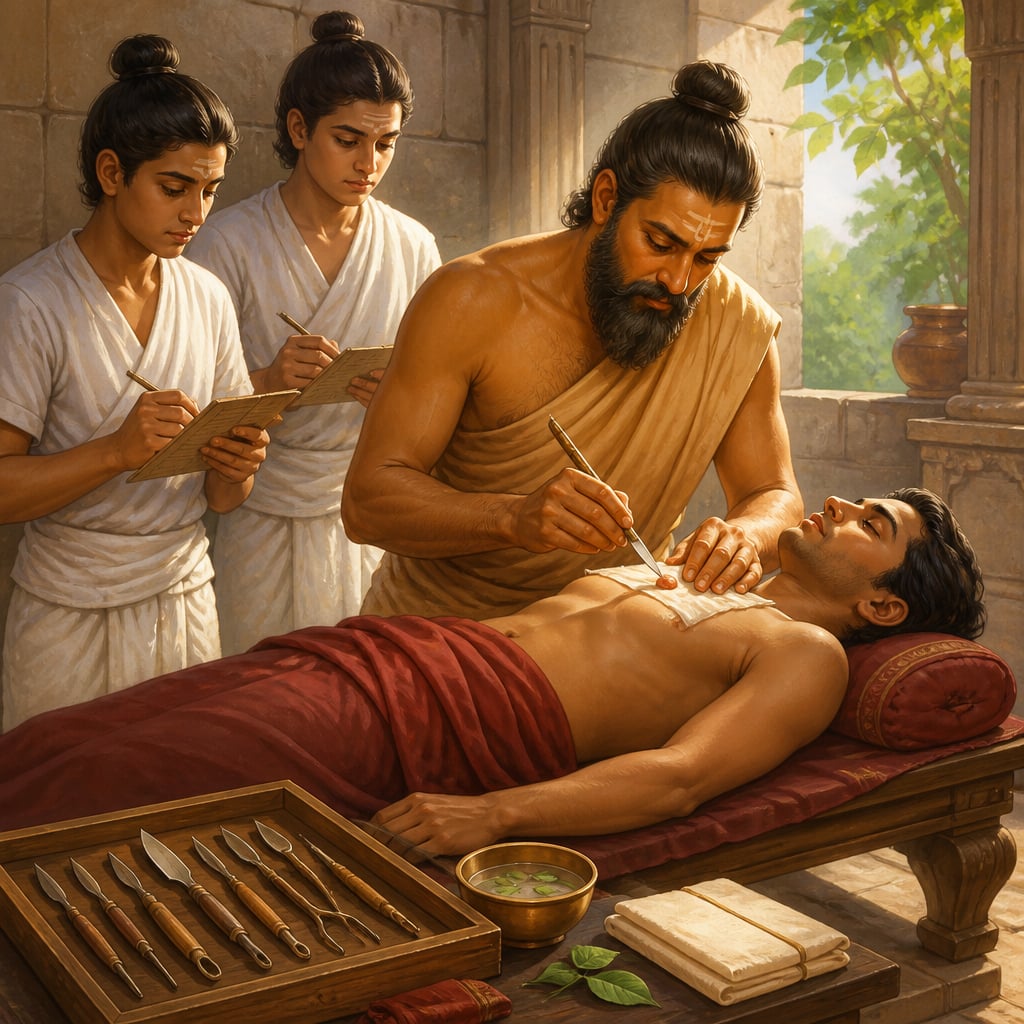
Sushruta performing chedana excision on calm patient

The Eight Surgical Actions

Suśruta identified that every surgical procedure, regardless of location or disease, falls into one of eight categories based on the action performed:

1. Chedya (छेद्य) – Excision

The complete removal of tissue, cutting away diseased or abnormal growths. This includes removal of tumors, cysts, and abnormal skin conditions.

Modern equivalent: Tumor resection, amputation, excision biopsy

Suśruta's applications: Removal of arbuda (tumors), removal of dead tissue, excision of fistula tracts

2. Bhedya (भेद्य) – Incision

Cutting into tissue to access underlying structures or to release contained fluids. Unlike excision, incision opens but doesn't remove.

Modern equivalent: Incision and drainage, exploratory surgery

Suśruta's applications: Opening abscesses, accessing internal structures, relieving pressure from fluid accumulation

3. Lekhya (लेख्य) – Scraping

Removing superficial tissue or deposits through scraping action. Used for conditions where abnormal material has accumulated.

Modern equivalent: Curettage, debridement

Suśruta's applications: Scraping granulation tissue, removing surface growths, cleaning wound beds

4. Vedhya (वेध्य) – Puncturing

Piercing tissue to release fluids, access cavities, or create therapeutic openings.

Modern equivalent: Paracentesis, thoracentesis, needle aspiration

Suśruta's applications: Draining hydrocele, puncturing abdominal fluid collections, bloodletting points

5. Eṣya (एष्य) – Probing

Exploring wound tracks, cavities, and fistulas to understand their extent and character.

Modern equivalent: Wound exploration, fistulography

Suśruta's applications: Determining sinus depth, exploring fistula connections, assessing wound tracks

6. Āharya (आहार्य) – Extraction

Removing foreign bodies, calculi (stones), or other objects from the body.

Modern equivalent: Lithotomy (stone removal), foreign body extraction

Suśruta's applications: Bladder stone removal, extracting arrowheads, removing splinters and thorns

7. Visrāvya (विस्राव्य) – Draining

Facilitating the outflow of accumulated fluids, pus, blood, or other collections.

Modern equivalent: Drainage procedures, creating stomas

Suśruta's applications: Abscess drainage, draining pleural effusions, evacuating hematomas

8. Sīvya (सीव्य) – Suturing

Closing wounds and incisions through various suturing techniques.

Modern equivalent: Wound closure, anastomosis

Suśruta's applications: Closing surgical wounds, intestinal repair, vessel repair

The Art of Suturing

Suśruta devoted particular attention to suturing, understanding that how a wound closes determines healing outcome. He described:

Suture Materials:

Suture Patterns:

Remarkable Innovation: Living Sutures

Ant-head sutures clamping a closed intestinal wound

For intestinal wounds, Suśruta describes using living organisms, the heads of large ants (Vamrī), as biological staples. The procedure: bring wound edges together, have ants bite across the junction, then sever the bodies leaving the heads clamped in place. These biodegradable 'staples' would dissolve as the wound healed.

This technique was independently developed in other cultures and remained in use until modern surgical staples were invented, testament to its practical effectiveness.

Wound Classification and Management

Suśruta classified wounds systematically:

By Cause:

By Healing Potential:

Wound Stages: Suśruta identified distinct healing phases, what we now call inflammation, granulation, and remodeling. He prescribed different treatments for each stage, understanding that wounds need different care as healing progresses.

Pain Management and Anesthesia

Surgery without pain control is torture. Ancient Indian surgeons developed multiple approaches to managing surgical pain:

Oral Anesthetics:

Local Preparations:

The Alcohol Protocol: Suśruta describes giving wine to the point where the patient is relaxed but not unconscious, maintaining cooperation while reducing pain response. This is remarkably similar to modern conscious sedation protocols.

Pre-operative and Post-operative Care

Suśruta's approach to surgery extended well beyond the operating table:

Pre-operative:

Post-operative:

Training Through Simulation

Perhaps most remarkably, Suśruta prescribed systematic training for surgeons before they operated on humans:

A student practicing incisions on a gourd before Sushruta

Practice Substrates:

This simulation-based training approach predates modern surgical simulation by over two millennia. The principle is identical: develop skill on forgiving materials before applying techniques to patients.

Surgical Hygiene

While ancient surgeons lacked germ theory, they developed practical hygiene measures:

These empirical practices reduced infection rates even without understanding why they worked. Observation had taught that certain precautions correlated with better outcomes.

The Integration of Surgery and Medicine

Suśruta's surgical system didn't operate in isolation. It integrated with Āyurvedic medical principles:

Doṣa Assessment: Understanding the patient's constitutional type affected surgical planning, vāta-predominant patients might bleed less but heal slowly; pitta-predominant patients might have more inflammation.

Seasonal Considerations: Certain surgeries were preferred in certain seasons, avoiding monsoon when infection risk was higher, preferring cooler months for better healing.

Holistic Recovery: Post-surgical recovery included diet, lifestyle, medication, and even psychological support, understanding that surgical success required the whole patient to heal, not just the wound.

Legacy

The eight surgical actions identified by Suśruta remain the fundamental operations of surgery. Modern surgical textbooks categorize procedures similarly, excision, incision, drainage, extraction, and repair are still the verbs of surgical action.

The systematic approach, classifying operations, specifying instruments for each, prescribing pre- and post-operative care, and training through simulation, created a reproducible system that could be taught, learned, and improved across generations.

This was surgery as a transmissible science, not merely as individual skill. That transformation, from art to science, was perhaps Suśruta's greatest contribution to human healing.

Key figures

Suśruta

Dhanvantari

Hippocrates

Case studies

The Ant-Head Sutures of Intestinal Surgery (Historical Reconstruction)

Among Suśruta's most remarkable techniques was the use of ant heads as biological staples for intestinal wounds. The procedure: after repairing an intestinal tear, large black ants were applied to bite across the wound junction. Once their mandibles clamped the tissue edges together, the ant bodies were severed, leaving the heads as biodegradable fasteners. This wasn't primitive improvisation - it was sophisticated engineering. Ant mandibles provide: - Strong, consistent clamping force - Gradual biodegradation as healing progresses - Smooth surfaces that don't irritate bowel - No need for later removal Remarkably, similar techniques were independently developed in North Africa and South America, suggesting that observant healers worldwide noticed ants' mechanical properties. Modern surgical staples - metal fasteners that clamp tissue edges - work on the identical principle.

This case reflects the deep knowledge tradition of Indian surgery and medicine (Shalya Tantra), where empirical observation and systematic methods were developed centuries before similar Western discoveries.

The knowledge demonstrated in this case study contributed to the broader legacy of Indian surgery and medicine (Shalya Tantra), influencing developments across Asia and eventually the world.

Innovation can come from careful observation of nature. The ant-head sutures demonstrate biomimetic engineering - learning solutions from biological systems - long before the term existed.

Biodegradable surgical staples and absorbable sutures are a major focus of modern biomedical engineering. Companies like Ethicon develop products that hold wounds closed and then dissolve, exactly the principle behind Sushruta's ant-head sutures. Nature-inspired solutions remain a fertile source of medical innovation.

The Sushruta Samhita describes over 300 surgical procedures and 120 surgical instruments, compiled around 600 BCE.

Surgical Simulation Training (Modern Validation)

Suśruta's prescription to practice surgical techniques on vegetables, leather, and animal tissues before operating on humans anticipated modern simulation-based surgical training by over two millennia. A 2020 study in the Journal of Surgical Education compared Suśruta's training substrates with modern simulation tools: | Suśruta's Substrate | Modern Equivalent | Skill Trained | |---------------------|-------------------|---------------| | Cucumber, watermelon | Silicone skin pads | Incision | | Leather water bags | Procedural simulators | Puncture/drainage | | Worm-eaten wood | Anatomical models | Probing/exploration | | Jackfruit seeds in meat | Foreign body trainers | Extraction | The study concluded that Suśruta's training program addressed the same skill domains as contemporary surgical curricula. The principle - develop motor skills on forgiving materials before clinical application - remains the foundation of surgical education.

This case reflects the deep knowledge tradition of Indian surgery and medicine (Shalya Tantra), where empirical observation and systematic methods were developed centuries before similar Western discoveries.

The knowledge demonstrated in this case study contributed to the broader legacy of Indian surgery and medicine (Shalya Tantra), influencing developments across Asia and eventually the world.

Sound pedagogical principles transcend time. Suśruta understood that surgical skill requires deliberate practice on appropriate substrates before patient care.

Medical schools worldwide now use simulation labs with synthetic tissue, cadavers, and virtual reality before students touch patients. The $2 billion surgical simulation industry directly implements Sushruta's pedagogical insight that skill must be practiced on appropriate substrates before clinical application.

The Sushruta Samhita describes over 300 surgical procedures and 120 surgical instruments, compiled around 600 BCE.

Indian vs. Greek Surgical Traditions (Comparative Study)

Comparing the Suśruta Saṃhitā with the Hippocratic Corpus reveals strikingly different attitudes toward surgical intervention: **Indian Tradition (Suśruta):** - Surgery is a primary treatment modality - Extensive surgical procedures documented - Detailed operative techniques with instruments - Training program for surgeons - Integration of surgery with broader medical theory **Greek Tradition (Hippocrates):** - 'First, do no harm' - caution about intervention - Preference for conservative management - Limited surgical procedures described - Surgery often relegated to lower-status practitioners - Separation between physicians and surgeons Why the difference? Possible factors: - Indian religious context accepted physical intervention on the body - Greek philosophical concerns about bodily integrity - Different disease burdens requiring different responses - Institutional differences in medical training The Greek surgical caution persisted in Western medicine for centuries, while the Indian surgical confidence eventually influenced Arabic and then European surgery.

This case reflects the deep knowledge tradition of Indian surgery and medicine (Shalya Tantra), where empirical observation and systematic methods were developed centuries before similar Western discoveries.

The knowledge demonstrated in this case study contributed to the broader legacy of Indian surgery and medicine (Shalya Tantra), influencing developments across Asia and eventually the world.

Cultural and philosophical context shapes medical development. The same human body was approached very differently by traditions with different underlying assumptions about intervention.

The divide between surgical and non-surgical medical traditions persists in modern healthcare debates. Integrative medicine programs try to combine pharmaceutical, surgical, and lifestyle interventions. The philosophical question Sushruta and Hippocrates answered differently still shapes how medical systems are organized.

The Sushruta Samhita describes over 300 surgical procedures and 120 surgical instruments, compiled around 600 BCE.

Historical context

Classical Period of Indian Medicine (c. 600 BCE - 600 CE)

Living traditions

Reflection

More in Śalya: Surgery and Medicine That Healed the World

All lessons in Śalya: Surgery and Medicine That Healed the World · Bharatiya Vigyan: Inventions & Discoveries course