Transmission Routes: Indian Medicine Goes Global

Buddhist monks, Arab translations, and European adoption

Trace how Indian medical knowledge traveled via Buddhist monks to China and Southeast Asia, Arabic translations like Kitab Susrud, and European contact and adoption.

Transmission Routes: How India Healed the World

Great ideas don't respect borders. The medical knowledge developed in ancient India didn't remain a local secret, it traveled along trade routes, through monastery networks, and via translation projects to reach civilizations across the known world. Understanding these transmission routes reveals how interconnected ancient civilizations were and how Indian medicine became a foundation for global healing traditions.
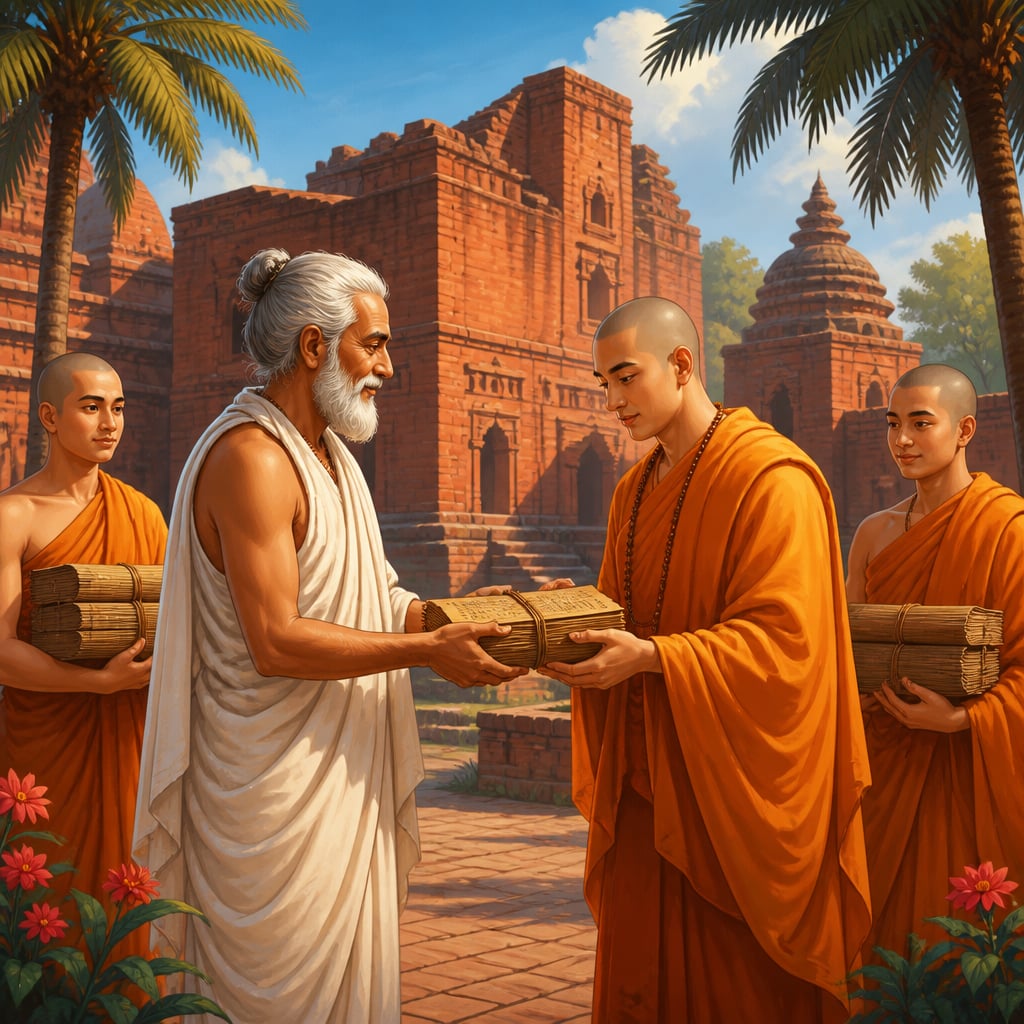
Xuanzang receiving medical manuscripts at Nalanda university

The Eastern Route: Buddhism Carries Medicine

When Buddhism spread across Asia, it carried Indian medical knowledge with it. Buddhist monks needed to maintain health in their monasteries and provide care to lay communities. Medicine was therefore inseparable from the dharma they transmitted.

To China

The transmission began early. As Buddhist texts reached China (starting 1st century CE), medical texts came alongside religious scriptures. Key transmissions included:

Texts Translated:

Indian Physicians in China: Indian doctors served at Chinese courts. Nāgārjuna (not the philosopher, but a later physician of the same name) reportedly traveled to China. The famed pilgrim Xuanzang (7th century) brought back medical manuscripts along with Buddhist texts.

Lasting Influences:

To Tibet

Tibetan medicine (Sowa Rigpa) is perhaps the most direct heir to Indian medical traditions:

The Gyud-zhi (Four Tantras): Tibet's foundational medical text draws heavily from Āyurveda. The humoral theory (vāta-pitta-kapha becomes rLung-mKhrispa-Badkan), diagnostic methods, and many treatments derive from Indian sources.

Personal Transmission: Indian physicians traveled to Tibet, and Tibetan scholars studied at Indian universities like Nālandā and Vikramaśīla. This direct guru-śiṣya transmission ensured accurate knowledge transfer.

Synthesis: Tibetan medicine synthesized Indian Āyurveda with Chinese medicine and indigenous Bon healing traditions, creating a distinctive system that preserved Indian elements while adapting to Himalayan conditions.

To Southeast Asia

Indian cultural influence across Southeast Asia included medicine:

Cambodia and Thailand: The traditional medicine systems of these countries show clear Āyurvedic influence, the tridoṣa concept, pharmacological principles, and treatment approaches.

Indonesia: Jamu (traditional Indonesian medicine) preserves Sanskrit-derived terminology and some Āyurvedic principles, though heavily mixed with local traditions.

Medical Manuscripts: Sanskrit medical manuscripts have been found across Southeast Asia, demonstrating direct text transmission alongside practical knowledge.

The Western Route: Arab Translations

The House of Wisdom (Bayt al-Hikma) in Baghdad (8th-9th centuries CE) was history's greatest translation project. Scholars translated Greek, Persian, and Indian texts into Arabic, creating a synthesized medical tradition that would eventually reach Europe.

The Translation Movement

Mechanisms:

An Arab scholar copying Sushruta into Kitab Susrud at Baghdad

Key Texts Translated:

Translators: Figures like Yaʿqūb ibn Isḥāq (9th century) specifically worked on Indian medical texts. The Barmakid family, originally Buddhist administrators from Balkh, facilitated Indo-Islamic knowledge exchange.

Specific Knowledge Transferred

Surgical Techniques:

Pharmacology:

Medical Theory:

Al-Razi and Ibn Sina

The greatest Arabic medical authors show Indian influence:

Al-Razi (Rhazes, 854-925 CE): Cited Indian sources explicitly. His pharmaceutical works include Indian drugs and preparations.

Ibn Sina (Avicenna, 980-1037 CE): The Canon of Medicine synthesized Greek, Arabic, and Indian knowledge. Indian surgical techniques and pharmaceuticals appear throughout.

When these Arabic works were later translated into Latin, Indian medical knowledge, now twice-translated, entered European medicine.

The European Route: Colonial Encounter

The direct European encounter with Indian medicine came through colonial contact, particularly Portuguese and British presence in India.

Portuguese Period (16th-17th centuries)

Garcia de Orta studying turmeric with an Indian vaidya in Goa

Garcia de Orta (1501-1568): Portuguese physician who spent decades in Goa studying Indian drugs. His Colóquios dos simples e drogas (1563) was Europe's first detailed account of Indian materia medica.

Drug Trade: Indian pharmaceutical products, opium, cannabis preparations, spices with medicinal properties, entered European markets and pharmacopoeias.

British Period (18th-20th centuries)

The 1794 Rhinoplasty: The observation of Cowasjee's nose reconstruction in Pune, published in the Gentleman's Magazine, introduced Indian plastic surgery to European surgeons. This single report sparked the development of modern reconstructive surgery.

Systematic Study: British surgeons and administrators began systematic documentation of Indian medicine:

The Indian Medical Service: British doctors stationed in India encountered indigenous practitioners and sometimes learned from them, though official attitudes were often dismissive.

Specific Techniques Adopted

Plastic Surgery: The forehead flap rhinoplasty spread from the 1794 observation through Carpue (1816) to become standard European technique.

Cataract Surgery: While couching was already known in Europe (via Arabic transmission), observation of Indian practice may have influenced technique refinement.

Pharmacology: Many drugs entered Western medicine through Indian routes: rauwolfia (for hypertension), strychnos (strychnine), ephedra, and numerous others.

The Invisible Influence

Much Indian medical influence is now invisible because it has been so thoroughly absorbed:

Surgical Principles: Modern surgery uses instrument categories (blunt vs. sharp), wound classification systems, and procedural frameworks with roots in Suśruta.

Pharmaceutical Products: Many standard drugs originated in Indian materia medica before being 'discovered' by modern pharmacology.

Holistic Concepts: The growing interest in 'whole person' medicine, constitutional types, and preventive care echoes Āyurvedic principles, sometimes unconsciously.

Modern Reversal: West to East?

Interestingly, modern Āyurveda has been influenced by Western medicine:

Knowledge flow is never one-directional. Today's Āyurvedic practitioners study both traditions, creating a new synthesis.

Lessons from Transmission

Studying how Indian medicine spread reveals broader truths:

Knowledge Travels Through People: Texts alone don't transmit knowledge, teachers, students, and practitioners carry it across borders. The Buddhist monk and the court physician were as important as the manuscript.

Translation Transforms: Each translation adapts knowledge to new contexts. Arabic medicine wasn't purely Indian; it synthesized multiple traditions. Tibetan medicine combined Indian theory with local plants. Transmission involves creative adaptation.

Recognition Lags Behind Adoption: Techniques can be used long before their origins are acknowledged. European surgeons practiced rhinoplasty for decades before Indian priority was widely recognized.

Universal Problems, Local Solutions: Cataracts, wounds, and fevers afflict all humanity. Different civilizations developed treatments independently or learned from each other. Medical knowledge is humanity's common heritage.

The Living Heritage

Today, Indian medicine's global influence continues:

The transmission routes that once carried Sanskrit manuscripts now carry scientific papers, commercial products, and practitioners trained in both traditions.

The story of Indian medicine's global spread is ultimately a story of human interconnection, the recognition that suffering is universal and that healing knowledge benefits all humanity when shared across the boundaries that divide us.

Key figures

Xuanzang (Hsüan-tsang)

Garcia de Orta

Yuthog Yonten Gonpo

Case studies

The Journey of Rhinoplasty from Pune to London (Historical Reconstruction)

The story of how Indian plastic surgery reached Europe is remarkably specific: **1794, Pune:** A Maratha tradesman named Cowasjee had his nose cut off by Tipu Sultan's forces as punishment. A traditional surgeon from the Kumhar (potter) caste reconstructed his nose using the forehead flap technique - a procedure passed down through generations. **The Observation:** Two British surgeons, Thomas Cruso and James Findlay, witnessed the procedure and sent a detailed report with illustrations to London. The account was published in the *Gentleman's Magazine* in October 1794. **1816, London:** Joseph Constantine Carpue, having read the 1794 report and studied Suśruta Saṃhitā translations, performed Britain's first forehead flap rhinoplasty. His success established the technique in European surgery. **Modern Legacy:** The forehead flap remains a standard reconstructive technique. Plastic surgery textbooks acknowledge the Indian origin. A technique practiced for millennia by Indian craftsman-surgeons became 'modern' Western surgery through a single published observation.

This case reflects the deep knowledge tradition of Indian surgery and medicine (Shalya Tantra), where empirical observation and systematic methods were developed centuries before similar Western discoveries.

The knowledge demonstrated in this case study contributed to the broader legacy of Indian surgery and medicine (Shalya Tantra), influencing developments across Asia and eventually the world.

Knowledge can remain local for millennia then spread globally through a single transmission event. The gap between practice and recognition can be vast - Cowasjee's surgeon possessed knowledge Carpue had to learn from a magazine article.

Open-source medical knowledge platforms like UpToDate and Cochrane Library aim to prevent exactly this kind of knowledge siloing. A surgical technique perfected in one region should not take centuries to reach practitioners elsewhere. Modern medical publishing exists to accelerate what took the Cowasjee case to catalyze.

The Sushruta Samhita describes over 300 surgical procedures and 120 surgical instruments, compiled around 600 BCE.

The House of Wisdom and Kitab Susrud (Historical Reconstruction)

The translation of Indian medical texts into Arabic was part of history's greatest knowledge transfer project: **The Context (8th-9th century CE):** The Abbasid Caliphate in Baghdad sponsored systematic translation of scientific texts from Greek, Persian, Sanskrit, and Syriac into Arabic. The *Bayt al-Hikma* (House of Wisdom) was the institutional center. **The Transmission Mechanism:** - Indian physicians served at the Abbasid court - Sanskrit manuscripts arrived via trade routes and diplomatic exchanges - Translators included Indians, Persians, and Arabs working in teams - The Barmakid family (originally Buddhist administrators from Balkh) facilitated Indo-Islamic exchange **The Products:** - *Kitab Susrud* (Book of Suśruta) – Arabic translation of surgical text - Pharmacological compilations including Indian drugs - Astronomical and mathematical texts alongside medical works **The Synthesis:** Arabic medicine didn't merely translate - it synthesized Greek, Indian, and Persian knowledge into new formulations. Indian surgical techniques and drugs were absorbed into Arabic medical practice, later reaching Europe through Latin translations of Arabic texts.

This case reflects the deep knowledge tradition of Indian surgery and medicine (Shalya Tantra), where empirical observation and systematic methods were developed centuries before similar Western discoveries.

The knowledge demonstrated in this case study contributed to the broader legacy of Indian surgery and medicine (Shalya Tantra), influencing developments across Asia and eventually the world.

Translation movements don't just transfer knowledge - they synthesize it. Arabic medicine created something new from Greek and Indian sources. The 'receiving' civilization is also creative.

Modern pharmaceutical companies study traditional medicine systems worldwide for drug leads. Artemisinin (malaria treatment from Chinese traditional medicine) won a Nobel Prize. The translation-and-synthesis model that Baghdad pioneered continues in ethnopharmacology research today.

9th century - referenced in the context of The House of Wisdom and Kitab Susrud (Historical Reconstruction).

Modern WHO Recognition of Traditional Medicine (Contemporary Development)

The World Health Organization's evolving stance on traditional medicine represents official recognition of knowledge systems like Āyurveda: **Key Developments:** - 2002: WHO Traditional Medicine Strategy launched - 2014: WHA Resolution on Traditional Medicine - 2018: ICD-11 includes traditional medicine diagnostic categories - 2022: WHO Global Centre for Traditional Medicine established in India (Jamnagar, Gujarat) **The WHO Centre in India:** The choice of India to host the Global Centre acknowledges India's role in developing and preserving traditional medicine. The Centre aims to: - Support research on traditional medicine - Develop quality standards and practices - Build evidence base for traditional treatments - Facilitate global knowledge sharing **Implications:** This institutional recognition completes a circle - knowledge that traveled from India across the world through informal transmission routes now returns through official international channels, validated by global health institutions.

This case reflects the deep knowledge tradition of Indian surgery and medicine (Shalya Tantra), where empirical observation and systematic methods were developed centuries before similar Western discoveries.

The knowledge demonstrated in this case study contributed to the broader legacy of Indian surgery and medicine (Shalya Tantra), influencing developments across Asia and eventually the world.

Knowledge that was marginalized during colonial periods can regain recognition. The establishment of WHO's traditional medicine center in India acknowledges millennia of accumulated healing knowledge.

The WHO's Global Centre for Traditional Medicine, established in Jamnagar, India in 2022, represents institutional recognition that traditional medical knowledge systems contain empirically validated insights worth systematic study. Integrating these systems into evidence-based global health frameworks is an active frontier.

The Sushruta Samhita describes over 300 surgical procedures and 120 surgical instruments, compiled around 600 BCE.

Historical context

Global Transmission Period (c. 200 BCE - 1900 CE)

Living traditions

Reflection

More in Śalya: Surgery and Medicine That Healed the World

All lessons in Śalya: Surgery and Medicine That Healed the World · Bharatiya Vigyan: Inventions & Discoveries course