Caraka's Internal Medicine: Diagnosis Revolution
Pulse diagnosis (Nāḍī Parīkṣā) and the eight examination methods
Explore pulse diagnosis (Nāḍī Parīkṣā), the eight examination methods (Aṣṭasthāna Parīkṣā), and how patient history and observation protocols were developed.
Caraka's Internal Medicine: The Art of Diagnosis
While Suśruta perfected the surgeon's art, another giant of Indian medicine, Caraka, revolutionized internal medicine. His Caraka Saṃhitā, compiled around 200 BCE, established that treating disease requires first understanding it through systematic examination. Before Caraka, diagnosis was often intuitive or supernatural. After Caraka, it became a rational, teachable science.
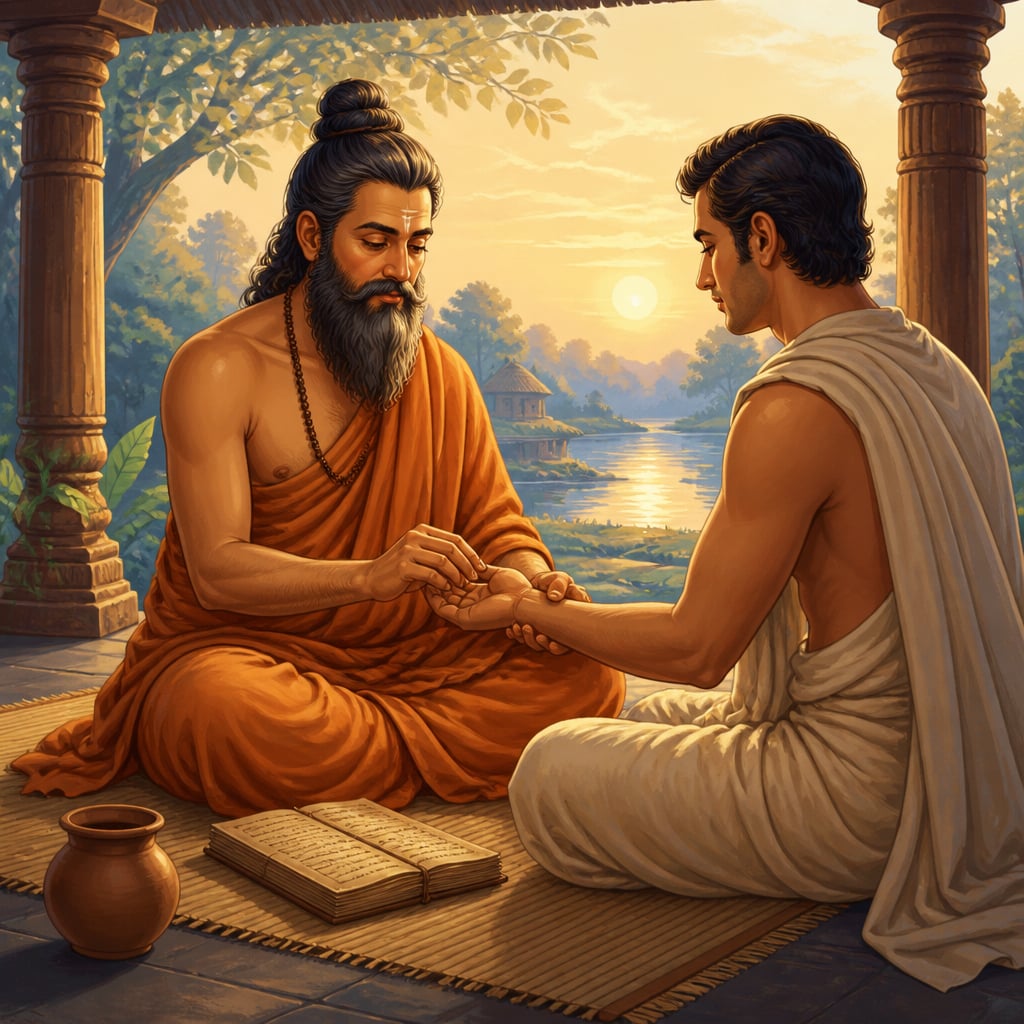
The Three Sources of Knowledge
Caraka begins with epistemology, how do we know anything? For medical diagnosis, he identifies three valid sources of knowledge:
1. Pratyakṣa (प्रत्यक्ष) – Direct Perception
What the physician sees, hears, touches, smells directly. The patient's appearance, the sound of breathing, the texture of skin, the odor of wounds. Direct observation is the foundation of diagnosis.
2. Anumāna (अनुमान) – Inference
Reasoning from what is observed to what cannot be directly seen. If the patient has fever, rapid pulse, and localized pain, the physician infers inflammation. If urine is dark and scanty, the physician infers dehydration. Inference extends perception.
3. Āptopadeśa (आप्तोपदेश) – Authoritative Testimony
Trusted knowledge from reliable sources, the patient's own account of symptoms, the observations of family members, and the accumulated wisdom of medical tradition. No physician can observe everything; testimony fills the gaps.
This three-fold epistemology (trividha parīkṣā) remains remarkably relevant. Modern clinical reasoning uses precisely these sources: physical examination (pratyakṣa), diagnostic reasoning (anumāna), and patient history plus medical literature (āptopadeśa).
The Eight-Fold Examination (Aṣṭasthāna Parīkṣā)
Building on Caraka's principles, the Āyurvedic tradition developed a systematic eight-point examination protocol. Each examination point reveals information about the body's internal state:
1. Nāḍī Parīkṣā (नाड़ी परीक्षा) – Pulse Examination
The crown jewel of Āyurvedic diagnosis. The physician palpates the radial artery at the wrist, feeling for:
- Rate – fast, normal, or slow
- Rhythm – regular or irregular
- Force – strong, weak, or thready
- Quality – described by animal movement analogies:
- Vāta pulse: moves like a snake (thin, fast, irregular)
- Pitta pulse: jumps like a frog (strong, bounding)
- Kapha pulse: glides like a swan (slow, steady, heavy)
Pulse diagnosis reaches extraordinary sophistication in later texts, with experienced practitioners claiming to detect specific diseases, pregnancy, and even emotional states through subtle pulse variations.
2. Mūtra Parīkṣā (मूत्र परीक्षा) – Urine Examination
Urine reveals the body's metabolic state:
- Color – pale, yellow, brown, red
- Clarity – clear, cloudy, sediment-filled
- Odor – normal, fruity (diabetes), foul (infection)
- Quantity – excessive, normal, scanty

The famous taila bindu parīkṣā (oil drop test): a drop of sesame oil placed on urine spreads differently depending on the dominant doṣa, revealing constitutional imbalances.
3. Mala Parīkṣā (मल परीक्षा) – Stool Examination
Digestive health manifests in stool:
- Consistency – formed, loose, hard
- Color – normal, pale (liver issues), dark (bleeding)
- Odor – normal, excessively foul
- Frequency – constipation, normal, diarrhea
4. Jihvā Parīkṣā (जिह्वा परीक्षा) – Tongue Examination
The tongue mirrors internal organs:
- Coating – thick white (kapha/digestive issues), yellow (pitta/heat)
- Color – pale (anemia), red (pitta excess)
- Shape – swollen, thin, cracked
- Movement – tremor indicates nervous involvement
Different tongue regions correspond to different organs, an early form of reflexology mapping.
5. Śabda Parīkṣā (शब्द परीक्षा) – Voice and Sound Examination
Sounds reveal respiratory and systemic health:
- Voice quality (hoarse, weak, nasal)
- Breathing sounds (wheezing, crackling)
- Abdominal sounds (gurgling, silence)
- Cough characteristics
6. Sparśa Parīkṣā (स्पर्श परीक्षा) – Touch Examination
Palpation reveals what eyes cannot see:
- Skin temperature (fever, cold extremities)
- Skin texture (dry, moist, rough)
- Tenderness points
- Swellings and masses
- Organ enlargement
7. Dṛk Parīkṣā (दृक् परीक्षा) – Eye Examination
Eyes reveal systemic state:
- Sclera color (yellow in jaundice, red in congestion)
- Pupil reactivity
- Eye movement
- Conjunctival pallor (anemia)
8. Ākṛti Parīkṣā (आकृति परीक्षा) – General Appearance
Overall assessment of:
- Body build (constitutional type)
- Posture and gait
- Facial expression
- Signs of distress
- Nutritional status
The Diagnostic Interview

Beyond physical examination, Caraka established the importance of systematic history-taking. The physician must learn:
Disease History:
- When did symptoms begin?
- How have they progressed?
- What makes them better or worse?
- Previous treatments attempted
Personal History:
- Diet and digestion
- Sleep patterns
- Elimination habits
- Emotional state
- Occupation and lifestyle
Constitutional Assessment:
- Birth circumstances
- Childhood health
- Family medical patterns
- Dominant prakṛti (constitutional type)
This comprehensive approach, combining physical examination with detailed history, is precisely what modern medicine calls the 'clinical encounter.' Caraka systematized it over two thousand years ago.
Diagnosis Before Treatment
Caraka insisted that treatment without proper diagnosis is dangerous:
"The physician who treats without understanding the disease, its cause, and its location acts blindly and harms the patient even while intending good."
This principle, diagnosis must precede treatment, seems obvious today but was revolutionary. Folk healing often prescribed standard remedies regardless of individual presentation. Caraka demanded personalized diagnosis leading to personalized treatment.
The Rational Foundation
What made Caraka's approach revolutionary was its rationality. He rejected:
- Diagnosis by divination or supernatural signs
- Standard treatments applied without examination
- Reliance on symptoms alone without understanding causes
He insisted on:
- Systematic observation protocols
- Logical inference from findings
- Integration of multiple information sources
- Consideration of individual variation
This rational foundation made Āyurvedic diagnosis teachable, improvable, and transmissible. A student could learn the examination protocol and apply it systematically, rather than depending on intuitive gifts.
Comparison with Hippocratic Diagnosis
Caraka and Hippocrates, working in different civilizations around the same period, both rejected supernatural explanations for disease. But their diagnostic approaches differed:
Hippocratic Tradition:
- Emphasized observation and prognosis
- Classified diseases by symptoms and outcomes
- Less systematic physical examination
- Strong emphasis on environmental factors
Caraka's Tradition:
- Structured eight-point examination
- Integration with constitutional theory (tridoṣa)
- Pulse diagnosis as central technique
- Emphasis on individual variation (prakṛti)
Both traditions contributed to the development of rational medicine. Their differences reflect distinct philosophical foundations, Greek emphasis on external causes versus Indian focus on internal balance.
Legacy in Modern Medicine
Caraka's diagnostic principles echo through modern clinical practice:
| Caraka's Concept | Modern Equivalent |
|---|---|
| Trividha parīkṣā | Clinical reasoning |
| Aṣṭasthāna parīkṣā | Review of systems |
| Nāḍī parīkṣā | Cardiovascular examination |
| Detailed history | History of present illness |
| Prakṛti assessment | Constitutional/genetic factors |
| Diagnosis before treatment | Evidence-based medicine |
The framework established by Caraka, systematic examination, logical inference, integration of history, remains the foundation of clinical diagnosis worldwide. Technology has expanded our perceptual capabilities enormously, but the underlying logic of diagnosis that Caraka articulated continues to guide clinical thinking.
Key figures
Caraka
Agniveśa
Vāgbhaṭa
Case studies
Ancient Case Records from Caraka Saṃhitā (Historical Reconstruction)
The Caraka Saṃhitā contains embedded case examples that reveal diagnostic reasoning in action. One such case describes a patient with: - Progressive weakness over several months - Pale complexion and breathlessness - Rapid, weak pulse (like a snake - vāta type) - Pale conjunctiva and tongue - Craving for sour and iron-rich foods The text's diagnostic reasoning: The signs indicate pāṇḍu roga (pallor disease, equivalent to anemia). The snake-like pulse indicates vāta involvement. The progressive course and specific food cravings suggest blood deficiency. Treatment prescribed: iron preparations (loha bhasma), pomegranate, dates, and blood-building herbs. This case demonstrates the integration of observation (pallor), inference (blood deficiency from signs), and systematic classification (pāṇḍu roga as a disease category).
This case reflects the deep knowledge tradition of Indian surgery and medicine (Shalya Tantra), where empirical observation and systematic methods were developed centuries before similar Western discoveries.
The knowledge demonstrated in this case study contributed to the broader legacy of Indian surgery and medicine (Shalya Tantra), influencing developments across Asia and eventually the world.
Systematic diagnosis combines multiple information sources. The ancient case shows pattern recognition across symptoms leading to diagnosis and targeted treatment.
Modern clinical decision support systems use the same multi-variable pattern matching that Caraka described. AI diagnostic tools like IBM Watson Health or Google's DeepMind analyze symptoms, history, and test results simultaneously, implementing computationally what experienced clinicians do intuitively.
The Sushruta Samhita describes over 300 surgical procedures and 120 surgical instruments, compiled around 600 BCE.
Modern Validation of Pulse Diagnosis (Scientific Validation)
A 2019 study published in the Journal of Ayurveda and Integrative Medicine used pulse wave analysis technology to investigate traditional nāḍī parīkṣā claims. The research examined whether pulse qualities associated with different prakṛti types showed measurable differences. Findings: - Vāta-type individuals showed higher pulse rate variability and lower pulse amplitude - Pitta-type individuals showed stronger pulse pressure and faster upstroke - Kapha-type individuals showed slower, more regular pulse with sustained waveforms These objective measurements correlated with traditional pulse descriptions (snake-like vāta, frog-like pitta, swan-like kapha). The study concluded that traditional pulse diagnosis encodes genuine physiological information in its classification system. The animal metaphors were teaching tools for patterns that modern instruments confirm as distinct waveform characteristics.
This case reflects the deep knowledge tradition of Indian surgery and medicine (Shalya Tantra), where empirical observation and systematic methods were developed centuries before similar Western discoveries.
The knowledge demonstrated in this case study contributed to the broader legacy of Indian surgery and medicine (Shalya Tantra), influencing developments across Asia and eventually the world.
Traditional knowledge can encode valid physiological distinctions even without modern theoretical frameworks. Sophisticated observation over generations can detect real patterns.
Wearable health devices like Apple Watch and Fitbit now measure pulse waveform characteristics continuously. Research linking pulse wave velocity to cardiovascular disease validates the core insight behind nadi pariksha: that pulse qualities carry diagnostic information beyond simple heart rate.
The Sushruta Samhita describes over 300 surgical procedures and 120 surgical instruments, compiled around 600 BCE.
Āyurvedic vs. Biomedical Diagnosis (Comparative Study)
A comparative analysis of diagnostic approaches reveals complementary strengths: **Āyurvedic Diagnosis (Caraka's Model):** - Emphasizes individual constitution (prakṛti) - Assesses functional imbalances (vikṛti/doṣa disturbance) - Uses accessible bedside techniques - Integrates physical, mental, and lifestyle factors - Targets the person, not just the disease **Biomedical Diagnosis:** - Emphasizes disease entities and pathology - Uses laboratory and imaging investigations - Identifies specific causative agents - Enables precise anatomical localization - Targets the disease mechanism **Integration Potential:** Modern integrative medicine increasingly recognizes that both approaches offer value. Biomedical diagnosis excels at identifying acute pathology; Āyurvedic diagnosis excels at understanding individual susceptibility and functional patterns. The growing field of 'Ayurgenomics' attempts to correlate prakṛti types with genetic variations, potentially bridging both systems.
This case reflects the deep knowledge tradition of Indian surgery and medicine (Shalya Tantra), where empirical observation and systematic methods were developed centuries before similar Western discoveries.
The knowledge demonstrated in this case study contributed to the broader legacy of Indian surgery and medicine (Shalya Tantra), influencing developments across Asia and eventually the world.
Different diagnostic paradigms reveal different aspects of illness. Comprehensive understanding may require multiple frameworks rather than exclusive commitment to one system.
Precision medicine and personalized treatment plans reflect the Ayurvedic insight that individual constitution matters. Pharmacogenomics, which tailors drug choices to a patient's genetic profile, operationalizes the same principle that prakriti-based diagnosis has applied for millennia.
The Sushruta Samhita describes over 300 surgical procedures and 120 surgical instruments, compiled around 600 BCE.
Historical context
Classical Period of Indian Medicine (c. 600 BCE - 600 CE)
Living traditions
- Nāḍī Parīkṣā Training: Traditional pulse diagnosis training takes years of practice under experienced teachers. Students learn to detect increasingly subtle pulse variations indicating different conditions and constitutions.
- Arya Vaidya Sala, Kottakkal: One of the world's largest traditional Āyurvedic treatment centers, where Caraka's diagnostic methods are practiced daily. Patients receive comprehensive aṣṭasthāna parīkṣā before treatment.
- Banaras Hindu University, Faculty of Ayurveda: Leading institution combining traditional Āyurvedic education with modern research. Students learn Caraka's diagnostic methods alongside contemporary medical sciences.
- Government Āyurveda College, Thiruvananthapuram: One of India's oldest Āyurvedic colleges (established 1889), preserving Kerala's distinctive tradition of pulse diagnosis and patient examination.
Reflection
- Caraka identified three sources of knowledge: direct observation, logical inference, and trusted testimony. When you're trying to understand something, a problem, a person, a situation, which source do you rely on most? What would happen if you consciously used all three?
- Caraka praised the physician who detects disease before it manifests fully. In your own life, what are the 'early warning signs' you could learn to recognize, whether for health, relationships, or projects going wrong? How might early detection change outcomes?
- Āyurveda emphasizes that the same disease needs different treatment in different people based on their constitution. Where else in life have you noticed that 'one size fits all' solutions fail? What would more personalized approaches look like?