Nāsikā Sandhāna: The World's First Plastic Surgery

Suśruta's rhinoplasty technique that British surgeons learned in 1794

Discover Suśruta's forehead flap rhinoplasty technique, how it was documented by British surgeons observing Kumhar potters in 1794, and its direct lineage to modern reconstructive surgery.

The Surgeon Who Made Faces Whole

In October 1794, a curious report appeared in The Gentleman's Magazine of London. British surgeons in India had witnessed something remarkable: a man named Cowasjee, a Maratha cart-driver who had lost his nose to Tipu Sultan's army, received a completely new nose, not transplanted from another person, but reconstructed from his own forehead skin.
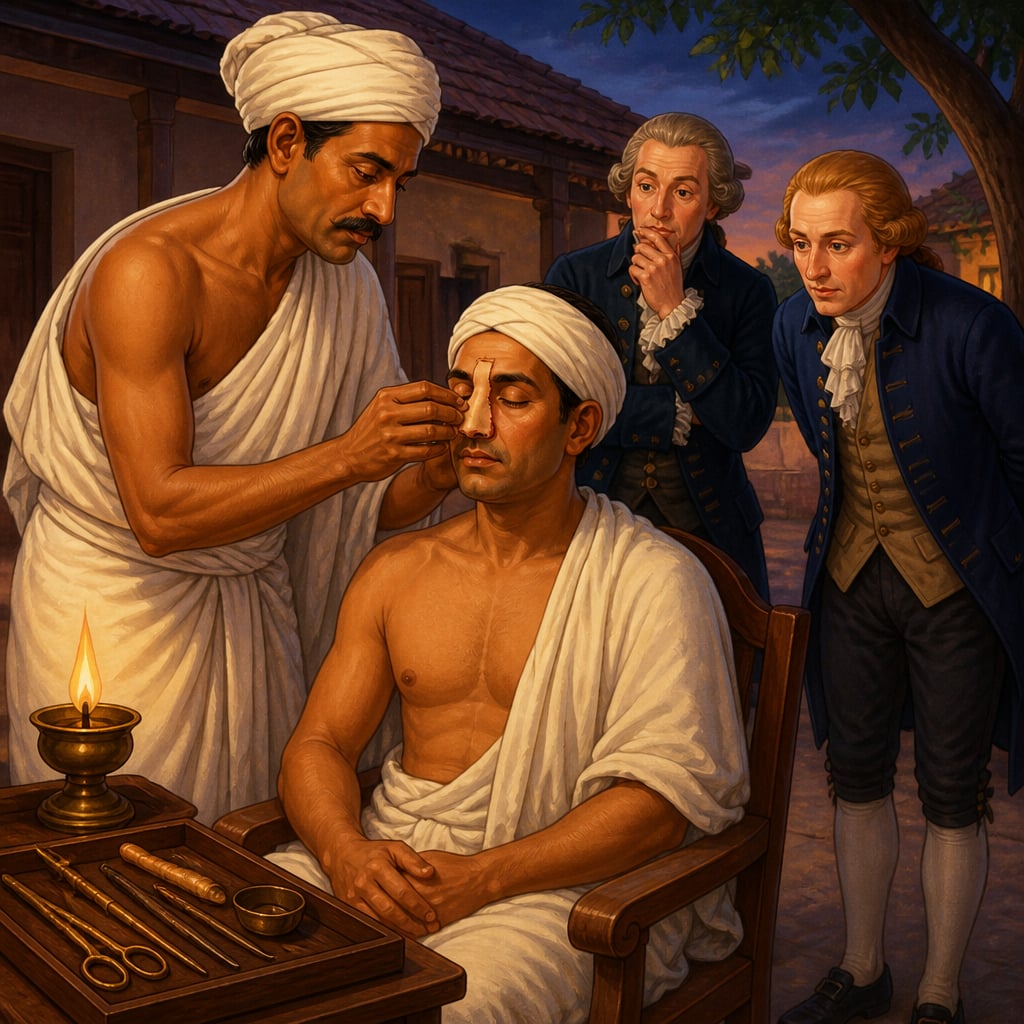
Traditional healer reconstructs Cowasjee nose in 1794 Pune

The surgeons watched in astonishment as a humble Kumhar (potter) caste practitioner performed what they called an "operation for restoring a lost nose." The technique was not new, it had been practiced in India for over two thousand years, passed down through families as sacred knowledge. But to European medicine, this was revolutionary.

What those British surgeons witnessed was Nāsikā Sandhāna, the "joining of the nose", a technique first documented by Suśruta in his monumental text, the Suśruta Saṃhitā, composed around 600 BCE.

Suśruta: The Father of Surgery

Suśruta lived in the ancient city of Kashi (modern Varanasi) and is considered one of the founding fathers of surgery, not just in India, but globally. His text, the Suśruta Saṃhitā, is among the oldest surgical treatises in human history.

But who was Suśruta? The text itself tells us he was a disciple of Dhanvantari, the divine physician and an incarnation of Vishnu in Hindu tradition. Whether Dhanvantari was a historical teacher or a mythological figure, Suśruta's surgical knowledge was remarkably practical and empirical.

The Suśruta Saṃhitā contains:

The Forehead Flap Technique

Why would ancient India need plastic surgery? The answer lies in a brutal form of punishment common across many ancient societies: nose-cutting (nāsikā-chedana). Criminals, prisoners of war, and adulterers were often punished by having their noses cut off, a visible, permanent mark of shame.

Suśruta's response was not to accept this disfigurement as permanent. He developed a technique to restore dignity along with the nose.

Sushruta measuring the nose with a banyan leaf

The procedure, described in Suśruta Saṃhitā (Sūtrasthāna Chapter 16), works as follows:

  1. Measurement: A leaf is used to measure the size of the missing nose. This template ensures the reconstructed nose matches the patient's face.

  2. Flap Creation: A section of skin from the forehead, including blood vessels, is carefully cut but left attached at the base near the eyebrows. This "pedicle" keeps the flap alive by maintaining blood supply.

  3. Shaping: The forehead skin is rotated down and shaped to form the new nose, including nostrils created using reeds as temporary supports.

  4. Attachment: The flap is sutured to the nasal area using fine threads.

  5. Healing: After the flap establishes blood supply from its new location, the connecting pedicle is severed.

This technique, the pedicled forehead flap, remains the gold standard for nasal reconstruction in modern plastic surgery. The fundamental principle has not changed in over 2,500 years.

The Scientific Method Behind the Technique

What made Suśruta's approach revolutionary was not just the procedure itself, but the scientific methodology underlying it:

Empirical Observation: Suśruta understood that skin with its blood supply intact would survive transplantation. This was not mysticism, it was careful observation of how wounds heal.

Standardization: By using a leaf as a template, Suśruta ensured reproducibility. Any trained surgeon could achieve similar results.

Holistic Care: The text specifies pre-operative preparation, surgical technique, AND post-operative care, the complete patient journey.

Training Protocol: Suśruta insisted that students practice on gourds, leather, and dead animals before operating on humans. This systematic training approach would not be standard in Western medicine until centuries later.

The 1794 Transmission

The Kumhar practitioners who performed rhinoplasty in 18th-century India were the inheritors of Suśruta's knowledge, passed down for generations within specific families. When British surgeons Thomas Cruso and James Findlay documented the procedure in 1794, they were witnessing a living tradition over two millennia old.

The publication in The Gentleman's Magazine sparked immediate interest. British surgeon Joseph Constantine Carpue studied the Indian technique and performed the first Western rhinoplasty using the forehead flap method in 1814, exactly following Suśruta's principles.

Carpue's success launched the field of modern plastic surgery. The technique spread across Europe and became known as the "Indian method" or "Hindu method" of rhinoplasty.

Modern Validation

In 2008, plastic surgeons from the UK performed a modern reconstruction using the exact technique described by Suśruta, documenting the procedure with modern imaging. Their conclusion? The ancient method works precisely as described and produces excellent results.

Today, the paramedian forehead flap, a direct descendant of Suśruta's technique, is used for nasal reconstruction after cancer surgery, trauma, and congenital defects. When surgeons perform this procedure in hospitals worldwide, they are practicing a technique that originated in ancient Kashi.

The American Society of Plastic Surgeons officially recognizes Suśruta as the "Father of Plastic Surgery", one of few ancient physicians to receive such recognition from modern medicine.

Comparative Context

Was India alone in developing reconstructive surgery? Other civilizations made contributions:

However, the Indian forehead flap technique was earlier, more sophisticated, and produced better results due to the superior blood supply from forehead skin. It remains the preferred method today.

The key insight, using tissue with intact blood supply, was Suśruta's breakthrough, and it predates similar Western understanding by nearly two thousand years.

The Living Tradition

Remarkably, traditional practitioners continued performing this surgery in India well into the 20th century. The knowledge passed from father to son, from guru to shishya, an unbroken chain connecting modern operating theaters to ancient Kashi.

Modern AIIMS surgeons performing the paramedian forehead flap

Today, the All India Institute of Medical Sciences (AIIMS) in New Delhi has a Department of Plastic Surgery that acknowledges this heritage while practicing modern techniques. The continuity from Suśruta to contemporary surgeons is not merely historical, it is a living lineage.

What We Learn

Suśruta's contribution teaches us several profound lessons:

Innovation Comes from Compassion: The technique was developed to restore dignity to those society had marked for shame. Medical innovation often arises from the desire to heal suffering.

Observation Beats Dogma: Suśruta didn't accept that lost noses were permanent. He observed how the body heals and used that knowledge to create solutions.

Documentation Preserves Knowledge: Because Suśruta wrote down his techniques in detail, they survived for millennia. The oral traditions of the Kumhar families eventually combined with this written record to reach the wider world.

Science Transcends Borders: When knowledge is true, it proves itself across cultures and centuries. The forehead flap works whether performed in ancient Kashi or modern London.

The next time you hear about reconstructive surgery, whether for accident victims, cancer survivors, or anyone seeking to restore their appearance, remember that this field began with a surgeon in ancient India who believed that no one should have to live with disfigurement when healing was possible.

Key figures

Suśruta

Ancient Indian physician and surgeon; author of the Suśruta Saṃhitā; considered the 'Father of Surgery' and 'Father of Plastic Surgery'

Dhanvantari

The divine physician in Hindu tradition; avatar of Vishnu associated with medicine and healing; traditional guru of Suśruta

Joseph Constantine Carpue

British surgeon who introduced Indian rhinoplasty to Western medicine after studying the technique described in The Gentleman's Magazine

Case studies

The Cowasjee Rhinoplasty (1794)

Cowasjee was a Maratha cart-driver serving the British army who was captured by forces loyal to Tipu Sultan. As punishment, his nose and one hand were cut off. After his release, he lived with this disfigurement for about a year before seeking treatment from a traditional surgeon of the Kumhar (potter) caste near Pune. British surgeons Thomas Cruso and James Findlay witnessed the procedure and documented it in detail for The Gentleman's Magazine.

This case proves the continuity of Suśruta's technique across two millennia. A procedure described around 600 BCE was being performed successfully in 1794 CE - virtually unchanged in its essential method. The surgeon drew a template on a wax plate matching Cowasjee's lost nose. He then marked a corresponding flap on the forehead, leaving a connecting bridge of skin between the eyebrows. After scraping the skin at the nasal stump to create a raw surface for attachment, he cut the forehead flap - keeping the connecting pedicle intact to maintain blood supply. The flap was rotated down, shaped into a nose with tubes inserted for nostrils, and sewn into place using fine sutures. After about 25 days, when the flap had established new blood supply from the nasal area, the pedicle connection to the forehead was severed.

The reconstruction was successful. Cowasjee received a functional nose that restored his appearance and dignity. The British surgeons noted that such operations were common in India and had been performed 'from time immemorial.' The detailed documentation they provided launched Western plastic surgery.

Ancient Indian scientific traditions produced practical, empirically validated knowledge that remains relevant to modern practice.

Plastic surgery is now a $50+ billion global industry. The forehead flap technique that the Pune surgeon used on Cowasjee in 1794 remains a standard reconstructive procedure in hospitals worldwide, demonstrating how empirically refined ancient techniques can hold up against millennia of subsequent medical development.

600 BCE - referenced in the context of The Cowasjee Rhinoplasty (1794).

Modern Surgical Validation of Suśruta's Technique

In 2008, plastic surgeons at the University of Liverpool performed a nasal reconstruction following Suśruta's original description as closely as possible, using modern imaging and documentation to verify each step. The goal was to scientifically validate whether the ancient technique could produce results comparable to modern methods.

The procedure worked precisely as described in the Suśruta Saṃhitā. The forehead flap maintained adequate blood supply through the pedicle. The reconstructed nose achieved good cosmetic and functional outcomes. The researchers concluded that Suśruta's technique was 'anatomically and physiologically sound' and represented 'a remarkable achievement in surgical thinking.' The paramedian forehead flap - the modern descendant of Suśruta's technique - remains the gold standard for nasal reconstruction after cancer surgery, trauma, or congenital defects. Its superiority comes from the rich blood supply of forehead tissue, exactly as Suśruta intuited over 2,500 years ago.

The paramedian forehead flap - the modern descendant of Suśruta's technique - remains the gold standard for nasal reconstruction after cancer surgery, trauma, or congenital defects. Its superiority comes from the rich blood supply of forehead tissue, exactly as Suśruta intuited over 2,500 years ago.

Ancient Indian scientific traditions produced practical, empirically validated knowledge that remains relevant to modern practice.

Modern surgical validation studies increasingly test traditional techniques using contemporary imaging and measurement tools. This approach, combining ancient procedural knowledge with modern verification methods, represents a productive model for evaluating traditional medical claims scientifically.

2,500 years - referenced in the context of Modern Surgical Validation of Suśruta's Technique.

Indian vs. Italian Methods: A Comparative Analysis

The 'Indian method' (forehead flap) and the 'Italian method' (arm flap, developed by Tagliacozzi in the 16th century) represent two distinct approaches to nasal reconstruction. Comparing them illuminates why Suśruta's technique remained superior.

indian_method: tissue_source: Forehead skin, blood_supply: Excellent - rich vascular network from supratrochlear artery, patient_comfort: Single surgical site; nose and forehead in same visual field, healing_time: 3-4 weeks for flap division, skin_match: Excellent - forehead skin closely matches nasal skin in color and texture, functional_outcome: Superior - thinner skin allows better nasal contour. indian_method_hi: tissue_source: माथे की त्वचा, blood_supply: बेहद अच्छा - खून की बहुत अच्छी आपूर्ति, patient_comfort: एक ही सर्जरी की जगह; नाक और माथा दोनों एक ही दिशा में, healing_time: 3-4 हफ्ते में ठीक हो जाता है, skin_match: उत्तम - माथे की त्वचा नाक की त्वचा से रंग और बनावट में मेल खाती है, functional_outcome: बेहद अच्छा - बारीक त्वचा से बेहतर नाक बनती है. italian_method: tissue_source: Upper arm skin, blood_supply: Moderate - random pattern blood supply, patient_comfort: Arm must be held to face for weeks during healing, healing_time: 2-3 weeks but more complications, skin_match: Poor - arm skin differs in color, texture, and thickness, functional_outcome: Adequate but inferior cosmetic results. italian_method_hi: tissue_source: भुजा की त्वचा, blood_supply: मध्यम - खून की आपूर्ति कम, patient_comfort: हफ्तों तक भुजा को चेहरे के पास रखना पड़ता है, healing_time: 2-3 हफ्ते पर ज्यादा जटिलताएं, skin_match: कमजोर - भुजा की त्वचा नाक की त्वचा से अलग दिखती है, functional_outcome: ठीक-ठाक पर कम सुंदर परिणाम Modern plastic surgeons prefer the Indian method for most nasal reconstructions because forehead skin provides better color match, superior blood supply, and allows for finer contour work. The Italian method is reserved for cases where forehead skin is unavailable. Suśruta's intuitive selection of forehead tissue reflects sophisticated understanding of surgical principles.

The knowledge demonstrated in this case study contributed to the broader legacy of Indian surgery and medicine (Shalya Tantra), influencing developments across Asia and eventually the world.

Ancient Indian scientific traditions produced practical, empirically validated knowledge that remains relevant to modern practice.

Surgeons today still debate the merits of different flap techniques for nasal reconstruction. The forehead flap (Sushruta's method) provides better blood supply and color match, while free flaps from other body sites offer more tissue. The clinical tradeoffs Sushruta identified remain central to surgical decision-making.

16th century - referenced in the context of Indian vs. Italian Methods: A Comparative Analysis.

Historical context

Classical Indian Medical Period (c. 800 BCE - 200 CE)

Reflection

More in Śalya: Surgery and Medicine That Healed the World

All lessons in Śalya: Surgery and Medicine That Healed the World · Bharatiya Vigyan: Inventions & Discoveries course