Sitadhyaksha: The Agriculture Superintendent

Kautilya's Vision for Agricultural Administration

Discover how Kautilya designed the Sitadhyaksha - a specialized agricultural superintendent who managed state farms, coordinated cultivators, and ensured food security. This 2,300-year-old bureaucratic innovation offers insights for modern agricultural governance.

The Monsoon That Never Came
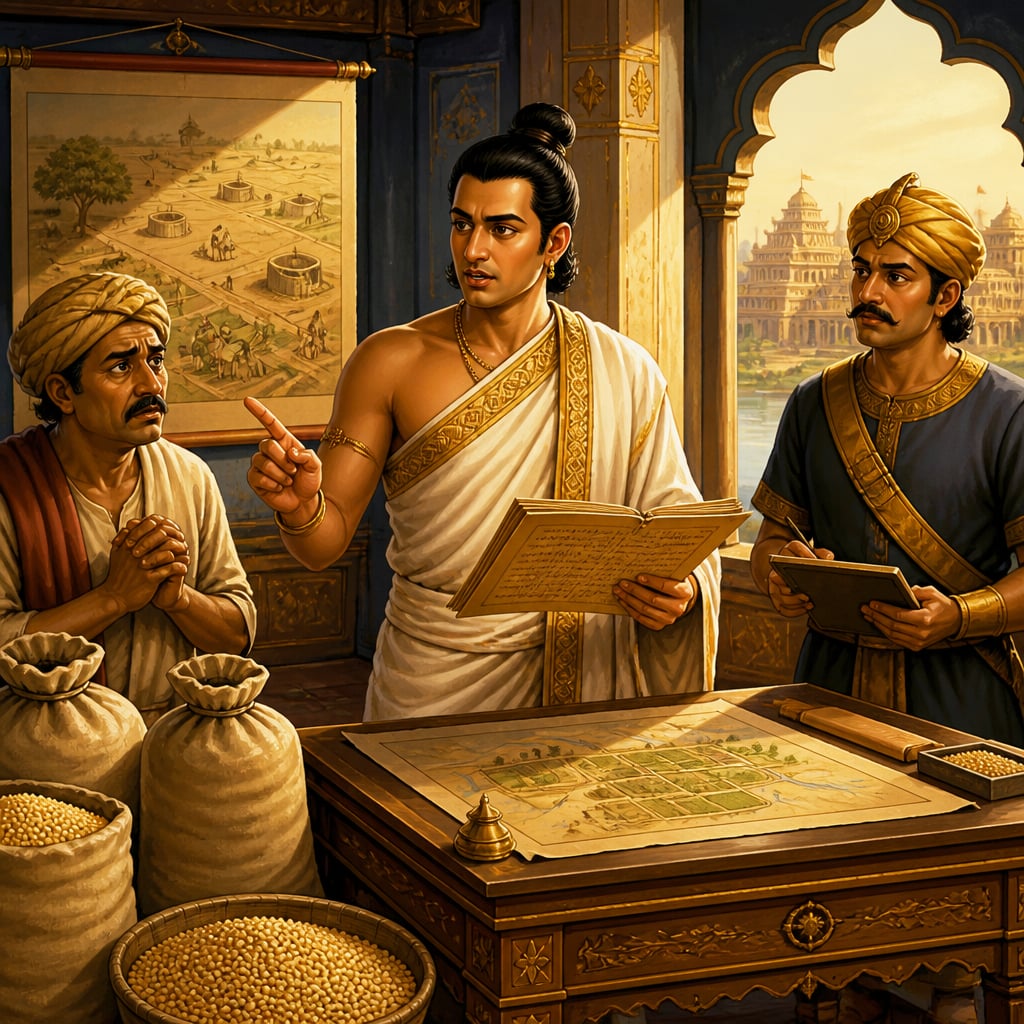
Sitadhyaksha Vrishala ordering drought relief at Pataliputra

The summer of 305 BCE brought no relief to Pataliputra. Vrishala, the newly appointed Sitadhyaksha of the northern provinces, stood at the edge of the Ganga floodplain watching dust devils dance across cracked earth. The monsoon had failed. Twelve thousand families on crown lands awaited his decision: plant with whatever moisture remained, or wait for rains that might never come?

In his leather satchel, Vrishala carried something no previous superintendent had possessed, a copy of the Arthashastra, personally annotated by Kautilya himself. Chapter 24 of the second book contained precise instructions for exactly this crisis. The master had anticipated everything.

The Birth of Agricultural Bureaucracy

Before Kautilya, Indian agriculture operated on tradition and instinct. Farmers planted what their fathers planted, when their fathers had planted. Kings taxed the harvest without understanding what produced it. The Sitadhyaksha changed everything.

Kautilya's vision was revolutionary: the state needed a scientifically trained agricultural administrator, someone who understood not just farming, but hydrology, meteorology, botany, and economics. The Arthashastra opens its agricultural section with an extraordinary requirement:

"सीताध्यक्षः कृषितन्त्रज्ञः स्यात्"

"The Superintendent of Agriculture shall be versed in the science of agriculture dealing with the sowing of crops." , Arthashastra 2.24.1

This wasn't a glorified tax collector. The Sitadhyaksha was expected to know:

The Sitadhyaksha managed sita lands, crown property cultivated either by state employees or by tenant farmers who received seeds, tools, and cattle from the treasury. In return, the state took one-fourth to one-half of the harvest, depending on the support provided.

The System in Action

Returning to Vrishala's crisis: what did Kautilya prescribe for drought?

The Arthashastra provides detailed contingency planning:

"अवर्षे च पर्जन्यवृष्टिं प्रतीक्षेत, देवमातृकं वा कृषेत्"

"In times of drought, one should either wait for rain or cultivate with water from wells and reservoirs." , Arthashastra 2.24.18

But Kautilya went further. The Sitadhyaksha was authorized to:

  1. Redistribute water from areas with surplus to those in deficit
  2. Release emergency seed stocks from state granaries
  3. Suspend or reduce taxes on farmers facing crop failure
  4. Mobilize labor for emergency irrigation construction
  5. Coordinate migration of cattle to areas with fodder

Vrishala ordered wells dug on every sita plot, released drought-resistant millet seeds from the Pataliputra granary, and reduced the state share from one-fourth to one-sixth. The harvest was reduced, but no family starved. The system had worked.

Global Perspectives on Agricultural Administration

Kautilya's Sitadhyaksha anticipated bureaucratic innovations that the West wouldn't see for two millennia.

Norman Borlaug inspecting dwarf wheat at CIMMYT Mexico

Norman Borlaug (1914-2009), the American agronomist who sparked the Green Revolution, faced a challenge strikingly similar to Vrishala's. In 1960s India, he introduced high-yielding wheat varieties that could survive drought conditions. But Borlaug recognized something crucial: scientific agriculture meant nothing without administrative systems to deliver seeds, fertilizers, and knowledge to farmers. He worked closely with the Indian government to create extension services, a modern echo of the Sitadhyaksha's role.

Thomas Jefferson (1743-1826) believed that farmers were the foundation of republican virtue, but he never designed a bureaucratic system to support them. The United States didn't establish a Department of Agriculture until 1862, over two thousand years after Kautilya detailed the Sitadhyaksha's duties.

Jean-Baptiste Colbert (1619-1683), France's famous finance minister, attempted state agricultural management but focused primarily on extracting revenue rather than supporting cultivators.

Thinker Era Key Insight Kautilyan Parallel
Borlaug 20th c. Scientific seeds need delivery systems Sitadhyaksha as knowledge multiplier
Jefferson 18th c. Farmers as civic backbone Agriculture as foundation of kosha (treasury)
Colbert 17th c. State coordination of production But extractive, not supportive

The crucial difference: Kautilya designed the Sitadhyaksha to serve cultivators, not merely to tax them. The superintendent's success was measured not by revenue extracted but by land brought under cultivation and yields increased.

From Pataliputra to PM-KISAN: Modern Resonance

Ashok Gulati, India's leading agricultural economist and chair professor at ICRIER, often channels Kautilyan thinking without naming it. His 2024 analysis of Minimum Support Price (MSP) policy echoes the Arthashastra's core insight: the state must balance revenue needs against farmer welfare.

Gulati's research shows that India's agricultural bureaucracy, from district agricultural officers to the Food Corporation of India, employs over 1.2 million people, making it one of the world's largest. Yet coordination failures persist. The 2023-24 buffer stock crisis, where FCI godowns overflowed with 100 million tonnes of grain while procurement prices squeezed farmer margins, would have horrified Kautilya.

The Arthashastra's solution? Decentralized accountability with centralized standards. Each Sitadhyaksha was personally responsible for his territory but operated within uniform procedures. Modern India has adopted this principle through:

Indian farmer at an e-NAM digital mandi counter

In December 2024, the government launched the Digital Agriculture Mission, aiming to create unique IDs for every farmer, essentially a database that the Sitadhyaksha could only dream of.

Your Turn: The Superintendent Within

You might wonder: what does a 2,300-year-old bureaucrat have to do with your life?

Consider this: Kautilya's Sitadhyaksha embodied a principle that applies to any enterprise, systematic knowledge applied to practical problems. Whether you're managing a team, running a household budget, or planning a project, the Sitadhyaksha's method is universal:

  1. Know your terrain, Understand the resources and constraints you're working with
  2. Plan for contingencies, The monsoon will fail; what's your backup?
  3. Measure and adjust, The Sitadhyaksha tracked yields; what metrics matter for your goals?
  4. Support before you extract, Give people tools to succeed before expecting results

In our next lesson, we'll explore how the Sitadhyaksha classified land, the Bhumi-Vargana system that ensured fair taxation and optimal cultivation across the empire's diverse geography.

Human capital in institutional design, the idea that bureaucratic effectiveness depends on specialized knowledge.

Max Weber (1864-1920) theorized 'rational-legal authority' based on expertise, but only in the 20th century. Kautilya implemented it in the 4th century BCE.

Indian tradition combined technical training with dharmic duty, the Sitadhyaksha served both the king and the cultivators, not just the revenue department.

The Mauryan administration employed an estimated 3,000+ trained officials across agricultural, mining, and trade superintendencies, history's first technocratic bureaucracy.

Investment in factors of production, providing capital and inputs to maximize output before claiming a share.

Adam Smith argued the state should limit itself to defense, justice, and infrastructure. Kautilya went further, direct production support to farmers.

Key terms

Sitadhyaksha
The Superintendent of Agriculture, a senior bureaucratic position responsible for managing state farms, coordinating cultivators, and ensuring agricultural productivity.
Sita Bhumi
Crown lands or state-cultivated agricultural lands, as distinct from privately owned farmland. These were cultivated either by state employees or tenant farmers receiving state support.
Krishi-tantra
The science or systematic knowledge of agriculture, encompassing soil science, hydrology, botany, meteorology, and farm management.
Deva-matrka
Rain-fed agriculture, cultivation dependent on rainfall (literally 'mothered by the gods/sky'). Contrasted with irrigated cultivation.

Verses

सीताध्यक्षः कृषितन्त्रज्ञः स्यात्

sītādhyakṣaḥ kṛṣitantrajñaḥ syāt

Let the guardian of crown lands be a master of agricultural science.

Kautilya understood that agricultural productivity, and therefore state revenue, depended on technical competence at the administrative level. This is an early articulation of technocratic governance.

Arthashastra, Book 2, Chapter 24, Verse 1 (R.P. Kangle critical edition)

अवर्षे च पर्जन्यवृष्टिं प्रतीक्षेत देवमातृकं वा कृषेत्

avarṣe ca parjanyavṛṣṭiṁ pratīkṣeta devamātṛkaṁ vā kṛṣet

When skies withhold their gift, wait for rain or draw from wells below.

The emphasis on irrigation alternatives reflects understanding that monsoon dependence is an economic vulnerability. Diversifying water sources reduces agricultural risk.

Arthashastra, Book 2, Chapter 24, Verse 18 (Patrick Olivelle (2013))

धान्यबीजौषधितृणकाष्ठवल्कलपुष्पफलानां कालाकालविशेषज्ञः

dhānyabījauṣadhitṛṇakāṣṭhavalkalpuṣpaphalānāṁ kālākālaviśeṣajñaḥ

He who knows the seasons of all growing things, grain and seed, herb and grass, timber and bark, flower and fruit.

Agricultural productivity depends on timing. The Sitadhyaksha's knowledge of seasonal cycles enabled optimization of planting, harvesting, and resource allocation across diverse crops.

Arthashastra, Book 2, Chapter 24, Verse 2 (L.N. Rangarajan)

Key figures

The Mauryan Sitadhyaksha

Agricultural superintendent responsible for crown lands across the Mauryan Empire

Ashok Gulati

Agricultural economist, Infosys Chair Professor at ICRIER, former chairman of Commission for Agricultural Costs and Prices (CACP)

Norman Borlaug

American agronomist, Nobel Peace Prize laureate (1970), architect of the Green Revolution

Case studies

The Farm Laws of 2020: Liberating Agriculture from APMC Constraints

In September 2020, the Indian Parliament passed three farm laws that fundamentally reformed agricultural markets. The Farmers' Produce Trade and Commerce Act allowed farmers to sell directly to private buyers, bypassing the APMC (Agricultural Produce Market Committee) mandis. The Farmers' Agreement on Price Assurance Act enabled contract farming with pre-agreed prices. The Essential Commodities Amendment removed stocking limits on key commodities. For decades, APMC mandis had created a government-controlled monopoly where farmers were forced to sell only through licensed traders, paying market fees of 2-6%. This system, established for colonial revenue collection, had become a barrier to farmer prosperity. Farmers in Punjab might receive Rs. 1,800 per quintal of wheat while consumers in Kerala paid Rs. 2,800, the difference captured by intermediaries, not producers. The 2020 reforms aimed to create what Kautilya would recognize: a system where the state facilitates rather than constrains trade, where cultivators have direct access to markets, and where arbitrary middlemen don't extract value without adding it.

The Arthashastra's approach to agricultural markets balanced state oversight with trader freedom. Kautilya prescribed fixed market places (*panya-shalas*) but also allowed private trade. He set quality standards but didn't mandate that all transactions pass through state-controlled channels. The APMC system violated a core Arthashastra principle: the state should regulate markets to prevent fraud, not to monopolize transactions. By giving farmers choice, sell to APMC, or sell directly, the 2020 laws aligned with Kautilyan market theory. The Sitadhyaksha's role was to support farmers' productivity, not to restrict their selling options. When the state becomes a barrier to farmer prosperity rather than its enabler, it has abandoned its dharmic duty.

While the laws were repealed in November 2021 following protests, the reform momentum continued through other channels. By 2024, e-NAM had connected 1,361 mandis, allowing inter-state trade without physical movement. Multiple states reformed their APMC Acts independently. Private investment in agricultural supply chains increased despite uncertainty. The core insight survived: Indian agriculture requires liberation from colonial-era market restrictions. The debate is now about implementation, not direction. Ashok Gulati noted in 2024 that farmer incomes grew faster in states with reformed APMC systems.

The Sitadhyaksha's mandate was to maximize agricultural productivity and farmer prosperity, not to control markets for their own sake. When regulations restrict rather than enable, they contradict the Arthashastra's vision of the state as agriculture's servant, not its master.

Despite the farm laws repeal, agricultural market reform continues through state-level APMC amendments and digital platforms. The fundamental tension between regulated markets and farmer freedom remains unresolved, but the direction is clear: technology-enabled transparency is gradually replacing physical intermediary control.

Market fees and commissions consume 15-20% of the farm-gate price in the APMC system. Direct procurement models have reduced this to under 5% for participating farmers.

e-NAM: The Digital Sitadhyaksha

In April 2016, the Government of India launched the Electronic National Agriculture Market (e-NAM), a unified online platform connecting agricultural markets across the country. By December 2024, 1,361 mandis across 23 states were integrated, with over 1.77 crore farmers and 2.5 lakh traders registered. Before e-NAM, a farmer in Madhya Pradesh selling soybean could only access buyers in the local mandi, often facing cartel-like behavior among traders. Price discovery was opaque. Quality assessment was subjective and often manipulated. The farmer had no way to know that buyers in Gujarat or Maharashtra might pay 10% more. e-NAM changed this. Farmers can now view prices across all connected mandis in real-time. Quality assaying through e-NAM's standardized parameters creates transparency. Online bidding from any registered trader increases competition. Payment happens directly to bank accounts, eliminating cash leakages.

Kautilya would recognize e-NAM as a digital implementation of his market principles. The Arthashastra prescribed that: 1. **Prices should be transparent**, e-NAM publishes real-time prices across mandis 2. **Quality standards should be uniform**, e-NAM uses standardized assaying 3. **Trade should be free within the realm**, e-NAM enables inter-state transactions 4. **Records should be maintained**, e-NAM creates digital audit trails The Sitadhyaksha coordinated information across the empire's agricultural economy. e-NAM does this at scale and speed that Kautilya could only dream of. The platform essentially creates 1,361 Sitadhyakshas connected in real-time.

e-NAM has processed over Rs. 2.5 lakh crore in trade value since launch. Farmers report 5-10% better price realization due to increased buyer competition. Transaction time has reduced from days to hours. Disputes have decreased due to standardized quality parameters. Challenges remain: only 30% of trades are fully online end-to-end, internet connectivity limits participation in remote areas, and trader resistance persists in some states. But the trajectory is clear, digital integration is transforming India's agricultural markets.

The Sitadhyaksha's power came from information, knowing what grew where, when to plant, how to price. e-NAM democratizes this information, giving every farmer access to market intelligence that was once available only to administrators and large traders. Technology enables the Kautilyan vision at scale.

e-NAM's expansion to 1,361 mandis demonstrates that digital market integration can achieve what legislative reform could not. The platform gives farmers price transparency across states without requiring the politically contentious step of dismantling existing market structures.

Farmers using e-NAM for inter-state trade report 8-12% higher prices than those restricted to local mandis, the power of market access.

Historical context

Mauryan Empire, 4th-3rd century BCE

The Mauryan period saw India's first large-scale experiment with centralized agricultural administration. Crown lands (sita bhumi) were systematically cultivated, with detailed records of yields, taxes, and cultivator welfare. Megasthenes, the Greek ambassador, described Indian agriculture as exceptionally productive, a result of irrigation systems and state support.

Contemporary agricultural systems, Persian, Greek, Chinese, relied primarily on peasant cultivation with simple tax extraction. The Mauryan innovation was active state involvement in improving agricultural productivity through trained administrators, infrastructure investment, and risk-sharing with cultivators.

Archaeological evidence suggests Mauryan-era irrigation systems brought an additional 2-3 million hectares under cultivation in the Gangetic plain alone.

The Sitadhyaksha system demonstrates that sophisticated agricultural bureaucracy is not a modern invention. India's current agricultural administrative structure, with its district officers, extension services, and coordinating bodies, has roots in Kautilyan thinking, even if colonial and post-colonial systems obscured this heritage.

Living traditions

India's agricultural bureaucracy employs over 1.2 million people in roles that trace conceptual ancestry to the Sitadhyaksha. The Digital Agriculture Mission (2024) aims to create a unified farmer database, essentially a 21st-century version of the Mauryan land records that the Sitadhyaksha maintained.

Reflection

More in Sita: Agriculture and Land Revenue

All lessons in Sita: Agriculture and Land Revenue · Arthashastra: Economic Principles course