Bija-Vitarana: Seed Distribution and Farmer Welfare

The Mauryan Agricultural Safety Net

The Arthashastra prescribed a comprehensive farmer welfare system: quality seeds from state granaries, emergency loans at low interest, tools and cattle for those who needed them, and crisis relief for those who suffered crop failure. This 2,300-year-old safety net anticipated modern programs by millennia.

The Seeds of Spring
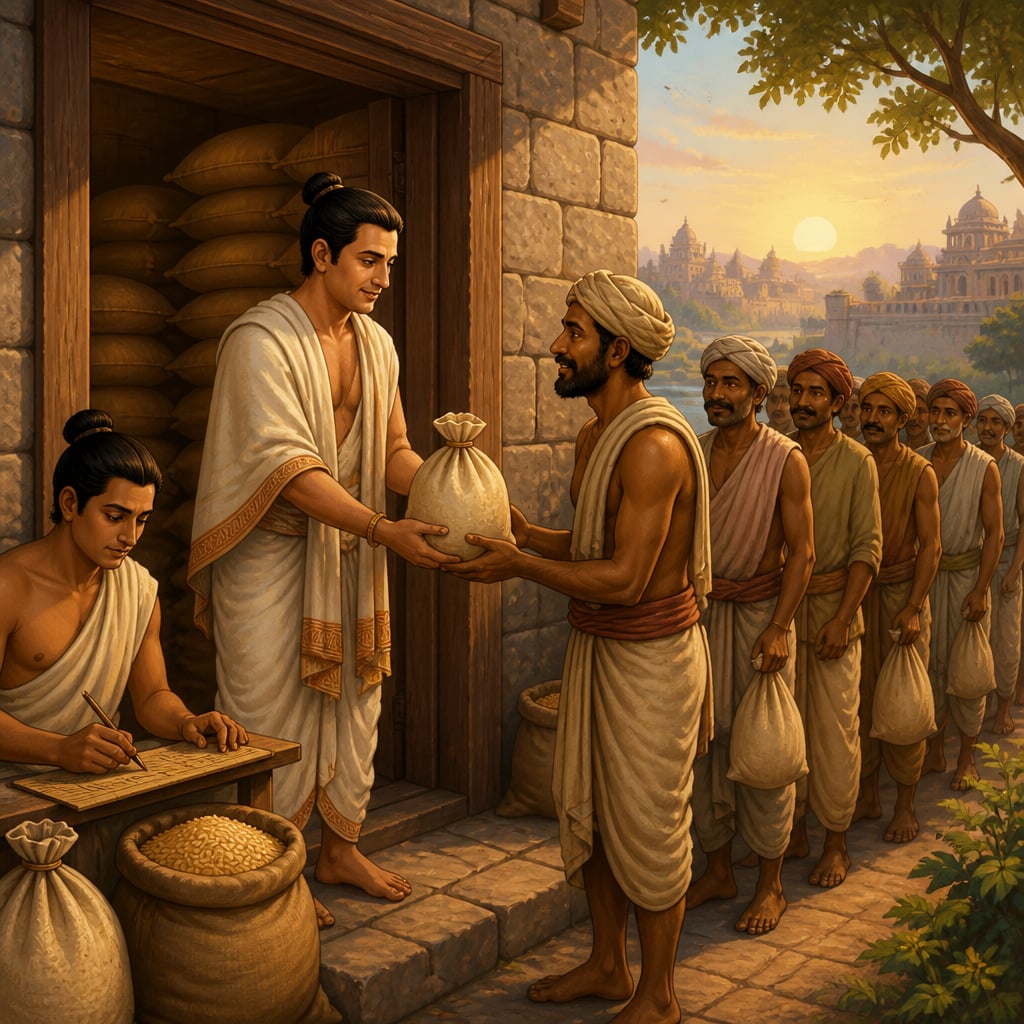
Dharmapala distributing state seeds to waiting farmers

As the winter rains receded in 296 BCE, farmers across the Gangetic plain faced their annual anxiety: did they have seed for the spring planting? Dharmapala, the bija-adhyaksha (seed superintendent) of the central districts, opened the imperial granary at Pataliputra to begin the season's most important distribution.

The queue stretched beyond the granary walls. Farmers who had eaten their reserves during a lean winter. Tenants whose landlords provided nothing. Settlers on newly cleared sita lands with no seed stocks of their own. A widow whose husband had died before harvest, leaving her with children and empty fields.

For each, Dharmapala had instructions from the Arthashastra. The widow would receive seed without repayment obligation, her situation was not her fault. The settlers would receive seed, cattle, and tools as state investment in new cultivation. The tenants would receive seed as loans, repayable from harvest. Even the farmers who had consumed their reserves would receive seed, but with counseling on maintaining buffer stocks.

This was not charity. This was bija-vitarana, the state's systematic investment in agricultural productivity through farmer welfare.

The Comprehensive Safety Net

Kautilya understood a truth that modern development economics rediscovered only in the 20th century: farmers without resources cannot cultivate. Land classification, crop planning, and irrigation mean nothing if the cultivator lacks seed, tools, and credit to put them to use. The Arthashastra therefore prescribed comprehensive farmer support.

Seed Distribution

"कृषीवलेभ्यः बीजं धान्यं च प्रयच्छेत्"

"He shall provide seed and grain to cultivators." , Arthashastra 2.24.14

The state maintained seed reserves (bija-kosha) separate from consumption grain. These seeds were:

The Sitadhyaksha kept detailed registers of seed distribution, expecting repayment at harvest rates (with interest for loans, without for emergency grants).

Credit and Loans

Ancient India suffered the same curse as modern developing nations: moneylender exploitation. Farmers who borrowed at harvest-time desperation faced interest rates that consumed their entire production. The Arthashastra's solution was state-provided agricultural credit:

"कृषिकर्मसु वर्धकं दद्यात्"

"He shall provide agricultural loans." , Arthashastra 2.1.14

State loans carried lower interest (15% annually, compared to 60%+ from private lenders) and could be repaid in kind at harvest. More importantly, the state didn't seize land for default, it restructured repayment or forgave loans in genuine hardship.

Tools and Cattle

Many cultivators lacked the capital for essential equipment. The Arthashastra prescribed:

New settlers on sita lands received complete equipment packages. Existing farmers could access tools through state distribution centers.

Crisis Relief

Crop failure, whether from drought, flood, or pest, could devastate farming families. The Arthashastra mandated:

"आपद्गतान् कृषीवलान् बीजभक्तादिभिः संधारयेत्"

"Cultivators who have suffered calamity shall be supported with seed, food, and other necessities." , Arthashastra 2.1.17

The state responsibility was explicit: farmers who lost crops through no fault of their own were entitled to:

This wasn't welfare in the modern pejorative sense. It was investment protection, ensuring that agricultural capacity survived temporary shocks.

The Logic of Farmer Support

Why would the state invest so heavily in cultivator welfare? The Arthashastra's reasoning was economically sophisticated:

The Productivity Argument

"कृषीवले कृषिर्निवसति, कृषौ कोशः"

"Agriculture resides in the cultivator; in agriculture resides the treasury." , Arthashastra 2.1.2

A farmer without seed doesn't plant. A farmer crushed by debt works without incentive. A farmer who lost everything to disaster abandons agriculture entirely. State support maintained the productive capacity that generated revenue.

The Settlement Argument

The Mauryan state actively colonized new territories by settling cultivators on previously uncultivated land. These settlers needed complete support packages to establish productive farms. Farmer welfare was colonization infrastructure.

The Loyalty Argument

Cultivators supported by the state during crisis became loyal subjects. Those exploited by moneylenders had no stake in the existing order. Farmer welfare was political investment.

The Efficiency Argument

Private moneylenders extracted maximum value from farmers, often forcing land sales that concentrated ownership and reduced total cultivation. State credit at reasonable rates preserved distributed cultivation, which was more productive than concentrated estates.

Global Perspectives on Agricultural Welfare

The modern world treats farm support as a 20th-century innovation. History suggests otherwise.

President Roosevelt signing the Agricultural Adjustment Act

Franklin D. Roosevelt's New Deal (1933-1939) created the modern American farm welfare system in response to the Great Depression. The Agricultural Adjustment Act, Farm Security Administration, and commodity programs provided exactly what Kautilya prescribed 2,200 years earlier: credit, price support, and crisis relief. Yet these innovations came in response to catastrophic farm failure that the Arthashastra's preventive approach might have avoided.

European agricultural support through the Common Agricultural Policy (CAP, 1962) provides direct payments to farmers, echoing PM-KISAN 2,260 years after the Arthashastra prescribed cultivator support.

Muhammad Yunus and Grameen Bank (1983) pioneered microfinance for rural Bangladesh, providing small loans at reasonable rates to those excluded from formal banking. The Arthashastra's state credit for cultivators anticipated this by 2,280 years.

Agricultural Welfare Innovation Modern Pioneer Date Kautilyan Parallel Arthashastra Era
State farm credit Farm Credit Act (US) 1916 CE Krishi-vardhaka loans 300 BCE
Crop insurance Federal Crop Insurance (US) 1938 CE Apad-pratyaya (calamity relief) 300 BCE
Direct farmer payments CAP (EU) 1962 CE Bija-bhakta-dāna 300 BCE
Microfinance Grameen Bank 1983 CE Low-interest state loans 300 BCE

From Bija-Kosha to PM-KISAN: Modern Resonance

India's current farmer welfare architecture would be recognizable to Dharmapala, though the scale has grown enormously.

Dr. R.S. Paroda, former Director General of ICAR and architect of India's seed system reforms, has spent decades building the modern equivalent of the bija-kosha. Under his leadership, India developed:

Paroda's philosophy echoes the Arthashastra: seed is the foundation of agriculture, and the state must ensure access to quality planting material regardless of farmer wealth.

The National Seed Mission (2014) represents scaled bija-vitarana:

The Modern Safety Net

Today's farmer welfare programs form an integrated system:

Farmer receiving his Kisan Credit Card at a cooperative bank

Kisan Credit Card (KCC) provides what the Arthashastra called krishi-vardhaka (agricultural advancement loans):

PM Fasal Bima Yojana (PMFBY) institutionalizes apad-pratyaya (calamity compensation):

PM-KISAN provides direct income support, the modern equivalent of bhakta-dāna (food grants):

Together, these programs represent the Arthashastra's vision at scale: state investment in cultivator welfare as the foundation of agricultural prosperity.

Your Turn: Building Your Safety Net

Kautilya's farmer welfare offers personal wisdom. Consider:

What are your "seeds"? Every enterprise needs starting resources, skills, capital, relationships, credibility. Are you maintaining reserves, or consuming your seed stock?

Who provides your credit? When you need resources beyond your current capacity, who do you turn to? The Arthashastra's lesson: low-cost supportive credit enables growth; exploitative lending destroys it. Choose your creditors wisely.

What's your calamity plan? Crop failure happens, job loss, health crisis, market collapse. The state maintained reserves for cultivator disasters. Do you have an emergency fund for yours?

In our next lesson, we'll explore Dhanya-Sangraha, how the Mauryan state maintained grain reserves that could feed the empire through famine, creating food security at civilizational scale.

Human capital as the foundation of productivity, the idea that investment in people enables all other economic activity.

Theodore Schultz won the 1979 Nobel Prize for demonstrating that investment in human capital drives agricultural development. Kautilya operationalized this insight 2,280 years earlier.

The Arthashastra integrated human capital investment with institutional support, not just education, but credit, insurance, and crisis relief. The cultivator was supported comprehensively.

PM-KISAN's Rs. 6,000 annual transfer reaches 11+ crore farmers, recognizing that cash in cultivator hands generates agricultural investment.

Public insurance against catastrophic risk, the idea that some risks are too large for individuals and require collective (state) absorption.

Federal Crop Insurance (US, 1938) and the Common Agricultural Policy (EU, 1962) institutionalized farm disaster relief. Kautilya prescribed it 2,200+ years before either.

Key terms

Bija-Vitarana
Seed distribution, the state system for providing quality planting material to cultivators, whether as grants, loans, or sales.
Bija-Kosha
Seed treasury or seed bank, the state reserve of quality planting material, maintained separately from consumption grain.
Krishi-Vardhaka
Agricultural advancement loan, credit provided by the state to farmers for productive purposes at rates below market lending.
Apad-Pratyaya
Calamity relief or disaster compensation, state support for farmers who have suffered crop loss through natural disaster or other causes beyond their control.

Verses

कृषीवलेभ्यः बीजं धान्यं च प्रयच्छेत्

kṛṣīvalebhyaḥ bījaṁ dhānyaṁ ca prayacchet

To those who till, let seed and grain be given, the state's support keeps agriculture driven.

Seed provision addresses a market failure: farmers often lack capital for quality seed at planting time, and private seed markets may not exist in remote areas. State provision ensures optimal varieties reach all fields.

Arthashastra, Book 2, Chapter 24, Verse 14 (R.P. Kangle critical edition)

आपद्गतान् कृषीवलान् बीजभक्तादिभिः संधारयेत्

āpadgatān kṛṣīvalān bījabhaktādibhiḥ saṁdhārayet

When disaster strikes the tiller's field, the state shall feed and help him heal.

Agricultural insurance principles in embryo: the state absorbs catastrophic risk that individual farmers cannot bear. This prevents agricultural capacity from being destroyed by temporary shocks.

Arthashastra, Book 2, Chapter 1, Verse 17 (Patrick Olivelle (2013))

कृषीवले कृषिर्निवसति कृषौ कोशः

kṛṣīvale kṛṣirnivasati kṛṣau kośaḥ

In the farmer dwells the farm, in farming dwells the gold, support the tiller, and wealth unfolds.

Human capital is foundational to productivity. The Arthashastra understood that investment in farmers, their skills, resources, and security, was investment in state capacity.

Arthashastra, Book 2, Chapter 1, Verse 2 (L.N. Rangarajan)

Key figures

The Mauryan Bija-Adhyaksha

Seed superintendent responsible for maintaining seed reserves, ensuring quality, and distributing planting material to cultivators

Dr. R.S. Paroda

Former Director General of ICAR, founder of Trust for Advancement of Agricultural Sciences (TAAS), architect of India's modern seed system

Franklin D. Roosevelt & New Deal Farm Programs

32nd US President whose New Deal created modern American farm welfare programs in response to the Great Depression

Case studies

The National Seed Mission: Rebuilding India's Bija-Kosha

When India faced the challenge of raising agricultural productivity in the 2010s, a fundamental constraint emerged: quality seed access. Farmers in many regions planted saved seed of declining genetic quality, or purchased uncertified seed of unknown variety. The gap between potential yields (demonstrated at research stations) and actual yields (achieved in farmers' fields) was 30-40% for many crops. The National Mission on Agricultural Extension and Technology (2014) included a dedicated seed component addressing this bija-vitarana challenge: **Infrastructure**: Rs. 920 crore for seed processing plants, testing labs, and storage facilities **Production**: Target 25 lakh quintals of certified seed annually, with focus on pulses, oilseeds, and climate-resilient varieties **Distribution**: Seed hubs in every agro-climatic zone ensuring local availability **Quality**: Strengthened certification to ensure varietal purity and germination standards **Access**: Seed village programs training farmers as local certified seed producers Dr. R.S. Paroda and the Trust for Advancement of Agricultural Sciences (TAAS) played a crucial role in designing and advocating for this mission, emphasizing that 'seed is the starting point of the food value chain.'

The National Seed Mission directly implements Arthashastra principles: **Bija-kosha (Seed treasury)** The mission's infrastructure creates modern seed treasuries, not the palm-roofed granaries of Pataliputra, but climate-controlled facilities that preserve genetic quality for distribution. **Quality matching** Just as the bija-adhyaksha matched seed varieties to land classification, the mission creates 'seed hubs' in each agro-climatic zone, ensuring locally appropriate varieties. **Distributed access** The seed village program, training farmers as certified seed producers, decentralizes the bija-vitarana function, bringing quality seed closer to every cultivator. **State investment for private benefit** Like the Arthashastra's loans and grants, the mission invests public resources to enable private agricultural productivity. The underlying logic is identical: agriculture depends on the cultivator, and the cultivator depends on quality seed. State investment in seed systems is investment in agricultural capacity.

By December 2024: **Seed production:** - Certified seed production increased 40% from 2014 baseline - Pulses seed replacement rate rose from 25% to 35% - Oilseed quality seed coverage up from 15% to 25% **Infrastructure:** - 200+ new seed processing plants operational - 150+ new seed testing laboratories - Seed storage capacity increased by 50% **Access:** - 15,000+ seed villages producing certified seed - 50,000+ trained farmer seed producers - Seed availability within 25 km for 80% of farmers **Yield impact:** - Fields using certified seed show 15-25% higher yields - Estimated Rs. 10,000 crore additional agricultural output annually Challenges persist, seed replacement rates remain low for some crops, and farmer awareness varies. But the bija-kosha is being rebuilt.

Seed is the first link in the agricultural chain. The National Seed Mission demonstrates that modern India, like Mauryan India, must invest in bija-vitarana infrastructure. Quality seed in every farmer's hands is the foundation of food security.

India's seed replacement rate for pulses and oilseeds remains well below the 33% minimum recommended for maintaining yield potential. As climate change demands faster varietal adaptation, the gap between seed infrastructure capacity and farmer needs becomes a binding constraint on agricultural productivity.

Every 1% increase in seed replacement rate adds Rs. 3,000 crore to agricultural GDP, the economic return on bija-vitarana investment.

KCC and PMFBY: Credit and Insurance for Modern Cultivators

India's farmers faced a dual vulnerability that the Arthashastra addressed 2,300 years ago: lack of affordable credit (forcing reliance on exploitative moneylenders) and lack of protection against crop failure (leaving families destitute after disasters). Two major programs address these ancient challenges: **Kisan Credit Card (KCC, 1998-present)** A credit mechanism providing: - Up to Rs. 3 lakh in crop loans - Interest rate of 4% (with subvention) vs. 24-60% from informal lenders - Flexible repayment aligned with harvest - No collateral required for loans up to Rs. 1.6 lakh - Coverage of cultivation and consumption needs **PM Fasal Bima Yojana (PMFBY, 2016-present)** Crop insurance providing: - Protection against yield loss from weather, pests, and disease - Low premium: 2% for kharif, 1.5% for rabi, 5% for commercial crops - No cap on claims, full insured amount payable - Smartphone-based damage assessment - 72-hour claim initiation through app Together, these programs create the krishi-vardhaka (advancement credit) and apad-pratyaya (calamity compensation) that Kautilya prescribed.

These programs embody Arthashastra farmer welfare principles: **Breaking the moneylender trap** KCC provides what the Arthashastra called state agricultural loans at 'reasonable' interest. By offering 4% credit, KCC undercuts informal lenders charging 24-60%, breaking the debt spiral that destroyed Mauryan cultivators and destroys modern farmers alike. **Institutionalizing calamity relief** PMFBY converts the Sitadhyaksha's discretionary disaster relief into an institutional guarantee. Farmers know before planting that crop failure won't mean starvation, exactly the security Kautilya prescribed. **Comprehensive support** KCC covers both cultivation (seeds, fertilizer) and consumption (food during growing season), recognizing that farmers need support for both production and survival. The Arthashastra's 'seed and food' provision is modernized. **Speed and dignity** PMFBY's smartphone claims eliminate the humiliation of begging for relief. The farmer submits evidence; the system pays. This dignified process echoes the Arthashastra's treatment of calamity relief as entitlement, not charity.

**Kisan Credit Card (by December 2024):** - 7.35 crore cards issued - Rs. 20 lakh crore+ cumulative credit disbursed - Average loan size: Rs. 1.2 lakh - Interest savings: Rs. 25,000+ per farmer per year vs. informal credit - Informal credit share reduced from 40% to 25% in covered areas **PM Fasal Bima Yojana (by December 2024):** - 4 crore+ farmers enrolled annually - 56 crore hectares insured since 2016 - Rs. 1.5 lakh crore claims paid - Average claim: Rs. 37,000 per farmer - Claim settlement time: 45 days (down from 180+ under previous schemes) **Combined impact:** - Farmer suicides down 20% in high-coverage districts - Agricultural investment up 25% in KCC-covered areas - Crop diversification increased (farmers willing to try new crops with insurance) - Gender gap narrowing, 23% of KCC holders are women (up from 8% in 2015)

Credit and insurance are two halves of farmer security. KCC provides the resources to cultivate; PMFBY protects against failure. Together, they create the environment where farmers can invest, innovate, and take rational risks, exactly what the Arthashastra's krishi-vardhaka and apad-pratyaya were designed to achieve.

India's agricultural credit ecosystem now reaches 7.35 crore farmers through KCC, but informal lending still accounts for 25% of rural credit. The gap represents both a market failure and an opportunity: each percentage point shifted from informal to formal credit reduces farmer interest burden by thousands of crores annually.

For every Rs. 1 of premium subsidy in PMFBY, Rs. 1.6 flows back to farmers as claims, making crop insurance one of the most efficient welfare transfers in Indian agriculture.

Historical context

Mauryan Empire, 4th-3rd century BCE

The Mauryan state's farmer welfare system was unprecedented in scale. The empire maintained seed reserves across provinces, provided credit through the treasury, and distributed tools from state foundries. This comprehensive support enabled rapid agricultural expansion that sustained one of the ancient world's largest populations.

No contemporary civilization had comparable farmer welfare systems. Rome's grain dole fed urban citizens but didn't support rural producers. Chinese agricultural policy focused on land reform rather than input support. The Arthashastra's comprehensive cultivator welfare was unique in its integration of credit, inputs, and crisis relief.

Megasthenes reported that Indian cultivators were 'more numerous than any other nation,' sustained by a state that 'takes care that they are not wronged', a rare ancient observation of agricultural welfare.

India's current farmer welfare debate, from PM-KISAN to MSP, has ancient roots. The Arthashastra's principle that 'agriculture resides in the cultivator' remains the foundation: farmer welfare isn't subsidy but investment in national productive capacity.

Living traditions

India's farmer welfare architecture, PM-KISAN, KCC, PMFBY, seed missions, represents the most comprehensive cultivator support system in the world. The scale is unprecedented: over Rs. 5 lakh crore annually reaches farmers through various channels. The Arthashastra's principles are now implemented at billion-farmer scale.

Reflection

More in Sita: Agriculture and Land Revenue

All lessons in Sita: Agriculture and Land Revenue · Arthashastra: Economic Principles course