Dhanya-Sangraha: Grain Reserves and Famine Prevention

Food Security Through Strategic Stockpiling

The Arthashastra prescribed empire-wide grain reserves that could feed populations through multi-year famines. This system of strategic stockpiling, quality maintenance, and crisis distribution created food security at civilizational scale, lessons that modern India has both learned and forgotten.

The Calculation That Saved an Empire
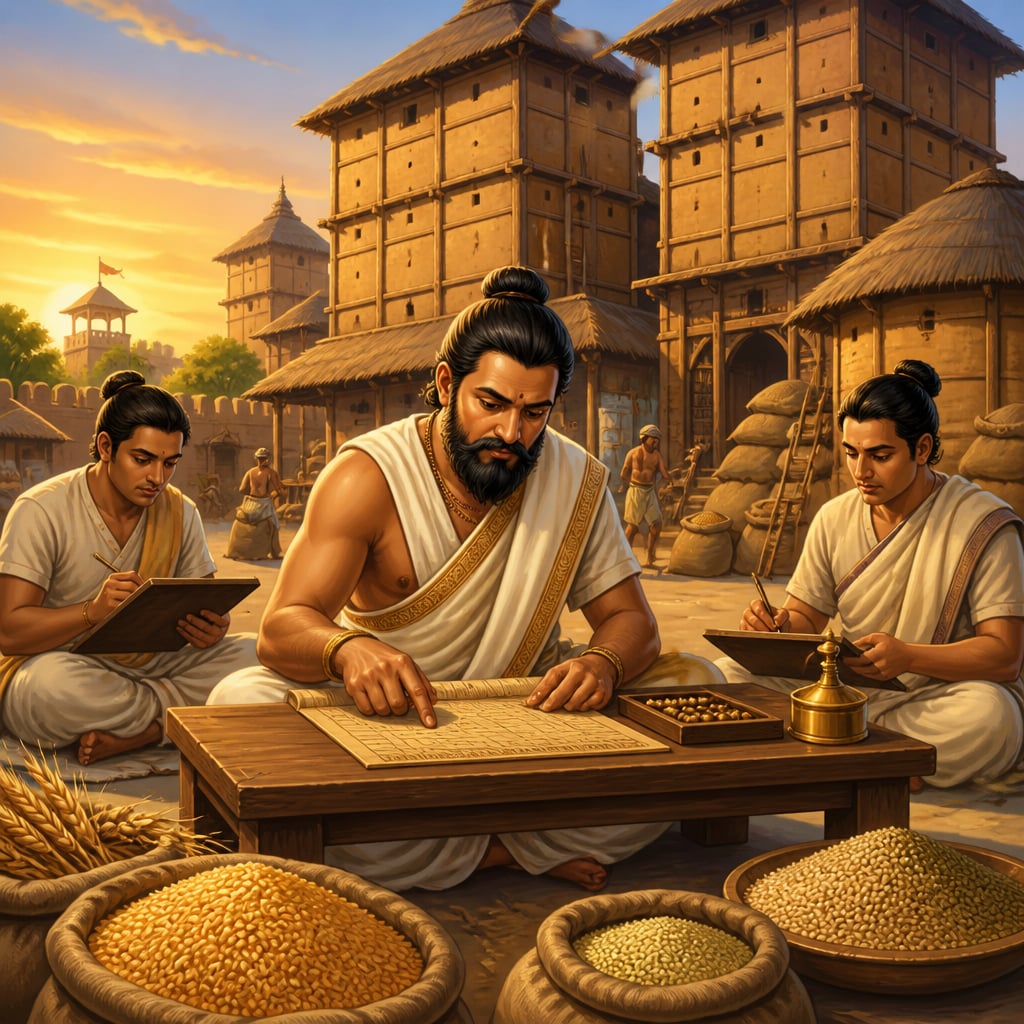
Vishvamitra calculating Mauryan three-year grain reserves

In the spring of 294 BCE, Vishvamitra, the koshthagaradhyaksha (superintendent of granaries) of the central provinces, spread his calculations before the assembled ministers. The monsoon oracles had delivered troubling news: signs pointed to a weak rainfall, possibly the second consecutive year of drought.

Vishvamitra had been tracking grain reserves obsessively. "We have 18 months of consumption in the central granaries," he reported. "If we reduce rations by one-sixth and halt all grain exports immediately, we can survive a complete crop failure and still have seed for replanting."

The Arthashastra had prepared him for exactly this moment. Kautilya's calculations for reserve requirements assumed not one bad year, but potentially three consecutive failures. The master's words echoed: "A kingdom without reserves is a kingdom waiting to starve."

The drought did come. It lasted eighteen months. And not a single subject of the Mauryan Empire starved to death in the central provinces. The granaries held. The system worked.

The Architecture of Food Security

Kautilya understood what modern food security experts call the "triple burden": production volatility, price volatility, and access inequality. His solution was a comprehensive reserve system that addressed all three.

The Reserve Requirements

"कोशे धान्यं त्रिवार्षिकं संचयेत्"

"In the treasury, grain sufficient for three years shall be accumulated." , Arthashastra 2.15.3

This wasn't a suggestion, it was a mandate. The state was required to maintain grain reserves capable of feeding the population through a three-year agricultural failure. The calculation was sophisticated:

Vishvamitra's 18-month reserve was actually below the prescribed minimum, he had been lobbying for increased procurement for years.

The Granary Network

The Arthashastra prescribed a hierarchical storage system:

Rajya-Koshthagara (Imperial Granaries): Massive storage facilities at the capital and provincial headquarters, holding multi-year reserves under direct royal control.

Janapada-Koshthagara (District Granaries): Medium-scale storage at district level, holding 6-12 month reserves for local distribution.

Grama-Koshthagara (Village Granaries): Community storage for immediate needs, managed by village headmen under state supervision.

This distributed network ensured that grain was both centrally controlled (for strategic purposes) and locally accessible (for crisis response).

Storage Science

Grain reserves are useless if they rot. The Arthashastra prescribed detailed storage protocols:

"धान्यं शुष्कं स्थालीषु निधापयेत् पक्षे पक्षे निरीक्षेत"

"Grain shall be stored dry in containers and inspected every fortnight." , Arthashastra 2.15.12

The protocols included:

Grain that failed quality checks was sold at discount for immediate consumption or converted to animal feed, never allowed to contaminate main reserves.

The Economics of Reserves

Kautilya understood that grain reserves served multiple economic functions beyond famine prevention:

Price Stabilization

"क्रयविक्रययोर्मध्ये धान्यं विनियोजयेत्"

"Grain shall be deployed between buying and selling to stabilize prices." , Arthashastra 2.16.5

When harvests were abundant and prices crashed (hurting farmers), the state bought grain for reserves, supporting prices. When harvests failed and prices spiked (hurting consumers), the state sold from reserves, preventing speculation. This "counter-cyclical" intervention is exactly what modern agricultural economists recommend.

Anti-Hoarding Measures

The Arthashastra recognized that private hoarding during crisis could be more devastating than the crisis itself:

Vishvamitra's announcement of 18-month reserves was itself an anti-hoarding measure, knowledge that the state had grain reduced incentives to hoard.

Strategic Security

Grain reserves were also military infrastructure:

A kingdom with full granaries could sustain a longer war than one without, making reserve maintenance a matter of national security.

The Tragedy of Forgetting: Bengal 1943

What happens when a state abandons Kautilyan principles? The Bengal Famine of 1943 provides the devastating answer.

In 1943, Bengal was part of British India, a colonial administration that had systematically dismantled indigenous food security systems. When cyclone, flooding, and war disrupted rice supplies, the British response was catastrophic:

The British administration's policies were the precise opposite of what the Arthashastra prescribed:

Arthashastra Principle British Colonial Practice
Three-year reserves mandatory No civilian reserves maintained
Export halt during shortage Rice exports continued
State intervention against hoarding Hoarding enabled speculation
Local distribution networks Distribution collapsed
Grain releases to stabilize prices Market left to spiral

The Bengal Famine wasn't a natural disaster, it was a policy failure. A Mauryan Vishvamitra would have prevented it.

Global Perspectives on Grain Reserves

The challenge of food security is universal. How do other civilizations compare?

Joseph of Egypt overseeing grain storage during plenty

Joseph's Egypt (Biblical account, c. 1700 BCE): The story of Joseph storing grain during seven years of plenty to survive seven years of famine is perhaps history's most famous reserve narrative. Yet this was reactive, wisdom after prophetic warning. Kautilya prescribed permanent reserves regardless of prophecy.

The "Ever-Normal Granary" (China, 54 BCE): The Han Dynasty's changping cang system maintained grain reserves to stabilize prices, a direct parallel to Kautilyan practice. This Chinese system and the Arthashastra may represent independent discoveries of the same essential insight.

Henry Wallace's Ever-Normal Granary (US, 1938): US Agriculture Secretary Henry Wallace explicitly borrowed the Chinese concept to create American commodity reserves during the New Deal. Modern US strategic grain reserves descended from this, 2,300 years after Kautilya.

Civilization System Date Kautilyan Comparison
Biblical Egypt Joseph's reserves c. 1700 BCE Reactive to prophecy vs. permanent requirement
China Changping cang 54 BCE Very similar, price stabilization focus
USA Ever-Normal Granary 1938 CE Borrowed from China, 2,300 years after Arthashastra
India FCI Buffer Stock 1965 CE Modern revival of indigenous tradition

From Koshthagara to FCI: Modern Resonance

Independent India learned from colonial failure. The Food Corporation of India (FCI), established in 1965, revived Kautilyan principles at national scale.

The Shanta Kumar Committee (2015) reviewed FCI operations and recommended reforms that echo Arthashastra optimization:

The Committee's recommendations recognized what Vishvamitra knew: reserves are valuable only if well-managed. Rotten grain doesn't prevent famine.

The Modern Reserve System

India today maintains what the Arthashastra prescribed:

Buffer Stock Norms (as of 2024):

Actual holdings often exceed norms, 70+ million tonnes, reflecting the trauma of 1943 embedded in policy DNA.

Storage Infrastructure:

This is the koshtharaga network at industrial scale.

The COVID Test: PM Garib Kalyan Anna Yojana

In March 2020, COVID-19 lockdowns threatened mass hunger. Migrant workers lost employment. Supply chains collapsed. The conditions that created Bengal 1943 loomed.

But this time, India had reserves.

Elderly woman receiving free PMGKAY ration during lockdown

PM Garib Kalyan Anna Yojana (PMGKAY) distributed free grain to 80 crore people, the largest food distribution program in human history:

The scale was staggering:

This was Vishvamitra's calculation at billion-person scale. The reserves held. The system worked.

Your Turn: Building Your Reserves

Kautilya's grain reserve wisdom applies beyond agriculture. Consider:

What are your "three-year reserves"? The Arthashastra mandated reserves for three years of failure. Do you have emergency funds for three months of income loss? Six months? What would make you famine-proof?

Are you maintaining quality? Vishvamitra inspected grain every fortnight. Are you checking your "reserves", savings, skills, relationships, to ensure they're not degrading?

Do you have distribution capacity? Reserves are useless if you can't access them in crisis. Is your emergency fund liquid? Are your backup plans actionable?

Are you preventing "hoarding"? The Arthashastra prohibited hoarding that created artificial scarcity. In your life, are you hoarding resources (knowledge, connections, opportunities) that should circulate?

In our final lesson, we'll explore how these ancient agricultural principles apply to India in 2026 and beyond, the living relevance of Kautilyan krishi-niti.

Precautionary savings and buffer stocks, the idea that rational actors maintain reserves against worst-case scenarios, not just expected outcomes.

Henry Wallace's 'Ever-Normal Granary' (1938) borrowed from Chinese precedent. Modern strategic petroleum reserves follow similar logic. Kautilya applied this to food 2,300 years earlier.

The Arthashastra integrated reserves with comprehensive agricultural governance, land classification, crop planning, irrigation, farmer welfare. Reserves were part of a system, not an afterthought.

India's grain reserves exceeded 70 million tonnes during COVID, sufficient to distribute free food to 80 crore people for 33 months through PMGKAY.

Counter-cyclical policy, the idea that government intervention should oppose rather than amplify market cycles, buying low and selling high rather than the reverse.

Keynesian economics (1930s) advocated counter-cyclical fiscal policy, government spending in recessions, saving in booms. Kautilya applied this to commodity markets 2,300 years earlier.

Key terms

Dhanya-Sangraha
Grain collection/storage, the systematic accumulation and preservation of food grains for strategic reserves, price stabilization, and crisis response.
Koshthagara
Granary or storehouse, the physical facility for storing grain reserves, ranging from village-level stores to imperial warehouses.
Trivarsika
Three-year (reserve), the Arthashastra's mandated minimum grain reserve level, sufficient to survive three consecutive years of crop failure.
Abhava-Kala
Time of scarcity or famine, the crisis period when normal food supply fails and reserves become essential for survival.

Verses

कोशे धान्यं त्रिवार्षिकं संचयेत्

kośe dhānyaṁ trivārṣikaṁ saṁcayet

Let three years' grain in granaries stay, against the drought that steals the day.

Three-year reserves provide insurance against correlated agricultural shocks (consecutive droughts). This was sophisticated risk management millennia before modern actuarial science.

Arthashastra, Book 2, Chapter 15, Verse 3 (R.P. Kangle critical edition)

क्रयविक्रययोर्मध्ये धान्यं विनियोजयेत्

krayavikrayayormadhye dhānyaṁ viniyojayet

Between the buy and sell, let grain its balance tell, the market's swing made moderate well.

Counter-cyclical intervention uses reserves to dampen market volatility, buying low and selling high. This is exactly what modern central banks do with currency reserves and what commodity boards do with buffer stocks.

Arthashastra, Book 2, Chapter 16, Verse 5 (Patrick Olivelle (2013))

धान्यं शुष्कं स्थालीषु निधापयेत् पक्षे पक्षे निरीक्षेत

dhānyaṁ śuṣkaṁ sthālīṣu nidhāpayet pakṣe pakṣe nirīkṣeta

Store the grain bone-dry, inspect it fortnight-nigh, for rotten stores mean famine's cry.

Storage losses can devastate reserve value. Modern India loses 5-7% of grain to poor storage, exactly the problem Kautilya's inspection protocols addressed. The Shanta Kumar Committee's reforms echo this ancient concern.

Arthashastra, Book 2, Chapter 15, Verse 12 (L.N. Rangarajan)

Key figures

The Mauryan Koshthagaradhyaksha

Superintendent of Granaries responsible for maintaining strategic grain reserves, ensuring storage quality, and coordinating distribution during crisis

Shanta Kumar Committee

High Level Committee chaired by Shanta Kumar to review FCI operations and recommend reforms for India's food grain management system

Joseph of Egypt (Biblical Figure)

Biblical figure who advised Pharaoh to store grain during seven years of plenty to survive seven years of famine

Case studies

Bengal Famine 1943: When Reserves Failed

The Bengal Famine of 1943 killed an estimated 3 million people, one of the deadliest famines in human history. Yet Bengal was not facing drought or crop failure. Rice production in 1943 was only 5% below the five-year average. What caused such catastrophic mortality? The answer lies in policy failure, the systematic abandonment of every principle Kautilya prescribed: **No Strategic Reserves**: British India maintained no civilian grain reserves. The colonial government relied on market mechanisms and imports, assuming trade would solve shortages. When shipping was diverted to war needs and Burma (a major rice source) fell to Japan, no buffer existed. **Continued Exports**: Remarkably, rice continued to be exported from Bengal even as famine spread. Colonial priorities favored keeping markets 'functioning' over preventing starvation. **Denial of Crisis**: The Bengal government denied famine conditions, refusing to trigger emergency provisions that would have released military stocks and controlled prices. **Market Chaos**: Without reserves to stabilize prices, speculation and hoarding exploded. Rice prices increased 300-400% while wages remained static. Those with money hoarded; those without starved. **Distribution Collapse**: The colonial administration had no distribution infrastructure for mass feeding. When the crisis was finally acknowledged, there was no system to move grain to those who needed it.

The Bengal Famine violated every Arthashastra principle: **No Trivarsika Reserve** Kautilya mandated three years of grain reserves. British India maintained zero for civilians. This single failure made everything else inevitable. **No Price Intervention** The Arthashastra prescribed buying and selling to stabilize prices. The colonial administration let markets spiral, enabling hoarding that killed millions. **No Emergency Distribution** Kautilya's koshthagaradhyaksha would have released grain through the distribution network. The British had no such network, and no such official. **Export During Scarcity** The Arthashastra prohibited grain export during shortage. Colonial Bengal continued exporting while people starved. The Bengal Famine was not inevitable. It was the predictable consequence of ignoring principles that Indian statecraft had understood for over two millennia.

**Immediate consequences:** - 2-3 million deaths from starvation and disease - Mass migration from rural areas to Calcutta - Social breakdown including sale of children - Economic devastation lasting decades **Long-term impact:** - Famine contributed to Independence movement momentum - Post-independence India made food security a national priority - FCI established (1965) to prevent recurrence - Buffer stock policy became constitutional commitment **Historical judgment:** Winston Churchill, who resisted diverting grain to Bengal, remains controversial. Nobel laureate Amartya Sen's research on the famine established that famines are policy failures, not natural disasters, essentially proving Kautilya's thesis that reserves and intervention prevent starvation.

Bengal 1943 proves the Arthashastra's case by demonstrating the alternative. Without reserves, without price intervention, without distribution infrastructure, without emergency protocols, starvation follows even when food exists somewhere in the system. Modern India's food security architecture is built on the determination to never repeat this catastrophe.

The Bengal Famine is now central to global food security policy discussions, particularly Amartya Sen's capability approach that shaped the UN's food rights framework. India's own food security architecture, including the National Food Security Act 2013 and PM Garib Kalyan Anna Yojana, was designed explicitly to prevent a recurrence.

Amartya Sen's research showed that Bengal 1943 had sufficient food at aggregate level, the problem was access, not availability. Reserves and distribution would have prevented all deaths.

PM Garib Kalyan Anna Yojana: Kautilyan Reserves in Action

When India locked down in March 2020 to combat COVID-19, the economic disruption threatened humanitarian catastrophe. Migrant workers lost employment overnight. Informal sector livelihoods collapsed. Supply chains fragmented. The conditions that created Bengal 1943 loomed, but this time, India had reserves. **PM Garib Kalyan Anna Yojana (PMGKAY)** launched on March 26, 2020, announcing free food grain for 80 crore people: **Entitlement**: 5 kg wheat/rice per person per month, plus 1 kg pulses per family per month, additional to existing PDS rations **Duration**: Initially 3 months, extended repeatedly through December 2022 (33 months total) **Coverage**: 80 crore people (60% of India's population), Antyodaya and Priority Household cardholders **Cost**: Rs. 3.91 lakh crore over the program duration **Logistics**: Delivered through 500,000+ Fair Price Shops using Aadhaar-linked biometric authentication The program was possible only because FCI granaries held 70+ million tonnes of grain, well above buffer norms. The reserves existed. The distribution infrastructure existed. The identity verification existed. The system could deliver.

PMGKAY implemented Arthashastra principles at unprecedented scale: **Dhanya-Sangraha in Action** The 70+ million tonne grain reserve made everything else possible. Without reserves, there would have been no grain to distribute. Kautilya's trivarsika mandate was vindicated. **Koshthagara Network** FCI's 2,100+ godowns and 500,000+ Fair Price Shops created the distribution network that colonial Bengal lacked. Grain reached villages because infrastructure existed to move it. **Abhava-Kala Response** The government recognized scarcity conditions (migrant crisis, economic collapse) and triggered emergency distribution immediately. This proactive response, rather than denial, saved lives. **Technology as Force Multiplier** Aadhaar-linked distribution (One Nation One Ration Card) ensured migrants could access grain anywhere in India, addressing the portability problem that traditional PDS couldn't solve. The contrast with Bengal 1943 is stark: when the state maintains reserves, builds infrastructure, and responds to crisis with release rather than denial, famine is prevented.

**Program achievements (by December 2022):** - 80 crore people covered, largest food program in human history - 1,118 lakh metric tonnes of food grain distributed - Rs. 3.91 lakh crore total expenditure - Zero famine deaths during India's worst economic shock since independence **Systemic benefits:** - Demonstrated reserve adequacy under extreme stress - Proved digital infrastructure (Aadhaar, ePoS) works at scale - One Nation One Ration Card expanded from pilot to national - Political consensus strengthened for food security spending **Global recognition:** - Largest food security intervention in history - Studied by World Food Programme and FAO as model - Demonstrated that developing countries can prevent famine **Continuation:** - PMGKAY principles integrated into regular PDS from 2024 - Free grain program extended under National Food Security Act

PMGKAY proves what the Arthashastra taught: reserves + infrastructure + political will = famine prevention. India in 2020 had all three; Bengal in 1943 had none. The difference was 3 million lives then, and zero famine deaths during a once-in-century crisis now.

India's grain reserve and distribution infrastructure, stress-tested during COVID-19, is now recognized as one of the world's most effective food security systems. The World Food Programme has studied PMGKAY as a model for rapid-deployment food assistance in crisis situations.

PMGKAY distributed more food grain in 33 months than the total consumption of most countries annually. The program prevented an estimated 10+ million people from falling into extreme poverty.

Historical context

Mauryan Empire, 4th-3rd century BCE

The Mauryan Empire created South Asia's first empire-wide food security system. Archaeological evidence suggests massive granary complexes at Pataliputra and provincial capitals. Megasthenes reported that 'Indian officials take care that no one shall be wronged', a reference to the welfare systems including food distribution.

Contemporary empires, Seleucid, Ptolemaic Egypt, maintained local grain reserves but lacked the Mauryan integration with comprehensive agricultural governance. Rome's grain dole (later) was urban-focused. China's changping system (54 BCE) came later. The Arthashastra's three-year requirement was uniquely demanding.

Archaeological estimates suggest Mauryan granary capacity at Pataliputra alone exceeded 100,000 tonnes, sufficient to feed the capital region for multiple years.

Food security remains India's existential priority. From FCI to PMGKAY, modern India's food policy continues Kautilyan traditions, maintaining reserves that prevented famine even during pandemic. The Bengal Famine of 1943 remains a warning of what happens when these principles are abandoned.

Living traditions

India's food security architecture, FCI, PDS, buffer stocks, NFSA, represents the most comprehensive implementation of Kautilyan reserve principles in the world. The system feeds 80 crore people through 500,000+ distribution points, holding 70+ million tonnes in reserve. PMGKAY demonstrated this system's capacity to respond to unprecedented crisis.

Reflection

More in Sita: Agriculture and Land Revenue

All lessons in Sita: Agriculture and Land Revenue · Arthashastra: Economic Principles course