Setu-Nirmana: Irrigation and Water Management

Hydraulic Engineering for Food Security

The Arthashastra's comprehensive approach to irrigation infrastructure, dams, tanks, canals, and wells, represented the largest investment the Mauryan state made. Learn how Kautilya engineered water security and resolved conflicts that still challenge India today.

The Dispute at Suvarnapur
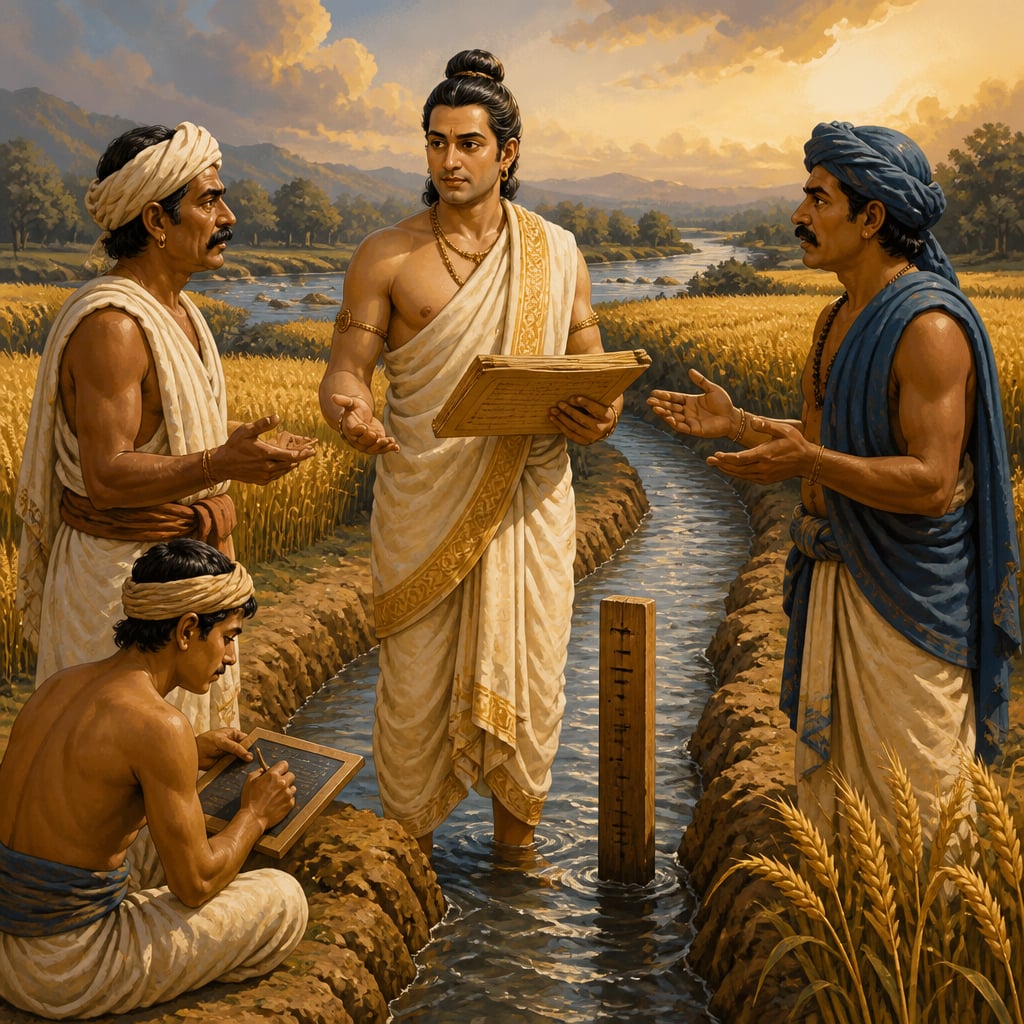
Chandrakirti arbitrating a water dispute between villages

The summer of 298 BCE brought crisis to the border between Suvarnapur and Rajagriha. Chandrakirti, the Sitadhyaksha of the western districts, arrived to find two villages on the brink of violence. Suvarnapur, upstream on the Phalgu tributary, had expanded its canal system. Rajagriha, downstream, watched its fields wither as water that once flowed to them now irrigated Suvarnapur's sugarcane.

"They steal our water!" shouted Rajagriha's headman. "This river has fed our fathers and their fathers."

"The river belongs to the king," Suvarnapur's headman countered. "We built our canals with state permission. You should build your own."

Chandrakirti unrolled his copy of the Arthashastra. The master had anticipated exactly this conflict. Chapter 2 of Book 3 contained not just principles of water rights, but a hierarchy of claims, a framework for resolution, and a vision of water as a shared resource that the state must manage for all.

The Architecture of Water

Kautilya understood what modern water policy sometimes forgets: water infrastructure is the foundation of all agriculture. Without reliable water, land classification means nothing, crop planning fails, and food security becomes impossible. The Arthashastra therefore dedicates extensive attention to setu-nirmana, the construction and management of water infrastructure.

The Four Sources

We've already encountered Kautilya's classification of land by water source. Now we explore the infrastructure behind each:

"सेतुबन्धश्च नद्यायत्तः कूपायत्तः तडागायत्तश्च"

"Irrigation works include those dependent on rivers, on wells, and on tanks." , Arthashastra 2.1.21

Nadi-setu (River works): Dams (setu), barrages, and canals (kulya) that diverted river water to fields. The Mauryan state constructed major diversion works on the Ganga, Yamuna, and their tributaries.

Kupa (Wells): Individual and community wells, essential for drought-resilient irrigation. The Arthashastra prescribed state support for well construction in areas lacking river access.

Tadaga (Tanks): Artificial reservoirs that captured monsoon runoff, providing water through the dry season. The tank system became the backbone of South Indian agriculture for millennia.

Pranali (Channels): Distribution networks that carried water from main sources to individual fields. The Arthashastra required careful engineering to ensure equitable distribution.

State Investment Priority

Kautilya was explicit: irrigation was the state's highest infrastructure priority.

"सेतुबन्धाद्धि कृषिः, कृषेः कोशः, कोशात् बलम्"

"From irrigation comes agriculture, from agriculture the treasury, from the treasury military power." , Arthashastra 2.6.7

This causal chain, water → crops → revenue → power, explains why Mauryan rulers invested more in irrigation than in any other infrastructure. Megasthenes reported that the third department of the Mauryan government was dedicated entirely to irrigation, supervising rivers and measuring land.

The Engineering of Justice

Back at Suvarnapur, Chandrakirti applied Kautilyan principles to resolve the dispute. The Arthashastra establishes a clear hierarchy of water rights:

"पूर्वकृतसेतोः परकृतसेतुना जलव्याघातो न कार्यः"

"An irrigation work built later shall not interfere with water supply to works built earlier." , Arthashastra 3.9.32

Rajagriha's claim had precedence, their irrigation predated Suvarnapur's expansion. But Kautilya's genius was not merely to adjudicate; it was to create more water. Chandrakirti ordered:

  1. A new tank upstream of both villages, capturing monsoon excess for dry-season use
  2. Timed distribution: Suvarnapur could draw only after Rajagriha's requirements were met
  3. Shared maintenance: Both villages contributed labor to the new tank, creating common interest
  4. State monitoring: Regular inspections to ensure compliance

The solution wasn't zero-sum. By expanding the water supply, both villages prospered. This is the essence of Kautilyan water management: infrastructure investment that transforms conflict into abundance.

Water Rights Hierarchy

The Arthashastra established priority rules that modern water law still echoes:

  1. Temporal priority: Earlier users before later users
  2. Investment priority: Those who built infrastructure before free riders
  3. Downstream protection: Upstream cannot deprive downstream of established flows
  4. State supremacy: The king ultimately controls all water for the common good

Global Perspectives on Hydraulic Engineering

Ancient civilizations understood water's importance, but Kautilya's integration of engineering, law, and economics was unique.

Sextus Frontinus inspecting a Roman aqueduct

Sextus Julius Frontinus (35-103 CE), Rome's water commissioner, wrote De Aquaeductu, a detailed account of Rome's famous aqueducts. The Romans excelled at moving water over long distances through engineering marvels. But Roman water management focused on urban supply, not agricultural irrigation. The Arthashastra's agricultural focus was more economically foundational.

Ancient Mesopotamia developed sophisticated canal systems, but these were maintained by temple-palace complexes with limited participation by farmers. Kautilya's system involved state, village, and individual in a coordinated hierarchy.

China's Dujiangyan Irrigation System (256 BCE), roughly contemporary with Kautilya, shows similar sophistication. Li Bing's engineering tamed the Min River without a dam, remarkably similar to Kautilyan principles of working with natural flows rather than fighting them.

Civilization Key Innovation Limitation Kautilyan Advantage
Rome Aqueducts for cities Urban focus, limited agriculture Agricultural priority
Mesopotamia Canal networks Temple control, farmer exclusion Participatory management
China Dujiangyan Brilliant engineering Integrated with land classification, taxation

The Arthashastra's uniqueness: water management wasn't just engineering, it was integrated with land classification, crop planning, taxation, and dispute resolution into a complete agricultural governance system.

From Setu-Bandha to Jal Jeevan: Modern Resonance

India's water challenge today would be familiar to Chandrakirti: growing demand, fixed supply, and conflicts between users. The solutions being deployed echo Kautilyan thinking.

Dr. Mihir Shah, who chaired the committee that shaped the Jal Jeevan Mission architecture, has explicitly called for a "paradigm shift" from supply-side engineering to demand-side management, essentially the Arthashastra's balance of infrastructure with regulation.

Shah's work emphasizes:

Village girl filling a pot at a Jal Jeevan tap

The Jal Jeevan Mission (2019) aims to provide tap water to every rural household by 2024, an infrastructure project that Kautilya would recognize. By December 2024:

The Mission's emphasis on source strengthening, ensuring water availability before building pipes, directly echoes the Arthashastra's priority on setu-nirmana before distribution.

The Economics of Water

Kautilya understood water's economic calculus with remarkable clarity:

Investment Returns

"यः सेतुं बध्नाति स षष्ठं भागं लभेत"

"He who constructs irrigation works shall receive one-sixth of the produce." , Arthashastra 3.9.35

This created incentives for private irrigation investment while ensuring farmer benefit. The state's share of irrigated land was higher than rain-fed (up to 1/4 vs 1/6), but yields were also higher, making irrigation economically rational for both state and farmer.

Maintenance Mandates

The Arthashastra required ongoing maintenance, not just construction:

Neglect of maintenance, the bane of modern Indian irrigation, was punishable. Kautilya understood that infrastructure without maintenance is a wasting asset.

Water Pricing

Different water sources justified different taxes:

This graduated pricing recognized both the value water added and the investment farmers made, principles that modern water economists advocate but rarely see implemented.

Your Turn: Managing Your Flow

Kautilya's water wisdom extends beyond agriculture. Consider:

What are your "irrigation works"? Every productivity system, habits, tools, relationships, is infrastructure that channels your energy toward results. Are you investing in infrastructure or just consuming the flow?

Are you managing upstream conflicts? Like Suvarnapur and Rajagriha, limited resources create competition. The Kautilyan solution: expand supply through investment, then regulate distribution. Where in your life could more "infrastructure" reduce zero-sum conflicts?

Is your maintenance current? Tanks silt up, canals leak, wells run dry without upkeep. What systems in your life need the annual maintenance the Arthashastra prescribed?

In our next lesson, we'll explore Bija-Vitarana, how the Mauryan state distributed seeds, loans, and support to cultivators, creating a welfare system that modern India is only now recreating.

Infrastructure as prerequisite for productivity, the idea that capital investment in physical infrastructure enables all subsequent economic activity.

Adam Smith identified roads and canals as public goods requiring state provision. But Kautilya's framework was more explicit about the causal priority: infrastructure first, then production, then revenue.

The Arthashastra integrated infrastructure with taxation, irrigated land paid more tax, creating revenue to fund more infrastructure. This virtuous cycle expanded productive capacity across the empire.

The Jal Jeevan Mission has invested Rs. 3.6 lakh crore in rural water infrastructure, roughly 1.5% of GDP for a single programme, reflecting infrastructure priority.

Property rights and investment incentives, the idea that secure ownership encourages capital investment because returns are protected.

The 'doctrine of prior appropriation' in Western water law (common in the American West) operates on similar principles. But Kautilya codified it two millennia earlier.

Key terms

Setu-Nirmana
Dam/embankment construction, the building of water infrastructure including dams, barrages, canals, and related works for irrigation and flood control.
Jalashaya
Water reservoir or tank, an artificial body of water created by damming or excavation to store monsoon runoff for agricultural use.
Kulya
Canal or irrigation channel, an artificial waterway that carries water from rivers or tanks to agricultural fields.
Kupa
Well, a vertical shaft dug to access groundwater, providing irrigation independent of surface water sources.

Verses

सेतुबन्धश्च नद्यायत्तः कूपायत्तः तडागायत्तश्च

setubandhaśca nadyāyattaḥ kūpāyattaḥ taḍāgāyattaśca

By dam, by well, by tank, let water serve the land and rank.

Diversified water sources reduce agricultural risk. An empire dependent on a single river is vulnerable; one with tanks, wells, and canals can survive localized failures.

Arthashastra, Book 2, Chapter 1, Verse 21 (R.P. Kangle critical edition)

सेतुबन्धाद्धि कृषिः कृषेः कोशः कोशात् बलम्

setubandhāddhi kṛṣiḥ kṛṣeḥ kośaḥ kośāt balam

From water comes the grain, from grain the gold, from gold the strength to hold.

This causal chain reveals sophisticated understanding of economic foundations. Military power (what moderns call 'hard power') ultimately rests on agricultural productivity, which depends on water infrastructure.

Arthashastra, Book 2, Chapter 6, Verse 7 (Patrick Olivelle (2013))

पूर्वकृतसेतोः परकृतसेतुना जलव्याघातो न कार्यः

pūrvakṛtasetoḥ parakṛtasetunā jalavyāghāto na kāryaḥ

What first was built shall first be served, let later works not steal what earlier earned.

Secure property rights encourage investment. If earlier irrigation investment could be nullified by later users, no one would invest. This rule protected the returns on water infrastructure.

Arthashastra, Book 3, Chapter 9, Verse 32 (L.N. Rangarajan)

Key figures

The Mauryan Water Commissioner

Official responsible for irrigation infrastructure, water allocation, and dispute resolution across the Mauryan Empire

Dr. Mihir Shah

Water policy expert, former Planning Commission member, chair of the committee that shaped Jal Jeevan Mission architecture

Sextus Julius Frontinus

Roman senator, water commissioner of Rome, author of De Aquaeductu Urbis Romae

Case studies

Jal Jeevan Mission and Atal Bhujal Yojana: Water Security for 21st-Century India

When Prime Minister Modi launched the Jal Jeevan Mission on August 15, 2019, rural India faced a water crisis that Kautilya would have recognized: abundant monsoon water flowing unused to the sea while villages suffered dry-season scarcity. The statistics were stark: - Only 3.23 crore (17%) of rural households had tap water connections - Women spent 45 minutes daily on average fetching water - 163 million Indians lacked access to safe water (NITI Aayog, 2018) - Groundwater, the primary rural source, was depleting in 60% of districts Jal Jeevan Mission (JJM) set an ambitious target: functional tap water to every rural household by 2024. But learning from past infrastructure projects that created 'pipes without water,' JJM integrated source sustainability through the complementary Atal Bhujal Yojana (ABY). ABY, launched in December 2019 with World Bank support, focused on the 78 water-stressed districts across 7 states (Gujarat, Haryana, Karnataka, Madhya Pradesh, Maharashtra, Rajasthan, Uttar Pradesh). Rather than just building infrastructure, ABY emphasized: - Community-led groundwater management - Water budgeting at gram panchayat level - Incentives for water-use efficiency - Convergence with watershed development

This twin-mission approach embodies Kautilyan water management: **Setu-nirmana (Infrastructure)** JJM's massive pipe-laying, over 12 crore new connections by 2024, creates the distribution network. Like Mauryan canals, pipes mean nothing without water to flow through them. **Source sustainability** ABY addresses what Kautilya called *jalashaya* (reservoir) management, ensuring the source doesn't run dry. The emphasis on groundwater recharge through community participation echoes the Arthashastra's mandate for tank maintenance. **Community participation** Both missions require gram panchayat involvement, village-level water committees that mirror the community labor (*vishti*) Kautilya prescribed for irrigation works. **State investment with local management** The Centre funds, states implement, villages maintain, a three-tier structure that echoes the Arthashastra's combination of imperial resources with local responsibility. Dr. Mihir Shah's influence is visible: his committee emphasized that 'water is a community resource' requiring participatory management, essentially Kautilya's principle that water belongs to the king (state) for common benefit.

By December 2024: **Jal Jeevan Mission:** - 15+ crore rural households with tap connections (from 3.2 crore in 2019) - Coverage increased from 17% to 78%+ - Goa, Telangana, Haryana, Gujarat achieved 100% coverage - Rs. 3.6 lakh crore invested **Atal Bhujal Yojana:** - 8,000+ gram panchayats prepared water security plans - 2,500+ community-led groundwater management structures - 25% reduction in groundwater extraction in pilot villages - Rs. 6,000 crore invested over 5 years **Combined impact:** - Women's water collection time reduced by 40+ minutes daily in connected villages - Waterborne disease incidence down 30% in high-coverage states - Agricultural productivity up 15% in ABY pilot areas due to assured water Challenges remain, supply sustainability, water quality, and maintenance require ongoing attention. But the Kautilyan framework is operational.

Infrastructure without source sustainability is a pipe dream (literally). JJM+ABY's success comes from integrating what Kautilya understood: setu-nirmana (construction) must combine with jalashaya-poshana (source nourishment). The state builds, but the community maintains. Distribution requires conservation.

Jal Jeevan Mission's coverage expansion from 17% to 78%+ in five years is one of the largest infrastructure rollouts in global development history. The challenge now shifts from installation to maintenance: without community ownership of water systems, piped connections degrade within 3-5 years, a pattern seen across developing nations.

Every Rs. 1 invested in rural water infrastructure generates Rs. 4 in economic returns through health improvements, time savings, and agricultural productivity, validating Kautilya's irrigation-first priority.

Ken-Betwa Link and PMKSY: Modern Setu-Bandha at Scale

In December 2021, the Cabinet approved India's first major river interlinking project: the Ken-Betwa Link. At an estimated cost of Rs. 44,605 crore, the project will connect two tributaries of the Yamuna, transferring 'surplus' water from the Ken (in Madhya Pradesh) to the 'deficit' Betwa basin (in Uttar Pradesh). The project includes: - Daudhan Dam on the Ken River (77m high, 2,275m long) - 230 km of canals and tunnels - 103 MW hydropower capacity - Irrigation for 10.62 lakh hectares in Bundelkhand Bundelkhand, spanning UP and MP, has suffered chronic drought, farmer distress, and out-migration for decades. The Ken-Betwa link aims to transform this arid region through assured irrigation. Complementing this mega-project, the Pradhan Mantri Krishi Sinchayee Yojana (PMKSY, 2015) promotes 'Per Drop More Crop', micro-irrigation that maximizes efficiency of available water. By 2024: - 75 lakh hectares under micro-irrigation (from 35 lakh in 2015) - Rs. 93,000+ crore invested - Focus on water-stressed regions

River interlinking represents setu-bandha (dam construction) at a scale Kautilya could only imagine, moving water between entire river basins to balance nature's unequal distribution. **The Arthashastra precedent** Kautilya prescribed that the state build irrigation works wherever water could be made available: 'The king shall construct reservoirs, making water flow from higher to lower ground' (2.1.20). Ken-Betwa follows this logic, Ken's monsoon surplus flowing to Betwa's deficit. **Upstream-downstream resolution** The project required agreements between MP (upstream, 'giving' state) and UP (downstream, 'receiving' state). The Arthashastra's inter-village dispute resolution principles scaled to inter-state level, prior appropriation respected, compensation provided, common benefit pursued. **Efficiency imperative** PMKSY's 'Per Drop More Crop' addresses the other side: not just more water, but better use. The Arthashastra mandated maintenance and prevented waste; drip irrigation is the modern equivalent. **Economic justification** The benefit-cost ratio (1.62:1) reflects the Arthashastra's insight: setu-bandha is investment, not expense. The returns in agricultural productivity and reduced migration justify upfront costs.

**Ken-Betwa (projected by 2033):** - 10.62 lakh hectares irrigated in Bundelkhand - Drinking water for 62 lakh people in water-stressed districts - 103 MW renewable hydropower - Estimated 10 lakh farmers benefited - Model for 30 additional interlinking projects planned **PMKSY achievements (by 2024):** - Micro-irrigation coverage doubled to 75 lakh hectares - Water use efficiency improved by 40-50% in drip-irrigated areas - Crop yields up 20-30% in micro-irrigated farms - Estimated Rs. 20,000 crore annual water savings **Bundelkhand transformation:** - Out-migration reduced 15% in PMKSY-covered areas - Farmer incomes up 25% in micro-irrigated districts - Cropping intensity increased from 120% to 150%+ Environmental concerns exist, submerging forest area, wildlife corridors, but the government has proposed mitigation through compensatory afforestation and wildlife management plans.

Large-scale water transfer, moving water from surplus to deficit basins, is Kautilyan setu-bandha for the 21st century. But scale requires efficiency: PMKSY's micro-irrigation ensures that expensively transferred water isn't wasted. Infrastructure (dams, canals) and technology (drip, sprinkler) must combine for true water security.

As climate change makes monsoon patterns less predictable, inter-basin water transfer becomes strategic infrastructure rather than optional investment. India's National Perspective Plan for river interlinking identifies 30 potential links. The Ken-Betwa project will determine whether the engineering, environmental, and political challenges of river linking can be managed at scale.

India's irrigation efficiency is 38% (vs. 50%+ in developed countries). Raising efficiency to 50% through PMKSY would save 100 billion cubic meters annually, equivalent to 4 Ken-Betwa projects.

Historical context

Mauryan Empire, 4th-3rd century BCE

The Mauryan period saw India's first empire-wide irrigation system. Major dams were built on Ganga tributaries, canal networks extended to previously rain-fed areas, and tanks were constructed across the Gangetic plain and Deccan. Megasthenes reported that irrigation officials supervised rivers and measured land, a specialized water bureaucracy.

Rome built aqueducts but focused on urban water supply. Persia maintained ancient Mesopotamian canals but without expansion. China's Dujiangyan was brilliant but localized. The Mauryan achievement was empire-wide integration of irrigation with land classification, taxation, and agricultural planning.

Mauryan irrigation is estimated to have brought 2-3 million additional hectares under cultivation, roughly doubling the empire's irrigated area compared to pre-Mauryan kingdoms.

Water infrastructure remains India's development priority. The Jal Jeevan Mission (Rs. 3.6 lakh crore), river interlinking (Rs. 10+ lakh crore proposed), and PMKSY represent continued commitment to setu-nirmana. The principles haven't changed; only the scale has grown.

Living traditions

India's irrigation bureaucracy, Central Water Commission, state irrigation departments, command area development authorities, represents institutionalized setu-nirmana. The Jal Shakti Ministry (2019) consolidates water functions much as Mauryan water commissioners consolidated irrigation governance.

Reflection

More in Sita: Agriculture and Land Revenue

All lessons in Sita: Agriculture and Land Revenue · Arthashastra: Economic Principles course